Enlighten IT Consulting LLC has received a $332.83 million U.S. Air Force contract to provide an enterprise service solution supporting interoperability with the Joint Cyber Warfighting Architecture (JCWA), including data analytics, storage and transport capabilities at the network edge.
The firm-fixed-price contract was awarded Sept. 30, 2026, through a Commercial Solutions Opening using the Tradewinds Solutions Marketplace. Seven offers were received in the competitive acquisition, according to the Department of Defense contract announcement supplied for this report.
The work will support the Integrated Defensive Cyber System architecture and is scheduled to run through Sept. 30, 2032. The Air Force Life Cycle Management Center at Joint Base San Antonio, Texas, is overseeing the award under contract number FA8307-26-C-B015.
The contract covers work both inside and outside the continental United States. The announcement does not specify individual delivery milestones, the number of personnel involved, or the precise technical components to be delivered.
What the contract will provide
The central requirement is an enterprise service solution that can interoperate with the JCWA Common Runtime Stack. The stated scope includes three related functions: data analytics, data storage and data transport at the edge.
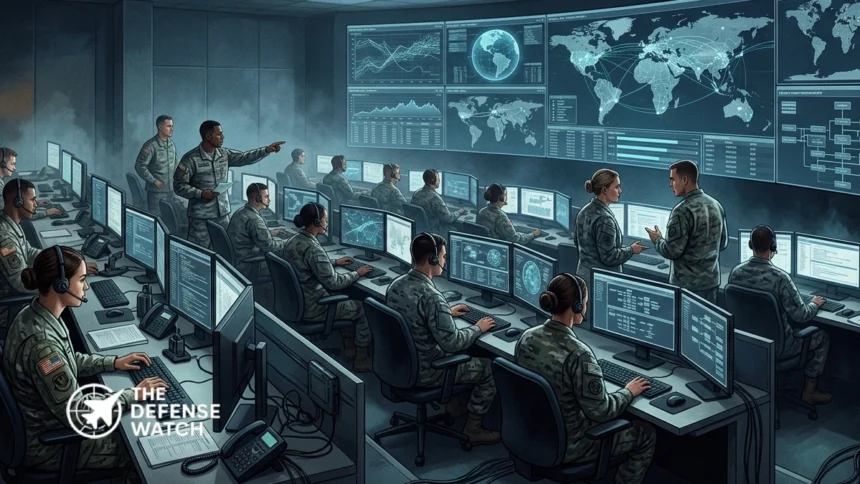
These capabilities are important to military cyber operations because defensive teams must collect and process information from multiple sources, make relevant data available to authorized users, and move information between connected systems. Delays, incompatible data formats or fragmented infrastructure can make it harder for operators to build an accurate picture of cyber threats.
The contract announcement does not identify specific software products, data volumes, processing speeds or supported network environments. It also does not establish whether the award includes a new platform, an expansion of existing services, or a combination of both.
That distinction matters. The award confirms a substantial investment in the supporting infrastructure for defensive cyber operations, but it does not by itself demonstrate that new operational capabilities have already been fielded.
Why interoperability matters to military cyber operations
The Joint Cyber Warfighting Architecture is a framework for integrating capabilities used across U.S. military cyberspace operations. U.S. Cyber Command has described the architecture as a suite of systems supporting the full range of cyberspace missions, with common standards intended to improve interoperability, tool development and data flows between service components and mission partners.
The data layer is particularly important. U.S. Cyber Command’s public documentation describes JCWA data platforms as systems that ingest and process large datasets, develop analytics and present results to support operational decisions. The command’s CASPIAN platform connects with service-level JCWA data platforms.
An enterprise service that improves compatibility with the Common Runtime Stack could therefore help support the movement and processing of information across the defensive cyber environment. However, the contract notice does not establish which existing systems will connect to the solution or quantify any expected improvement in threat detection, response times or network resilience.
The award’s reference to edge analytics is also relevant. Processing information closer to where it is collected can help reduce dependence on transferring every data item to a centralized location before analysis. The practical benefit will depend on the solution’s design, available computing resources, communications links and security requirements, none of which are detailed in the announcement.
Six-year performance period and funding
The Air Force awarded the contract as a firm-fixed-price agreement, with performance expected to continue until Sept. 30, 2032. The award is worth $332,830,519, and the announcement identifies several funding sources across the Air Force and Space Force.
These include fiscal 2026 operations and maintenance funding for both services, along with research, development, test and evaluation funding for both services.
The involvement of both the Air Force and Space Force in the funding structure indicates that the contract draws on resources from multiple parts of the Department of the Air Force. It does not, on its own, establish how much each service will contribute or which specific operational units will use the resulting capabilities.
The award notice also does not provide a funding breakdown by fiscal year, a detailed payment schedule or a list of subcontractors. The total contract value should therefore not be interpreted as the amount paid at the time of award.
Tradewinds procurement and competitive selection
The contract was awarded through the Tradewinds Solutions Marketplace using a Commercial Solutions Opening. Tradewinds is an acquisition pathway designed to help government customers identify and acquire commercial technology solutions in areas including artificial intelligence, digital services and data analytics. Its marketplace features solutions that have undergone an assessment process for government use.
The Air Force reported receiving seven offers for this contract. That confirms competition took place, although the public award details do not disclose the other bidders, the evaluation scores or the reasons Enlighten IT Consulting’s proposal was selected.
Using a marketplace-based acquisition pathway provides the government with a route to source commercial technology for a defined requirement. In this case, the stated requirement centers on enterprise services and interoperability rather than a disclosed new weapon system or standalone cyber platform.
The contract’s firm-fixed-price structure also establishes a defined price for the contracted work, subject to the agreement’s terms and any authorized changes. Publicly available award details do not provide enough information to assess the distribution of cost or the risks associated with technical changes over the six-year performance period.
For the government, execution will depend on whether the solution meets integration, security and operational requirements while remaining compatible with the wider cyber architecture.
What remains undisclosed
Several details will be important for assessing the contract’s eventual impact:
- Technical scope: The announcement does not identify the specific software, hardware or service components to be delivered.
- Integration milestones: No schedule for testing, deployment or acceptance is provided.
- Operational users: The notice does not name specific cyber units, installations or mission partners that will use the solution.
- Performance measures: No targets for analytics speed, data throughput, availability or threat-response improvement are disclosed.
- Funding distribution: The award announcement lists funding categories but does not break down the contributions by service or fiscal year.
These gaps limit what can be concluded about the contract’s immediate operational effects. The award establishes the government’s commitment to an enterprise service supporting defensive cyber architecture, but the announcement does not show when the capabilities will enter service or how their effectiveness will be measured.
The next meaningful indicators will be published milestones covering integration, acceptance and delivery, together with any subsequent contract modifications or official reports describing the solution’s operational use.