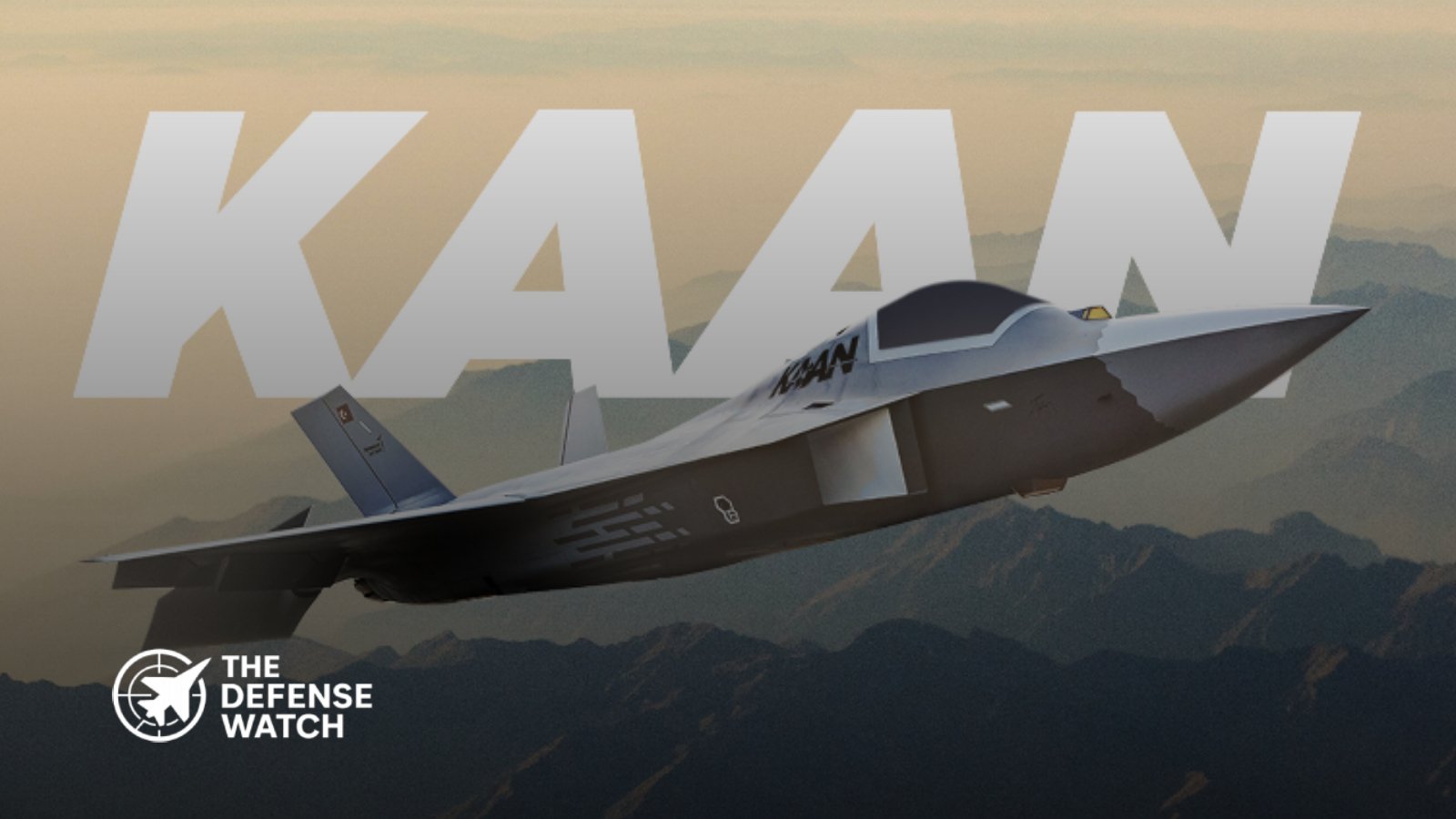
Turkey’s KAAN Advances Toward New Flight Tests
Turkey’s KAAN fighter program is moving from its initial flight demonstration toward a more demanding prototype test phase, with Turkish Aerospace Industries preparing a newer prototype for flight testing in late 2026. The aircraft is being developed as a fifth-generation multirole fighter for the Turkish Air Force, but its current development status makes direct comparisons with the operational F-35A Lightning II premature.
The distinction matters because KAAN has so far completed only two publicly documented flights. The first prototype flew on February 21, 2024, followed by a second test flight on May 6 of that year. Turkish Aerospace reported that the aircraft reached 8,000 feet and 230 knots during the first flight, and 10,000 feet and 230 knots during the second.
Those flights demonstrated the basic flightworthiness of the design. They did not demonstrate the aircraft’s full advertised performance envelope, weapons employment, sensor fusion, electronic warfare capability, or operational suitability.
A new phase of KAAN testing
The next stage involves newer prototypes rather than simply extending the flight record of the original aircraft.
Turkish Aerospace General Manager Mehmet Demiroğlu said in early October that the P1 prototype had completed system checks and low-speed taxi testing. High-speed taxi tests were expected to follow, with a first flight targeted for October or November if ground testing proceeds without major problems. Work on the P2 prototype is continuing.
Turkey’s Presidency of Defence Industries also confirmed in August that the KAAN P1 prototype had conducted its first taxi test.
This distinction is important when assessing the program. The aircraft that flew in 2024 should not automatically be treated as representative of the configuration that Turkey intends to place into operational service.
The newer prototypes are intended to support the maturation of the aircraft’s systems and aerodynamic configuration before production aircraft enter the Turkish Air Force.
What KAAN is designed to become
Turkish Aerospace describes KAAN as a fifth-generation multirole fighter designed for both air-to-air and air-to-ground missions. The company lists low observability, internal weapons carriage, sensor fusion, integrated radio-frequency and electro-optical systems, a helmet-mounted display and networked communications among its intended capabilities.
The published design data also lists a length of 20.3 meters, a wingspan of 13.4 meters, a maximum takeoff weight of 34,750 kilograms and a projected maximum speed of Mach 1.8 at 40,000 feet.
Those figures should be treated as manufacturer-published design specifications rather than flight-test results. The two publicly documented 2024 flights did not establish that KAAN has reached its advertised maximum speed, service ceiling or other performance limits.
The same caution applies to claims concerning supercruise, sensor performance and combat effectiveness. These are important design objectives, but they require flight testing, system qualification and ultimately operational evaluation before they can be treated as demonstrated capabilities.
The engine remains a major program issue
Propulsion illustrates both the progress and the remaining dependence within the KAAN program.
The current aircraft uses two General Electric F110 engines, a powerplant family already used by Turkey’s F-16 fleet. In June 2026, the United States moved forward with a planned sale of F110 engines to Turkey intended to support the KAAN program.
Turkish Aerospace subsequently said that it had engines available for the prototype and flight-test phase and was working toward obtaining additional engines for early production.
At the same time, Turkey is developing the indigenous TF35000 engine through its national aviation-engine industry. TEI said in August 2026 that the TF35000 program would continue under the newly reorganized TEI TEKNOLOJİ structure.
This creates a two-stage propulsion path for KAAN. Early production aircraft are expected to depend on U.S.-supplied engines, while Turkey’s longer-term objective is to transition the fighter to an indigenous powerplant.
That transition will be one of the most consequential technical milestones in the program because an indigenous engine would reduce an important external dependency and give Turkish engineers greater control over future aircraft upgrades.
Why the F-35 comparison needs context
KAAN is frequently described as an alternative or counterpart to the F-35, particularly because both aircraft are designed around low observability, internal weapons carriage, advanced sensors and networked operations.
There is a legitimate basis for comparing their design philosophies. There is not yet enough evidence to compare their combat effectiveness on an equal basis.
The F-35A has been in operational service for years and has accumulated extensive flight, maintenance, weapons-integration and deployment experience across the United States and allied air forces. The U.S. Air Force lists the F-35A as a fifth-generation multirole fighter combining stealth, sensor fusion, electronic systems and networked data sharing.
The F-35A is also a mature production aircraft. Its published maximum speed is Mach 1.6, while earlier official U.S. Air Force and Lockheed Martin material lists a combat radius of more than 590 nautical miles for the conventional takeoff and landing F-35A configuration.
KAAN’s published Mach 1.8 figure therefore looks higher on paper. But maximum speed alone is a poor measure of fifth-generation fighter effectiveness.
A modern fighter’s value also depends on its ability to detect and classify threats, maintain a useful tactical picture, manage electromagnetic emissions, resist electronic attack, share information, employ weapons and survive in contested airspace.
KAAN is being designed around many of these requirements, but its systems remain in development. The F-35’s corresponding systems have already been subjected to years of testing and operational use.
Turkey’s F-35 position adds another dimension
KAAN’s development also has a broader procurement history.
Turkey was removed from the F-35 program after Washington suspended its participation in 2019 following Ankara’s acquisition of the Russian S-400 air defense system. Lockheed Martin’s corporate filings have continued to identify Turkey’s removal from the program as a consequence of the S-400 issue.
That history helps explain why KAAN has assumed importance beyond being another fighter development project.
Turkey’s stated objective is not simply to produce an aircraft with similar characteristics to the F-35. The KAAN program is intended to increase domestic control over fighter design, mission systems, avionics and future modernization.
The Turkish Presidency of Defence Industries describes the program as an effort to design and produce a next-generation fighter for future Turkish Air Force requirements while maximizing domestic industrial participation and technological localization.
That objective is strategically different from simply purchasing an existing foreign fighter.
Production is approaching, but operational maturity is not
Turkey has established an ambitious production timetable. Turkish Aerospace has said that initial KAAN deliveries to the Turkish Air Force are targeted for the end of 2028 or the beginning of 2029, while earlier program plans had pointed toward initial deliveries in 2028.
The company has also secured an export agreement with Indonesia covering 48 KAAN aircraft, with deliveries planned over a 120-month period. The agreement includes technology cooperation and is intended to involve Indonesian industrial capabilities.
These commitments give the program an industrial dimension that extends beyond Turkey’s own fighter requirement.
They also increase the importance of maintaining the development schedule. A fifth-generation fighter requires much more than a flyable airframe. Radar, electronic warfare, infrared sensors, mission computers, communications, weapons integration, software and sustainment systems all have to mature together.
The key test is no longer whether KAAN can fly
KAAN has already crossed the first major threshold by completing its maiden flight and a second test sortie.
The harder question is whether Turkey can take the design from prototype flight testing to a reliable production aircraft with a mature mission system.
The forthcoming P1 and P2 flight-test program will provide more meaningful evidence than the original 2024 flights. Higher-speed testing, expanded flight envelopes and eventual systems integration will begin to show whether the published design objectives can be translated into an operational fighter.
For that reason, describing KAAN simply as a Turkish F-35 counterpart misses the most important part of the story. The two aircraft share several fifth-generation design principles, but they currently occupy very different positions in the development cycle.
KAAN is still proving its design and systems. The F-35A is an established operational aircraft undergoing continuing upgrades.
Turkey’s achievement will therefore be measured less by whether KAAN matches a published F-35 specification and more by whether it can complete development, establish reliable series production, integrate its intended weapons and sensors, and eventually transition to the indigenous TF35000 engine.
Until those milestones are demonstrated, the fairest assessment is that KAAN is a serious fifth-generation fighter development program with significant industrial ambitions, but not yet an operational peer of the F-35A.