Navy Orders 15 SPARTA Trainers for E-2D Hawkeye
The U.S. Navy has awarded Rockwell Collins Simulation & Training Solutions LLC a $10.72 million contract modification to procure 15 Special Programs Advanced Readiness Trainers Afloat/Ashore, or SPARTA systems, supporting the E-2D Hawkeye Integrated Training Systems V program.
Takeaways
Key facts from the contract announcement
1. 15 SPARTA Trainers Ordered
Rockwell Collins Simulation & Training Solutions will provide 15 Special Programs Advanced Readiness Trainers Afloat/Ashore for the E-2D Hawkeye training program.
2. $10.7 Million Contract Modification
The firm-fixed-price modification adds $10,721,245 in new contract line items, with fiscal 2026 Navy aircraft procurement funds obligated at award.
The contract modification, identified as P00002 to firm-fixed-price contract N6134026C1001, adds new contract line items covering the trainers and associated technical data, computer software, and software documentation. The action was not competitively procured.
Scope of the E-2D SPARTA Trainer Contract
The $10,721,245 modification covers 15 Special Programs Advanced Readiness Trainers Afloat/Ashore for the Navy’s E-2D Hawkeye training architecture.
The announcement also includes associated technical data, computer software, and computer software documentation. The notice does not disclose the individual configuration, hardware content, delivery distribution, or unit price of the 15 trainers.
The award is a modification rather than a new standalone contract. The underlying N6134026C1001 contract was awarded to Rockwell Collins Simulation & Training Solutions for technical refreshes and capability upgrades across the E-2D Hawkeye training system. Earlier contract documentation identifies work involving flight trainers, system integration laboratories, SPARTA devices, Joint Simulation Environment integration, distributed mission testing, virtual maintenance training, and instructor and operator training.
E-2D Hawkeye Technical and Operational Context
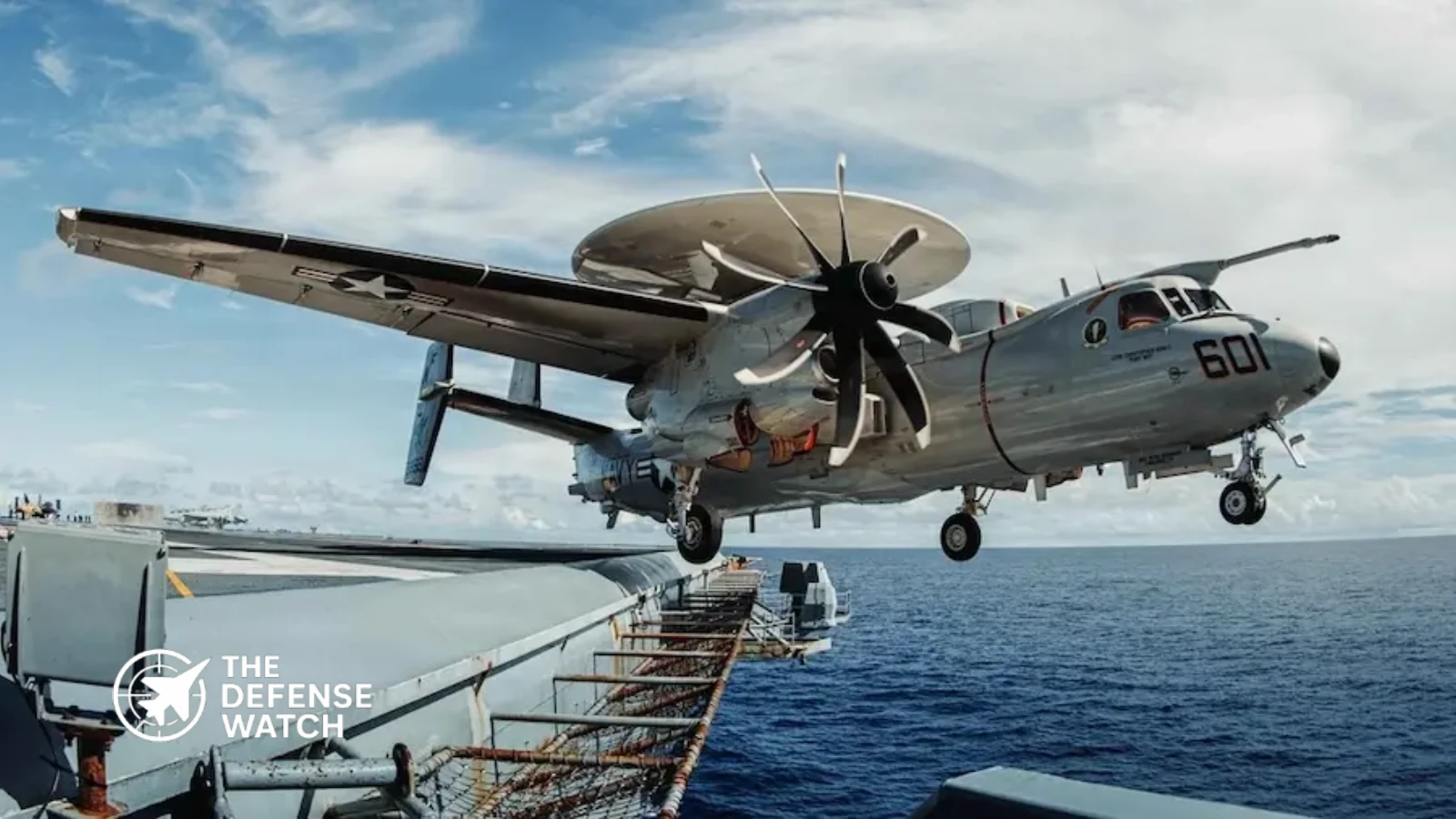
The E-2D Advanced Hawkeye is the U.S. Navy’s carrier-based airborne early warning and command and control aircraft. NAVAIR identifies the aircraft as the newest E-2 variant, with an integrated open-architecture sensor system and a five-person crew consisting of two pilots and three mission systems operators.
The aircraft provides airborne surveillance and command and control functions for carrier air wings and wider naval operations. Its role means that E-2D crews must train not only for aircraft operation but also for complex mission management, coordination, communications, and tactical employment.
The Navy has previously used distributed E-2D training devices to allow full crews to practice mission scenarios without using operational aircraft. NAVAIR reported that its Distributed Readiness Trainers could support training for two pilots and three flight officers while also allowing E-2D crews to participate in distributed exercises with other aircraft and joint forces.
The HITS V program is part of that broader training infrastructure. A Naval Air Warfare Center Training Systems Division planning document describes HITS V as covering E-2D software configuration updates, cockpit technical refresh activity, maintenance and aircrew training devices, visual system upgrades, cybersecurity updates, and multi-level security implementation.
Operational Impact on U.S. Navy E-2D Fleet Readiness
The SPARTA procurement is relevant to the Navy’s effort to make E-2D training more flexible across shore-based and deployed environments.
The Afloat/Ashore designation is particularly significant because carrier aviation training requirements can extend beyond fixed installations. The Navy has already demonstrated the value of deployable simulation through its Simulators at Sea initiative, which connected virtual training systems aboard an aircraft carrier and supported aircraft including the E-2D Hawkeye, F-35C, F/A-18E/F and EA-18G.
From an acquisition perspective, additional SPARTA systems can provide the Navy with more training capacity and greater flexibility for maintaining aircrew proficiency. However, the contract announcement does not specify where the 15 systems will be installed or deployed, so their eventual distribution cannot be confirmed from the award.
The Navy also maintains dedicated E-2D training and readiness organizations. The Airborne Command & Control and Logistics Weapons School conducts simulator and aircraft training for Hawkeye squadrons as part of the fleet readiness process.
Contract Breakdown: Rockwell Collins E-2D Award Details
Contract Value
The modification is valued at $10,721,245. The full amount will be obligated at the time of award using fiscal 2026 aircraft procurement, Navy funds.
The announced amount represents the value of this modification. It should not be interpreted as the total value of the underlying HITS V contract.
Contractor
Rockwell Collins Simulation & Training Solutions LLC, based in Cedar Rapids, Iowa, is the contractor.
The company operates within Collins Aerospace, which has an established role in Navy simulation and training programs.
Contract Type
The action is a firm-fixed-price modification to contract N6134026C1001.
The modification establishes new contract line items for the 15 SPARTA systems and associated technical information and software deliverables.
Work Locations
The announcement identifies Sterling, Virginia, as the work location.
It does not provide a percentage breakdown for the work or identify specific Navy facilities where the completed trainers will ultimately operate.
Performance Period
Work is expected to be completed in November 2027.
Funding
Fiscal 2026 aircraft procurement, Navy funds totaling $10,721,245, will be obligated at the time of award.
Options Or Follow-On Work
The announcement does not identify additional options associated specifically with this modification.
The broader HITS V effort includes multiple training-system modernization activities, but those should not be treated as additional funding or work under this particular $10.72 million modification unless separately awarded.
Rockwell Collins Defense Industrial Base and Acquisition Impact
The modification illustrates how the Navy is continuing to invest in simulation infrastructure alongside upgrades to operational aircraft.
Keeping training systems aligned with aircraft software, hardware, and mission-system changes is important for platforms such as the E-2D, where aircrew performance depends on both aircraft operation and complex mission-system employment. HITS V documentation specifically identifies technical refreshes and configuration updates as part of the program’s scope.
The approach also reflects a broader Navy move toward distributed and synthetic training. Deployable simulators can reduce the need to conduct every training event using operational aircraft while allowing crews to rehearse complex scenarios in controlled environments.
The Navy has previously described distributed E-2D trainers as a way to support increasingly complex tactics and training with other aircraft in a carrier strike group.
Program Milestones and Next Steps
The immediate milestone is delivery of the 15 SPARTA trainers and associated technical and software documentation under the modified contract.
The Navy expects the work to be completed by November 2027. The announcement does not provide individual delivery dates, deployment locations, trainer configurations, or acceptance milestones.
The award follows the Navy’s broader HITS V effort to maintain and update E-2D training infrastructure as the Advanced Hawkeye program evolves. NAVAIR has separately identified continuing work on E-2D software configurations and cockpit modernization, reinforcing the need to keep associated training systems aligned with aircraft changes.