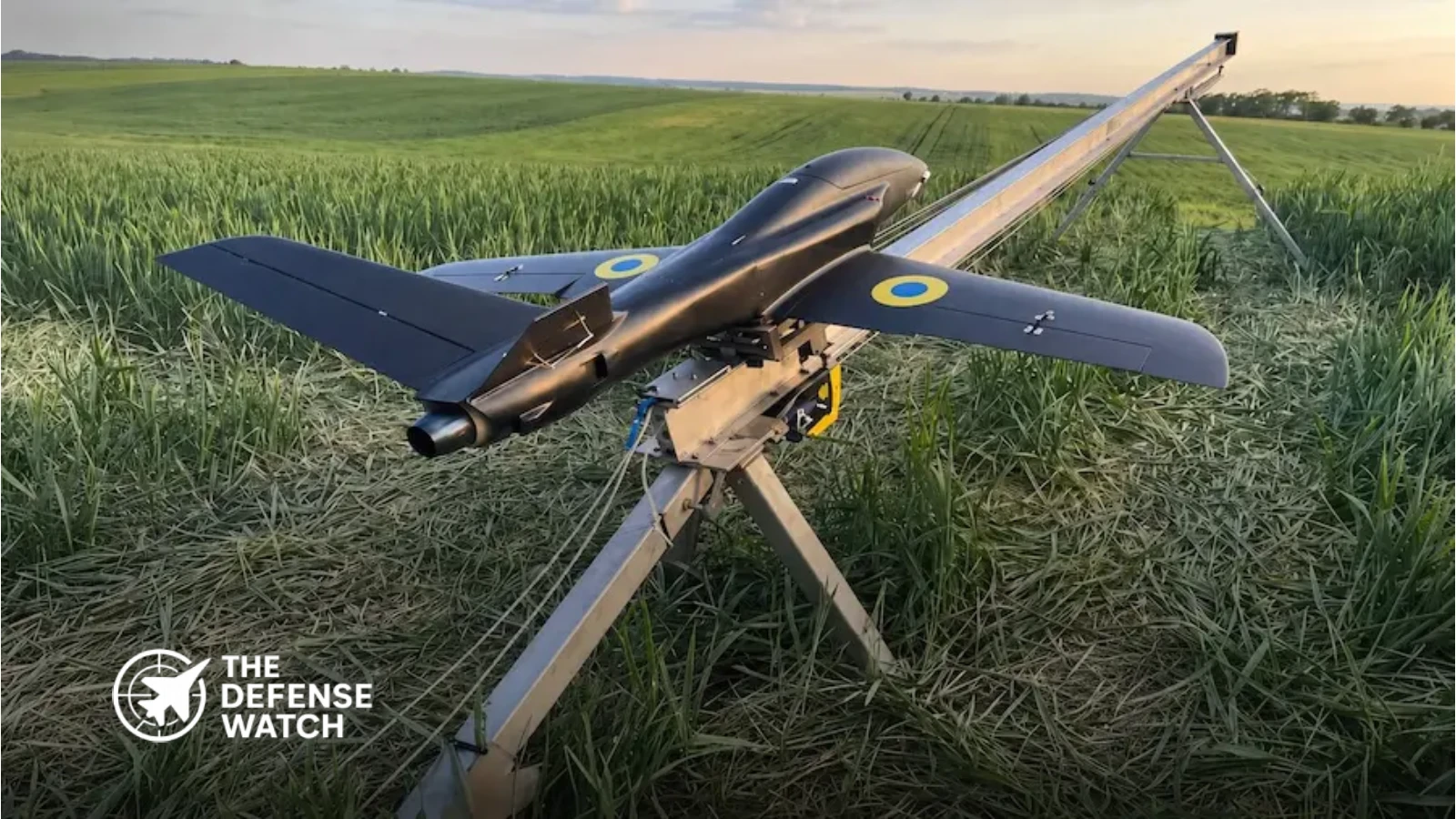
Ukraine Adds Alexa Spatium Interceptor To Counter Russian Drone Threat
The Alexa Spatium interceptor gives Ukraine a new jet-powered option for defending against Russian strike drones, according to the Ukrainian Ministry of Defence. The ministry said Aug. 21 that the domestically developed aircraft has been added to the arsenal of the Defence Forces of Ukraine and was designed to destroy small aerial, ground and surface targets in combat conditions.
Takeaways
Ukraine adds a domestically developed jet-powered interceptor to its counter-drone arsenal
1. Jet-Powered Interceptor
Ukraine’s Defence Ministry says Alexa Spatium is the country’s first domestically developed jet-powered drone interceptor.
2. Designed For Faster UAVs
The system is intended primarily to counter Russian Geran-3, Geran-4, Geran-5 and Shahed-131 attack drones, according to Ukraine’s Defence Ministry.
3. Turbojet Propulsion
Its turbojet engine provides a higher operating ceiling and supports operations across low to medium altitudes, according to the ministry.
4. Remote Launch And Operation
Alexa Spatium can be prepared and launched remotely from a mobile catapult, reducing the personnel required at the launch position.
5. Part Of A Growing Ukrainian Fleet
Ukraine says it has authorized hundreds of unmanned systems for military use in 2026, reflecting the rapid expansion of domestic drone and counter-drone production.
The system is primarily intended to engage Russian Geran-3, Geran-4 and Geran-5 kamikaze drones, as well as the Shahed-131. Ukraine also says the aircraft can be used against reconnaissance UAVs, helicopters and other individual targets.
The introduction comes as Ukraine continues to expand its use of unmanned interceptors as a lower-cost layer of air defense. The Ministry of Defence previously authorized the JEDI Shahed Hunter, an electric interceptor capable of speeds above 350 km/h and operations at altitudes of up to 6 kilometers.
Turbojet Design Built For Rapid Interception
At the center of the Alexa Spatium design is a turbojet engine. Ukraine’s Defence Ministry says the propulsion system gives the interceptor a high operating ceiling, a substantial combat radius and an operating envelope covering low to medium altitudes.
The ministry has not publicly released a maximum speed, combat radius or endurance figure for the system in its announcement. That distinction is important because available reports about Ukrainian jet-powered interceptors have cited different performance figures for different systems.
For example, former Ukrainian Defence Minister Mykhailo Fedorov said on Aug. 14 that Ukrainian companies were already testing jet-powered interceptors intended to counter jet-powered Shaheds. He said one system developed by a Ukrainian manufacturer could exceed 600 km/h, but the statement did not identify that system as Alexa Spatium.
That makes the Ministry of Defence description of Alexa Spatium particularly relevant. Rather than assigning unverified performance figures to the aircraft, the available official information confirms its propulsion concept, target set and operating characteristics.
Remote Launch And Automated Operation
The Alexa Spatium interceptor is designed around a mobile and relatively light deployment concept. Ukraine’s Defence Ministry says the aircraft measures approximately 1.5 meters by 1.7 meters and can be launched from a mobile catapult within several minutes.
The complete system is also designed for transport in a pickup truck. The ministry describes the architecture as modular and highly automated, with preparation and launch capable of being conducted remotely. An aircraft that does not complete its mission can return to the launch area and be reused.
This approach addresses an important operational requirement for modern counter-UAS forces: the ability to relocate launch teams quickly after an engagement.
A mobile interceptor force can potentially be distributed across multiple defensive positions rather than relying exclusively on fixed launch infrastructure. That is particularly relevant in a conflict where both sides use drones for surveillance, targeting and attack against air-defense positions.
Multiple Warhead Options And Sensors
Ukraine says Alexa Spatium can be configured with high-explosive fragmentation, shaped-charge or thermobaric warheads. The ministry said the warhead weight gives the aircraft the ability to engage a range of aerial targets.
The interceptor also incorporates television and infrared search-and-sighting systems for target detection and engagement. Its control and video-transmission systems support remote operation.
The combination of onboard sensing and remote control is significant for an interceptor intended to operate against moving UAVs. However, Ukraine has not publicly disclosed detailed information on the sensor ranges, target acquisition algorithms, datalink architecture or engagement rules associated with Alexa Spatium.
Those limitations mean the system’s effectiveness against specific Russian UAV variants cannot yet be independently assessed from the publicly available information.
Why Jet Propulsion Matters In Ukraine’s Counter-UAS Fight
Ukraine has spent much of the war developing increasingly specialized interceptor drones. In March, the Ministry of Defence said the JEDI Shahed Hunter had been authorized for operational use after successfully engaging Shahed-type drones, including Geran and Gerbera UAVs. The system uses four electric motors, can exceed 350 km/h and can operate at altitudes up to 6 kilometers.
Ukraine also authorized the Shvidun interceptor, which the ministry says can exceed 250 km/h, operate at up to 6 kilometers and has a range of more than 70 kilometers.
These systems illustrate the evolution of Ukraine’s counter-drone approach from relatively simple interceptor platforms toward specialized aircraft designed around the speed, altitude and maneuverability of the threats they face.
The Alexa Spatium interceptor takes that development another step by using turbojet propulsion. Its intended targets include several Geran variants and Shahed-131, while its design allows rapid deployment and remote launch.
The immediate challenge is scale. Russian forces continue to conduct large drone attacks, including raids involving jet-powered UAVs. On Aug. 10, Ukraine’s Air Force reported that Russian forces used 126 Shahed-type strike UAVs, including jet-powered drones, along with Gerbera and Parodiya decoys during a large overnight attack. Ukrainian forces reported using aviation, surface-to-air missiles, electronic warfare, unmanned systems and mobile fire groups to respond.
This layered approach is likely to remain important. Interceptor drones do not replace traditional air-defense systems. Instead, they can add another engagement layer against UAVs while potentially preserving more expensive missile interceptors for higher-value or more difficult threats.
Ukraine Expands Domestic Unmanned Systems Production
The Alexa Spatium announcement also fits within a broader Ukrainian effort to expand domestic defense production.
Ukraine’s Ministry of Defence said in June that it had codified 1,000 weapons and military equipment models since the beginning of 2026. More than 300 were new unmanned aerial systems, while nearly 90 percent of the total systems were produced domestically.
The ministry has also said that more than 25 Ukrainian interceptor UAV models had been authorized for military use by August 2025, highlighting how quickly the counter-UAS segment has expanded.
The country’s Unmanned Systems Forces have become a dedicated military branch responsible for operating aerial, ground and maritime unmanned systems. Ukraine describes the force as focused on integrating reconnaissance, strike and defensive unmanned capabilities.
The growth of this industrial and operational ecosystem provides the environment in which systems such as Alexa Spatium can move from development into military service.
What Alexa Spatium Adds To Ukraine’s Air Defense
The Alexa Spatium interceptor does not represent a replacement for Ukraine’s broader air-defense network. Its significance is that it adds a jet-powered unmanned aircraft specifically designed around the changing characteristics of the Russian drone threat.
The system combines a turbojet engine, remote launch, electro-optical and infrared sensing, modular construction and multiple warhead options. Ukraine says the aircraft can be deployed within minutes and transported using a pickup truck, potentially supporting distributed counter-UAS operations.
The most important unanswered questions concern production scale, unit cost, confirmed combat performance and the number of systems entering operational service. Ukraine’s announcement establishes the platform’s intended role and reported technical characteristics, but does not provide enough public data to independently measure its effectiveness against Russian jet-powered UAVs.
For now, the addition of Alexa Spatium demonstrates how Ukraine’s counter-drone architecture is continuing to evolve in response to a faster and more varied aerial threat. As Russian strike drones become more diverse, Ukraine is responding with a broader mix of electronic warfare, conventional air defense and increasingly specialized interceptor aircraft.