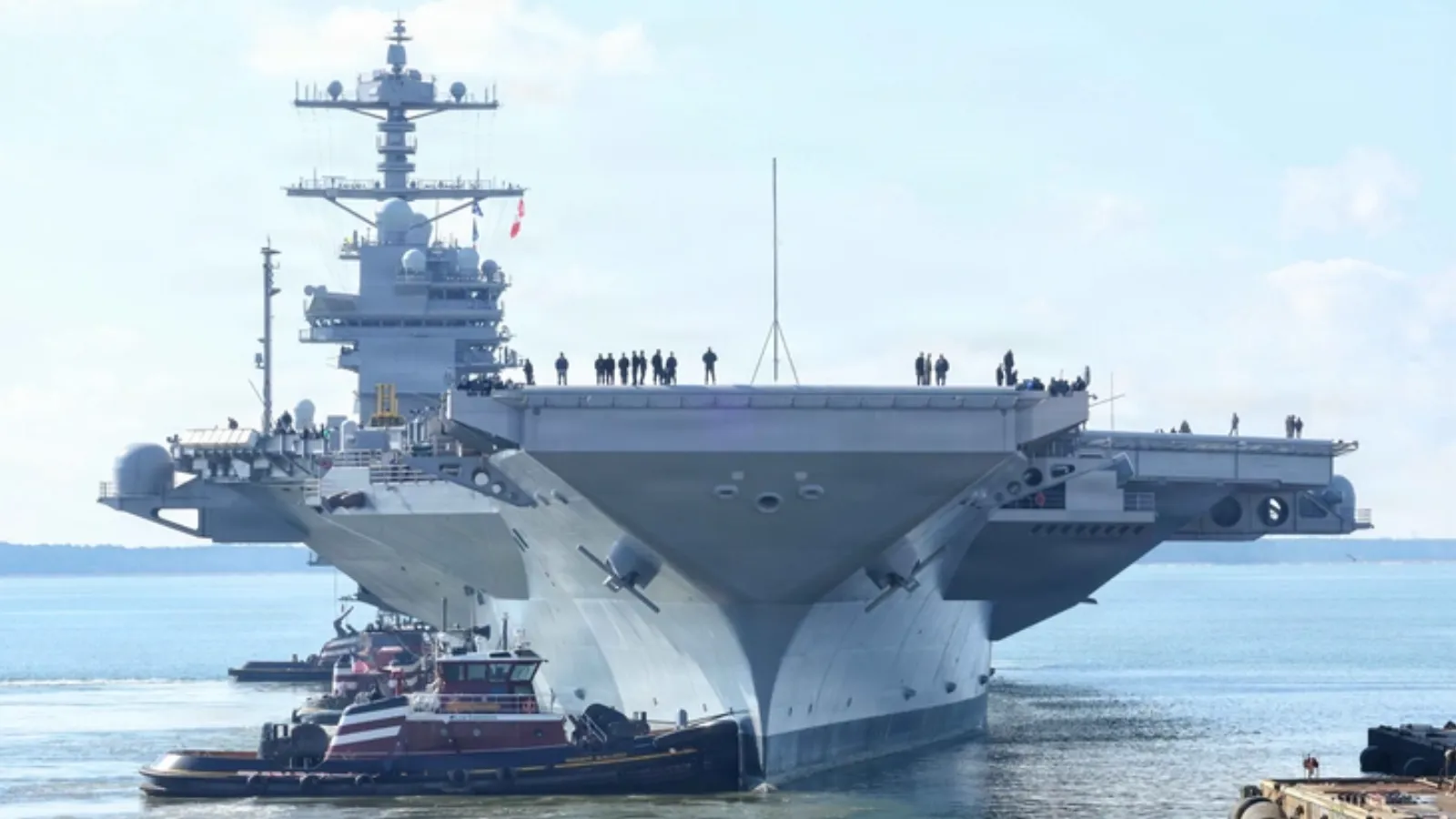
Executive Summary: The future USS John F. Kennedy (CVN-79), the second Gerald R. Ford-class nuclear-powered aircraft carrier, departed Huntington Ingalls Industries’ Newport News Shipbuilding facility on Aug. 12 to begin acceptance sea trials. The evaluation represents a major pre-delivery milestone for the carrier, which is currently scheduled for delivery to the U.S. Navy in spring 2027.
USS John F. Kennedy Enters Acceptance Trials
The USS John F. Kennedy carrier trials have entered a decisive phase, with the future CVN-79 beginning acceptance sea trials on Aug. 12 after completing its builder’s sea trials earlier in 2026. The acceptance process is conducted for the Navy to evaluate whether the ship’s systems and performance meet required standards before formal delivery.
Huntington Ingalls Industries, the carrier’s builder through its Newport News Shipbuilding division, had previously confirmed that CVN-79 was being prepared for acceptance trials during its first-quarter 2026 results. HII said in May that the carrier’s builder’s trials had been completed and that the company remained focused on preparing the ship for the next stage.
The latest milestone moves CVN-79 closer to delivery, although acceptance trials do not by themselves mean that the carrier is ready for operational deployment. Outstanding discrepancies identified during testing can require additional corrective work before the Navy accepts the ship.
From Builder’s Trials to Navy Acceptance
CVN-79 completed its first builder’s sea trials after departing Newport News on Jan. 28, 2026. During those trials, the ship’s crew, shipbuilders and Navy personnel evaluated major systems and components at sea. The carrier returned to the shipyard in early February for continued completion and corrective work.
Builder’s trials and acceptance trials serve different purposes.
Builder’s trials allow the shipbuilder and Navy teams to test the vessel’s major systems under operational conditions and identify problems that require correction. Acceptance trials are a later evaluation in which the Navy determines whether the ship meets its contractual and military requirements.
That distinction is important for CVN-79 because the Ford-class program incorporates a large number of new technologies compared with the older Nimitz class. The Navy has described the class as incorporating more than 23 new or significantly modified technologies, covering propulsion, electrical power, aircraft launch and recovery, ordnance handling, radar and other ship systems.
CVN-79 Specifications
| Specification | USS John F. Kennedy |
|---|---|
| Hull number | CVN-79 |
| Class | Gerald R. Ford |
| Ship type | Nuclear-powered aircraft carrier |
| Length | 1,092 feet |
| Full-load displacement | Approximately 100,000 long tons |
| Propulsion | Two nuclear reactors, four shafts |
| Maximum speed | More than 30 knots |
| Flight deck width | 256 feet |
| Aircraft capacity | 75 or more aircraft |
| Builder | HII Newport News Shipbuilding |
| Aircraft launch system | Electromagnetic Aircraft Launch System |
| Recovery system | Advanced Arresting Gear |
The Navy lists the Ford-class at approximately 100,000 long tons full load, with a length of 1,092 feet and a speed exceeding 30 knots. The design can support an air wing of more than 75 aircraft.
Why Ford-Class Technology Matters
The most significant difference between the Ford class and the preceding Nimitz class is not simply the size of the ship. It is the integration of new electrical, aviation and automation technologies intended to increase aircraft generation capacity while reducing manpower and maintenance demands.
The Electromagnetic Aircraft Launch System, or EMALS, replaces the steam catapults used on Nimitz-class carriers. The system uses electromagnetic energy to accelerate aircraft from the flight deck and is designed to provide more precise control across a wider range of aircraft weights.
The Ford class also uses Advanced Arresting Gear, or AAG, instead of the legacy Mk 7 arresting system. According to NAVAIR, AAG uses energy absorbers, power conditioning equipment and digital controls, while incorporating built-in testing and diagnostic capabilities. The system is intended to support aircraft ranging from unmanned systems to heavy manned fighters.
These technologies matter because the effectiveness of a carrier depends heavily on how quickly and reliably it can launch, recover, refuel, rearm and maintain aircraft. Increasing the number of aircraft that can be cycled through flight operations can improve the combat output of the carrier without increasing the physical size of the air wing.
CVN-79 Was Built With F-35C Operations in Mind
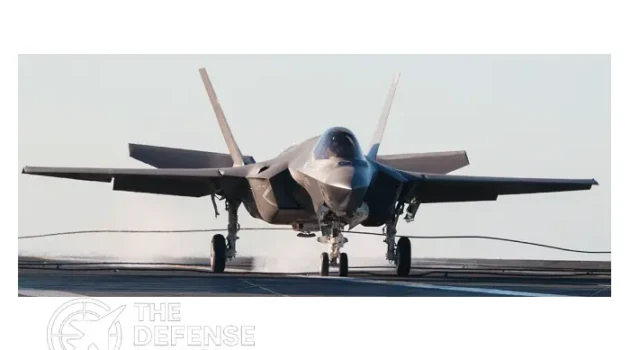
One important distinction between John F. Kennedy and the first Ford-class carrier, USS Gerald R. Ford, is the decision to incorporate modifications for the F-35C Lightning II during CVN-79 construction.
The Navy announced in 2020 that it would incorporate F-35C modifications into CVN-79 before delivery. The change was intended to ensure that the carrier could deploy with the carrier-based stealth fighter without requiring the same type of major post-delivery modification period.
This approach increased complexity during construction, but it also reflects a broader Navy effort to deliver carriers with more of their required combat capability already integrated.
For a carrier expected to operate with modern strike fighters, unmanned aircraft and increasingly networked weapons, aviation integration is central to the ship’s value. The carrier is effectively a mobile airfield, command center and logistics hub operating thousands of miles from the continental United States.
A More Electrified Carrier Design
The Ford-class also places substantially greater emphasis on electrical power.
The Navy’s Naval Aviation 2025 publication identifies the class’s new propulsion and electrical architecture, all-electric auxiliary services, electromagnetic catapults, advanced arresting gear and improved flight deck arrangement as major differences from the Nimitz class. The Navy says the class has three times the electrical generating capacity of its predecessor.
That additional electrical capacity is important beyond today’s aircraft systems. Modern radars, electronic warfare equipment, communications systems and future directed-energy weapons all require substantial electrical power.
The Ford-class architecture therefore provides the Navy with more electrical growth margin than a conventional steam-based carrier design. This is one reason the carrier remains relevant as naval aviation moves toward more networked and unmanned systems.
The Delivery Schedule Remains a Key Milestone
CVN-79’s progress is significant because the carrier has experienced a lengthy construction and testing period.
The Navy initially pursued an earlier delivery schedule, but construction changes, technology integration and the decision to incorporate additional capabilities affected the timeline. The carrier is now expected to be delivered in spring 2027, according to recent reporting on the program.
The delay also illustrates the difficulty of building a second ship in a class that introduces a large number of new technologies.
At the same time, CVN-79 benefits from lessons learned during the construction and operational introduction of USS Gerald R. Ford. The Navy has sought to incorporate those lessons into subsequent Ford-class ships while improving construction processes and reducing long-term operating costs.
The Navy has stated that Ford-class carriers are expected to reduce life-cycle operations and support costs by approximately $4 billion per ship compared with Nimitz-class carriers.
What Acceptance Trials Will Demonstrate
The current trials are important because they provide the Navy with an opportunity to evaluate CVN-79 as an integrated warship rather than as a collection of individual systems.
Key areas of interest include:
- Propulsion and electrical power generation
- Navigation and ship-control systems
- Flight deck operations
- Aircraft launch and recovery systems
- Advanced Arresting Gear performance
- Electromagnetic Aircraft Launch System operation
- Radar and combat-system integration
- Damage-control and ship survivability functions
- Crew performance and operational procedures
Not every aspect of carrier combat capability can be demonstrated during acceptance trials. Some aviation and weapons certifications occur through later testing and fleet integration activities.
The broader objective is to establish that the ship can safely and reliably perform the functions required of a nuclear-powered aircraft carrier before the Navy formally accepts it.
Strategic Importance for the U.S. Navy
CVN-79’s progress comes as the Navy works to maintain a carrier force capable of supporting operations across multiple maritime theaters.
A nuclear-powered carrier provides sustained aviation presence without requiring a host nation’s land base for its primary air operations. Its mobility allows commanders to reposition an air wing as operational conditions change.
The Ford-class adds another dimension through increased electrical capacity, automation and redesigned aircraft handling systems. Those changes are intended to support higher sortie generation while reducing some of the manpower and maintenance burden associated with earlier carriers.
For the Navy, the significance of CVN-79 therefore extends beyond adding another hull to the fleet. The carrier is a test of whether the Ford-class design can transition from the difficult introduction of the lead ship into a more mature production and operational model.
That transition will matter for the ships that follow, including the future USS Enterprise (CVN-80) and USS Doris Miller (CVN-81).
What Comes Next for CVN-79
Successful acceptance trials would represent another major step toward formal Navy acceptance, but the carrier will still require additional work, certifications, crew training and fleet integration before becoming a fully operational carrier.
The Navy’s 2025 aviation documentation identified CVN-79 as the next Ford-class carrier scheduled for delivery, while future carriers Enterprise, Doris Miller, William J. Clinton and George W. Bush are planned to follow.
For now, the immediate focus is on the performance of CVN-79 at sea.
If the acceptance process proceeds successfully, the carrier will move closer to its planned spring 2027 delivery and eventual integration into the U.S. fleet. That milestone would mark an important step in the Navy’s transition from the Nimitz-class generation to the Ford-class carrier force.