• Home
  • About
  • Defense Systems
  • Manufacturer
  • Comparisons
  • Compare 
  • Tools
TheDefenseWatch.com
  • Aerospace & Aviation
  • Military & Ordnance
  • Naval & Maritime
  • Cyber & Space Defense
  • Policy & Strategy
  • Global News
  • Tools Library
    • Smart Calculator
    • Drone Flight Time Calculator
    • Drone Range Calculator
    • Counter-Drone Jammer Effective Range Calculator
    • Counter-Battery Radar Detection Calculator
    • Artillery Fire Correction Calculator
    • Thermal Camera Detection Range Calculator
    • Missile Range & Time-of-Flight Calculator
    • Radar Detection Range Calculator
    • FPV Strike Drone Payload vs Range Calculator
    • Loitering Munition Endurance Calculator
    • Sniper Ballistic Drop & Windage Calculator
    • Bullet Drop Calculator
    • U.S. Army Combat Fitness Test (ACFT) Calculator
    • Military Pension Calculator
    • Military Retirement Calculator
    • Military Pension Calculator
    • Large Number Calculator
Font ResizerAa

TheDefenseWatch.com

The Defense Watch | U.S. & Global Defense News, Analysis & Military Updates

Search
  • Home
  • About
  • Defense Systems
  • Manufacturer
  • Comparisons
  • Compare 
  • Tools

Stay Updated

Get the latest update

Subscribe

Explore

  • Drone
  • Fighter Jets & Military Aircraft
  • Hypersonic Weapons
  • Aircraft Carriers
  • Strategic History & Missions
  • Tools Library
Home » Russia Deploys 48-Missile Pantsir Loadout To Counter Drone Swarm Battlefield Saturation
Artillery & Missile SystemsMilitary & Ordnance

Russia Deploys 48-Missile Pantsir Loadout To Counter Drone Swarm Battlefield Saturation

Daniel Mercer / Defense & Aerospace Analyst
Last updated: September 7, 2026 6:40 pm
Daniel Mercer / Defense & Aerospace Analyst
Share
2 Min Read
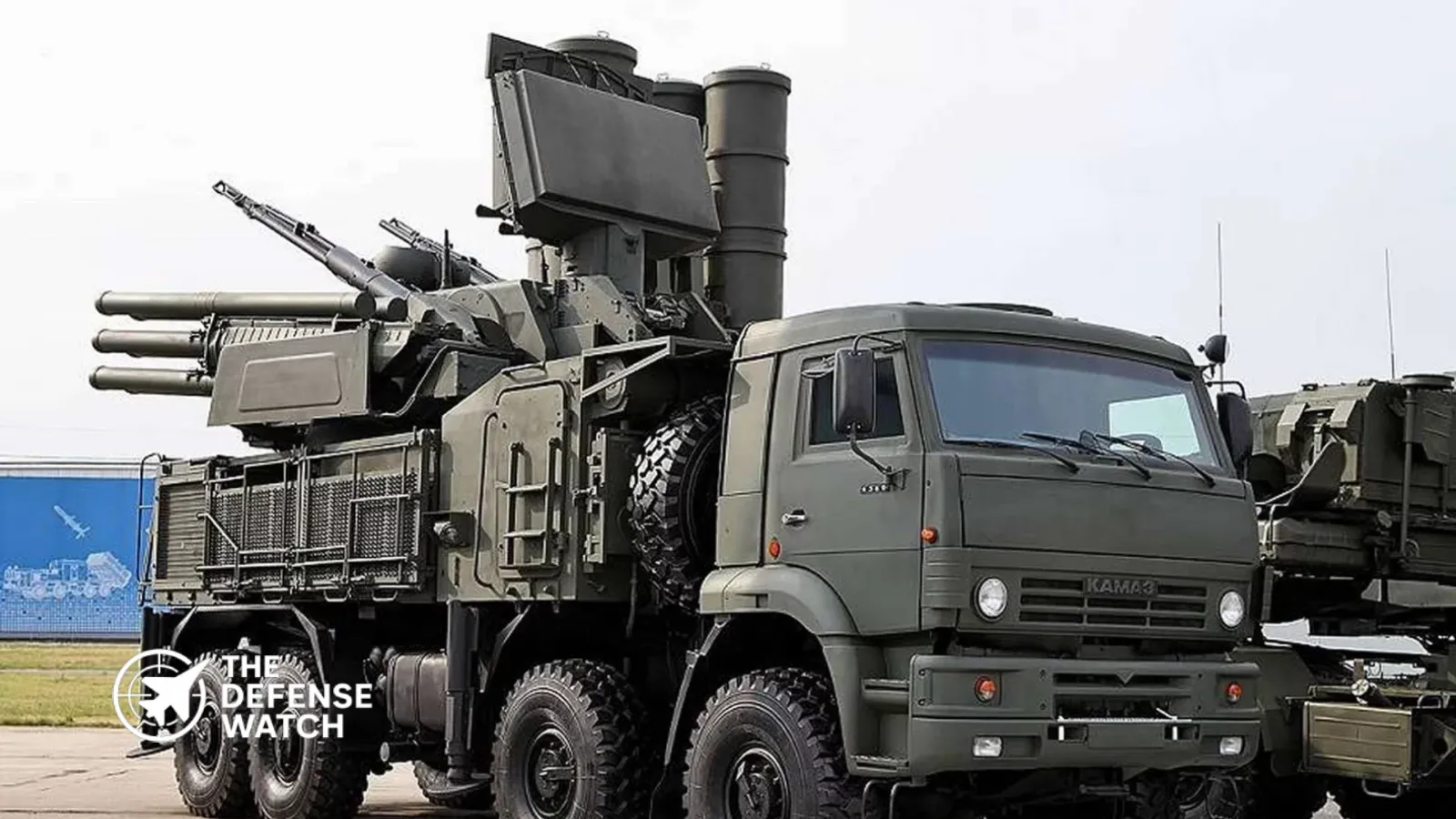
Russia 48-missile Pantsir loadout
SHARE
Follow The Defense Watch on Google:
■ KEY FACTS AT A GLANCE
  • ► Russia has deployed a 48-missile Pantsir loadout to improve short range air defense against drone swarms.
  • ► The configuration replaces or supplements traditional gun and missile arrangements with higher missile density.
  • ► Designed to counter low cost UAV saturation attacks observed in recent conflicts.
  • ► The Pantsir system integrates radar, electro optical tracking, and surface to air missiles on a mobile chassis.
  • ► The adaptation highlights the growing centrality of counter UAV defenses in Russian military modernization.

Russia Deploys 48-Missile Pantsir Loadout To Counter Drone Swarm Battlefield Saturation

The Russia 48-missile Pantsir loadout marks a significant adjustment in Moscow’s short range air defense posture, aimed directly at countering drone swarm saturation on today’s battlefield.

Contents
Russia Deploys 48-Missile Pantsir Loadout To Counter Drone Swarm Battlefield SaturationA Shift In Short Range Air Defense DoctrineTechnical Characteristics Of The Pantsir PlatformBattlefield Lessons Driving ModernizationStrategic Implications

Russian forces have introduced a modified configuration of the Pantsir-S1 featuring up to 48 ready-to-fire missiles. The new loadout is designed to increase engagement capacity against massed unmanned aerial vehicles, a threat that has reshaped modern air defense doctrine.

(adsbygoogle = window.adsbygoogle || []).push({});

The move reflects lessons drawn from ongoing combat operations, where low cost drones have been used to overwhelm traditional air defense systems through sheer volume.

A Shift In Short Range Air Defense Doctrine

The Russia 48-missile Pantsir loadout represents more than a technical upgrade. It signals a doctrinal response to the rise of inexpensive, networked drones used in coordinated attacks.

- Advertisement -

Traditional short range air defense systems such as the Pantsir-S1 were built to counter aircraft, helicopters, cruise missiles, and limited UAV threats. However, recent conflicts have demonstrated that small drones, often deployed in waves, can saturate defensive systems by exhausting missile inventories.

By expanding the ready missile count to 48, Russian forces appear to be prioritizing engagement volume over mixed weapon flexibility. Earlier Pantsir variants typically carried 12 surface to air missiles supported by dual 30 mm autocannons. The revised configuration increases missile density, potentially trading gun capability for sustained interception capacity.

(adsbygoogle = window.adsbygoogle || []).push({});

This approach reflects battlefield realities. Drone swarms, including first person view attack drones and loitering munitions, are frequently used to target artillery, armored vehicles, logistics hubs, and air defense assets themselves.

Technical Characteristics Of The Pantsir Platform

The Pantsir-S1, developed by KBP Instrument Design Bureau and produced by Russia’s defense industry, combines target acquisition radar, tracking radar, electro optical sensors, and vertically launched surface to air missiles mounted on a wheeled or tracked chassis.

The system is designed to protect strategic sites and maneuvering formations from low altitude threats. Depending on the missile variant, engagement ranges typically extend up to 20 kilometers, with effective interception against small UAVs at shorter distances.

The expanded 48-missile configuration suggests either the integration of smaller interceptors or a modular canister approach that increases the number of ready rounds. While detailed technical specifications have not been fully disclosed, the reported design emphasizes counter UAV efficiency rather than long range air defense.

Battlefield Lessons Driving Modernization

The Russia 48-missile Pantsir loadout must be viewed within the broader evolution of air defense seen across multiple theaters.

Drone swarm tactics aim to create target saturation. Even advanced systems can be overwhelmed if forced to engage large numbers of low cost aerial threats simultaneously. Each interceptor missile often costs significantly more than the attacking drone, creating economic asymmetry.

- Advertisement -

By increasing onboard missile capacity, Russia appears to be addressing two operational challenges:

(adsbygoogle = window.adsbygoogle || []).push({});

First, reducing reload frequency under fire.
Second, sustaining defensive coverage during prolonged swarm attacks.

This shift mirrors global trends. Western militaries are also investing in layered defenses that include electronic warfare, directed energy weapons, and rapid fire interceptors to manage drone saturation. The emphasis is on resilience and depth rather than single shot capability.

Strategic Implications

The deployment of the Russia 48-missile Pantsir loadout underscores how drone warfare is reshaping force protection requirements.

Short range air defense systems are no longer niche enablers. They are central to survivability on the modern battlefield. Units lacking robust counter UAV capability risk rapid attrition from persistent aerial surveillance and precision strikes.

For Russia, reinforcing Pantsir batteries with higher missile density could improve protection of artillery formations, logistics corridors, and high value infrastructure. It may also enhance layered defenses around strategic facilities.

(adsbygoogle = window.adsbygoogle || []).push({});

However, missile based interception alone may not fully solve the drone swarm problem. Integrated approaches combining kinetic interceptors, electronic warfare jamming, and potentially laser systems are increasingly seen as necessary to manage cost and scale.

The Russia 48-missile Pantsir loadout therefore represents a tactical adaptation within a broader strategic shift toward counter saturation warfare.

Enjoying our coverage?

Make The Defense Watch a preferred source on Google to see more of our geopolitical and defense insights when relevant to you.


TAGGED:battlefield modernizationdrone swarm warfarePantsir systemRussia Air Defenseshort range missile defense
Share This Article
Facebook Copy Link Print
ByDaniel Mercer / Defense & Aerospace Analyst
Follow:
Daniel Mercer is a defense and aerospace analyst at TheDefenseWatch.com covering military aviation, aerospace technology, unmanned systems, air warfare, and defense procurement. His reporting uses official documents, government and military statements, company announcements, and other public sources.
Leave a Comment

Leave a Reply Cancel reply

Your email address will not be published. Required fields are marked *

Search Defense Systems

Latest Defense Systems

  • Ilyushin Il-20 Coot Aircraft Ilyushin Il-20 Coot Aircraft
  • FGM-148 Javelin Anti-Tank Missile FGM-148 Javelin Anti-Tank Missile
  • F-104 Starfighter F-104 Starfighter
  • F-15J Eagle Fighter Jet F-15J Eagle Fighter Jet
  • China’s GJ-21 Stealth Drone China’s GJ-21 Stealth Drone
  • China’s GJ-11 Stealth Drone China’s GJ-11 Stealth Drone
  • F-15EX Eagle Fighter Jet F-15EX Eagle Fighter Jet
  • TRML-4D Radar TRML-4D Radar
  • F-47A Fighter Jet F-47A Fighter Jet

Recent Compares

  • J-10C vs JF-17 Thunder: Which Fighter Is More Capable? J-10C vs JF-17 Thunder: Which Fighter Is More Capable? View Comparison →
  • Tejas vs Gripen: Key Differences and Capabilities Tejas vs Gripen: Key Differences and Capabilities View Comparison →
  • Tejas vs MiG-21 Bison: How India Replaced Its Iconic Supersonic Fighter Tejas vs MiG-21 Bison: How India Replaced Its Iconic Supersonic Fighter View Comparison →
  • F-35 vs F-16: Stealth, Sensors and Combat Roles F-35 vs F-16: Stealth, Sensors and Combat Roles View Comparison →
  • Tejas Fighter Jet vs F-16 Fighting Falcon: Capability Compared Tejas Fighter Jet vs F-16 Fighting Falcon: Capability Compared View Comparison →
  • Rafale Fighter Jet vs F-16 Fighting Falcon : Which Fighter Has the Edge? Rafale Fighter Jet vs F-16 Fighting Falcon : Which Fighter Has the Edge? View Comparison →
  • Su-57 Fighter Jet vs J-20 Fighter Jet: Stealth and Air Combat Compared Su-57 Fighter Jet vs J-20 Fighter Jet: Stealth and Air Combat Compared View Comparison →
  • Mirage 2000 vs Tejas Mk1A: Legacy Combat Power vs Indigenous Modernization Mirage 2000 vs Tejas Mk1A: Legacy Combat Power vs Indigenous Modernization View Comparison →
  • Rafale Fighter Jet vs F-22 Raptor: Which Air Dominance Fighter Has the Edge? Rafale Fighter Jet vs F-22 Raptor: Which Air Dominance Fighter Has the Edge? View Comparison →
  • Tejas Fighter Jet vs. Rafale Fighter Jet: India’s Indigenous Fighter Meets France’s Proven Multirole Combat Aircraft Tejas Fighter Jet vs. Rafale Fighter Jet: India’s Indigenous Fighter Meets France’s Proven Multirole Combat Aircraft View Comparison →

Recent Posts

  • Russia Uses Cold War-Era Il-20 Spy Plane to Monitor Ukrainian Radar From Belarus
  • Boeing Receives $11.7 Million Air Force Contract Modification for VC-25B Parts Repair
  • U.S. Navy Awards DRS Systems $19.8 Million to Expand DAIRCM Testing Capacity
  • Lockheed Martin Wins $47.9 Million Navy Combat System Integration Contract
  • Florida National Guard Builds Flood Barrier to Protect Sanford Hospital

You Might Also Like

TASACK loitering munition
Artillery & Missile SystemsMilitary & Ordnance

Poland Unveils TASACK Loitering Munition With 110-Kilometer Range And Top-Attack Capability

September 9, 2026
North Korea tank active protection system
Military & OrdnanceTanks & Armored Vehicles

North Korea Tests New Tank Active Protection System Against Anti Tank Missiles And Drone Threats

September 7, 2026
Volkswagen Iron Dome production
Military & OrdnanceMissile Defense Systems

Volkswagen Iron Dome Parts Deal Signals Defense Industrial Shift In Europe

September 8, 2026
Lockheed PAC-3 ACE
Military & OrdnanceMissile Defense Systems

Lockheed Martin Races To Deploy Lower Cost Patriot Interceptor Amid Soaring Global Air Defense Demand

September 7, 2026

Logo

Copyright © 2026 TheDefenseWatch.com

Helpful Links

  • Home
  • About Us
  • Privacy Policy
  • Terms of Use / Disclaimer
  • U.S. Privacy Notice – CCPA Compliance

Defense Systems

  • Defense Systems
  • Comparisons 
  • Manufacturer
  • Tactical Calculators

Popuplar

Which 5 Air Forces Possess the Costliest Fighter Jet Fleets in the World
Evolving Strategic Value: Carrier Strike Groups in the Indo-Pacific’s Future Security Architecture
Autonomous Weapon Systems Spark U.S. Ethics Debate Amid Rapid Military AI Integration

We report on developments involving military forces, governments, defense companies, research organizations, and security institutions around the world. 

Welcome Back!

Sign in to your account

Username or Email Address
Password

Lost your password?

Enjoying our coverage?

Make The Defense Watch a preferred source on Google to see more insights.