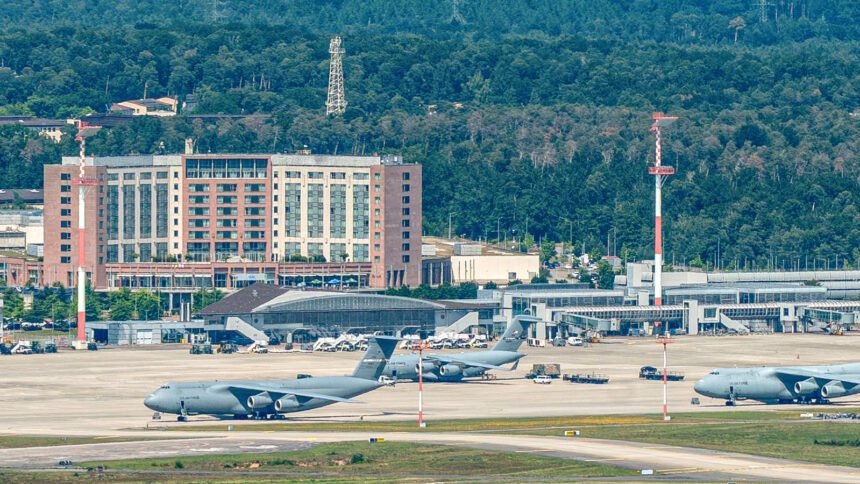
Ramstein Air Base is most visible through its aircraft: transport planes on the flightline, cargo moving across the ramp, and aircrews preparing for their next mission. Those flight operations, however, are only the most visible part of a much larger system.
Every departure relies on logistics, ground transportation, communications, infrastructure, and personnel support working in sync. Vehicles must stay mission-ready. Facilities and utility systems must work reliably. Information also has to move quickly across multiple organizations.
Ramstein also does not operate in isolation. The base is part of the Kaiserslautern Military Community, or KMC, a broad network of U.S. military installations across Rheinland-Pfalz. According to the U.S. Air Force, the 86th Airlift Wing serves as Ramstein’s host wing, supporting more than 120 mission partners. These include USAFE-AFAFRICA, NATO elements, and other organizations involved in air mobility and mission support.
To understand how Ramstein operates day to day, it helps to look beyond the runway.
How Maintenance, Logistics, and Ground Transportation Work Together
Ramstein is home to the 86th Airlift Wing and is the U.S. Air Force’s largest mobility hub. Long before an aircraft takes off, several support systems are already at work.
The first requirement is the technical readiness of the aircraft themselves. At Ramstein, the 86th Aircraft Maintenance Squadron and 86th Maintenance Squadron help keep aircraft mission-ready. Their work also includes associated ground support equipment. Once the aircraft are mission-ready, the rest of the logistics chain can move into place.
Much of that logistics support is coordinated through the 86th Logistics Readiness Group. Its responsibilities include supply, cargo and passenger transportation, and support for deployment and mobility operations.
Cargo and equipment must be received, prepared, and made ready for onward movement. Some loads also require temporary storage. At the same time, aircrews, passengers, and equipment have to be in the right place at the right time.
The 86th Vehicle Readiness Squadron shows how much coordination goes into a routine transportation task. The squadron transports aircrews, moves mission-critical cargo, and responds to vehicle breakdowns directly on the flightline. Even a routine movement can turn into a short-notice coordination effort involving several organizations.
If a vehicle becomes unavailable or a transport movement is delayed, follow-on activities can quickly come under time pressure. Ground transportation may look routine from the outside, but it is part of what keeps operations moving on schedule.
Communications: The Network Behind the Mission
Ramstein does not operate as a stand-alone airfield. Units and organizations based there work with locations throughout Europe and beyond.
Transportation movements, logistics requirements, and operational processes have to be coordinated across that wider network. That level of coordination depends on reliable communications and IT infrastructure.
One example is Ramstein’s Premier Data Center. It reopened in January 2025 after a major modernization effort. The facility supports cyber and IT services for military units across Europe and Africa.
During the renovation, systems were moved to other data centers to keep services running. The process showed why resilient IT infrastructure matters for military operations.
At Ramstein, communications infrastructure goes far beyond routine office IT. It connects units and locations, enables coordination across long distances, and helps ensure that information is available where decisions need to be made.
Civil Engineering: Power, Infrastructure, and Emergency Response
Ramstein also depends on physical infrastructure that has to work around the clock.
Buildings need reliable power and climate control. Technical systems require maintenance, and facilities must remain operational. At the same time, construction and modernization projects have to move forward without simply shutting down day-to-day operations.
A significant share of that responsibility falls to the 86th Civil Engineer Group. Its mission includes facilities, utilities, construction and maintenance, as well as emergency services.
An April 2026 Rapid Airfield Deployment Readiness exercise showed how directly civil engineering affects operational readiness. Members of the 86th Civil Engineer Group practiced assessing damage and quickly repairing a simulated damaged section of the airfield.
The goal is simple: restore airfield operations quickly after an attack, natural disaster, or other disruption.
The exercise makes the point clearly: aircraft and aircrews alone do not keep an airfield operational. Critical infrastructure also has to be restored quickly enough to return the airfield to service.
Personnel Support as Part of Operational Readiness
Ramstein is more than an airfield. It is also part of one of the largest American communities outside the United States.
According to the U.S. Air Force, roughly 56,000 Americans live within the Kaiserslautern Military Community. They include active-duty service members, civilian employees, family members, contractors, and others connected to U.S. installations.
At that scale, supporting the people behind the mission becomes an infrastructure challenge of its own.
The population is constantly turning over as well. Personnel arrive in Germany on PCS orders, while others spend only a few weeks or months in the KMC for TDY and other temporary assignments.
A network of support services helps personnel navigate those transitions. The 786th Force Support Squadron handles military personnel support and relocation. The Military & Family Readiness Center helps newcomers adjust to a new duty station and navigate the requirements of a move.
Those responsibilities may sit far from the flightline, but they help newcomers get settled, clear administrative hurdles, and focus on the job they were sent to do.
Where Military Life and Civilian Infrastructure Meet
The KMC extends far beyond Ramstein Air Base. It includes Air Force and Army locations around Ramstein, Vogelweh, and Kapaun, as well as facilities in Landstuhl, Kaiserslautern, and Sembach.
Many people who work at these installations live off base and commute to their duty locations each day. That puts civilian infrastructure into the picture as well. Housing, mobility, retail, and other local services complement what is available inside the installations.
The connection is especially clear during longer temporary assignments. Personnel spending several weeks or months in the region often need more than a conventional hotel room.
For stays lasting weeks or months, practical features often matter more than traditional hotel amenities. That can include a kitchen, laundry, workspace, reliable internet, and parking.
As a result, the KMC has a market for furnished extended-stay accommodations, particularly for longer TDY and TLA stays. Providers such as Stay Eden complement hotels and other off-base options for temporary personnel. These accommodations serve longer stays near Ramstein and other installations in the region.
These providers are not part of the military infrastructure, but they do form part of the civilian economy that supports a large, mobile international community.
Why the Connection to the Region Matters
The surrounding German region matters for more than housing and everyday services. For military members, civilian employees, and families who spend several years in the KMC, the region itself becomes part of everyday life.
For many families, an overseas assignment is shaped by more than life on base. The surrounding towns, outdoor spaces, culture, and access to the rest of Europe also matter.
American and German communities have also lived alongside one another in the region for decades. That makes cooperation and mutual understanding part of daily life.
The German-American Community Office in Kaiserslautern is one practical example of that relationship. It assists with administrative questions, communication challenges, and navigating the differences between U.S. and German systems.
The host-nation relationship is visible not only in formal cooperation, but in the everyday ways the KMC and surrounding German communities interact.
Conclusion
Ramstein is best known for what happens on its flightline and runway. But its daily operations depend on a much larger network.
Maintenance keeps aircraft mission-ready. Logistics moves cargo and equipment. Ground transportation moves people and materiel, while communications, civil engineering, and personnel support keep the wider system running.
Civilian infrastructure across the Kaiserslautern Military Community complements that system as well.
What takes off from Ramstein’s runway is only the visible result. Behind it is a network of people, systems, and services that keeps the mission moving every day.
Enjoying our coverage?
Make The Defense Watch a preferred source on Google to see more of our geopolitical and defense insights when relevant to you.