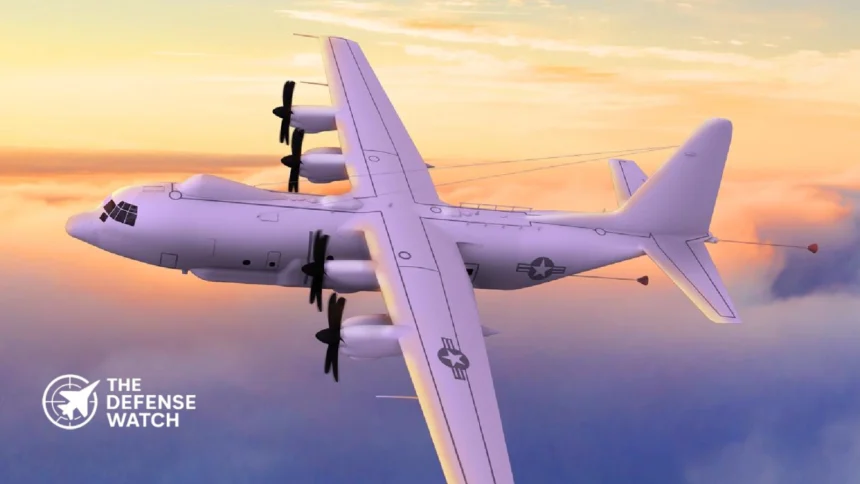
Northrop Grumman has received a $1.13 billion U.S. Navy contract modification to develop and deliver three additional E-130J strategic communications aircraft, advancing the service’s effort to replace the aging E-6B Mercury fleet.
The $1,130,397,498 modification, awarded through Naval Air Systems Command (NAVAIR), exercises previously established contract options for three System Demonstration Test Articles (SDTAs) and initial spare parts. The work supports the E-130J’s engineering and manufacturing development phase and is scheduled for completion in January 2030.
The aircraft will provide the Navy with a new platform for its Take Charge and Move Out (TACAMO) mission, which maintains communications between U.S. national command authorities and strategic nuclear forces, particularly ballistic missile submarines.
The award adds another major development commitment to a program central to maintaining the Navy’s airborne nuclear command, control and communications capability.
Three Additional Aircraft Expand the E-130J Development Effort
The latest modification, designated P00018 under contract N0001925C0130, covers the design, development and delivery of three E-130J system demonstration test aircraft.
These aircraft are intended to support engineering development, system integration and demonstration activities before the program moves toward operational production.
The contract also includes initial spares, which will support the development and testing effort.
The modification follows the Navy’s December 2024 award of a $3.459 billion engineering and manufacturing development contract to Northrop Grumman. That original agreement covered three Engineering Development Model aircraft and included options for three additional system demonstration test articles and up to six aircraft in the first production lot. U.S. Navy+1
The new award exercises the options for the three demonstration aircraft.
This distinction matters because the $1.13 billion modification is not a contract for three operational fleet aircraft. It funds another stage of development and testing intended to mature the integrated E-130J system.
Why the Navy Needs a New TACAMO Aircraft
The E-130J is being developed to replace the Navy’s aging E-6B Mercury aircraft in the TACAMO mission.
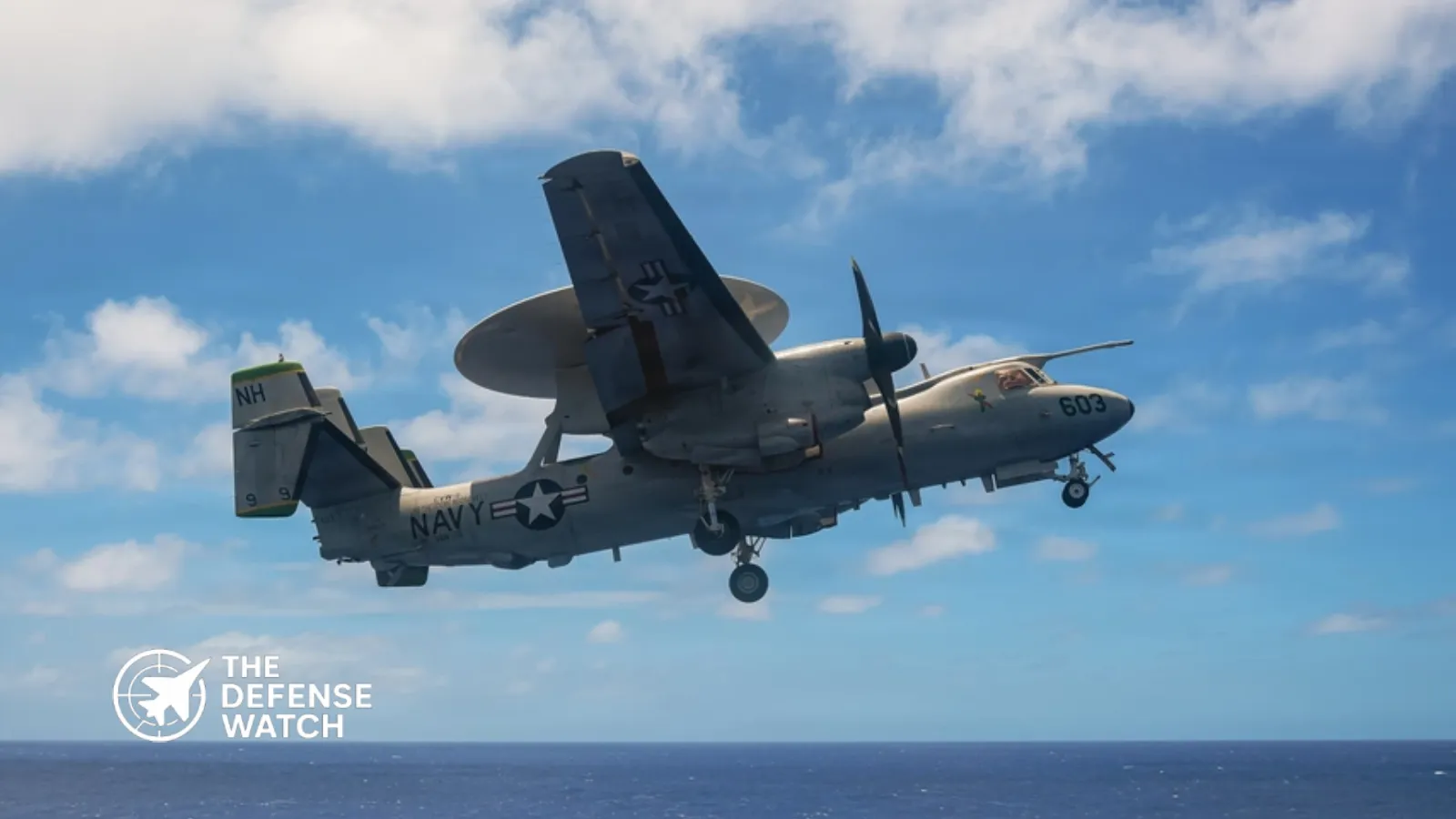
The E-6B provides an airborne communications relay and strategic command post capability. Its primary TACAMO responsibility is to maintain a survivable communications link between national command authorities and the U.S. nuclear triad.
This mission is particularly important for ballistic missile submarines, which operate across large ocean areas and require reliable communications with national leadership.
According to NAVAIR, the E-6B has served for more than three decades. Although the aircraft continues to meet operational requirements, its aging airframe makes replacement necessary to maintain long-term mission coverage.
The E-130J will use a militarized Lockheed Martin C-130J-30 Super Hercules airframe supplied by the government. Northrop Grumman is responsible for integrating the specialized mission equipment.
The architecture includes a Very Low Frequency (VLF) communications system supplied by Collins Aerospace, alongside other specialized communications capabilities.
VLF communications are important to the TACAMO mission because they support communications with submerged ballistic missile submarines. The Navy’s objective is to retain this strategic communications function while transitioning to a newer aircraft platform.
The E-130J is therefore more than a conventional transport aircraft modification. Its operational value will depend on the successful integration, testing and reliability of its specialized communications equipment.
Northrop Grumman Leads a Multi-State Industrial Effort
Northrop Grumman is serving as the prime contractor for E-130J mission-system integration, with Lockheed Martin and Collins Aerospace supporting the program.
The work distribution under the latest modification demonstrates the industrial scale of the development effort.
| Work location | Share of contract work |
|---|---|
| Melbourne, Florida | 35% |
| Marietta, Georgia | 23% |
| Richardson, Texas | 15% |
| Largo, Florida | 8% |
| Oklahoma City, Oklahoma | 6% |
| Other continental U.S. locations | 13% |
The remaining work is distributed across Orlando, Indianapolis, Phoenix, Torrance, Clearwater, Fort Wayne and San Antonio.
Melbourne accounts for the largest share, reflecting Northrop Grumman’s central role in the program. Marietta and Richardson also represent significant portions of the industrial effort.
The Navy expects the work covered by this modification to be completed in January 2030.
Although the total modification is valued at approximately $1.13 billion, only $4.18 million in fiscal year 2027 research, development, test and evaluation funding will be obligated at the time of award. This is the initial funding obligation, not the total value of the contract modification.
Development Risks Remain an Important Consideration
The E-130J program’s progress will depend on integrating specialized communications equipment into the C-130J-30 airframe without compromising aircraft performance, reliability or maintainability.
A July 2026 assessment by the U.S. Government Accountability Office (GAO) identified technical and acquisition challenges facing the program.
According to the GAO, the Navy’s original development plan faced significant systems-integration risks. These concerns included the complexity of incorporating mission equipment into the aircraft and the need to address equipment weight constraints.
The report said contractors were working to modify existing mission systems to reduce their weight so they could be accommodated within the C-130J-30 platform.
The GAO also reported that the program had delayed its low-rate production decision by approximately one year. Its published timeline placed that decision in April 2029.
These issues are relevant to the latest contract because the three system demonstration aircraft will support further development and evaluation of the integrated platform.
The GAO also questioned the program’s approach to incremental development and digital engineering. It noted that the Navy was not pursuing a minimum viable product approach and had reduced some efforts to establish a digital thread for development activities.
The Navy program office disputed aspects of the GAO’s assessment, stating that the program remained on track to recapitalize TACAMO capability through software improvements, iterative development and digital engineering. However, the GAO said the program office had not provided documentation to substantiate those statements.
This disagreement illustrates the challenges facing the program. Delivering the aircraft will require more than adapting a proven airframe. The specialized communications architecture must also work reliably as an integrated system.
What the E-130J Means for U.S. Nuclear Communications
The E-130J recapitalization effort addresses a critical part of the U.S. nuclear command and control architecture.
The Navy must maintain reliable communications with its ballistic missile submarine force under conditions in which conventional communications infrastructure may be unavailable or disrupted.
An airborne TACAMO platform provides an alternative communications pathway, helping preserve the ability of national command authorities to communicate with strategic forces.
The transition from the E-6B to the E-130J is therefore a long-term force modernization requirement rather than simply an aircraft replacement project.
The Navy plans to transition its airborne strategic nuclear communications capability without interrupting operational coverage. That requirement makes testing, system reliability and coordination between the aircraft and communications-system suppliers particularly important.
The latest $1.13 billion modification moves the E-130J further through its development phase. However, it does not establish an operational service-entry date or confirm that the aircraft has completed testing.
For Northrop Grumman and its industry partners, the immediate challenge is to deliver the three demonstration aircraft and validate the specialized systems required for the Navy’s future TACAMO mission.
Until that work is completed, the E-6B Mercury will remain central to the Navy’s airborne strategic communications responsibilities.
Enjoying our coverage?
Make The Defense Watch a preferred source on Google to see more of our geopolitical and defense insights when relevant to you.