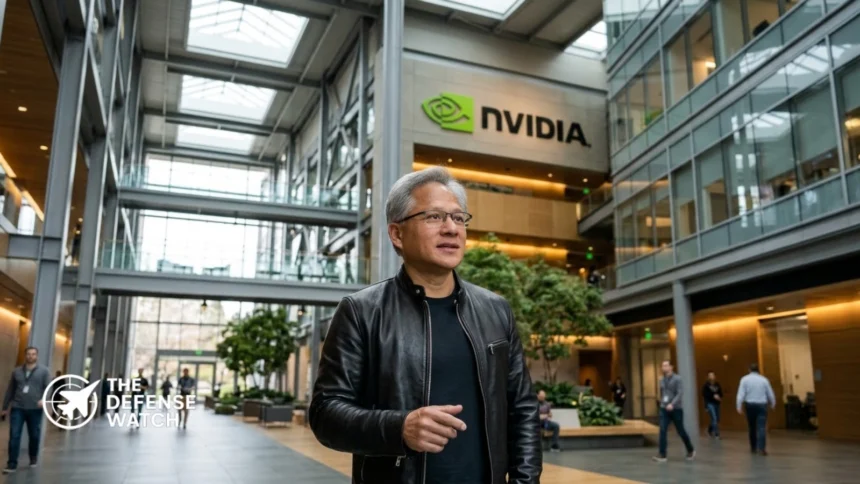
NVIDIA has reinstated co-founder Jensen Huang as president and chief executive officer, reversing its decision to accept his resignation less than two weeks earlier. The board’s unanimous decision, announced on November 23, 2026, restores Huang to executive leadership while leaving an independent investigation and new national security oversight measures in place.
The decision brings an abrupt end to a short period of leadership uncertainty at the artificial intelligence semiconductor manufacturer, but it does not resolve the wider questions surrounding export-control compliance, corporate governance and the security implications of advanced AI computing technology.
NVIDIA said the board reached its decision after a series of discussions with Huang. It also confirmed that senior U.S. government officials provided input during the process.
According to the company’s announcement, the board concluded that Huang’s reinstatement did not pose a national security risk.
A reversal of NVIDIA’s November leadership decision
The leadership changes began on November 12, when NVIDIA announced that Huang had resigned as president, CEO and a member of the board, effective immediately.
The company appointed Chief Financial Officer Colette Kress as interim CEO while directors considered the leadership transition.
Board Chairman Harvey C. Jones subsequently indicated that the company did not intend to bring Huang back, despite growing support for his return among employees, investors and prominent technology figures.
However, the board reversed that position on November 23, voting unanimously to reinstate Huang.
Huang will resume responsibility for NVIDIA’s executive leadership and return to the board. Jones will remain chairman, while Kress will return to her previous responsibilities as executive vice president and CFO.
ersion risks.
NVIDIA’s leadership and compliance decisions therefore have implications beyond ordinary corporate management.
However, the board’s statement that Huang’s reinstatement poses no national security risk should not be interpreted as a general government approval of every NVIDIA export transaction or a conclusion that all outstanding investigations have been resolved.
The company has not published the details of the government input received by its board.
Independent investigation will continue
One important detail in NVIDIA’s announcement is that Huang’s reinstatement does not end the independent investigation established by the board.
NVIDIA said the investigation was launched following reporting that Huang had been the target of a foreign intelligence effort.
The board appointed an independent committee to examine the matter and retained outside legal counsel to support its work.
The company confirmed that the investigation will continue to its conclusion and that Huang has agreed to cooperate.
The distinction matters. Reinstating an executive is a corporate governance decision, not necessarily a determination that every allegation or concern surrounding that executive has been resolved.
Associated Press reporting has also described continuing congressional scrutiny involving national security concerns and the possible diversion of advanced NVIDIA chips to China.
Those issues remain subject to investigation. Allegations involving individuals or suspected intelligence activity should not be treated as established findings without official confirmation.
NVIDIA establishes dedicated export-control oversight
Alongside Huang’s return, NVIDIA is strengthening its internal governance structure for national security and international trade compliance.
On November 17, the company announced the creation of a National Security and Export Control Oversight Committee.
The committee is composed of independent directors and is responsible for board-level oversight of:
- National security policies.
- Export-control compliance.
- International trade risks.
- Related corporate compliance arrangements.
Director Suzanne Nora Johnson was appointed committee chair.
NVIDIA also said the committee would obtain outside legal and specialist advice to support its oversight responsibilities.
The November 23 announcement adds further steps. The company is beginning a search for a new Chief Compliance Officer who will oversee compliance across NVIDIA and report to the board’s Nominating and Corporate Governance Committee.
NVIDIA also confirmed that it will continue cooperating with government investigations and inquiries.
These measures are relevant because semiconductor export compliance involves more than checking whether a product can legally be shipped to a particular destination.
Companies must also consider end users, intermediaries, licensing conditions, technology restrictions and the possibility that computing capacity could be transferred or made available to restricted entities.
For a company supplying advanced computing infrastructure internationally, board-level oversight and dedicated compliance leadership can influence how these risks are identified and managed.
What Huang’s return means for the semiconductor and defense sectors
Huang’s reinstatement restores NVIDIA’s established executive leadership at a time when demand for AI computing infrastructure remains central to the technology industry.
For defense organizations, the company’s position in the semiconductor supply chain is particularly relevant.
Advanced processors are increasingly important to defense research, intelligence systems, autonomous platforms and military data infrastructure. Access to these technologies can influence the pace at which governments and defense contractors develop AI-enabled capabilities.
The same technology creates export-control challenges because commercial computing hardware can support both civilian and military applications.
NVIDIA’s ability to maintain international business relationships while complying with U.S. restrictions will therefore remain an important issue for policymakers and customers.
The new compliance committee and Chief Compliance Officer search suggest that the company intends to give these issues greater formal attention at board level.
However, the practical effectiveness of those measures will depend on their implementation, the committee’s findings and NVIDIA’s ability to demonstrate compliance with applicable regulations.
There is also a corporate governance question. The rapid reversal from accepting Huang’s resignation to reinstating him illustrates the difficulty of separating executive leadership decisions from investor confidence, strategic continuity and government concerns when a company occupies a critical position in the technology supply chain.
Leadership restored, scrutiny remains
Huang’s return provides NVIDIA with continuity in its executive leadership, but the company still faces questions involving national security oversight, export controls and the independent investigation.
The board has restored its co-founder to the CEO position while retaining the mechanisms established to examine those concerns.
For the defense and semiconductor industries, the more consequential issue will be whether NVIDIA can maintain its role as a major supplier of advanced computing technology while meeting the regulatory and security requirements governing its international operations.
The board’s decision resolves the immediate leadership question. It does not, by itself, settle the wider regulatory and governance issues facing the company.
Enjoying our coverage?
Make The Defense Watch a preferred source on Google to see more of our geopolitical and defense insights when relevant to you.