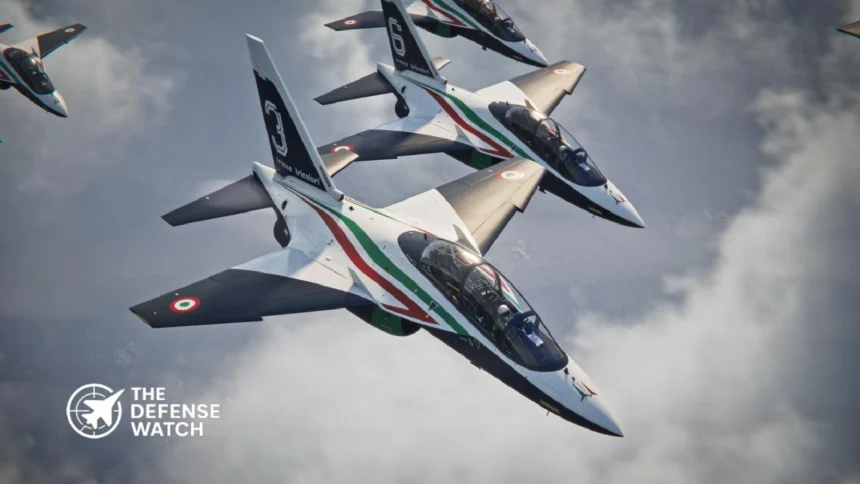
Leonardo has presented the first M-346 PAN aircraft developed for Italy’s Frecce Tricolori aerobatic team, bringing the Italian Air Force closer to replacing its long-serving Aermacchi MB-339 display jets.
The aircraft was unveiled on November 26, 2026, at Leonardo’s production facility in Venegono Superiore, northern Italy. The presentation included a flight demonstration and marked the start of the testing phase for a program covering 15 specially configured M-346 aircraft.
The new aircraft will replace the MB-339PAN, which has served with the National Aerobatic Team, known in Italian as Pattuglia Acrobatica Nazionale (PAN), since 1982. Leonardo plans to manufacture and deliver the 15 aircraft between 2027 and 2028.
The transition involves more than changing aircraft. Italy is also preparing new training arrangements, maintenance support and infrastructure at Rivolto Air Base, where the Frecce Tricolori are based.
From Advanced Trainer to Aerobatic Display Aircraft
The M-346 was originally developed as an advanced jet trainer for preparing military pilots to operate modern combat aircraft. Its Italian Air Force designation is T-346A.
The aircraft features two Honeywell F124-GA-200 turbofan engines, digital flight controls and a tandem-seat cockpit. Its fly-by-wire control system and aerodynamic design support demanding flight manoeuvres, making the platform suitable for the precision flying required by an aerobatic formation.
According to the Italian Air Force, the T-346A is used for Lead-In Fighter Training, the advanced stage of pilot preparation before assignment to operational fighter aircraft. Its training system also combines live flying with virtual and computer-generated training environments.
The PAN configuration retains the core aircraft architecture but introduces dedicated equipment and cockpit modifications for formation aerobatics.
These changes are intended to help pilots manage close-formation manoeuvres, coordinate display sequences and provide visual coverage of performances without requiring a completely different aircraft design.
What Changes in the M-346 PAN Configuration?
The most visible modification is the installation of a dedicated smoke-generation system.
The system uses a tank mounted beneath the fuselage and two internal supply lines. White smoke is produced using a petroleum-based fluid, while green and red trails are generated through the addition of specific pigments.
This arrangement allows the aircraft to reproduce the Italian national colours during public demonstrations.
The aircraft also receives a dedicated video system consisting of eight cameras installed at different locations around the fuselage. Four cameras will transmit footage in real time to a ground-based video control station, while the remaining cameras provide additional recording capabilities.
This equipment can support flight training, display coordination and the production of aerial footage for public events.
Another important modification is the introduction of a dedicated aerobatic flight-control mode known as Acro Mode. It changes the operation of the aircraft’s airbrake to suit the requirements of formation flying.
The cockpit also receives adjustments to its avionics and flight-control interfaces, helping pilots manage the specific demands of coordinated aerobatic manoeuvres.
An integrated boarding ladder is another practical addition, allowing pilots to access the aircraft without depending on external ground equipment at temporary display locations. The aircraft can also accommodate two external fuel tanks when additional endurance is required for transfer flights.
Why Italy Is Replacing the MB-339
The MB-339 has been closely associated with the Frecce Tricolori for more than four decades. Its replacement reflects the need to renew an ageing aircraft fleet while maintaining the team’s demanding display requirements.
The M-346 introduces a twin-engine configuration, digital flight-control technology and a more modern cockpit environment compared with the single-engine MB-339.
However, the change also creates a transition requirement for pilots and ground crews. Aerobatic teams depend on consistent aircraft handling, predictable flight characteristics and precise coordination between pilots. Moving to a different aircraft therefore requires more than conversion training.
Pilots must become familiar with the new aircraft’s handling characteristics, cockpit systems and modified aerobatic controls. The team must also develop and validate display routines appropriate to the M-346.
The Italian Air Force and Leonardo have been preparing personnel for the transition, with pilot and technician training forming part of the wider program.
A Wider Program Beyond Aircraft Procurement
The M-346 PAN program includes additional elements required to operate the new aircraft from Rivolto Air Base.
According to reporting on Leonardo’s November 26 presentation, the package covers:
- 15 M-346 aircraft: Dedicated aircraft for the Frecce Tricolori.
- Technical and logistical support: Maintenance arrangements and associated equipment.
- Training systems: Instruction and simulation facilities for pilots and maintenance personnel.
- Infrastructure improvements: Modifications at Rivolto to accommodate the aircraft and its supporting equipment.
The aircraft will be manufactured at Leonardo’s Venegono Superiore facility, with deliveries scheduled between 2027 and 2028.
The infrastructure element is important because introducing a new aircraft type affects maintenance facilities, ground equipment, technical training and operational procedures. These requirements must be addressed alongside aircraft production to support a successful fleet transition.
Pininfarina Design Retains Italy’s Aerobatic Identity
The new aircraft carries a special livery designed by Italian design company Pininfarina.
The design retains the national colours associated with the Frecce Tricolori while introducing a revised appearance for the M-346’s different airframe.
The aircraft was first presented as the team’s future platform in September 2024 at Istrana Air Base. That announcement established the replacement direction before the dedicated PAN aircraft entered its current testing phase.
The livery also serves a practical purpose. Its contrasting colours help distinguish aircraft orientation during close-formation manoeuvres, where pilots must maintain precise visual references.
What the M-346 Transition Means for Leonardo
The program gives Leonardo another opportunity to demonstrate the flexibility of the M-346 platform.
The aircraft already serves as an advanced trainer for military pilot preparation. Its use by the Frecce Tricolori adds a different operational role focused on precision formation flying and public demonstrations.
For Leonardo, the program also involves more than delivering aircraft. The associated training, simulation, maintenance and infrastructure requirements create a wider support commitment.
However, the aerobatic configuration should not be confused with a new combat variant. The M-346 PAN is being adapted for the specific requirements of Italy’s national display team, rather than introduced as a new frontline combat aircraft.
The transition’s success will depend on aircraft testing, pilot conversion, maintenance preparation and the development of new display routines.
Leonardo has not yet established a publicly confirmed date for the Frecce Tricolori’s first full operational display season with the new aircraft.
For now, the November presentation marks an important production and testing milestone. The MB-339’s eventual retirement will close a chapter that began in 1982, while the M-346 PAN prepares to carry Italy’s national aerobatic team into its next aircraft generation.
Enjoying our coverage?
Make The Defense Watch a preferred source on Google to see more of our geopolitical and defense insights when relevant to you.