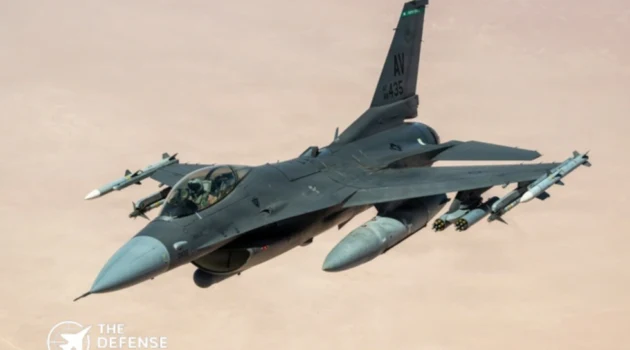
Executive Summary: U.S. Central Command imagery released through DVIDS shows a U.S. Air Force F-16 operating in the CENTCOM area of responsibility with an apparent eight-weapon GBU-39/B Small Diameter Bomb load. The configuration uses two BRU-61/A four-place carriages while retaining external fuel, targeting equipment and air-to-air missiles, demonstrating how the F-16 can generate a high density of precision effects without being configured solely as a strike aircraft.
U.S. F-16 Carries Eight GBU-39/Bs in CENTCOM
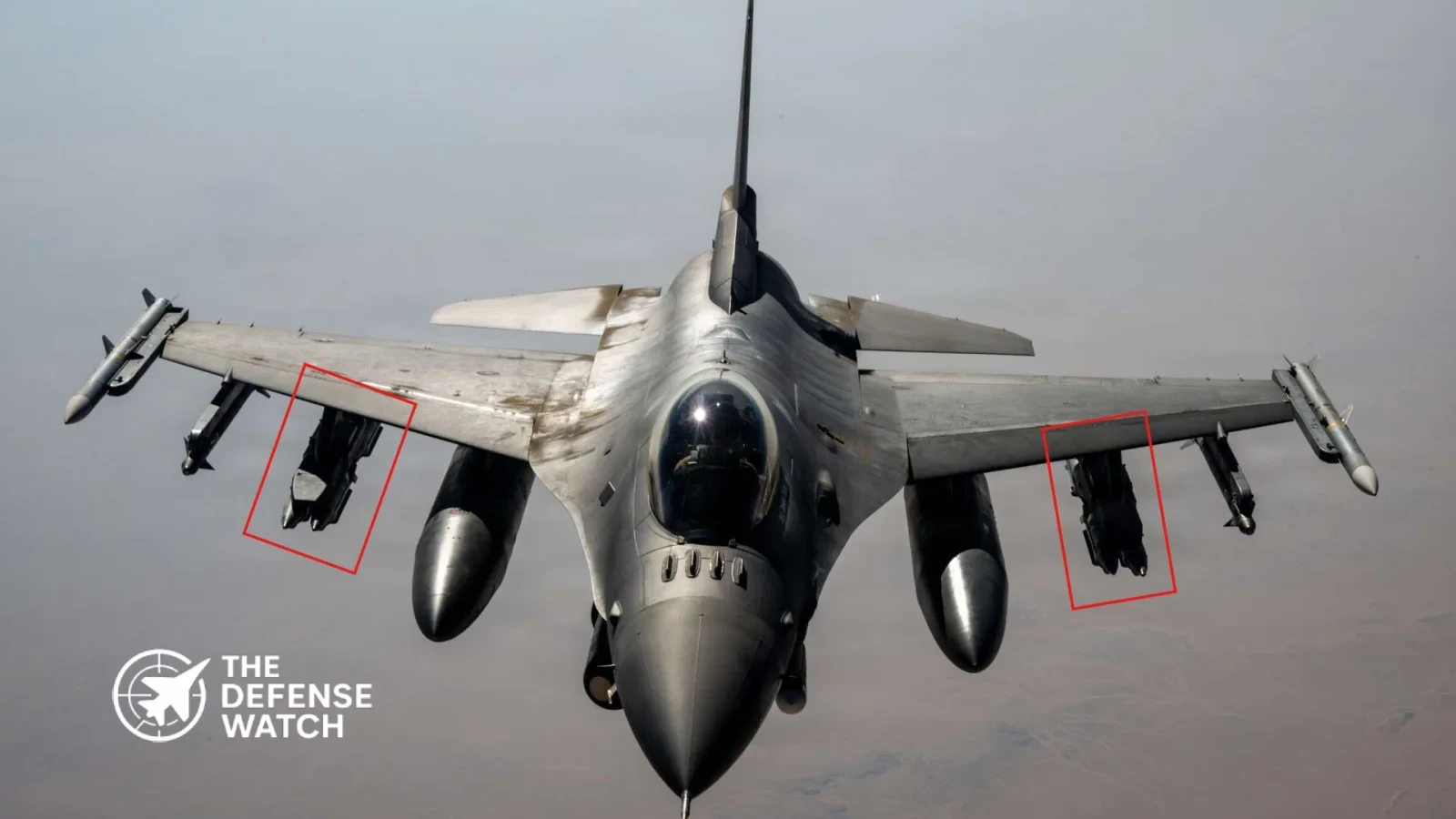
The F-16 GBU-39/B loadout revealed in recent U.S. Central Command imagery provides a clear example of how the Air Force is increasing precision strike capacity from an established fourth-generation fighter. U.S. Air Forces Central released imagery through the Defense Visual Information Distribution Service showing an F-16 receiving fuel from a KC-135 Stratotanker in the CENTCOM area of responsibility on August 7, with the imagery released August 13.
The aircraft appears to carry two BRU-61/A smart pneumatic carriages, each holding four GBU-39/B Small Diameter Bombs. That produces an apparent total of eight precision-guided weapons on one fighter.
The configuration is notable because the F-16 does not appear to be dedicated exclusively to ground attack. The aircraft also carries external fuel, targeting equipment and a mixed air-to-air weapons load, preserving capabilities needed for a multirole mission.
What the Eight-Bomb Configuration Provides
The GBU-39/B was designed around a simple operational requirement: increase the number of precision weapons that a fighter can carry without consuming a proportional number of weapons stations.
The U.S. Air Force describes the SDB as a 250-pound-class, all-weather, day-or-night guided air-to-surface weapon using GPS and inertial navigation. The Air Force lists a range of more than 40 nautical miles and says the weapon is intended for high-priority fixed and stationary targets.
Boeing’s published SDB specifications list the weapon at approximately 268 pounds and 70.8 inches long. The company also identifies the BRU-61/A as a four-weapon carriage, allowing four SDBs to occupy a single compatible aircraft weapons station.
Capability GBU-39/B SDB Weapon class 250-pound-class guided munition Weight About 268 pounds Length About 70.8 inches Guidance GPS/INS Published range More than 40 nautical miles Carriage BRU-61/A, four weapons Apparent F-16 load Eight GBU-39/Bs Primary target type Fixed and stationary targets Eight weapons do not necessarily mean eight targets in every mission. Actual employment depends on target planning, rules of engagement, weapon availability, aircraft configuration and the quality of target coordinates.
The important point is the potential number of precision effects available from a single aircraft. Compared with a conventional load of larger weapons, the SDB’s compact design allows the F-16 to carry more individually guided weapons while retaining other mission equipment.
Why the BRU-61/A Matters
The BRU-61/A carriage is central to the configuration. Instead of mounting each GBU-39/B individually, the four-place carriage groups four weapons into a single carriage assembly.
The Air Force identifies the smart carriage as a system capable of carrying four 250-pound-class guided munitions. Boeing likewise describes the four-weapon carriage as a major part of the SDB’s ability to increase the number of precision weapons carried by a combat aircraft.
Two such carriages therefore provide eight weapons while allowing the F-16 to retain additional stations for other stores.
That creates what can be described as precision-strike density. The aircraft does not need to become physically larger to increase the number of available precision effects.
This distinction matters in sustained air operations. Aircraft numbers are finite, and each sortie involves fuel, maintenance, crews and support assets. Increasing the number of precision weapons carried per sortie can raise the number of targets a force can potentially service without increasing aircraft numbers at the same rate.
The F-16 Remains a Multirole Platform
The CENTCOM aircraft is particularly significant because the visible loadout combines strike weapons with systems associated with targeting and self-defense.
Army Recognition’s assessment of the imagery identifies an apparent LITENING targeting pod and AN/ASQ-213 HARM Targeting System, or HTS, along with two external fuel tanks and apparent AIM-120 AMRAAM and AIM-9 Sidewinder missiles. These identifications are based on visual assessment of the released imagery rather than an official detailed U.S. description of every store.
The distinction is important. The GBU-39/B is not an anti-radiation missile and does not home on radar emissions.
The HTS, where carried, supports the detection, identification and geolocation of hostile radar emitters. The LITENING pod provides electro-optical and infrared sensing and targeting functions. Together, these systems can support a broader targeting architecture in which information from different sensors contributes to the development of target coordinates.
That does not mean the photographed aircraft was necessarily conducting a specific suppression or destruction of enemy air defenses mission. The imagery alone cannot establish the aircraft’s tasking.
It does show, however, that the F-16 can combine precision strike weapons with sensors and electronic-support equipment rather than operating as a simple bomb carrier.
Tanker Support Adds Operational Flexibility
The aircraft was photographed receiving fuel from a KC-135 Stratotanker, providing another important part of the configuration.
Aerial refueling is particularly relevant when an F-16 carries external fuel and multiple mission systems. Tanker support can extend the aircraft’s time and distance available for operations, although the precise effect depends on the mission profile, fuel state, weather and other operational factors.
U.S. Central Command and Air Forces Central have repeatedly documented KC-135 support for F-16 operations in the theater. DVIDS imagery from April and June 2026 also shows F-16s receiving tanker support during CENTCOM operations.
The combination of tanker support, external fuel and air-to-air missiles is therefore significant. It indicates that the aircraft can remain part of a broader tactical air operation while carrying a substantial precision strike load.
From Four SDBs to Eight
The latest imagery also provides an interesting comparison with another F-16 configuration previously observed in the CENTCOM region.
Army Recognition reported in August that an F-16 photographed on July 17 appeared to carry one BRU-61/A with four GBU-39/Bs, alongside rocket launchers, HTS and LITENING equipment, external fuel and air-to-air missiles. The newly released imagery appears to show a second BRU-61/A, increasing the apparent SDB load from four weapons to eight.
That difference illustrates how the same aircraft can be configured for different mission priorities.
A mixed weapons load can provide greater effector diversity, while two SDB carriages place more emphasis on precision-strike capacity. Neither configuration is inherently superior. The appropriate load depends on the target set and the tactical situation.
The ability to change the balance between sensors, weapons, fuel and self-defense equipment is one of the enduring characteristics of the F-16 platform.
What This Means for U.S. Airpower
The significance of the eight-GBU-39/B configuration extends beyond the number of bombs carried by one aircraft.
The F-16 first entered U.S. service decades ago, but its continued integration with precision weapons, targeting systems, electronic-support equipment and modern mission planning allows the platform to remain useful in contemporary operations.
The GBU-39/B supports that approach because its relatively small size enables more weapons to be carried on a fighter. The Air Force specifically identifies increased aircraft loadout, reduced logistical requirements and improved sortie-generation efficiency among the weapon’s advantages.
The result is a different form of combat mass. Instead of relying only on larger numbers of aircraft, a force can increase the number of precision effects generated by each sortie.
For CENTCOM, where U.S. aircraft routinely operate across a large geographic area and must balance strike, air defense, reconnaissance and force protection requirements, that flexibility has practical value.
The imagery also illustrates why legacy platforms continue to receive attention even as the Air Force fields fifth-generation fighters. An F-16 equipped with modern sensors, precision weapons, communications and tanker support can perform missions that require a combination of range, weapons capacity and multirole flexibility.
The Limits of the GBU-39/B
The eight-weapon configuration should not be interpreted as a universal replacement for heavier precision weapons.
The GBU-39/B is optimized around a relatively small, guided munition and is primarily intended for fixed and stationary targets. Boeing describes it as a weapon capable of attacking targets including command facilities, air-defense assets, airfields, fuel sites, missiles and artillery positions.
Target hardness, desired effects and the need for greater warhead mass can dictate the use of other weapons.
The SDB’s value is therefore not simply its explosive payload. Its operational advantage comes from the combination of precision, compact dimensions, standoff capability and the ability to carry multiple weapons on one fighter.
That makes the GBU-39/B particularly useful when commanders need multiple precision effects against a distributed set of suitable targets.
A Mature Fighter Gains Greater Strike Density
The latest CENTCOM imagery offers a useful snapshot of how the U.S. Air Force continues to extract additional combat utility from the F-16.
An apparent eight GBU-39/B load gives one fighter a significantly greater precision-strike inventory than a four-weapon SDB configuration, while the aircraft retains fuel, targeting equipment and air-to-air weapons. The aircraft can therefore remain part of a multirole package rather than being configured exclusively for ground attack.
The broader lesson is about weapons integration rather than the F-16 alone. Compact precision munitions allow existing fighters to generate more individual effects per sortie, while sensors and tanker support help preserve the aircraft’s broader mission flexibility.
For U.S. air operations in the Middle East, the configuration demonstrates how precision weapons, targeting systems, aerial refueling and established fourth-generation aircraft can be combined to produce greater strike capacity from each available fighter.
As the Air Force continues to balance legacy platforms with newer aircraft, the eight-GBU-39/B F-16 provides a concrete example of how weapon integration can increase the effectiveness of an existing fleet without requiring a new aircraft design.

Enjoying our coverage?
Make The Defense Watch a preferred source on Google to see more of our geopolitical and defense insights when relevant to you.