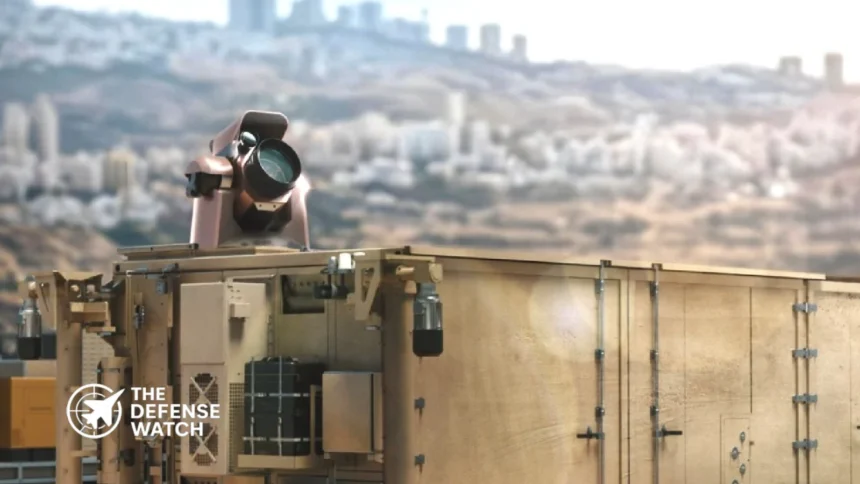
The United States and Israel have evaluated approximately 20 counter-unmanned aircraft systems (C-UAS) during a joint military technology campaign in Israel, bringing together defense researchers, military operators and companies from both countries to assess technologies against evolving drone threats.
The campaign, known as Black Sands, was led by Israel’s Ministry of Defense Directorate of Defense Research and Development (DDR&D), working with several U.S. military and defense organizations. The Israeli ministry announced the results of the evaluation on November 26, 2026.
The trials involved the Israel Defense Forces Ground Forces and Israeli Air Force, alongside U.S. Central Command (CENTCOM), Special Operations Command Central (SOCCENT), the Office of Naval Research (ONR), Joint Interagency Task Force 401 (JIATF 401), and the U.S. Capabilities Development and Innovation (CD&I) office.
Unlike a conventional equipment demonstration, Black Sands was designed to involve personnel who could eventually operate the technologies. Israeli and American military end users assessed the systems against simulated unmanned aerial threats and considered their suitability for operational requirements.
The Israeli ministry did not disclose individual system performance, participating manufacturers, interception success rates or procurement decisions.
Black Sands brings U.S. and Israeli defense organizations together
The November 2026 campaign is the first Black Sands trial conducted on Israeli soil.
Israel’s DDR&D coordinated the activity with U.S. defense and research organizations. The participating agencies brought together operational experience, technical expertise and military requirements from different parts of the U.S. defense establishment.
The participating organizations included:
- Israel Ministry of Defense DDR&D: Led the campaign and coordinated Israeli defense research participation.
- U.S. Capabilities Development and Innovation: Supports the identification and development of military capabilities, particularly for asymmetric warfare.
- U.S. Central Command: Provides regional operational requirements and military coordination.
- Special Operations Command Central: Represents U.S. special operations requirements in the CENTCOM area.
- Office of Naval Research: Contributes defense science, technology and experimental capabilities.
- Joint Interagency Task Force 401: Focuses on coordinating U.S. military counter-small-unmanned-aircraft efforts.
The Israeli Air Force and Ground Forces also participated, providing operational perspectives on how counter-drone technologies could support military formations and air defense activities.
Brig. Gen. (Res.) Dr. Daniel Gold, head of Israel’s DDR&D, said the campaign was intended to combine Israeli operational experience with American technologies and expertise to assess solutions required by military personnel.
The participating organizations also included defense companies from both countries, although the Israeli ministry did not publish a complete list of manufacturers.
Why counter-drone systems are becoming a military priority
The operational problem behind Black Sands extends beyond conventional military reconnaissance drones.
Small unmanned aircraft can perform surveillance, identify military positions, adjust artillery fire and carry explosive payloads. Their relatively accessible components and adaptable designs allow both state and non-state actors to develop or modify systems without the industrial infrastructure required for traditional military aircraft.
The threat also varies considerably by platform.
A small commercial quadcopter presents different detection and interception challenges from a larger fixed-wing unmanned aircraft or a one-way attack drone.
Consequently, counter-UAS operations require more than a single interception weapon.
A military counter-drone architecture can involve several interconnected functions:
Detection: Radar, radio-frequency monitoring, electro-optical sensors and other surveillance equipment identify potential aerial threats.
Identification and tracking: Operators and automated systems determine whether a detected aircraft represents a hostile threat and maintain its position.
Command and coordination: Information is distributed between sensors, command systems and available interception assets.
Defeat: Depending on the threat and engagement conditions, forces can employ electronic warfare, kinetic interceptors, guns or directed-energy weapons.
These are established counter-UAS approaches, not a confirmed breakdown of the technologies evaluated during Black Sands. The Israeli Ministry of Defense has not identified which specific interception methods were represented across the approximately 20 systems.
Previous Black Sands trials established the foundation
The latest campaign builds on earlier U.S.-Israeli cooperation in counter-unmanned systems.
According to an official U.S. Special Operations Command Central report published on December 19, 2025, the first Black Sands exercise took place between October 20 and October 31, 2025, at Marine Corps Base Camp Lejeune in North Carolina.
That exercise involved approximately 110 U.S. Department of War and interagency personnel, including operators, planners, program managers and senior military leaders.
It featured 12 co-developed technological capabilities designed to detect and defeat unmanned aircraft systems under operationally relevant testing conditions.
SOCCENT also reported that many participating technologies had previously been battle-proven in Israel and were selected to address identified counter-UAS capability gaps within U.S. special operations forces. DVIDS
The distinction between the two campaigns is important.
The 2025 exercise focused on 12 co-developed capabilities at a U.S. military installation. The November 2026 campaign evaluated approximately 20 systems in Israel, with participation from military organizations and defense companies from both countries.
The two figures describe separate testing campaigns and should not be interpreted as a cumulative procurement total or the number of systems entering military service.
What the trials could mean for U.S. and Israeli forces
The value of Black Sands lies partly in connecting technology development with the requirements of military personnel.
Counter-drone equipment must operate under conditions that can include electronic interference, limited reaction times, multiple incoming aircraft and difficult identification environments.
A system that performs well during a controlled demonstration may face different challenges when integrated into an operational military formation.
For U.S. forces, cooperation with Israel provides access to technologies and operational experience developed in an environment where unmanned aerial threats have been a recurring military concern.
This is particularly relevant to U.S. special operations units, deployed forces and installations that may face small drones used for surveillance or attacks.
For Israel, cooperation with American military organizations provides opportunities to evaluate domestic technologies against additional operational requirements and expand defense research partnerships.
There is also an industrial dimension.
Joint trials can help manufacturers understand military requirements, identify integration problems and demonstrate technologies to potential government customers. However, participation in an evaluation does not guarantee a contract, production order or operational deployment.
The Israeli Ministry of Defense has not announced procurement awards resulting from the November campaign.
System performance and procurement decisions remain undisclosed
Despite the participation of approximately 20 systems, important details about Black Sands remain unavailable.
The Israeli announcement does not identify the manufacturers, individual equipment designations, test conditions or performance results.
It also does not specify whether the evaluation produced a preferred shortlist or established a timetable for additional trials.
These omissions limit the ability to assess which technologies performed best or whether the campaign will lead to changes in either country’s counter-drone inventory.
The appearance of equipment in official trial imagery or accompanying video should also not be treated as confirmation that a particular system passed testing or received an operational selection.
For now, the confirmed outcome is a joint evaluation involving approximately 20 counter-UAS systems and military end users from the United States and Israel.
The next meaningful indicator will be whether either government identifies selected technologies, announces follow-on testing or moves specific systems toward procurement and operational integration.
Enjoying our coverage?
Make The Defense Watch a preferred source on Google to see more of our geopolitical and defense insights when relevant to you.