Lockheed Martin Prepares Robotic Welding Demonstration in Space
Building large structures in orbit has a fundamental engineering problem: spacecraft components must generally fit inside launch vehicle payload fairings before they can be assembled. Lockheed Martin is working on a technology that could reduce that constraint by allowing robotic systems to join metal components directly in space.
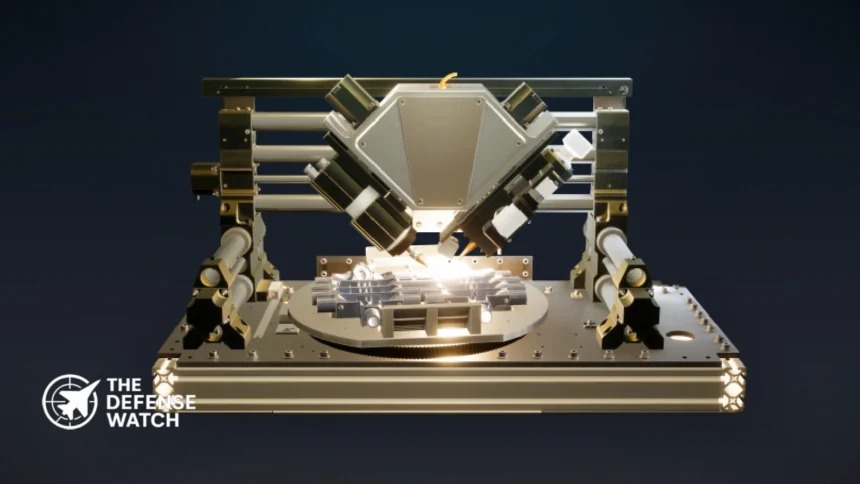
The company’s JOINS (JOining Demonstrations IN-Space) program will test two welding techniques aboard the International Space Station (ISS), using aluminum and stainless-steel samples. The project is intended to establish whether robotic welding can produce reliable structural connections under the conditions encountered outside Earth’s atmosphere.
However, the demonstration has not yet taken place. NASA currently lists November 2026 as the estimated launch period and March 2027 as the expected demonstration date.
JOINS targets a new approach to space construction
Lockheed Martin announced the latest details of JOINS on November 23, 2026. The project is being developed to advance in-space servicing, assembly and manufacturing (ISAM), a group of technologies intended to make spacecraft and other large structures easier to construct, maintain and upgrade after launch.
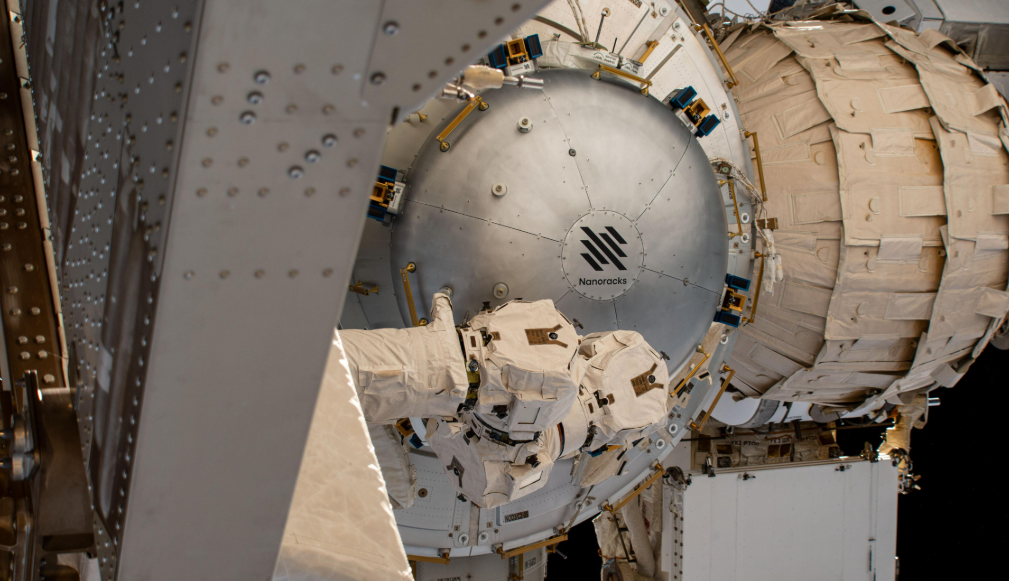
NASA identifies Lockheed Martin as the lead organization for JOINS under its Tipping Point program. The planned experiment will take place inside Voyager’s Bishop Airlock aboard the ISS, where the equipment can be exposed to the space environment.
NASA identifies Northrop Grumman’s CRS-25 cargo mission, using the Cygnus XL spacecraft, as the planned transportation mission for the payload.
The engineering challenge extends beyond simply making two pieces of metal stick together. Welding processes developed for terrestrial manufacturing must operate differently when exposed to vacuum, microgravity and extreme temperature changes.
In orbit, the absence of conventional atmospheric conditions changes heat transfer. Equipment also experiences thermal expansion and contraction as it moves between different temperature conditions. These factors can affect weld formation, structural integrity and the performance of robotic equipment.
JOINS is intended to collect experimental data that will help engineers understand and address these problems.
Two welding methods will be tested
The demonstration will examine two distinct approaches to joining metal components. Each offers different engineering advantages.
Laser beam welding
Precision-based metal joining
Laser beam welding uses a concentrated energy beam to heat and join materials. Its localized heat input makes it suitable for applications involving relatively thin materials and joints requiring precise control.
For space construction, the technology could eventually support the assembly of lightweight structural components, provided engineers can control heat distribution and maintain consistent weld quality.
Friction stir welding
Solid-state metal joining
Friction stir welding works differently. A rotating tool generates frictional heat and mechanically mixes material along a joint without melting the base metal.
The process can produce strong joints while reducing some of the problems associated with conventional fusion welding, including certain forms of thermal distortion and cracking.
NASA has previously developed friction stir welding techniques for aerospace manufacturing. The agency’s Space Launch System (SLS) production facilities use the technology to join large aluminum structures, including rocket tank components.
Testing the process in space introduces additional challenges, particularly the need to control tool pressure, robotic movement and structural reactions during welding.
Lockheed Martin plans to use both techniques on aluminum and stainless-steel samples. The results should help determine how different joining processes behave under actual orbital conditions.
Inspection will be as important as the welding itself
Producing a weld is only part of the challenge. Engineers must also establish whether the resulting connection can withstand the mechanical and thermal demands expected during a space mission.
JOINS will incorporate onboard inspection equipment, including cameras, to monitor welding operations and examine the resulting joints.
Data will be transmitted to the project’s mission control in Houston. The physical test samples are also expected to return to Earth months after the experiment for additional inspection and testing.
This approach will allow engineers to compare remote observations with physical assessments of the completed joints.
For future spacecraft construction, this capability is particularly important. A robotic system operating hundreds or thousands of miles from Earth cannot depend on technicians performing immediate repairs or manually inspecting every connection.
Reliable automated inspection will therefore be essential if in-space manufacturing is eventually used for large structures, commercial satellites or lunar infrastructure.
NASA’s investment and the next development stage
JOINS is backed by a NASA Funded Space Act Agreement valued at approximately $9.1 million.
NASA’s official agreement records identify the project as a funded partnership signed with Lockheed Martin on July 20, 2023. The agreement runs through July 2028. The company says it is contributing additional investment to mature the technology.
The project forms part of a wider NASA effort to develop technologies for building and maintaining infrastructure beyond Earth.
Lockheed Martin is also connecting the work to its STRATOS initiative, which focuses on robotic assembly technologies. NASA’s June 2026 announcement of collaboration selections included Lockheed Martin’s Space Technologies for Robotic-Assembly, Acceptance Testing, and Outfitting of Space-Infrastructure (STRATOS) proposal.
The relationship between these projects is important. Welding can connect structural elements, but constructing a complete space facility also requires robotic manipulation, component positioning, inspection, testing and integration.
JOINS addresses one part of that larger engineering requirement.
Why in-space welding matters for future space infrastructure
The potential value of robotic welding becomes clearer when considering the limitations of conventional spacecraft launches.
Large orbital platforms, communications structures, solar arrays and space telescopes can require structural dimensions that create difficulties for transportation inside launch vehicle fairings.
Building such systems in sections and joining them after launch could offer greater design flexibility. It could also reduce the need to develop structures around the physical dimensions of available launch vehicles.
NASA’s 2026 In-Space Servicing, Assembly, and Manufacturing State of Play report identifies structural manufacturing and assembly as an important capability area for future civil, commercial and national security space missions. It specifically identifies growing interest in autonomous robotic manufacturing and assembly.
For lunar operations, the implications could be particularly relevant. Future surface infrastructure may include communications towers, equipment shelters, power systems and structures supporting long-duration human exploration.
Transporting every completed structure from Earth would impose substantial demands on launch capacity and mission logistics. Robotic assembly could eventually allow infrastructure to be delivered as smaller components and constructed at its destination.
There is also a potential national security application. Larger or more adaptable orbital structures could support future space operations, although JOINS is currently a technology demonstration rather than a military procurement program. No operational defense deployment has been announced.
Space welding is not entirely new
Although JOINS could represent an important step in robotic construction, welding experiments in space have a much longer history.
NASA’s 2026 ISAM report documents the Soviet Vulkan welding experiment aboard Soyuz-6 in 1969. It also records the use of a handheld electron-beam welder in an exposed space environment during the 1984 Soyuz T-12 mission to the Salyut-7 station.
The distinction is that JOINS is designed to demonstrate robotic welding rather than rely on astronauts operating welding equipment manually.
Lockheed Martin describes it as the first robotic welding demonstration of its kind in exposed space. That claim should not be confused with the first welding experiment conducted beyond Earth.
The 2026 NASA ISAM report still classifies JOINS as a technology under development, rather than an operational capability.
The road from orbital testing to lunar construction
The immediate objective is to establish whether the two welding techniques can produce reliable joints in a space environment. Successful results would provide engineering data for more advanced robotic assembly systems.
NASA’s planned March 2027 demonstration will be an important technical milestone, but it will not by itself establish that autonomous welding is ready for routine construction or repair missions.
Engineers will still need to address robotic positioning, power requirements, material compatibility, weld inspection and long-term structural performance.
For Lockheed Martin, JOINS provides an opportunity to mature one of the technologies that could eventually support larger orbital facilities and lunar infrastructure. Its practical value will depend on whether the demonstration produces repeatable, inspectable and structurally reliable connections.
Enjoying our coverage?
Make The Defense Watch a preferred source on Google to see more of our geopolitical and defense insights when relevant to you.