• Home
  • About
  • Defense Systems
  • Manufacturer
  • Comparisons
  • Compare 
  • Tools
TheDefenseWatch.com
  • Aerospace & Aviation
  • Military & Ordnance
  • Naval & Maritime
  • Cyber & Space Defense
  • Policy & Strategy
  • Global News
  • Tools Library
    • Smart Calculator
    • Drone Flight Time Calculator
    • Drone Range Calculator
    • Counter-Drone Jammer Effective Range Calculator
    • Counter-Battery Radar Detection Calculator
    • Artillery Fire Correction Calculator
    • Thermal Camera Detection Range Calculator
    • Missile Range & Time-of-Flight Calculator
    • Radar Detection Range Calculator
    • FPV Strike Drone Payload vs Range Calculator
    • Loitering Munition Endurance Calculator
    • Sniper Ballistic Drop & Windage Calculator
    • Bullet Drop Calculator
    • U.S. Army Combat Fitness Test (ACFT) Calculator
    • Military Pension Calculator
    • Military Retirement Calculator
    • Military Pension Calculator
    • Large Number Calculator
Font ResizerAa

TheDefenseWatch.com

The Defense Watch | U.S. & Global Defense News, Analysis & Military Updates

Search
  • Home
  • About
  • Defense Systems
  • Manufacturer
  • Comparisons
  • Compare 
  • Tools

Stay Updated

Get the latest update

Subscribe

Explore

  • Drone
  • Fighter Jets & Military Aircraft
  • Hypersonic Weapons
  • Aircraft Carriers
  • Strategic History & Missions
  • Tools Library
Home » North Korea Fires Unidentified Projectile Toward East Coast, Seoul Says
Asian Defense & Security

North Korea Fires Unidentified Projectile Toward East Coast, Seoul Says

Kaleem Sheikh | Regional Defense Correspondent
Last updated: October 12, 2026 10:55 pm
Kaleem Sheikh | Regional Defense Correspondent
Share
6 Min Read
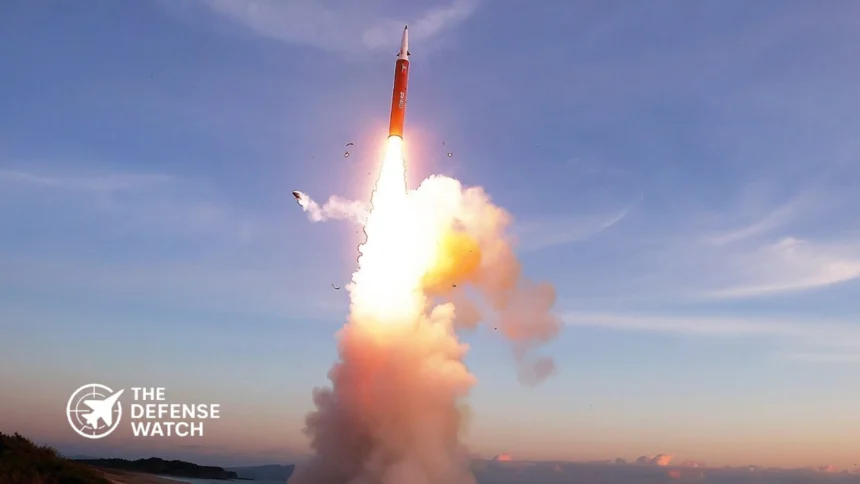
North Korea unidentified projectile October 2026
Photo : North Korea's official Korean Central News Agency
SHARE

North Korea Fires Multiple Ballistic Missiles Toward East Sea

North Korea fired multiple ballistic missiles toward the East Sea on October 12, 2026, according to South Korea’s Joint Chiefs of Staff (JCS), prompting renewed monitoring by regional militaries as Seoul and Pyongyang continue to develop advanced missile capabilities.

Contents
  • North Korea Fires Multiple Ballistic Missiles Toward East Sea
    • South Korea and Japan Track the Launches
    • Launches Follow Competing Missile Tests
    • What the Launches Mean for Regional Missile Defense
    • A Continuing Test of Regional Readiness

The launches originated from the Pyongyang area at about 9:20 a.m. local time, South Korea’s military said. At least one missile traveled more than 900 kilometers, according to the JCS statement reported by Yonhap News Agency.

Japan’s authorities also detected the launches. The Japan Coast Guard reported that the projectiles appeared to have fallen, while Japanese authorities said there was no confirmed indication that they had entered Japanese territory or its exclusive economic zone.

The launch initially drew attention as an unidentified projectile, but subsequent reporting from South Korea identified multiple ballistic missiles. Public information available at the time did not establish the full technical characteristics of every missile involved.

- Advertisement -

South Korea and Japan Track the Launches

South Korea’s military said it had increased surveillance to prepare for possible additional launches and was sharing information with the United States and Japan. The response reflects the importance of coordinated tracking when North Korea launches missiles toward the waters separating the Korean Peninsula and Japan.

Japan’s prime minister issued instructions on October 12 to collect and analyze information, provide timely public updates, protect aircraft and vessels, and maintain readiness for contingencies. The statement confirmed the government’s response but did not provide a complete technical assessment of the missiles.

The available reporting did not establish that the launches caused damage to ships, aircraft or infrastructure. Nor did it indicate that the missiles struck Japanese territory.

Launches Follow Competing Missile Tests

The October 12 launches followed South Korea’s first test launch of a domestically developed hypersonic glide vehicle the previous week, overseen by President Lee Jae Myung. The South Korean test came amid heightened tensions following a landmine explosion near the Demilitarized Zone that injured three South Korean soldiers in September.

South Korea’s military described the North Korean launches as a show of force and a demonstration of missile capabilities. That assessment reflects Seoul’s interpretation of the timing, rather than independently established evidence of Pyongyang’s decision-making.

North Korea’s previous ballistic missile launch occurred on October 3. State media subsequently described that test as involving an intermediate-range strategic missile associated with what it called a hypersonic weapon system. The October 12 launches therefore continued a recent series of tests involving different missile types.

What the Launches Mean for Regional Missile Defense

The launches matter to South Korea, Japan and the United States because tracking ballistic missiles requires rapid detection, trajectory assessment and information sharing across national boundaries.

The reported flight of more than 900 kilometers indicates that at least one missile covered a substantial distance over the region. However, that figure alone does not establish the missile’s maximum range, accuracy, payload or operational effectiveness. Those characteristics cannot be reliably determined from the publicly reported launch data.

- Advertisement -

The report that the missiles appeared to be of different types is also relevant. If confirmed through further technical analysis, differences in flight profiles could affect how regional forces detect, track and assess incoming threats. The available reporting does not provide enough information to determine the specific countermeasures that would be required for each projectile.

The U.S. Indo-Pacific Command said it was aware of the launches and was consulting with allies and partners. It assessed that the event posed no immediate threat to U.S. personnel, territory or allies. That statement addressed the immediate incident and did not amount to a broader assessment of North Korea’s missile capabilities.

North Korea has been subject to United Nations sanctions since 2006 over its nuclear weapons and ballistic missile programs. South Korea’s National Security Office condemned the October 12 launches as violations of UN Security Council resolutions and called for them to stop.

A Continuing Test of Regional Readiness

The latest launches add to a period of heightened military activity on the Korean Peninsula, with both North and South Korea publicly demonstrating missile-related capabilities. South Korea has strengthened surveillance following the launches and is coordinating with Washington and Tokyo.

The available evidence confirms the launches and the reported flight distance of at least one missile. It does not yet establish the full performance characteristics of all the projectiles or whether the tests introduced a new operational capability.

For regional defense planners, the immediate priorities remain accurate missile tracking, timely information sharing and readiness to respond to further launches.


TAGGED:Indo-Pacific SecurityMissile TestsNorth KoreaSouth Korea
Share This Article
Facebook Copy Link Print
ByKaleem Sheikh | Regional Defense Correspondent
Follow:
Kaleem Sheikh is a regional defense correspondent at TheDefenseWatch.com covering defense and security developments across Asia and the Middle East, including military operations, procurement, and regional security issues.

Latest Defense Systems

  • SPY-6 Radar SPY-6 Radar
  • Boeing VC-25B Presidential Aircraft Boeing VC-25B Presidential Aircraft
  • SM-3 Block IB Missile SM-3 Block IB Missile
  • USS Abraham Lincoln Aircraft Carrier USS Abraham Lincoln Aircraft Carrier
  • M142 HIMARS M142 HIMARS
  • Terrex S5 Infantry Vehicle Terrex S5 Infantry Vehicle
  • A-29 Super Tucano Aircraft A-29 Super Tucano Aircraft
  • DSAR 15 Rifle DSAR 15 Rifle
  • ASMP Missile ASMP Missile

Recent Compares

  • Tejas vs Gripen: Key Differences and Capabilities Tejas vs Gripen: Key Differences and Capabilities View Comparison →
  • Tejas vs MiG-21 Bison: How India Replaced Its Iconic Supersonic Fighter Tejas vs MiG-21 Bison: How India Replaced Its Iconic Supersonic Fighter View Comparison →
  • F-35 vs F-16: Stealth, Sensors and Combat Roles F-35 vs F-16: Stealth, Sensors and Combat Roles View Comparison →
  • Tejas Fighter Jet vs F-16 Fighting Falcon: Capability Compared Tejas Fighter Jet vs F-16 Fighting Falcon: Capability Compared View Comparison →
  • Rafale Fighter Jet vs F-16 Fighting Falcon : Which Fighter Has the Edge? Rafale Fighter Jet vs F-16 Fighting Falcon : Which Fighter Has the Edge? View Comparison →
  • Su-57 Fighter Jet vs J-20 Fighter Jet: Stealth and Air Combat Compared Su-57 Fighter Jet vs J-20 Fighter Jet: Stealth and Air Combat Compared View Comparison →
  • Mirage 2000 vs Tejas Mk1A: Legacy Combat Power vs Indigenous Modernization Mirage 2000 vs Tejas Mk1A: Legacy Combat Power vs Indigenous Modernization View Comparison →
  • Rafale Fighter Jet vs F-22 Raptor: Which Air Dominance Fighter Has the Edge? Rafale Fighter Jet vs F-22 Raptor: Which Air Dominance Fighter Has the Edge? View Comparison →
  • Tejas Fighter Jet vs. Rafale Fighter Jet: India’s Indigenous Fighter Meets France’s Proven Multirole Combat Aircraft Tejas Fighter Jet vs. Rafale Fighter Jet: India’s Indigenous Fighter Meets France’s Proven Multirole Combat Aircraft View Comparison →
  • F-22 Raptor vs. F-35 Joint Strike Fighter: Which Fifth Generation Fighter Has the Edge? F-22 Raptor vs. F-35 Joint Strike Fighter: Which Fifth Generation Fighter Has the Edge? View Comparison →

Recent Posts

  • Raytheon Tests Faster Coyote Interceptor With New Rocket Motor
  • Raytheon to Develop Software Upgrades for U.S. Navy Radar Detection
  • Kim Jong Un Opens North Korea Weapons Museum as Pyongyang Claims Missile Test Success
  • Pentagon Certifies Bath Iron Works for Second Arleigh Burke Destroyer
  • North Korea Fires Unidentified Projectile Toward East Coast, Seoul Says

You Might Also Like

U.S. Air Force F-35 stealth fighter undergoing maintenance inside a military hangar during corrosion inspection work.
Alliances & DoctrinesPolicy & Strategy

Taiwan Presses US Arms Sales Case As Trump Weighs Major Weapons Package

September 7, 2026
Tripoli Expeditionary Strike Group
Naval & MaritimeNaval Strategy & Maritime Security

US Navy Tripoli Expeditionary Strike Group Now Operating in 7th Fleet Area

January 15, 2026
China Taiwan conflict planning
Asian Defense & Security

China Shifts Taiwan War Plans After Russia-Ukraine Lessons, US Report Says

December 25, 2025
China J-10CE combat success
Asian Defense & Security

China Confirms First Combat Kill for J-10CE Fighter in 2025 India-Pakistan War

January 15, 2026

Logo

Copyright © 2026 TheDefenseWatch.com

Helpful Links

  • Home
  • About Us
  • Privacy Policy
  • Terms of Use / Disclaimer
  • U.S. Privacy Notice – CCPA Compliance

Defense Systems

  • Defense Systems
  • Comparisons 
  • Manufacturer
  • Tactical Calculators

Popuplar

Which 5 Air Forces Possess the Costliest Fighter Jet Fleets in the World
Evolving Strategic Value: Carrier Strike Groups in the Indo-Pacific’s Future Security Architecture
Autonomous Weapon Systems Spark U.S. Ethics Debate Amid Rapid Military AI Integration

We report on developments involving military forces, governments, defense companies, research organizations, and security institutions around the world. 

Welcome Back!

Sign in to your account

Username or Email Address
Password

Lost your password?