L3Harris Expands Saudi Defense Partnership With Strategic Technology Agreement
RIYADH, Saudi Arabia — L3Harris Technologies has signed a strategic Memorandum of Understanding with the Kingdom of Saudi Arabia to develop advanced defense capabilities, marking a significant expansion of the American defense contractor’s five-decade relationship with the Gulf nation.
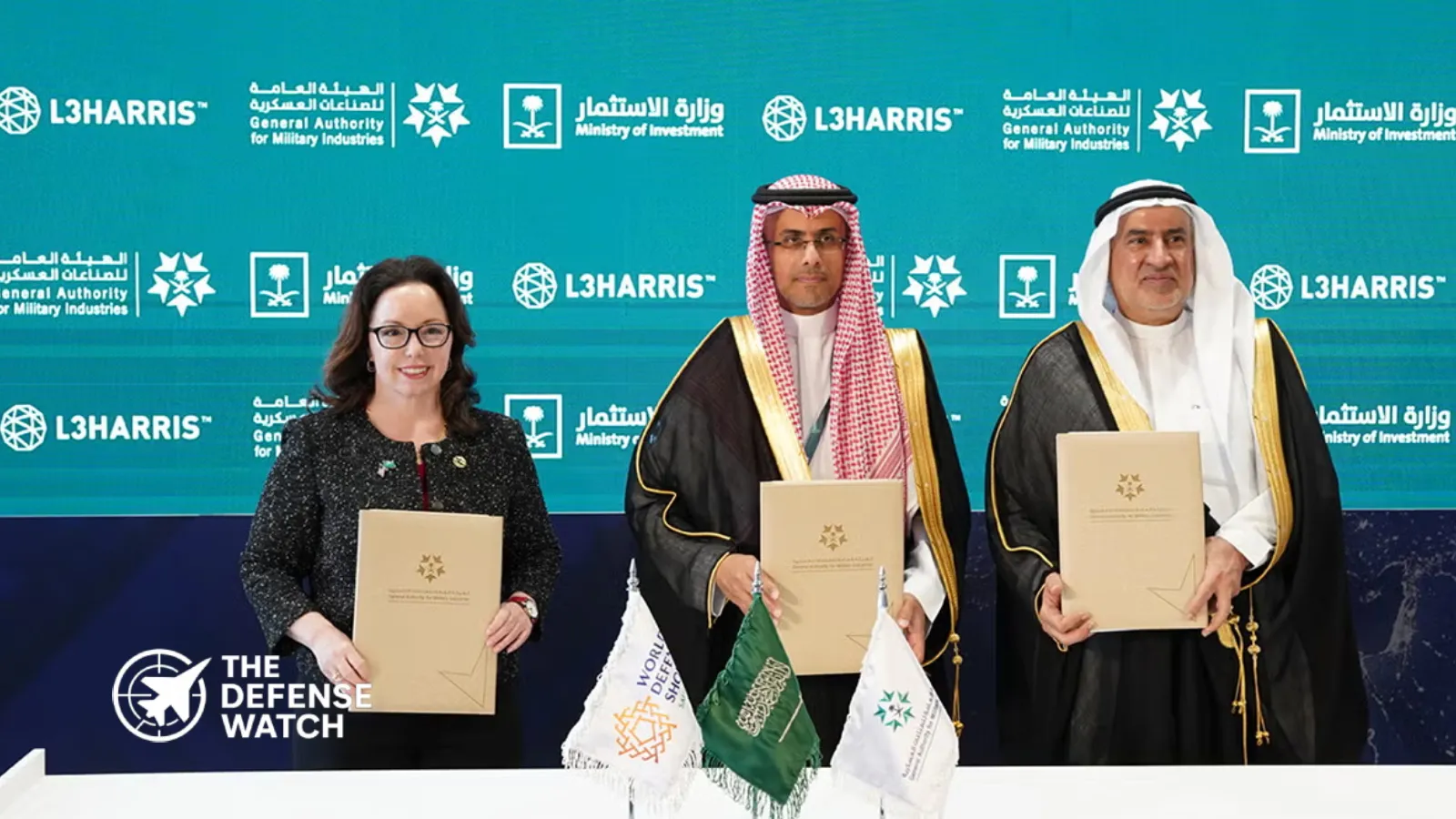
The MOU, signed at the World Defense Show 2026 in Riyadh on February 10, establishes a framework for collaboration between L3Harris and Saudi Arabia’s Ministry of Investment and the General Authority for Military Industries (GAMI) to assess and develop local production capabilities for cutting-edge military technologies.
Jennifer Hanley, Vice President of International at L3Harris, signed the agreement with Saudi government representatives at the biennial defense exhibition, which runs from February 8-12, 2026.
Focus On Artificial Intelligence And Command Systems
The L3Harris Saudi Arabia defense agreement centers on two critical technology areas that align with the Kingdom’s military modernization priorities: artificial intelligence applications for defense and resilient command, control, communications, computers, intelligence, surveillance, and reconnaissance (C4ISR) solutions.
“L3Harris has been a committed partner with the Kingdom of Saudi Arabia for over 50 years, and we pride ourselves on delivering the most advanced capabilities to the country,” Hanley stated in the official announcement. “This MOU is a significant step forward in expanding our commitment to delivering and localizing key capabilities aligned with the Kingdom’s development plans and national security needs.”
The agreement will evaluate the local value chain for these advanced defense technologies, identifying opportunities to establish indigenous production capabilities within Saudi Arabia. This approach directly supports the Kingdom’s Vision 2030 objective to localize more than 50 percent of military equipment spending by 2030.
Building On Established Joint Venture Success
The new MOU builds upon the foundation established by the SAMI L3Harris joint venture, which was signed in 2019 at the Paris Air Show and became fully operational in February 2021. The joint venture represents the first fully operational U.S.-Saudi defense partnership of its kind in the Kingdom.
Through SAMI L3Harris, the partners have already established a production line for software-defined radios within Saudi Arabia. This facility has delivered several thousand tactical radios to the Saudi Ministry of Defense, providing resilient communications for Saudi military forces.
The joint venture is owned 51 percent by Saudi Arabian Military Industries (SAMI), a wholly-owned subsidiary of the Public Investment Fund, and 49 percent by L3Harris Technologies. SAMI L3Harris has focused on localizing advanced communication systems, sensor systems, and integrated mission systems for land, air, and maritime domains.
Technology Transfer And Local Capability Development
The strategic focus on AI military applications Saudi Arabia and C4ISR systems Middle East represents an evolution in the partnership’s scope. Artificial intelligence applications in defense include autonomous systems, predictive maintenance, intelligence analysis, and decision-support tools that enhance operational effectiveness.
C4ISR systems integrate multiple defense technologies into cohesive networks that enable commanders to gather intelligence, communicate securely, and coordinate military operations across multiple domains. L3Harris specializes in resilient C4ISR solutions designed to operate in contested electromagnetic environments where adversaries attempt to jam or intercept communications.
The assessment of local value chains indicates that the partnership will examine existing Saudi industrial capabilities, identify gaps, and determine which technologies can be manufactured or integrated locally. This methodology aligns with GAMI’s mandate to develop domestic defense manufacturing capacity while maintaining access to world-class military technology.
Broader Saudi Defense Modernization Context
The L3Harris agreement comes as Saudi Arabia accelerates its defense industry transformation. The World Defense Show 2026, where the MOU was signed, attracted 925 exhibitors from 80 countries and approximately 130,000 visitors across an 800,000 square meter venue.
The Kingdom has signed multiple defense cooperation agreements during the exhibition, reflecting its systematic approach to building a comprehensive domestic defense industrial base. Saudi Defense Minister Prince Khalid bin Salman inaugurated the show and oversaw the signing of various defense partnerships throughout the event.
Previous SAMI L3Harris initiatives demonstrate the partnership’s operational effectiveness. In April 2025, the joint venture signed an agreement with Zamil Shipyards to develop autonomous maritime capabilities, including unmanned surface vessels designed and manufactured within the Kingdom. These collaborative programs combine L3Harris technology with Saudi manufacturing and engineering expertise.
Strategic Implications For U.S.-Saudi Defense Relations
The expanded L3Harris-Saudi partnership reflects sustained U.S.-Saudi defense cooperation despite evolving geopolitical dynamics in the Middle East. American defense contractors maintain substantial presence in Saudi Arabia, providing advanced military systems, training, and sustainment support.
L3Harris operates across multiple defense domains including space, air, land, sea, and cyber. The company’s portfolio includes tactical radios, electronic warfare systems, intelligence and reconnaissance platforms, missile defense technologies, and space systems. The emphasis on AI and C4ISR positions the partnership at the forefront of defense technology trends.
The MOU structure allows both parties to assess technical feasibility, economic viability, and security requirements before committing to specific programs. This deliberate approach reduces risk and ensures that localized production meets both Saudi operational needs and L3Harris quality standards.
Next Steps And Implementation Timeline
While the MOU establishes the framework for collaboration, specific programs and timelines will be developed through the assessment process outlined in the agreement. The evaluation of local value chains will determine which capabilities can be efficiently produced within Saudi Arabia and which elements require continued international supply chain integration.
L3Harris and GAMI will jointly identify opportunities for technology transfer, workforce development, and research and development activities. The partnership may include establishment of new manufacturing facilities, expansion of existing SAMI L3Harris operations, or integration with other Saudi defense industry entities.
The Kingdom’s commitment to defense localization, backed by substantial financial resources through the Public Investment Fund, provides a foundation for sustained partnership growth. Saudi Arabia’s defense budget and strategic location in the Middle East make it a priority market for international defense contractors.
Industry Analysis
Defense industry analysts note that L3Harris’ systematic approach to the Saudi market—establishing joint ventures, demonstrating operational success, and gradually expanding scope—represents a model for sustainable international defense partnerships. Unlike simple arms sales, the technology localization strategy builds long-term relationships and creates mutual dependencies that strengthen bilateral defense ties.
The focus on AI and C4ISR reflects global defense trends toward networked, information-centric warfare. Saudi Arabia’s investments in these areas position the Kingdom to operate alongside Western military forces in coalition operations while developing indigenous capabilities for regional security challenges.
The agreement’s timing, announced at the World Defense Show 2026, maximizes visibility and demonstrates both parties’ commitment to the partnership. The exhibition provides a platform for showcasing existing SAMI L3Harris achievements while signaling future collaboration areas to other potential partners and competitors.
Conclusion
The L3Harris Technologies MOU with Saudi Arabia represents a strategic deepening of defense cooperation focused on emerging military technologies. By combining American innovation in artificial intelligence and command systems with Saudi industrial capacity and market access, the partnership aims to create sustainable defense capabilities aligned with the Kingdom’s Vision 2030 objectives.
As regional security challenges evolve and military technology advances, partnerships that emphasize technology transfer and local capability development will likely become increasingly important for both defense contractors and host nations. The L3Harris-Saudi model offers insights into how such relationships can be structured for mutual benefit while addressing national security and economic development priorities.