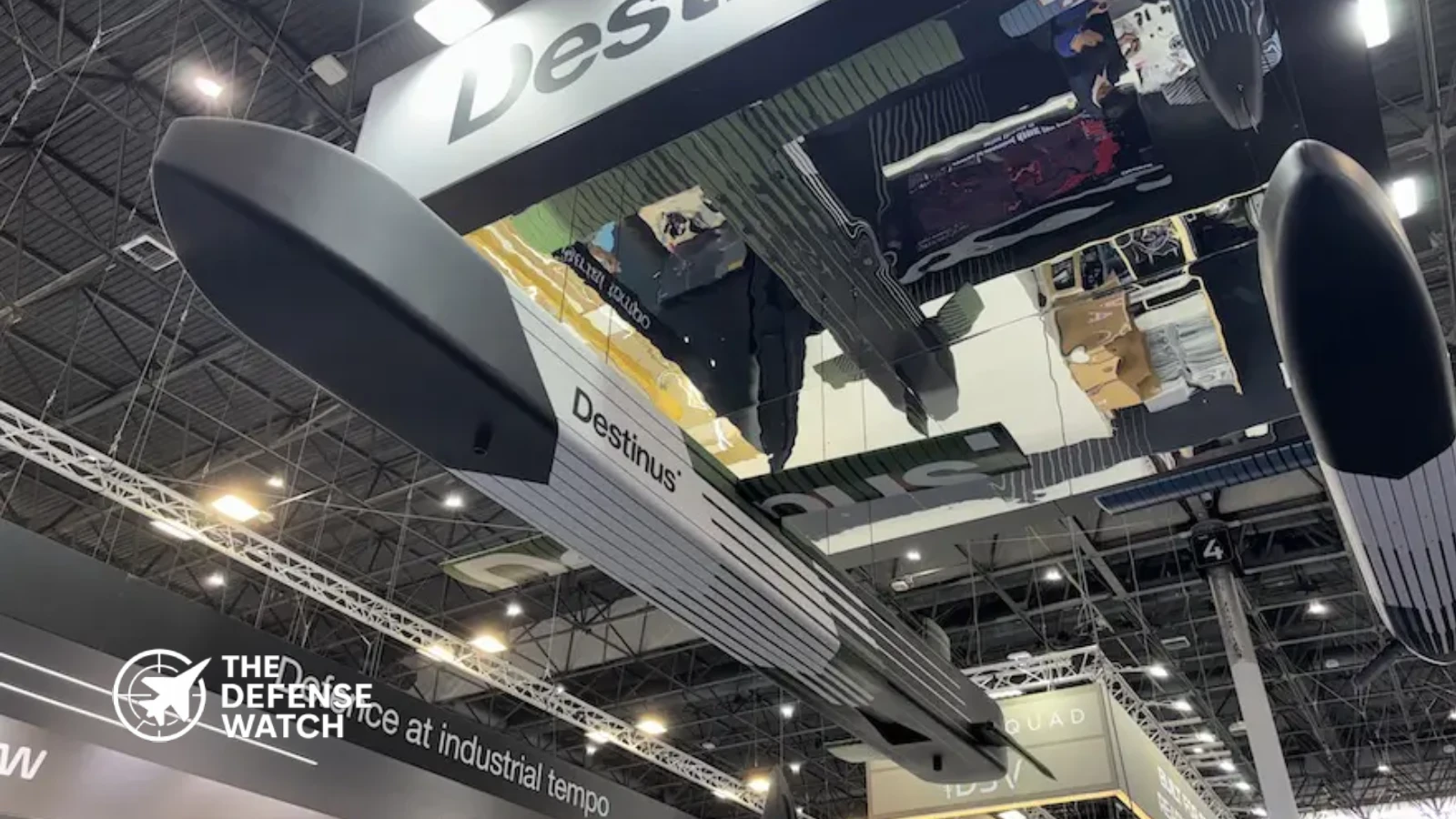
Executive Summary: Rheinmetall is moving to accelerate production of Destinus cruise missiles through the Rheinmetall Destinus Strike Systems joint venture, with the companies targeting initial German production in 2026. The effort reflects growing European demand for long range precision strike weapons and the production pressures demonstrated by the war in Ukraine.
Rheinmetall Destinus Cruise Missile Production Moves Toward 2026
Rheinmetall Destinus cruise missile production is advancing as the German defense company and Dutch defense technology firm Destinus prepare to establish serial manufacturing capacity in Germany. Rheinmetall has said the joint venture expects initial delivery readiness in 2026, while broader production is planned around the Ruta and Kryla missile families.
The development is significant because Rheinmetall has traditionally been strongest in armored vehicles, artillery, ammunition and air defense rather than long range cruise missiles. Its partnership with Destinus therefore represents an expansion into a strike weapons market where European production capacity has become a major strategic issue.
The companies announced the Rheinmetall Destinus Strike Systems venture in April. Rheinmetall is planned to hold a 51 percent stake and Destinus 49 percent, subject to regulatory approvals. The venture is intended to manufacture, assemble, test and market advanced cruise missiles and ballistic rocket artillery for European and selected NATO customers.
Ukraine Has Become an Important Driver of Missile Demand
The Ukraine war has demonstrated the importance of having sufficient stocks of precision weapons and the industrial capacity to replace them during sustained combat.
For European militaries, the issue is not simply whether a missile can achieve a specified range or payload. A credible long range strike capability also requires a production system capable of delivering weapons in meaningful quantities, maintaining supply chains and replacing expended stocks.
That production challenge has become more visible as European governments increase defense spending and seek greater control over critical weapons production.
Destinus has already developed the Ruta family with a focus on scalable production. The company says its Ruta Block 2 has a range of more than 700 kilometers and a 250-kilogram payload. It is designed for low altitude flight and terminal guidance using an electro-optical/infrared seeker with AI-assisted target recognition.
Destinus has also worked with Ukrainian defense organizations during development of the Ruta family, giving the company experience with requirements associated with an active conflict environment.
Ruta Block 2 Forms the Near-Term Production Focus
The Ruta Block 2 is particularly important to the Rheinmetall partnership because it sits between shorter range tactical strike weapons and much longer range strategic systems.
| System | Publicly stated capability |
|---|---|
| Ruta Block 2 | 700+ km range |
| Ruta Block 2 payload | 250 kg |
| Guidance | EO/IR terminal guidance |
| Target recognition | AI-assisted |
| Launch concept | Containerized, booster-assisted |
| Production | Netherlands and planned German capacity |
| Ruta Block 3 | More than 2,000 km stated range |
| Ruta Block 3 payload | Up to 250 kg |
Rheinmetall said in June that production would begin with the Kryla and Ruta Block 2 systems, while the companies are accelerating development of the longer range Ruta Block 3.
The Block 2 is designed to launch from a 40-foot container, according to Destinus. That approach can reduce dependence on specialized launch vehicles and allows the weapon system to be integrated with existing transport and deployment infrastructure.
Ruta Block 3 Expands the Strategic Ambition
The longer term objective is the Ruta Block 3, which Rheinmetall describes as a deep strike cruise missile with a range exceeding 2,000 kilometers and a warhead of up to 250 kilograms.
Rheinmetall says the Block 3 will be launched exclusively from standard containers and could be carried on vehicle platforms, including Rheinmetall HX trucks, as well as maritime platforms. The company has stated that the system could reach firing readiness in approximately two minutes.
Flight testing of the Block 3 is expected to follow the development and production work already underway on the earlier Ruta variants. Independent reporting from Eurosatory 2026 indicated that flight testing for the Block 3 is planned for 2027.
This creates a two-stage industrial strategy. The earlier Ruta systems can provide a near term production base while the more ambitious Block 3 develops toward qualification and operational introduction.
Why German Production Matters
The German production element is more important than simply adding another factory.
Rheinmetall plans to provide industrial capacity, manufacturing infrastructure and experience in large scale defense production, while Destinus contributes the missile architecture and technology. Rheinmetall has said Destinus will supply technological core components while Rheinmetall provides energetic components such as warheads and booster rocket motors.
That division of responsibility addresses one of the central problems facing European missile production: expanding output requires more than assembling complete weapons.
Propulsion, energetics, guidance systems, electronics, airframe structures and final integration all have to scale together. A bottleneck in any one of these areas can limit overall production regardless of demand.
Rheinmetall’s established industrial base gives the venture access to manufacturing infrastructure that a smaller defense technology company would have difficulty building alone.
European Long Range Strike Is Becoming an Industrial Priority
The partnership also fits into a wider European effort to strengthen sovereign long range strike capabilities.
Rheinmetall has described the venture as part of an effort to create a fully European value chain for advanced strike weapons. The company says final assembly, integration and testing capacity will be established in Germany.
For NATO countries, domestic production can reduce dependence on a limited number of external suppliers. It can also give governments greater control over replenishment schedules, industrial mobilization and future upgrades.
The issue has gained additional attention following changes to planned U.S. missile deployments in Europe and wider debates about how much long range strike capability European NATO members should generate themselves. Financial Times reporting has noted that European governments are seeking alternatives as they address gaps in deep precision strike.
This does not mean European systems will replace U.S. weapons. Instead, the trend points toward a broader NATO strike inventory in which European-developed systems complement U.S. capabilities.
Production Scale Will Be the Key Test
The most important measure of the Rheinmetall Destinus partnership will ultimately be production rather than the announcement of another missile design.
Rheinmetall and Destinus are attempting to move from a relatively young missile architecture toward a larger industrial program. That transition requires qualification, reliable suppliers, production tooling, trained personnel and sustained government procurement.
Rheinmetall’s own statements show that the timetable extends beyond simply producing an initial missile. The company has discussed production beginning around the end of 2026 or early 2027, with qualification and subsequent full scale production following.
That distinction matters. Initial production can demonstrate that a system can be manufactured. Sustained high rate production demonstrates that the industrial architecture can support military stockpiles over many years.
For Europe, that second objective is arguably the more consequential one.
Implications for U.S. and NATO Defense Planning
The Rheinmetall Destinus effort also has implications for the United States and the wider NATO alliance.
A larger European inventory of domestically produced long range weapons could give NATO additional options for distributed strike planning. It could also reduce pressure on U.S. inventories when European forces require replenishment during prolonged operations.
The same industrial lesson applies to the United States. Recent reporting on U.S. missile inventories and efforts to expand production has highlighted how quickly precision weapon stocks can become a strategic constraint during sustained operations. Rheinmetall has separately been working with Lockheed Martin on plans to produce ATACMS in Germany, illustrating the broader movement toward distributed missile manufacturing.
The European and American approaches are different, but the underlying requirement is similar: modern militaries need both sophisticated weapons and sufficient manufacturing capacity to sustain them.
What Comes Next
The immediate milestones for Rheinmetall Destinus Strike Systems are establishment of the joint venture, completion of German production infrastructure and initial production of the Ruta and Kryla families.
The companies have also identified NATO qualification as an objective for Ruta Block 3. If achieved, that would expand the potential customer base across European and allied militaries.
The strategic question will be whether Rheinmetall and Destinus can convert their existing technology and production plans into a dependable, high volume European strike weapons supply chain.
For NATO, that could become as important as the missile’s advertised range. The war in Ukraine has reinforced that precision strike capability depends not only on technology, but also on the ability to manufacture, replenish and sustain weapons throughout a prolonged conflict.