Russia Upgrades Geran-4 With Bridge-Cutting Warhead
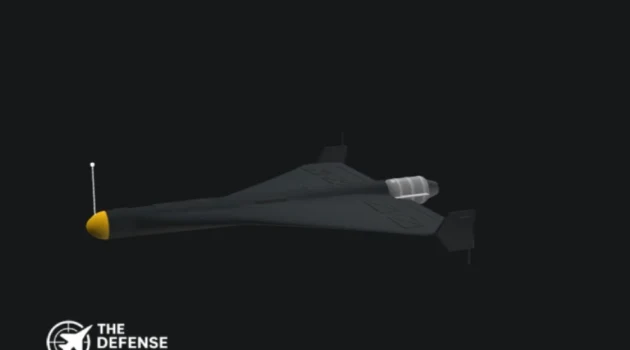
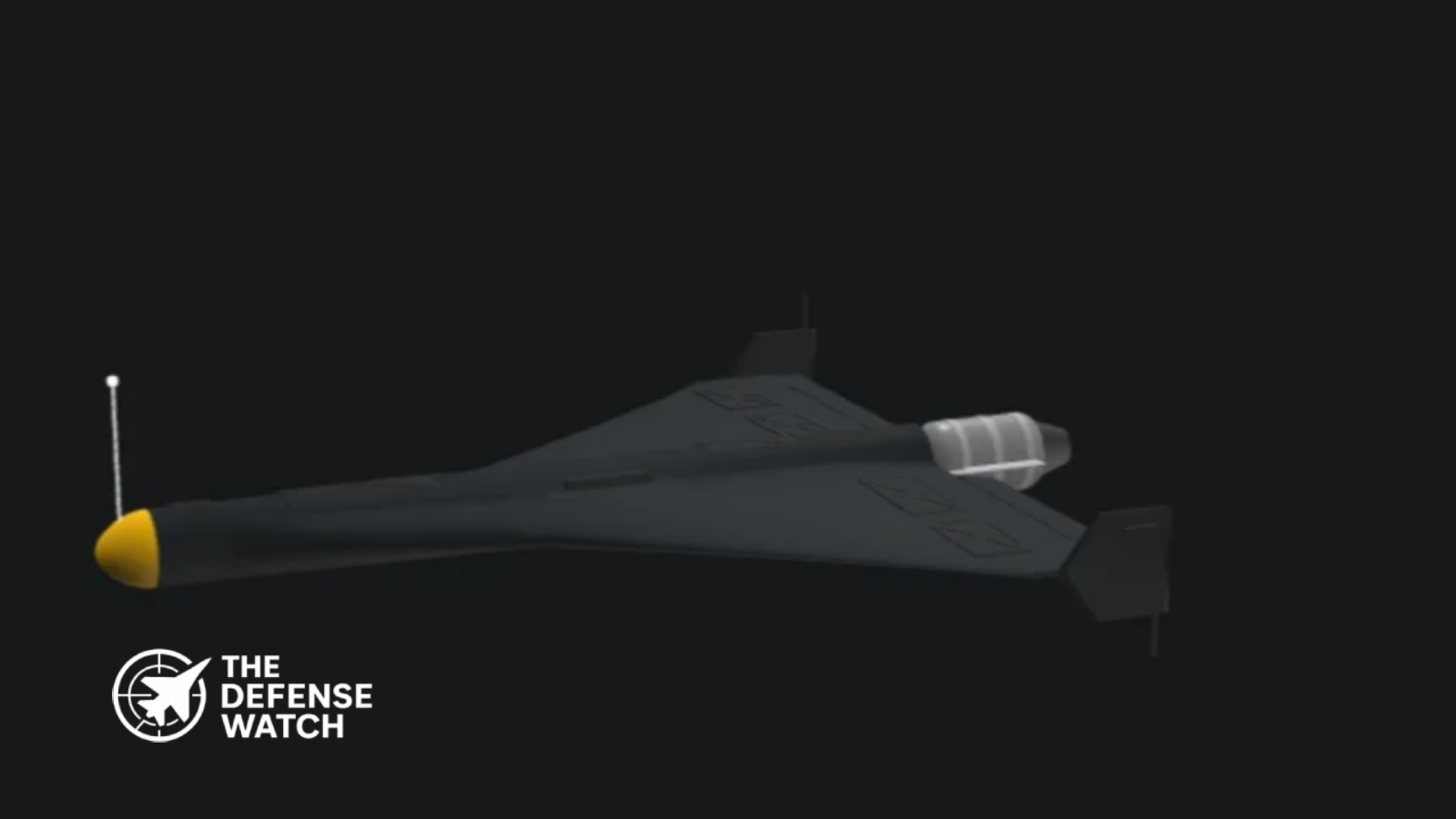
Russia has begun deploying an upgraded version of its Geran-4 jet-powered attack drone with a specialized KRSN payload designed to damage bridge structures and power transmission supports, according to Ukraine’s Defense Intelligence Directorate.
The Ukrainian intelligence agency, known as HUR, disclosed details of the modified Geran-4 on October 5 through its War & Sanctions database. The updated aircraft also incorporates additional navigation equipment and a Russian-produced engine, indicating that the Geran-4 is being refined beyond its earlier configuration.
HUR says the upgraded drones began appearing in Russian attacks during the fall of 2026.
A new payload for structural targets
The most notable change is the introduction of the KRSN, described by HUR as a cumulative-cutting special payload.
Unlike a conventional high-explosive warhead that distributes its blast and fragmentation over a wider area, a cumulative cutting charge is intended to concentrate explosive energy into a directional effect. HUR says the Geran-4 version is configured to use the payload against bridge structures and supports for overhead power transmission lines.
Ukraine-based reporting had already described the KRSN payload on September 30. Ukrainian radio technology specialist Serhii Beskrestnov said the weapon had been used on a jet-powered strike UAV and was intended for high-voltage pylons and steel bridge structures. He described the configuration as containing a main charge and additional destructive modules. Those details remain attributed to the Ukrainian source rather than independently verified battlefield data.
HUR’s own component database separately identifies the KRSN as part of the October 2026 Geran-4 configuration.
The available evidence does not establish the payload’s actual effectiveness against a particular bridge or transmission pylon. The significance of the modification is therefore its apparent specialization for infrastructure targets, rather than any unverified claim about its destructive performance.
Geran-4 gains additional autonomous navigation
The new payload is not the only reported modification.
HUR says the updated Geran-4 incorporates a magnetic compass module based on the PNI5GA magneto-inductive sensor. The module operates alongside the drone’s SADRA inertial navigation system and is intended to reduce gyroscope drift and improve autonomous navigation.

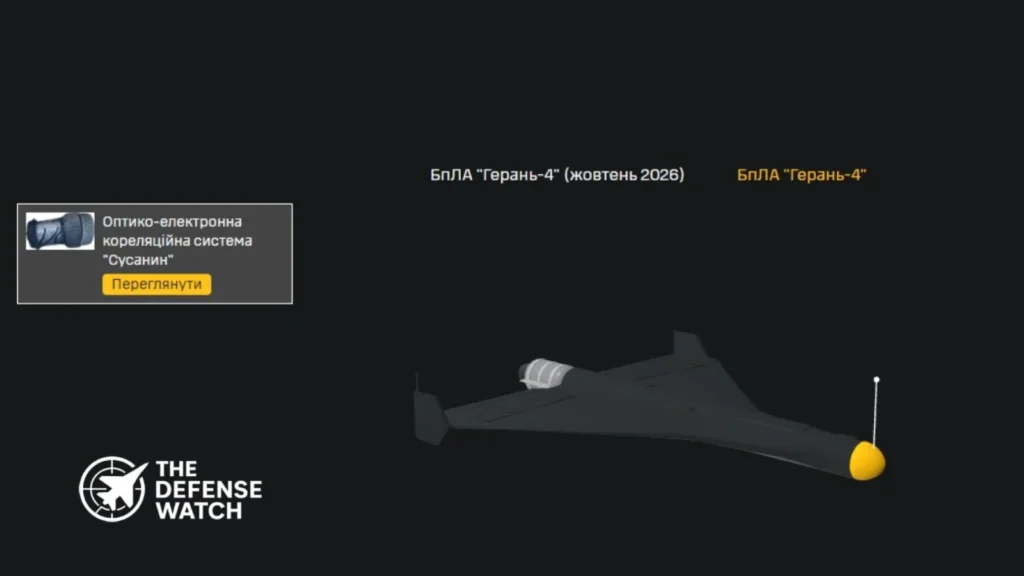
Photo: Screenshot / War&Sanctions The drone also reportedly receives an optical-electronic correlation system called Susanin.
According to HUR, Susanin compares imagery collected by an onboard optical sensor with reference images stored in the aircraft’s computer. The system is intended to help the drone follow its route from launch point to target while complementing satellite and inertial navigation.
This matters in an environment where electronic warfare can interfere with satellite navigation. Adding multiple navigation inputs does not make the aircraft immune to jamming or other countermeasures, but it can give the guidance system additional information when satellite navigation is degraded.
HUR has separately documented Susanin as a component of the October 2026 Geran-4 configuration.
Russian engine replaces earlier Chinese propulsion
HUR also reports a change in propulsion.
The Ukrainian agency says the Chinese Telefly turbojet engine previously associated with the Geran-4 has been replaced by a Russian-produced equivalent manufactured at Alabuga.
The change is relevant to Russia’s effort to expand domestic production of the Geran family. Earlier reporting had identified Chinese Telefly engines in Russian Geran-4 and Geran-5 aircraft, including engines assembled at the Alabuga production site.
The reported Russian-produced replacement should not, however, be interpreted as evidence that the entire Geran-4 supply chain is domestically sourced. HUR’s component records show that foreign-made electronics remain present in the aircraft.
One example is the PNI5GA magnetometer, which HUR identifies as manufactured by PNI Sensor, a U.S.-based company.
The Geran-4 is becoming a more specialized weapon
The reported changes point to a broader evolution in Russia’s one-way attack drone fleet.
The Geran-4 is a larger, jet-powered member of the Geran family. HUR’s October 2026 database lists the aircraft at 3.6 meters in length with a 3.05-meter wingspan and a maximum takeoff weight of up to 450 kilograms. The same database lists a 50-kilogram warhead and a maximum speed of 350 km/h, although these figures represent Ukrainian intelligence data rather than specifications published by Russia.
The newer configuration appears to combine three changes that address different operational requirements.
First, the KRSN payload is intended for specific structural targets.
Second, the Susanin optical navigation system and magnetic sensing provide additional navigation inputs.
Third, the reported Russian-produced engine could reduce dependence on the previously identified Chinese turbojet supply.
Taken together, those modifications suggest an effort to make the Geran-4 more adaptable to specific missions rather than relying on a standardized airframe and warhead combination.
Bridge attacks provide important context, but not attribution
The new Geran-4 configuration comes as Russian attacks have increasingly affected major infrastructure in Kyiv.
Reuters reported on October 2 that Russian attacks had targeted bridges across the Dnipro River, including the Southern Bridge, causing major transportation disruptions and closures.
Those attacks provide relevant operational context for the reported KRSN development, but the available evidence does not establish that a KRSN-equipped Geran-4 was responsible for a particular bridge strike.
That distinction is important. The existence of a specialized bridge-targeting payload and the occurrence of attacks against bridges are separate facts unless recovered wreckage or official forensic analysis links the two.
The same caution applies to power infrastructure. A specialized payload could potentially increase the effectiveness of a strike against a narrow structural target, but publicly available information does not yet establish its battlefield success rate or the number of targets damaged with the system.
What the modification means for Ukraine’s air defenses
The updated Geran-4 creates a more complicated counter-UAS problem because its threat is not limited to the explosive payload.
A drone equipped with inertial, magnetic and optical navigation can potentially retain useful navigation information even when satellite signals are disrupted. That makes electronic warfare only one part of the defensive response.
Ukraine would still have to detect and track the aircraft, determine its likely target, and engage it with an appropriate interceptor before it reaches critical infrastructure.
The specialized payload also increases the importance of target protection. Bridges, transmission pylons and other fixed infrastructure cannot simply maneuver away from an approaching UAV. Defensive measures therefore have to focus on detection, interception, redundancy and rapid repair as well as electronic countermeasures.
The available evidence does not show that the upgraded Geran-4 represents a fundamental change in the balance between Russian strike drones and Ukrainian air defenses. It does show that Russia continues to modify the Geran family around specific operational problems.
For now, the clearest finding is that the October 2026 Geran-4 configuration combines a specialized KRSN structural-cutting payload with additional autonomous navigation equipment and a reported Russian-produced engine. The effectiveness and scale of deployment of these modifications remain less certain.
Further recovered wreckage and independent forensic analysis will be important in determining how widely the configuration is being fielded and how effective it is against the infrastructure targets for which it was designed.