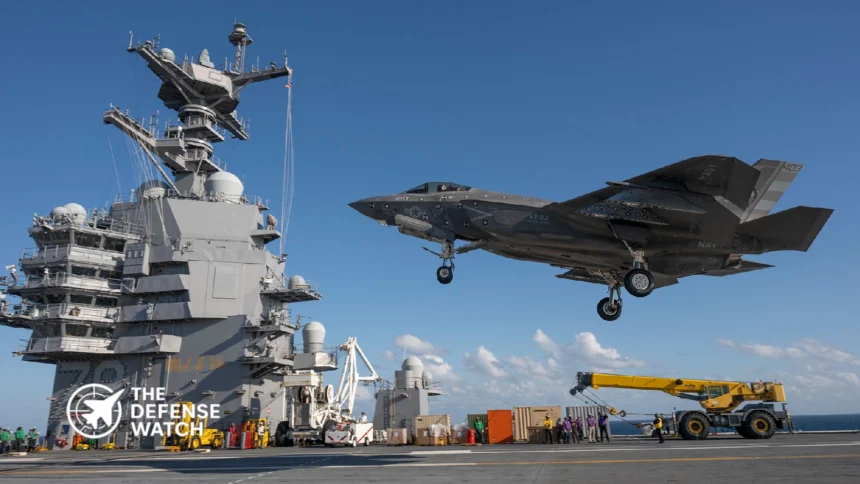
The U.S. Navy’s F-35C Lightning II has completed its first shipboard launch and recovery trials aboard a Gerald R. Ford-class aircraft carrier, opening the way for the fifth-generation fighter to operate from the service’s newest carrier design.
Two F-35C aircraft conducted the testing aboard the future USS John F. Kennedy (CVN 79), completing 34 flights, 122 electromagnetic catapult launches and 122 arrested landings over an 11-day period.
Lockheed Martin announced the achievement on November 19, 2026. The testing itself began on October 13, coinciding with the U.S. Navy’s 251st birthday.
The campaign was the first shipboard compatibility evaluation of the F-35C aboard a Ford-class carrier. It examined how the aircraft interacts with the ship’s launch and recovery equipment, flight deck configuration and operating environment.
Testing the F-35C with EMALS and Advanced Arresting Gear
The Ford-class carrier introduces a different launch and recovery architecture from the Navy’s older Nimitz-class vessels.
Instead of conventional steam catapults and hydraulic arresting equipment, the new carriers use two major systems:
- Electromagnetic Aircraft Launch System (EMALS): Uses electromagnetic technology to accelerate aircraft along the flight deck for takeoff.
- Advanced Arresting Gear (AAG): Uses an advanced recovery system to decelerate aircraft during arrested landings.
Both systems require aircraft-specific compatibility assessments to establish safe operating conditions.
During the Kennedy trials, the test team evaluated the F-35C’s interaction with these systems, including the software and shipboard installations supporting catapult launches and arrested recoveries.
The redesigned flight deck and island structure also create a different environment for carrier aviation. Changes in airflow, aircraft exhaust patterns and deck operations require additional evaluation before aircraft can routinely operate from the new carrier design.
The testing therefore went beyond demonstrating that the F-35C could take off and land. Engineers also needed data to establish the aircraft’s operating limits and support procedures for future carrier operations.
What the 11-Day Test Campaign Established
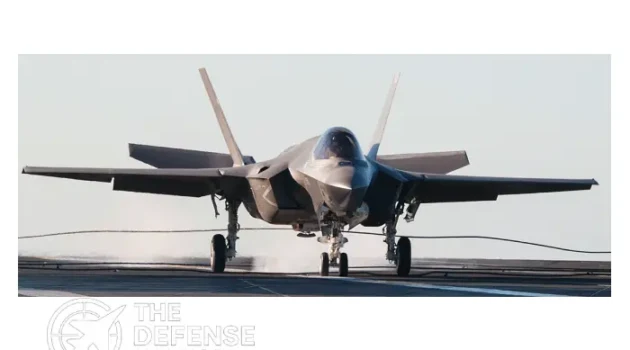
According to Lockheed Martin, two F-35Cs from Naval Air Station Patuxent River, Maryland, completed 34 flights during the campaign.
The 122 catapult launches and 122 arrested landings provided an extensive series of test events for evaluating the aircraft and carrier systems together.
The collected data will support several technical and operational requirements:
Launch and recovery system verification: Testing examined the software and shipboard installations associated with EMALS and AAG.
Aircraft structural validation: Engineers collected information to validate the F-35C’s structural models and assess loads imposed during launches and arrested landings.
Carrier operating procedures: Results will support the development of Aircraft Launch Bulletins and Aircraft Recovery Bulletins for Ford-class carriers. These documents establish the relevant operating conditions and procedures for aircraft operations.
Mission-system software assessment: The campaign included the initial use of F-35 Block 4 software in a carrier environment, allowing the team to assess mission-system software stability during shipboard operations.
Aircraft supportability: Testing also examined how the aircraft and its support requirements perform in the Ford-class carrier environment.
The at-sea campaign followed shore-based trials conducted between January 2024 and May 2025.
Together, the two testing phases provided the technical foundation for integrating the F-35C with the Navy’s newest carrier class.
Why the Ford-Class Integration Matters
The F-35C is the carrier-based variant of the F-35 Lightning II family, developed specifically for U.S. Navy carrier operations.
Its design incorporates features intended for catapult launches and arrested recoveries, alongside stealth characteristics, advanced sensors and integrated mission systems.
The aircraft already operates from modified Nimitz-class carriers. Its first carrier landing took place aboard USS Nimitz in November 2014.
However, compatibility with the Nimitz class did not automatically establish compatibility with the Ford class.
The newer carriers use different launch and recovery equipment and have a redesigned flight deck. Those differences require dedicated testing, aircraft-specific operating guidance and supporting shipboard equipment.
The successful Kennedy campaign addresses an important part of that integration requirement.
It also gives the Navy a path toward introducing F-35C operations aboard a second carrier class without relying exclusively on modifications and procedures developed for older ships.
For carrier air wings, the integration is relevant to future force planning. The F-35C combines a stealth-oriented aircraft design with sensor and information-sharing capabilities, allowing it to contribute to reconnaissance, strike and other naval aviation missions.
Its operational value will nevertheless depend on the wider carrier air wing, weapons availability, maintenance support, trained personnel and integration with other aircraft and naval systems.
USS John F. Kennedy Is Still Preparing for Delivery
The aircraft testing took place aboard the future USS John F. Kennedy, the second ship in the Gerald R. Ford class.
The carrier is being constructed by Huntington Ingalls Industries‘ Newport News Shipbuilding division in Virginia.
The U.S. Navy announced on September 29, 2026, that it had taken preliminary acceptance of CVN 79 following successful acceptance trials in August.
At that point, the ship was approximately 99 percent complete, with major systems installed. However, the shipbuilder still had work to finish, including testing of the remaining Advanced Weapons Elevators.
Preliminary acceptance allows the Navy and ship’s crew to conduct additional at-sea testing and training while construction work continues.
The Navy’s announced schedule places formal delivery in spring 2027.
This distinction is important. Completing F-35C compatibility testing does not mean the carrier has completed its entire construction and operational certification process.
The ship must still complete the remaining work required for delivery and subsequent preparation for fleet service.
Does This Clear the F-35C for Every U.S. Navy Carrier?
Lockheed Martin’s announcement included a statement from Sean Jackson, vice president of the company’s F-35 Development Program, saying that completion of the testing had cleared the F-35C for operations across the Navy’s entire aircraft carrier fleet.
However, the precise meaning of that clearance requires some qualification.
Defense News reported that it had requested further details from Lockheed Martin. A company official explained that ships would be cleared to launch and recover F-35 aircraft once the relevant launch and recovery bulletins were published.
The official also said that carriers would not be ready to deploy with the aircraft until they were fully equipped with the necessary supporting equipment. The U.S. Navy retains final clearance authority.
Consequently, successful compatibility testing should not be confused with immediate operational availability aboard every carrier.
The distinction matters particularly for the lead Ford-class ship, USS Gerald R. Ford (CVN 78). Integration of the F-35C requires the appropriate shipboard equipment, operating procedures and Navy authorization.
Kennedy’s successful testing provides evidence that the aircraft can operate from the Ford-class flight deck. Fleet-wide deployment readiness remains dependent on the completion of the necessary integration steps.
A Step Toward Expanding Fifth-Generation Naval Aviation
The F-35C’s first Ford-class launch and recovery campaign resolves an important aircraft compatibility milestone for the U.S. Navy’s next-generation carriers.
The results provide engineering and operational data for establishing aircraft-specific launch and recovery procedures, while the use of initial Block 4 software adds another element to the integration effort.
The next challenge is translating the test results into approved operating procedures and ensuring that individual carriers have the equipment and authorization required to support the aircraft.
For the Navy, the objective is not simply to demonstrate that the F-35C can operate from a new flight deck. It is to establish the technical and logistical conditions needed to sustain fifth-generation fighter operations across its expanding carrier fleet.

Enjoying our coverage?
Make The Defense Watch a preferred source on Google to see more of our geopolitical and defense insights when relevant to you.