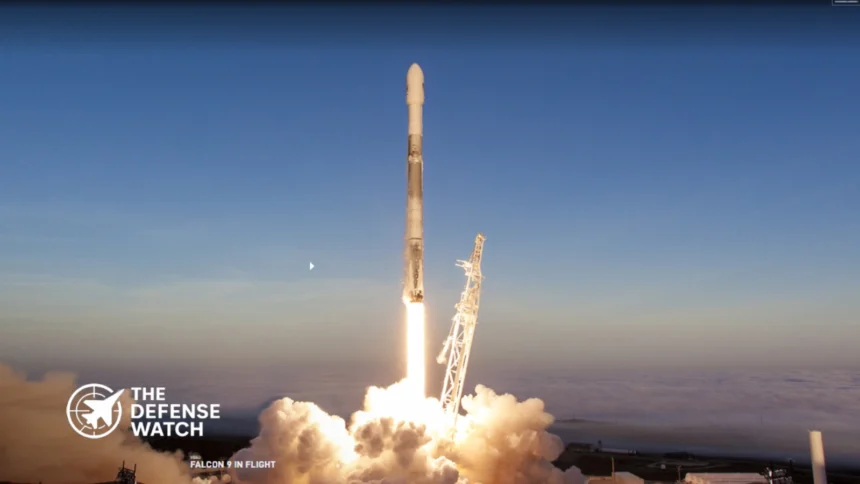
The U.S. Space Force has awarded contract modifications worth a combined maximum of $985 million to SpaceX, United Launch Services and Blue Origin for National Security Space Launch (NSSL) Phase Three, Lane Two services.
The modifications cover launch services under three existing contracts and extend their performance period through April 2033. The Department of War announcement, published November 16, 2026, states that no additional funds are being obligated at the time of the awards.
The contracting activity is Space Systems Command’s Space Access organization at Los Angeles Air Force Base, California.
The $985 million figure is a combined maximum contract ceiling increase, not an immediate payment to the three companies. Actual spending will depend on subsequent funding and orders under the contracts.
Three launch providers share the expanded contract ceiling
The modifications apply to the following existing contract awards:
| Contractor | Original contract number | Modification |
|---|---|---|
| Space Exploration Technologies Corp. (SpaceX) | FA8811-25-D-B002 | P00006 |
| United Launch Services LLC | FA8811-25-D-B003 | P00004 |
| Blue Origin LLC | FA8811-25-D-B005 | P00006 |
The government announcement does not provide an individual dollar allocation for each contractor. It also does not identify new launch missions, satellite payloads or a revised mission distribution associated with the modifications.
Work will be performed at the companies’ respective facilities and at three major U.S. launch locations:
- Cape Canaveral Space Force Station, Florida
- Kennedy Space Center, Florida
- Vandenberg Space Force Base, California
These locations support launches to different orbital inclinations and mission profiles, giving the national security launch program access to infrastructure on both the U.S. East and West Coasts.
Why the Lane Two procurement structure matters
NSSL Phase Three uses two procurement lanes to balance competition, launch capacity and the reliability requirements of national security missions.
Lane One is designed for more risk-tolerant spacecraft and commercially addressable orbital missions. It allows a wider group of launch companies to compete for task orders, with opportunities for additional providers to join as their launch systems mature.
Lane Two serves more demanding national security missions. These launches require fully certified launch systems, more extensive mission assurance and the ability to support complex payload integration and security requirements.
According to Space Systems Command’s original procurement framework, Lane Two uses firm-fixed-price, indefinite-delivery requirements contracts. This structure establishes contractual terms and a framework for ordering launch services without requiring the government to purchase every potential service at the time of the initial award.
That distinction is important when interpreting the latest $985 million modification. The increased ceiling provides additional contractual capacity, but it does not establish that the full amount has been committed or that an equivalent number of launches has been ordered.
Original awards established a 54-mission launch framework
The three companies received their initial NSSL Phase Three Lane Two contracts on April 4, 2025.
According to the original Space Systems Command award announcement, the anticipated contract values were:
| Provider | Original anticipated contract value | Planned missions |
|---|---|---|
| SpaceX | $5.92 billion | 28 |
| United Launch Services (ULA) | $5.37 billion | 19 |
| Blue Origin | $2.39 billion | 7 |
| Combined | $13.68 billion | 54 |
These figures describe the original awards, not the allocation of the new $985 million modification.
The Government Accountability Office (GAO), in its June 2025 report on national security launch procurement, confirmed the planned 54-mission framework. It also explained that Lane Two contracts cover launch services, mission-specific support, special studies and early integration activities.
The original ordering period covers fiscal years 2025 through 2029. However, performance under individual task orders can extend beyond that period, helping explain why the contracts have a completion horizon of April 2033.
Launch reliability remains central to U.S. space security
National security launch services support the deployment of satellites used for military communications, missile warning, navigation, intelligence collection and other government missions.
These spacecraft require dependable access to orbit. A launch delay or loss can affect satellite replacement schedules, the introduction of new capabilities and the availability of space-based services used by U.S. military forces.
The three-provider Lane Two arrangement is intended to reduce dependence on a single launch company. It also gives the Space Force alternatives when assigning missions that require demanding orbital performance, extensive payload integration or stringent security arrangements.
The GAO notes that Lane Two providers must satisfy full national security mission assurance requirements. These include detailed reviews of contractor processes and independent verification and validation activities.
This approach is particularly relevant as the Pentagon expands its use of space-based capabilities and faces growing demand for satellite launches.
The GAO estimated that the Department of Defense anticipated approximately 85 national security launches during fiscal years 2025 through 2029, compared with about 40 during the preceding five-year period.
However, the additional contract ceiling does not by itself demonstrate an increase in the number of missions. The November 16 announcement does not identify additional launches, specific spacecraft or new delivery schedules.
What the modification means for the launch industry
The additional $985 million provides greater contractual capacity across three established national security launch providers. It also maintains the government’s ability to procure launch services through the existing Lane Two framework.
For SpaceX, United Launch Services and Blue Origin, the contracts provide a long-term route into the U.S. national security launch market. For the Space Force, maintaining multiple qualified providers supports competition and reduces exposure to disruptions affecting an individual launch system or contractor.
The financial details remain important. Because no funds were obligated at the time of the November 16 award, the announcement should not be interpreted as $985 million in immediate revenue or guaranteed payments to the companies.
The actual financial and operational effects will depend on subsequent contract orders, funding decisions and the allocation of launch requirements.
For now, the confirmed outcome is an increase in the combined maximum ceiling of the NSSL Phase Three Lane Two contracts, with the existing three-provider arrangement continuing through the program’s April 2033 performance horizon.