Europe’s defence industry is seeking closer ties with Ukrainian manufacturers as governments look for ways to shorten procurement timelines, increase production capacity and adapt military technology to lessons emerging from the war with Russia.
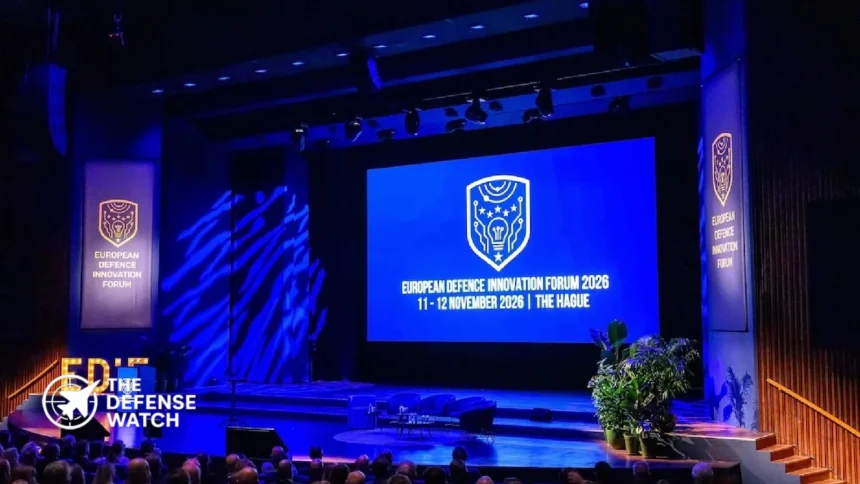
The European Defence Innovation Forum (EDIF) 2026, held at the World Forum in The Hague on November 11–12, brought together approximately 1,500 participants from more than 10 countries. Organisers reported that the event generated up to 10 cooperation agreements involving defence companies, technology developers and industry organisations.
The discussions focused on translating Ukraine’s wartime experience into practical industrial partnerships, particularly in unmanned systems, counter-drone technology, artificial intelligence, electronic warfare and air defence. More than 60 companies exhibited equipment and technologies during the event, according to reporting by Defence Industry Europe.
From military assistance to industrial partnership
A central theme of the forum was the changing relationship between Ukraine and its European partners.
Ukraine has spent several years adapting military equipment and operational tactics under the pressure of continuous combat. Its experience with relatively inexpensive drones, rapidly changing electronic warfare environments and battlefield technology integration has become increasingly relevant to European military planners.
Dutch Defence Minister Dilan Yeşilgöz-Zegerius addressed this issue during the forum’s opening session on November 11.
She argued that European countries need to remove unnecessary bureaucratic obstacles and learn from Ukraine’s experience in modern warfare. She also described cooperation with Ukrainian companies as a strategic interest rather than simply another form of assistance.
Her speech identified a particular challenge for European defence organisations: Ukrainian military units and technology developers can sometimes move battlefield lessons into practical solutions within days, while conventional European procurement and development processes often take considerably longer.
The minister also highlighted the role of direct operational feedback in improving defence technology. Dutch companies, she said, have opportunities to test and refine products through engagement with Ukrainian military users.
This approach reflects a shift toward longer-term industrial cooperation. Instead of limiting relationships to supplying weapons and equipment, European governments and companies are increasingly looking at joint development, manufacturing and technology exchange.
Three cooperation areas illustrate the forum’s industrial focus
The agreements reported from the event covered several different capability requirements.
1. WARDEN air defence missile development
Guardian Dynamics, Demcon, Axient Systems and the Netherlands Organisation for Applied Scientific Research (TNO) signed a memorandum of understanding covering the development of WARDEN, a Dutch air defence missile initiative.
Guardian Dynamics will serve as the programme’s prime contractor and design authority, according to Defence Industry Europe.
The partnership involves cooperation with the Dutch Ministry of Defence and operational users. The participating organisations also intend to draw on existing industrial manufacturing capacity, including facilities in the automotive sector, if production requirements increase.
The project is relevant to European efforts to expand air defence capabilities and establish more flexible production arrangements. However, the available reporting does not establish WARDEN’s technical specifications, development schedule, procurement commitment or planned production quantities.
2. Unmanned ground vehicles for casualty evacuation
Hospitainer, Intelic, Offroad Apps and DroneShield signed an agreement to explore the development of unmanned ground vehicles for casualty evacuation.
The proposed collaboration aims to combine the participating companies’ technologies to move injured personnel in dangerous environments.
Unmanned ground vehicles have potential military applications beyond casualty evacuation, including logistics, equipment transportation and operations in areas exposed to enemy observation or fire.
For European forces, casualty evacuation is an important requirement in environments where conventional vehicles and medical personnel may face significant risks.
The agreement, however, should be understood as a cooperation initiative rather than evidence that a completed evacuation vehicle has entered military service.
3. European and Baltic defence technology cooperation
The Defence Technology Development Association (DTDA) and MilTech Latvia signed a memorandum covering defence and dual-use technologies.
Its areas of cooperation include:
- Uncrewed and autonomous systems for air, land and maritime operations.
- Counter-unmanned aerial system technologies.
- Joint research and manufacturing.
- Supply-chain cooperation.
- Testing and technology validation.
- Participation in European and NATO-related programmes.
The organisations also intend to coordinate industry events, exchange technical knowledge and help their member companies establish partnerships for international markets.
The agreement provides a framework for industrial cooperation across Northern Europe and the Baltic region, with potential involvement from Ukrainian companies. It does not, by itself, establish a funded procurement programme or guaranteed production orders.
Ukraine’s operational experience is becoming an industrial resource
The significance of the forum extends beyond the agreements themselves.
Ukraine’s experience has demonstrated how rapidly military technology requirements can change during a prolonged conflict. Unmanned aerial vehicles, electronic warfare equipment, surveillance systems and battlefield communications must adapt to changing threats and countermeasures.
This creates a different development environment from traditional defence procurement, where platforms can remain in development for many years before reaching operational units.
Dutch Chief of Defence General Onno Eichelsheim addressed this challenge in his November 11 closing speech.
He argued that European militaries need to learn from Ukraine’s approach to military leadership, technology integration and rapid innovation. He also identified a vulnerability period extending toward 2030, during which European armed forces must strengthen their readiness and deterrence capabilities.
Eichelsheim highlighted the importance of connecting military users with technology developers rather than allowing innovation to remain separated from operational requirements.
That issue is particularly relevant to unmanned systems and electronic warfare.
A drone that performs effectively in one operational environment may become less useful when an opponent introduces new jamming methods or detection systems. Manufacturers therefore need frequent feedback from military users and the ability to modify equipment without restarting lengthy development cycles.
European cooperation with Ukrainian companies could provide access to this operational feedback while helping Ukrainian manufacturers expand their customer base and production opportunities.
However, transferring battlefield experience into European military capability will require more than technology demonstrations. It will also depend on testing standards, secure supply chains, interoperability, financing and the ability to manufacture equipment at scale.
Drone production and investment remain major priorities
Unmanned systems received considerable attention during the two-day programme.
The official agenda included dedicated sessions on UAV production, testing and deployment, as well as robotics on the frontline and the integration of Ukrainian defence experience into European industrial development.
The forum also included an investment and startup competition on November 12.
Ten startups participated, with two representatives each from Ukraine, the Netherlands, the United Kingdom, Latvia and NATO’s Defence Innovation Accelerator for the North Atlantic (DIANA).
The three announced winners were:
| Startup | Country / affiliation | Award |
|---|---|---|
| Modifire (MDS) | Ukraine | €15,000 |
| Spherical | Netherlands, NATO DIANA | €10,000 |
| Estel Industries | Netherlands | €5,000 |
The awards were intended to support further development of the participating companies’ technologies.
The competition illustrates another aspect of Europe’s defence innovation strategy: attracting investment into smaller technology companies that may be able to develop specialised military solutions faster than traditional defence contractors.
For Ukraine, access to European investment and industrial partnerships could help manufacturers expand beyond domestic wartime demand. For European companies, cooperation offers opportunities to learn from technologies developed under actual combat conditions.
What the agreements mean for European defence procurement
The forum’s outcomes point toward three interconnected priorities.
First, European governments want to reduce the time between identifying a military requirement and delivering equipment to operational units. Ukraine’s experience provides examples of how direct communication between soldiers, engineers and manufacturers can accelerate that process.
Second, European defence organisations are looking to diversify production capacity. Cooperation with Ukrainian manufacturers could provide additional sources of unmanned systems and other military technologies while strengthening industrial links across NATO partner countries.
Third, European countries need to improve their ability to manufacture equipment in sufficient quantities. Advanced systems remain important, but the war in Ukraine has also demonstrated the operational value of affordable equipment that can be replaced, upgraded and produced at scale.
These priorities will require sustained procurement commitments rather than agreements limited to conferences and industry networking.
The reported memorandums establish opportunities for cooperation, but their practical value will ultimately depend on funded development work, successful testing, production contracts and adoption by military users.
European defence cooperation moves toward practical implementation
The European Defence Innovation Forum 2026 provided a platform for Ukrainian and European defence organisations to establish industrial relationships across several military technology areas.
The reported agreements involving WARDEN missile development, unmanned ground vehicles and wider European-Baltic technology cooperation offer examples of how those relationships could develop.
The next challenge is implementation. European governments and defence companies will need to turn cooperation frameworks into tested equipment, reliable supply chains and production capacity that can support military requirements.
The Netherlands has already signalled an interest in moving beyond a traditional donor-recipient relationship with Ukraine toward a partnership based on shared technology, industrial cooperation and operational experience.
Whether the forum’s agreements produce substantial new military capabilities will depend on the progress made after the event.
Enjoying our coverage?
Make The Defense Watch a preferred source on Google to see more of our geopolitical and defense insights when relevant to you.