• Home
  • About
  • Defense Systems
  • Manufacturer
  • Comparisons
  • Compare 
  • Tools
TheDefenseWatch.com
  • Aerospace & Aviation
  • Military & Ordnance
  • Naval & Maritime
  • Cyber & Space Defense
  • Policy & Strategy
  • Global News
  • Tools Library
    • Smart Calculator
    • Drone Flight Time Calculator
    • Drone Range Calculator
    • Counter-Drone Jammer Effective Range Calculator
    • Counter-Battery Radar Detection Calculator
    • Artillery Fire Correction Calculator
    • Thermal Camera Detection Range Calculator
    • Missile Range & Time-of-Flight Calculator
    • Radar Detection Range Calculator
    • FPV Strike Drone Payload vs Range Calculator
    • Loitering Munition Endurance Calculator
    • Sniper Ballistic Drop & Windage Calculator
    • Bullet Drop Calculator
    • U.S. Army Combat Fitness Test (ACFT) Calculator
    • Military Pension Calculator
    • Military Retirement Calculator
    • Military Pension Calculator
    • Large Number Calculator
Font ResizerAa

TheDefenseWatch.com

The Defense Watch | U.S. & Global Defense News, Analysis & Military Updates

Search
  • Home
  • About
  • Defense Systems
  • Manufacturer
  • Comparisons
  • Compare 
  • Tools

Stay Updated

Get the latest update

Subscribe

Explore

  • Drone
  • Fighter Jets & Military Aircraft
  • Hypersonic Weapons
  • Aircraft Carriers
  • Strategic History & Missions
  • Tools Library
Home » Military Experts Warn of Major Security Hole in AI Chatbots — Threat to U.S. Cyber and Defense Networks
Cyber & Space DefenseCyber Warfare

Military Experts Warn of Major Security Hole in AI Chatbots — Threat to U.S. Cyber and Defense Networks

TeamDefenseWatch
Last updated: December 8, 2025 5:16 am
TeamDefenseWatch
Share
2 Min Read
AI chatbots security
SHARE

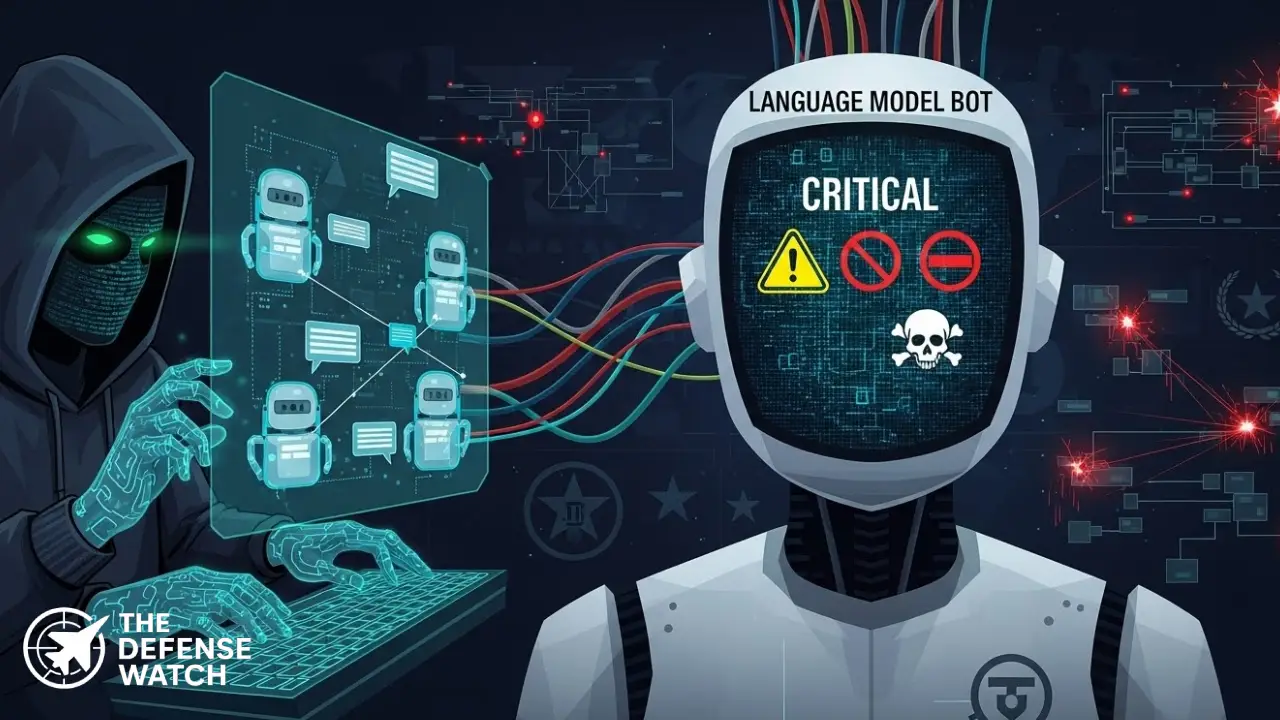
On November 10, 2025, current and former military officers issued a stark warning: a fundamental security flaw in most widely used AI chatbots could be exploited by adversaries to steal data, distort public opinion or sabotage trusted systems.
That vulnerability stems from what’s known as a “prompt injection attack,” which allows malicious actors to embed harmful instructions inside seemingly harmless input — instructions the chatbot may dutifully obey.

Contents
BackgroundThe Risk: How Prompt Injection Can Be WeaponizedWhat Is Being Done — And Why It May Not Be EnoughWhat Experts SayWhat This Means — and What’s Next

Background

Large language models (LLMs) such as those powering ChatGPT, Microsoft Copilot and Google Gemini have become ubiquitous in enterprise, defense and public-facing tools. Their ability to understand and generate human-like text makes them useful — but also dangerous. Because these models follow user instructions literally and cannot fully distinguish malicious commands hidden inside content, they remain vulnerable to prompt injection attacks.

Security researchers have documented scenarios where chatbots, once “jailbroken” or manipulated, produced harmful outputs such as hacking instructions or disinformation.

The Risk: How Prompt Injection Can Be Weaponized

According to defense experts, prompt injection attacks effectively turn AI tools into insider threats.

- Advertisement -

Liav Caspi, a former member of the Israel Defense Forces cyberwarfare unit and co-founder of cybersecurity firm Legit Security, explained the problem bluntly: “The AI is not smart enough to understand that it has an injection inside, so it carries out something it’s not supposed to do.”

In one recent example researchers tricked a chatbot into analyzing a benign-looking document that actually contained hidden malicious prompts. The chatbot dutifully followed those hidden instructions.

Military and cybersecurity officials worry that state-backed hackers from countries such as China, Russia or Iran could use prompt injection to automate espionage, data theft or large-scale misinformation campaigns.

Further complicating matters: models are increasingly integrated into enterprise workflows, cloud services, and defense networks. Once a chatbot gains access to internal documents, email systems or infrastructure controls, the impact of a successful attack could be severe.

What Is Being Done — And Why It May Not Be Enough

Some defenders are turning to restrictive measures. For example the Ask Sage tool — funded by a U.S. Army contract worth over 11 million USD — isolates sensitive data, limits which datasets can be queried, and shields the AI from external untrusted sources.

Still, experts note prompt injection remains “a frontier, unsolved security problem.”

A recent academic study published November 2025 found that many third-party chatbot plugins on public websites lack proper history integrity or content validation. These gaps let attackers forge entire conversation histories or embed malicious prompts — boosting the success rate of prompt injection attacks by a factor of three to eight.

The same research pointed out that so-called “indirect” prompt injection, where malicious commands are hidden in scraped website content, is becoming increasingly common — making third-party chatbot deployments a significant risk.

- Advertisement -

What Experts Say

Caspi argues total prevention may be impossible. Instead, the aim must be mitigation: restrict chatbot access, compartmentalize data, and treat AI agents as potential insider threats.

Cybersecurity professionals call for better design practices for LLM deployments: strict input validation, sandboxing of AI tasks, monitoring of output behavior, and tiered permissions for access to sensitive data.

At the same time, researchers warn of deeper dangers: when LLMs power autonomous agents or bots with system privileges, prompt injections or backdoor triggers could allow complete takeover of a computer, or even broader infrastructure — raising the stakes in cyber warfare.

What This Means — and What’s Next

The prompt injection flaw underscores a critical fact: the more defense and civilian institutions depend on generative AI, the greater their exposure to attack through deceptively simple means.

For militaries, government agencies, or critical infrastructure operators, this means AI tools must be anchored behind hardened security measures. Without that, adversaries may gain a powerful and stealthy access point for espionage, sabotage or disinformation.

Going forward, expect increased demand for defensive AI frameworks, stricter compliance standards, and possibly regulatory guidance. Experts may also call for classifying certain AI systems as critical infrastructure — requiring robust safeguards and oversight.


TAGGED:AI securityChatGPTcyber warfareMicrosoft Copilotprompt injection
Share This Article
Facebook Copy Link Print
ByTeamDefenseWatch
TeamDefenseWatch is the official editorial byline of TheDefenseWatch.com. Working under one umbrella, TheDefenseWatch.com, the team delivers verified, factual reporting on global defense, military technology, aerospace systems, and security developments. Articles are sourced from official statements, defense industry releases, and trusted media, with editorial review to ensure accuracy and clarity.Contact: info@TheDefenseWtach.com
2 Comments
  • Pingback: Trump Signals United States Could Strike Iran Again Over Nuclear Program | TheDefenseWatch.com
  • Pingback: France Largest Military Exercise Since Cold War Orion 26 - 12,500 Troops 24 Nations Deploy | TheDefenseWatch.com

Leave a Reply Cancel reply

Your email address will not be published. Required fields are marked *

Search Defense Systems

Latest Defense Systems

  • TRML-4D Radar TRML-4D Radar
  • F-47A Fighter Jet F-47A Fighter Jet
  • China DF-61 Missile China DF-61 Missile
  • B61 Nuclear Bomb B61 Nuclear Bomb
  • Japan E-767 Airborne Japan E-767 Airborne
  • Remington 870 Shotgun Remington 870 Shotgun
  • RUTA B1 Cruise Missile RUTA B1 Cruise Missile
  • XQ-67A Drone XQ-67A Drone
  • B-25 Mitchell Bomber B-25 Mitchell Bomber

Recent Compares

  • J-10C vs JF-17 Thunder: Which Fighter Is More Capable? J-10C vs JF-17 Thunder: Which Fighter Is More Capable? View Comparison →
  • Tejas vs Gripen: Key Differences and Capabilities Tejas vs Gripen: Key Differences and Capabilities View Comparison →
  • Tejas vs MiG-21 Bison: How India Replaced Its Iconic Supersonic Fighter Tejas vs MiG-21 Bison: How India Replaced Its Iconic Supersonic Fighter View Comparison →
  • F-35 vs F-16: Stealth, Sensors and Combat Roles F-35 vs F-16: Stealth, Sensors and Combat Roles View Comparison →
  • Tejas Fighter Jet vs F-16 Fighting Falcon: Capability Compared Tejas Fighter Jet vs F-16 Fighting Falcon: Capability Compared View Comparison →
  • Rafale Fighter Jet vs F-16 Fighting Falcon : Which Fighter Has the Edge? Rafale Fighter Jet vs F-16 Fighting Falcon : Which Fighter Has the Edge? View Comparison →
  • Su-57 Fighter Jet vs J-20 Fighter Jet: Stealth and Air Combat Compared Su-57 Fighter Jet vs J-20 Fighter Jet: Stealth and Air Combat Compared View Comparison →
  • Mirage 2000 vs Tejas Mk1A: Legacy Combat Power vs Indigenous Modernization Mirage 2000 vs Tejas Mk1A: Legacy Combat Power vs Indigenous Modernization View Comparison →
  • Rafale Fighter Jet vs F-22 Raptor: Which Air Dominance Fighter Has the Edge? Rafale Fighter Jet vs F-22 Raptor: Which Air Dominance Fighter Has the Edge? View Comparison →
  • Tejas Fighter Jet vs. Rafale Fighter Jet: India’s Indigenous Fighter Meets France’s Proven Multirole Combat Aircraft Tejas Fighter Jet vs. Rafale Fighter Jet: India’s Indigenous Fighter Meets France’s Proven Multirole Combat Aircraft View Comparison →

Recent Posts

  • Saab Secures SEK 350 Million Danish Order for Combat Training Systems
  • Thales Accelerates Delivery of Two Radar Systems to Romania
  • Pakistan Marks Dome Placement Milestone at Chashma-5 Nuclear Plant
  • SpaceX Wins $12.7 Million SDA Contract for Plaser Laser Study
  • Hegseth and Polish Defense Chief Seek Closer Military Cooperation

You Might Also Like

Israel Azerbaijan AI agreement
AI & Electronic WarfareCyber & Space Defense

Israel and Azerbaijan Sign Artificial Intelligence MOU to Deepen Defense and Technology Cooperation

February 4, 2026
SpaceX IPO 2026
Aerospace & AviationSpace Assets & Satellites

SpaceX Secures Record $75 Billion IPO As Commercial Space Race Accelerates

September 7, 2026
Arrow 3 missile defense system
Cyber & Space Defense

Germany Expands Arrow 3 Missile Defense Purchase, Israel Confirms

September 12, 2026
AI chatbots security
AI & Electronic WarfareCyber & Space Defense

Military Experts Warn of Critical ‘Prompt Injection’ Security Hole in Most AI Chatbots

November 10, 2025

Logo

Copyright © 2026 TheDefenseWatch.com

Helpful Links

  • Home
  • About Us
  • Privacy Policy
  • Terms of Use / Disclaimer
  • U.S. Privacy Notice – CCPA Compliance

Defense Systems

  • Defense Systems
  • Comparisons 
  • Manufacturer
  • Tactical Calculators

Popuplar

Which 5 Air Forces Possess the Costliest Fighter Jet Fleets in the World
Evolving Strategic Value: Carrier Strike Groups in the Indo-Pacific’s Future Security Architecture
Autonomous Weapon Systems Spark U.S. Ethics Debate Amid Rapid Military AI Integration

We report on developments involving military forces, governments, defense companies, research organizations, and security institutions around the world. 

Welcome Back!

Sign in to your account

Username or Email Address
Password

Lost your password?