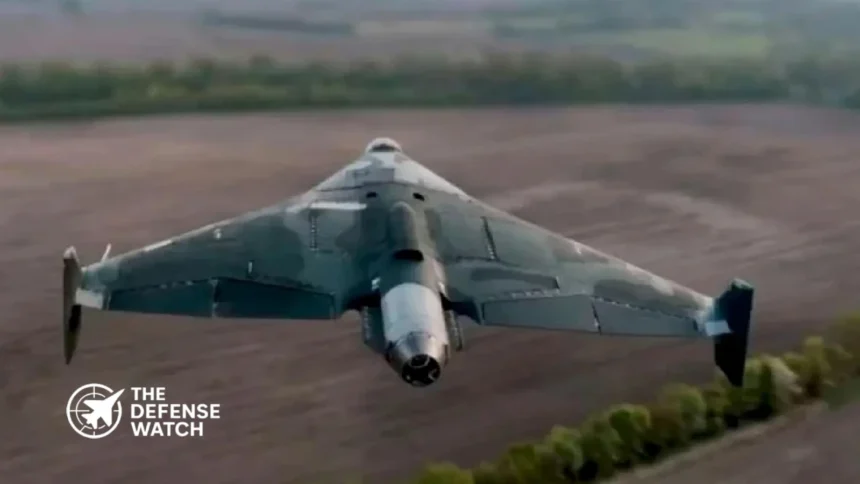
Ukraine says it has achieved a new milestone in counter-drone warfare after a domestically developed laser air defense system reportedly intercepted a Russian jet-powered Geran attack drone during combat operations.
Serhii Beskrestnov, a Ukrainian presidential adviser on defense technology known by the callsign Flash, announced the interception on November 25, 2026. He identified the weapon as the Blysk laser air defense system, developed by Ukrainian defense technology company Carmine Sky.
According to Beskrestnov, the system was protecting a critical infrastructure facility when it engaged the Russian drone. He also released video footage associated with the reported interception.
The claim has been reported by Ukrainska Pravda, The Kyiv Independent and other Ukrainian news organizations. However, the engagement has not been independently verified, and publicly available information does not establish all the circumstances of the interception.
Blysk moves from testing toward operational use
The Blysk system is part of Ukraine’s growing effort to develop directed-energy weapons for protecting infrastructure and other important facilities against unmanned aerial threats.
Beskrestnov said several Ukrainian companies are working on laser-based air defense technologies. However, he cautioned against treating the reported interception as evidence that the technology is ready for large-scale production.
Testing remains underway, with laser systems being used to protect infrastructure facilities during their evaluation.
The distinction is important. A successful engagement under particular conditions demonstrates a potential operational application, but it does not establish the system’s reliability against different drone types, weather conditions or large-scale attacks.
What is known about the Blysk laser?
Available reporting identifies Blysk as a ground-based, short-range laser weapon designed to engage unmanned aerial vehicles.
The Kyiv Independent reported an output of approximately 4 kilowatts and an effective engagement range of up to 1 kilometer. These figures should be treated as reported specifications rather than independently verified performance measurements.
Unlike conventional air defense missiles, a laser weapon directs concentrated energy toward a target rather than launching a physical interceptor.
According to Beskrestnov’s subsequent explanation, the objective is to maintain the laser beam on a particular point until the target’s internal components fail. This approach requires accurate tracking and sustained energy delivery rather than simply illuminating a drone momentarily.
Why jet-powered Russian drones present a different challenge
Russia’s expanding use of jet-powered attack drones has created additional pressure on Ukraine’s air defense network.
Jet-powered platforms generally fly faster than comparable propeller-driven attack drones. Their higher speed can reduce the time available for detection, tracking and interception, particularly when they approach defended infrastructure.
Russia uses the Geran designation for its family of one-way attack drones derived from Iranian-designed Shahed technology. The family includes different configurations, and the reported laser engagement involved a jet-powered variant.
Ukraine needs several complementary interception methods to address this threat. Conventional surface-to-air missiles, mobile gun systems, electronic warfare equipment and interceptor drones all have different operational advantages and limitations.
A ground-based laser could add another option, particularly against relatively short-range threats approaching protected facilities.
Laser weapons offer advantages, but weather remains a problem
One attraction of directed-energy weapons is their potential to reduce dependence on expensive physical interceptors.
A laser system does not expend a missile each time it engages a target. Once deployed, its operating costs may be lower per engagement than those of conventional missile-based air defense, although acquisition, maintenance, electricity and support costs must also be considered.
However, laser weapons have important limitations.
Weather and atmospheric conditions: Fog, rain, dust and cloud cover can reduce the effectiveness of a laser beam by absorbing or scattering its energy.
Target tracking: The system must maintain accurate tracking while directing energy toward a moving target. This becomes more difficult when drones maneuver or approach at higher speeds.
Engagement time: The laser may need to remain focused on a target for a sustained period before causing sufficient damage.
Limited engagement distance: Short-range systems cannot replace longer-range air defense weapons responsible for protecting wider areas.
The Kyiv Independent previously reported that cloud cover and fog had complicated Blysk’s engagement opportunities around Kyiv.
These constraints mean that laser weapons are more likely to complement existing air defense systems than replace them.
Ukraine’s private air defense program expands
The reported Blysk interception also illustrates Ukraine’s growing involvement of private companies in national air defense.
Under its Private Air Defense initiative, Ukraine allows authorized businesses to establish air defense groups to protect personnel, production facilities and energy infrastructure against Russian aerial attacks.
The groups operate within the country’s unified air defense network and remain under military command, rather than functioning as independent armed organizations.
Ukraine’s Ministry of Defence reported on November 4 that nearly 100 companies had joined the initiative by mid-October 2026. These groups had destroyed more than 60 aerial targets, including Shahed-type attack drones and Zala reconnaissance UAVs.
The program is intended to expand defensive capacity without placing the entire burden on Ukraine’s regular armed forces.
For the defense industry, it also creates opportunities to test new technologies in operational conditions. Carmine Sky’s laser system is one example of the wider effort to introduce privately developed capabilities into Ukraine’s air defense architecture.
What the reported interception means for counter-drone warfare
The Blysk engagement is potentially important because it suggests that a relatively compact laser system may be able to engage a faster jet-powered attack drone.
However, the strategic value of the system will depend on its performance beyond a single reported interception.
Ukraine would need to demonstrate consistent target acquisition, reliable engagement under different atmospheric conditions, effective protection against multiple incoming drones and sustainable operating costs before Blysk could be considered a widely deployable solution.
The distinction between a successful test or combat engagement and a mature operational capability is particularly important for directed-energy weapons.
For now, the reported interception provides an indication of Ukraine’s progress in developing alternative methods to counter Russian unmanned aerial attacks. Whether Blysk can become a dependable part of a wider layered air defense network remains an open question.
Enjoying our coverage?
Make The Defense Watch a preferred source on Google to see more of our geopolitical and defense insights when relevant to you.