

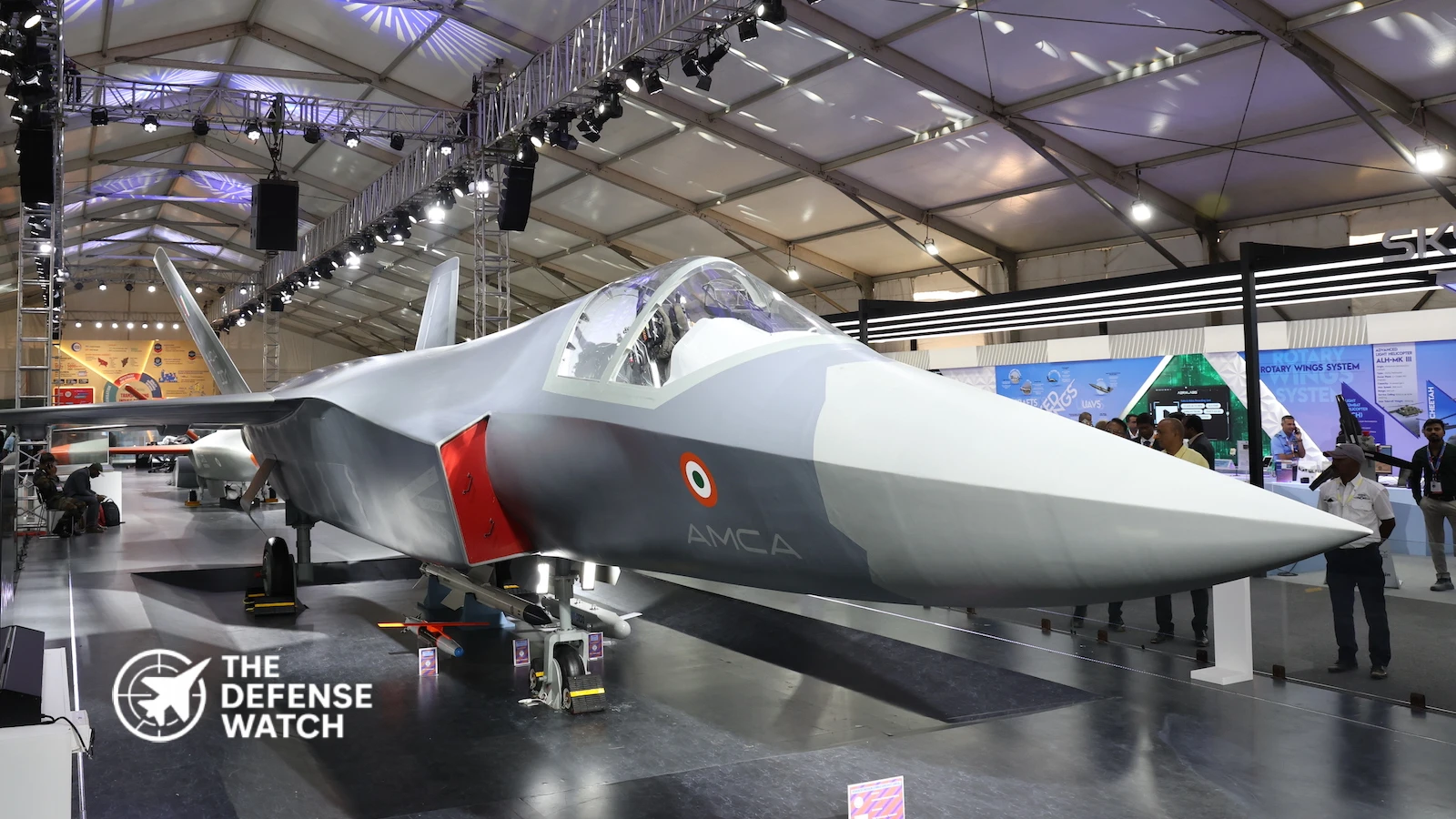
Executive Summary: Reliance Industries and Rolls-Royce announced on August 14, 2026, that they intend to work together on the design, development and manufacture of a sovereign combat engine for India’s Advanced Medium Combat Aircraft program. The companies also plan to explore an Aerospace Gas Turbine Complex in India, potentially creating a domestic industrial base for advanced military propulsion.
Reliance and Rolls-Royce Target AMCA Fighter Engine
The AMCA fighter engine has become the focus of a new proposed partnership between Reliance Industries and Rolls-Royce, as the two companies seek to combine British propulsion expertise with Indian industrial capacity. The announcement follows India’s decision to open the AMCA development program to competitive participation from Indian private and public-sector companies.
Reliance and Rolls-Royce said their strategic intent covers the design, development, manufacturing and delivery of an indigenous combat engine for the AMCA. The companies also intend to explore a dedicated Aerospace Gas Turbine Complex that would serve as a center for advanced power and propulsion technologies in India.
The announcement does not itself represent a completed production contract for the engine. Rather, it establishes an industrial partnership intended to compete for and support India’s AMCA propulsion requirement.
Why The AMCA Engine Is Strategically Important
India has developed significant capabilities in airframe design, aircraft manufacturing and systems integration, but high-performance fighter propulsion remains one of its most difficult aerospace technology challenges.
The AMCA is intended to be a fifth-generation fighter aircraft, making its propulsion requirements substantially more demanding than those of earlier Indian combat aircraft. Engine performance affects acceleration, range, payload, thermal management and the aircraft’s ability to sustain demanding flight profiles.
The propulsion system must also integrate with the aircraft’s inlet, exhaust, flight-control architecture and thermal-management systems. For a stealth-oriented aircraft, the engine and exhaust arrangement additionally have implications for infrared and radar signatures.
That makes an indigenous engine more than a manufacturing objective. It is a strategic capability involving design authority, materials science, testing infrastructure, production engineering and long-term sustainment.
Proposed Aerospace Gas Turbine Complex
A central element of the Reliance-Rolls-Royce proposal is the possible establishment of an Aerospace Gas Turbine Complex in India.
Such a facility could provide an industrial framework for activities extending beyond final engine assembly. Depending on the final structure and technology-transfer arrangements, a domestic complex could support engineering, component manufacturing, testing, integration and maintenance.
Rolls-Royce has previously said it sees India as an important location for expanding aerospace engineering and manufacturing capabilities. The company has also highlighted its long history of working with Indian industry and the Indian armed forces.
Rolls-Royce says more than 750 of its engines across 10 types power Indian military aircraft. The company has also transferred whole-engine manufacturing capability to India through previous industrial arrangements.
The proposed AMCA initiative would move that relationship toward a much more demanding area: development of a modern fighter engine rather than licensed production or support of an existing design.
AMCA Development Is Moving Toward Industry-Led Execution
India’s Ministry of Defence approved the AMCA Programme Execution Model in May 2025, allowing Indian companies to participate through independent bids, joint ventures or consortia. The government said the approach was designed to provide equal opportunities to private and public-sector companies while expanding India’s domestic aerospace industrial capacity.
The government has also stated that the AMCA program plans to develop five prototypes before series production.
In May 2026, India’s Ministry of Defence announced the foundation stone for an AMCA Core Integration and Flight Testing Centre in Andhra Pradesh. The facility is intended to support aircraft integration, testing, validation and certification.
These developments indicate that the program is progressing beyond conceptual design toward a broader industrial and test infrastructure.
Engine Development Remains The Critical Technology Challenge
Developing a modern fighter engine is considerably more difficult than manufacturing an existing powerplant under license.
A new engine requires expertise in areas such as:
Technology Area Importance To AMCA High-pressure compressor Produces the pressure ratio required for efficient high-performance operation Turbine technology Converts hot gas energy into mechanical power Advanced materials Allows components to withstand extreme temperatures and stresses Combustion system Balances efficiency, stability and emissions Digital engine control Manages engine operation across demanding flight conditions Thermal management Controls heat generated by the engine and aircraft systems Afterburner Provides additional thrust when required for combat operations Testing infrastructure Validates performance, reliability and safety before flight The most difficult areas include high-temperature materials, turbine cooling, compressor efficiency and manufacturing tolerances. These technologies determine whether an engine can deliver high thrust while maintaining acceptable weight, fuel consumption and durability.
For India, gaining deeper control over these technologies would have implications beyond AMCA. It could provide a foundation for future combat aircraft, unmanned aircraft and other advanced aerospace propulsion programs.
Rolls-Royce Brings Existing Fighter-Engine Experience
Rolls-Royce has extensive experience in military propulsion and has participated in multinational combat-aircraft engine programs. Its broader defense aerospace portfolio includes propulsion systems for aircraft, naval platforms and other military applications.
The company has also been pursuing a larger role in India’s domestic engine-development ambitions.
In June 2026, Rolls-Royce said it was proposing an aerospace gas turbine complex in India with technology transfer to support indigenous engine development. At that stage, the company indicated that an AMCA engine could potentially undergo ground testing in the early 2030s, followed by flight testing later in the decade.
Earlier reporting indicated that Rolls-Royce had proposed a next-generation engine in the 120-kilonewton-plus class, with an engine-core test targeted for 2030, first flight in 2034 and production potentially beginning in 2036 if an agreement were finalized by the end of 2026.
Those timelines should be treated as company proposals rather than confirmed Indian government program milestones.
Competition With Safran Adds A Second Path
The Reliance-Rolls-Royce proposal comes as India evaluates competing approaches to the AMCA engine requirement.
French aerospace company Safran has also offered to work with India on a high-thrust fighter engine, including local development and technology transfer. Rolls-Royce’s proposal therefore enters an already competitive field for one of India’s most strategically important aerospace programs.
The central issue for India is not simply which company can supply an engine. It is how much design authority, intellectual property, manufacturing capability and technology access can be established inside the country.
That distinction matters because a sovereign engine capability is built over decades. The ability to manufacture an imported design domestically is valuable, but it does not provide the same level of strategic independence as the ability to design, modify, test and produce a future engine without external approval.
What The Partnership Could Mean For India’s Defense Industry
The proposed Reliance-Rolls-Royce arrangement would also mark a significant expansion of private-sector participation in Indian military aerospace.
India has traditionally relied heavily on state-owned organizations for major combat-aircraft development and production. The AMCA execution model was specifically designed to broaden that industrial base and encourage private companies to participate in large defense programs.
Reliance’s role could therefore extend beyond the AMCA itself if the partnership develops into a sustained propulsion manufacturing and engineering capability.
A successful engine program would require a network of specialized suppliers producing precision components, advanced materials, electronic systems and testing equipment. That could create a wider industrial ecosystem rather than a single assembly facility.
For Rolls-Royce, India offers access to a large defense market and an expanding engineering workforce. For India, the value lies in gaining deeper propulsion expertise and reducing dependence on imported fighter engines.
Implications For The AMCA Program
The engine decision will have a direct effect on the broader AMCA development schedule because propulsion development and airframe development must progress in coordination.
The aircraft’s inlet design, internal volume, cooling architecture, center of gravity, fuel system and exhaust arrangement all depend on the selected engine’s physical and performance characteristics.
A mature engine solution could therefore reduce integration risks later in the aircraft program. Conversely, delays in engine development could affect prototype construction, ground testing and flight testing.
India’s establishment of dedicated AMCA integration and flight-test infrastructure provides part of the required foundation, but engine development remains a separate and highly specialized challenge.
A Long-Term Test Of India’s Aerospace Ambitions
The Reliance-Rolls-Royce proposal is significant because it addresses one of the hardest remaining gaps in India’s combat-aircraft industrial base.
India already has experience producing military aircraft and increasingly complex defense systems domestically. The AMCA engine program, however, requires progress from assembly and licensed production toward indigenous design and development of a high-performance propulsion system.
If the proposed partnership advances into a formal development agreement, its most important measure will not be the establishment of an Indian manufacturing site alone. The critical indicators will be the extent of technology transfer, Indian ownership of relevant intellectual property, domestic engineering responsibility, test capability and the ability to evolve the engine for future aircraft.
For the United States and its allies, the development is also relevant to the broader evolution of India’s defense-industrial base. A stronger Indian propulsion sector could eventually support a more independent Indian aerospace industry and create additional opportunities for international defense cooperation and supply-chain partnerships.
At present, Reliance and Rolls-Royce have announced an intent to pursue the capability, not a finalized production program. The next milestones will be the structure of the industrial arrangement, India’s selection process for the AMCA engine and the technical and commercial terms governing development and technology transfer.
Key Facts
Item Current Status Aircraft Advanced Medium Combat Aircraft Engine initiative Reliance-Rolls-Royce strategic partnership Proposed capability Indigenous combat aircraft engine Industrial proposal Aerospace Gas Turbine Complex in India Indian program authority Aeronautical Development Agency AMCA execution model Competitive industry partnership Prototype plan Five prototypes before series production Engine timeline previously proposed by Rolls-Royce Core testing around 2030, flight testing around 2034 Production timeline previously proposed Around 2036, subject to agreement and development progress Bottom Line
The Reliance-Rolls-Royce initiative places advanced fighter propulsion at the center of India’s broader effort to establish a more self-reliant aerospace industry. Its significance will ultimately depend on whether the partnership can convert foreign propulsion expertise and Indian manufacturing capacity into a genuine domestic engine-development capability.
For the AMCA program, the propulsion decision remains one of the most consequential industrial choices ahead. The outcome could shape not only the aircraft’s development schedule, but also India’s ability to design and sustain future generations of combat aircraft.

