

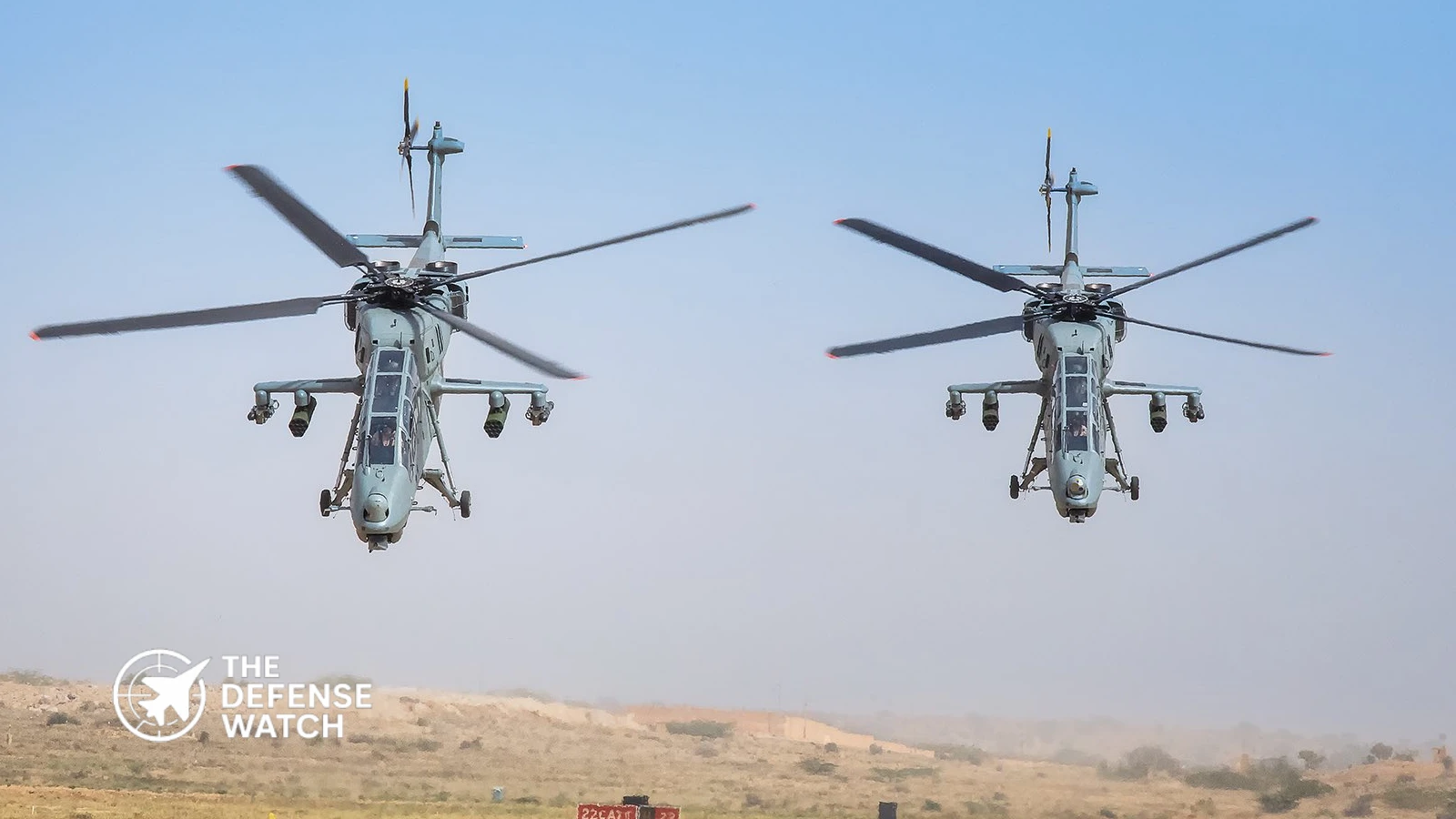
Executive Summary: Hindustan Aeronautics Limited is bringing additional Indian industrial partners into production of the Prachand Light Combat Helicopter, with Adani Defence and Bharat Earth Movers Limited manufacturing fuselage structures. The move comes as HAL scales production for a 156-helicopter order worth ₹62,700 crore for the Indian Air Force and Indian Army, with deliveries scheduled to begin in the third year of the 2025 contracts.
HAL Expands Prachand LCH Production
Prachand LCH production is expanding beyond HAL’s traditional manufacturing base as Hindustan Aeronautics Limited brings Adani Defence Systems and Technologies Limited and Bharat Earth Movers Limited into fuselage manufacturing for the combat helicopter.
The development and subsequently corroborated by Indian reporting, represents a further expansion of India’s domestic aerospace manufacturing network around one of the country’s largest current helicopter procurement programs. The companies are expected to manufacture fuselage structures, giving HAL additional production capacity as it works through a major order for the Indian armed forces.
HAL has already been increasing its own LCH manufacturing infrastructure. The company said in April 2026 that a new LCH production line had been inaugurated at its helicopter factory, while its May 2026 investor briefing identified LCH manufacturing at Bengaluru and Tumakuru as a major production focus.
156 Prachand Helicopters Are Under Contract
The production expansion is directly linked to India’s March 2025 procurement of 156 LCH Prachand helicopters.
The Indian Ministry of Defence signed two contracts with HAL on March 28, 2025, with a combined value of ₹62,700 crore, excluding taxes. The Indian Air Force is scheduled to receive 66 helicopters, while the Indian Army will receive 90.
| Program | Details |
|---|---|
| Helicopter | LCH Prachand |
| Manufacturer | Hindustan Aeronautics Limited |
| Total ordered | 156 |
| Indian Air Force | 66 |
| Indian Army | 90 |
| Contract value | ₹62,700 crore, excluding taxes |
| Contract date | March 28, 2025 |
| Delivery schedule | Begins in the third year and continues over five years |
| Planned indigenous content | More than 65% |
| Domestic companies involved | More than 250 |
The Ministry of Defence said the program is expected to involve more than 250 domestic companies, primarily micro, small and medium enterprises, and generate more than 8,500 direct and indirect jobs.
The scale of the order makes production capacity as important as the helicopter’s design. HAL must simultaneously manufacture the aircraft, integrate mission systems, maintain quality standards and establish a supply chain capable of supporting deliveries over several years.
Adani Defence and BEML Add Fuselage Capacity
The involvement of Adani Defence and BEML gives HAL two additional industrial channels for a major structural component of the helicopter.
Fuselage manufacturing requires controlled production processes, dimensional accuracy, structural quality assurance and repeatability across a large production run. For a military helicopter, the structure also has to support demanding flight loads while accommodating equipment, crew stations, fuel systems, avionics and mission systems.
The reported arrangement is therefore significant less because of the individual fuselage sections and more because it illustrates a broader shift in India’s defense manufacturing model.
HAL remains responsible for the overall LCH program, but production of selected structures can be distributed across qualified domestic companies. That approach can allow the prime manufacturer to concentrate resources on final assembly, systems integration, testing and other high-value activities while suppliers increase throughput on structural components.
Why Production Capacity Matters
The Prachand order comes as HAL manages several large aerospace programs at the same time.
In its May 2026 investor briefing, HAL said it was increasing production capacity for major programs and specifically identified LCH manufacturing at Bengaluru and Tumakuru as a focus area. The company also reported more than ₹2,386 crore in capital expenditure during the year and ₹2,794 crore in research and development spending.
This production environment creates a practical challenge. Increasing output cannot depend only on adding final assembly stations. The upstream supply chain must also expand at roughly the required pace.
A bottleneck in fuselage structures, for example, could constrain final helicopter deliveries even if engines, avionics and other systems are available. Creating additional qualified sources for structural production can reduce that concentration of manufacturing workload.
The arrangement also gives India a way to build industrial capacity that can potentially support future aerospace programs. That is particularly relevant as New Delhi seeks to increase domestic defense production and reduce dependence on imported equipment and components.
Prachand Designed for High-Altitude Operations
The LCH is a 5.8-ton-class dedicated combat helicopter developed by HAL for the Indian armed forces. HAL describes it as a tandem-seat platform designed for anti-infantry and anti-armour missions, including operations at high altitude and in demanding climatic conditions.
HAL’s published specifications list a maximum takeoff weight of 5,800 kilograms, a maximum speed of 268 kilometers per hour, a range of 550 kilometers and a service ceiling of 6.5 kilometers. The helicopter uses two Shakti engines rated at 1,032 kilowatts each.
Its equipment includes a glass cockpit, helmet-mounted display system, electro-optical systems, electronic warfare equipment and a countermeasures dispensing system. The weapons architecture includes a 20mm gun, 70mm rockets and air-to-air and air-to-ground missiles.
The high-altitude requirement is particularly important for India’s military because portions of the country’s northern frontier involve mountainous terrain where helicopter performance can be affected by reduced air density and demanding operating conditions.
The Ministry of Defence has stated that the Prachand is capable of operating above 5,000 meters and that the 156-aircraft procurement is intended to strengthen combat capability at high altitudes.
A Broader Shift in Indian Aerospace Manufacturing
The decision to distribute LCH structural production among HAL and domestic partners fits into a wider effort to expand India’s aerospace industrial base.
The government has made higher indigenous content a central objective of major defense procurements. For the Prachand program, the Ministry of Defence has targeted more than 65% indigenous content during execution of the 156-helicopter procurement.
For HAL, the immediate advantage is additional manufacturing capacity. For the wider industrial base, the significance is the transfer of more aerospace production work into a network of Indian companies.
That model can be particularly valuable for complex military aircraft because the industrial challenge extends well beyond designing the platform. Long-term readiness depends on a dependable supply chain for structures, components, electronics, engines, weapons integration and maintenance.
The Prachand program therefore serves two purposes at once. It provides the Indian Army and Air Force with a dedicated light attack helicopter, while also creating sustained demand for India’s aerospace manufacturing sector.
Implications for India’s Military Modernization
The 156-helicopter program represents a substantial increase in India’s indigenous combat helicopter inventory.
The distribution between the Indian Air Force and Army also reflects the helicopter’s intended role as a platform for operations in difficult terrain and demanding environments. Its relatively light design and high-altitude operating capability make it particularly relevant to missions where larger attack helicopters may face greater operating constraints.
For the Indian defense industry, the production arrangement is equally important. Additional suppliers can help HAL build the capacity required to deliver a large number of aircraft without placing every manufacturing operation inside a single production organization.
The immediate test will be execution. The 2025 contracts call for deliveries to begin in the third year and continue over five years, placing sustained pressure on HAL and its supplier network to maintain quality and production rates.
If the expanded industrial structure performs as planned, the Prachand program could provide India with both additional combat helicopter capacity and a deeper domestic manufacturing base capable of supporting future military aerospace programs.
What Comes Next
HAL’s priority will now be coordinating multiple production lines and supplier operations while maintaining the engineering and quality standards required for military rotorcraft.
The company’s own production expansion at Bengaluru and Tumakuru provides the main industrial framework, while the addition of external fuselage manufacturers broadens the supply base.
The key measure will be whether this additional capacity translates into consistent deliveries against the 156-aircraft schedule.
For India’s armed forces, timely production matters because the Prachand is intended to strengthen combat helicopter capability in high-altitude environments. For India’s defense industry, the program is another test of whether domestic public and private manufacturers can work together to deliver complex military aerospace systems at scale.
