

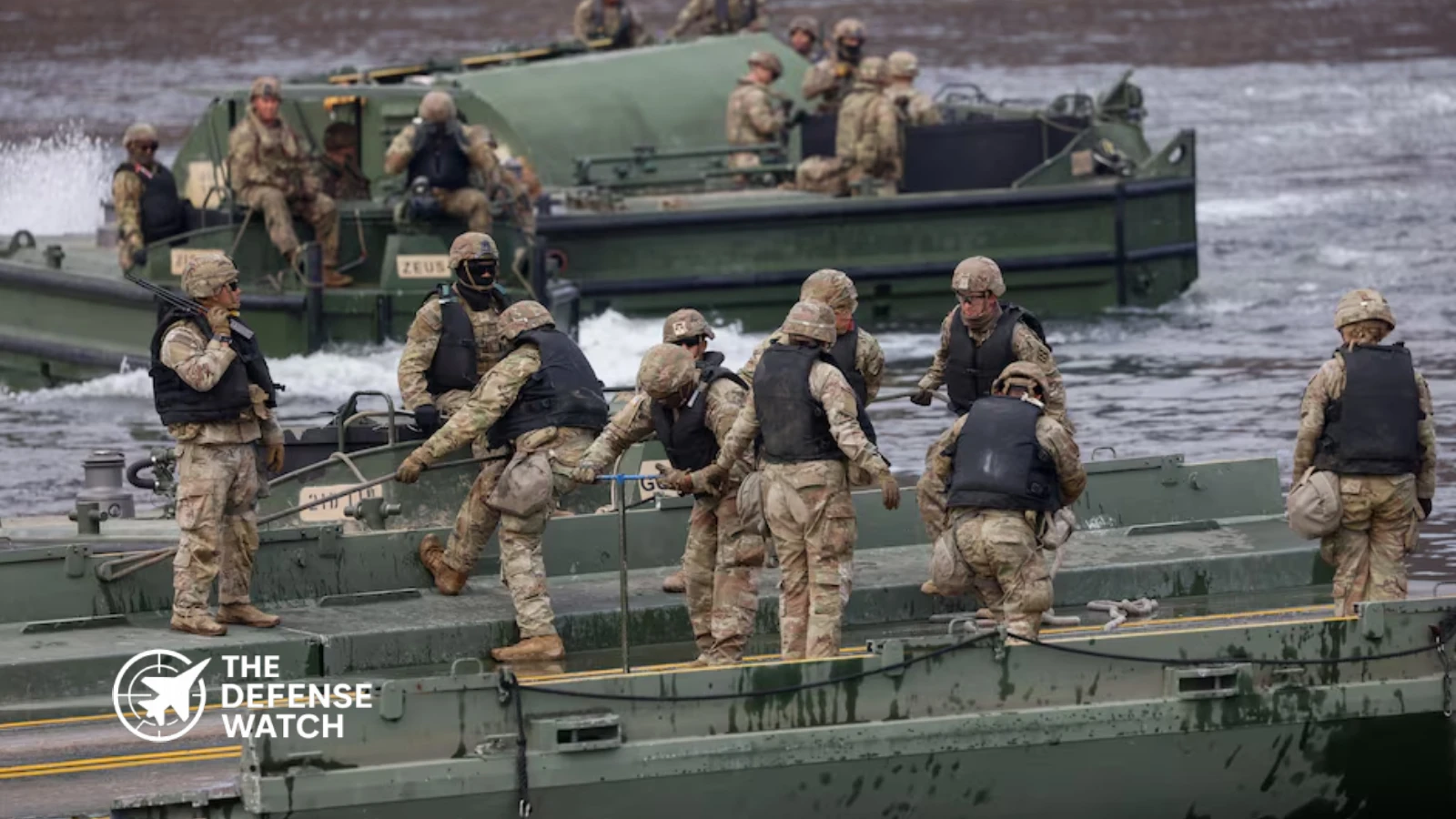
Executive Summary: President Donald Trump has instructed the Pentagon to substantially reduce the 10-day Ulchi Freedom Shield exercises with South Korea. The move comes as North Korea continues missile activity and advances in cyber, electronic warfare and unmanned systems, raising questions about the future scale of combined training.
U.S.-South Korea Military Exercises Face New Limits
U.S.-South Korea military exercises are facing a significant reduction after President Donald Trump instructed the Pentagon on August 16 to substantially scale back the annual Ulchi Freedom Shield drills.
Trump cited the cost of the exercises and South Korea’s decision not to participate in U.S. actions against Iran. He also argued that the drills send what he described as an inappropriate and hostile signal toward North Korea.
The directive came only hours before the exercises were scheduled to begin. South Korea’s Joint Chiefs of Staff said the drills started as scheduled on August 17, according to Reuters, but did not comment on Trump’s remarks. The Pentagon referred questions about the next steps to the White House.
Ulchi Freedom Shield Begins Despite Trump’s Directive
Ulchi Freedom Shield is scheduled to run from August 17 through August 27. Reuters reported that roughly 18,000 South Korean military personnel are expected to participate.
The exercise is designed to improve the ability of U.S. and South Korean forces to operate together during a crisis on the Korean Peninsula. This year’s training is expected to address several areas linked to North Korea’s changing military capabilities, including drone operations, GPS disruption and cyberattacks.
The exercises have also increasingly incorporated computer-based simulations and command-post training rather than relying exclusively on large-scale live-fire activity.
South Korean defense documents describe Ulchi Freedom Shield as a theater-level combined exercise that integrates military training with the country’s broader government emergency exercise. The current UFS format dates to 2022.
Trump Cites Cost And Iran Policy
Trump’s decision adds another point of tension to an alliance that has periodically faced disagreements over military exercises and the cost of maintaining U.S. forces in South Korea.
Reuters reported that Trump has previously sought to reduce or suspend U.S.-South Korean military drills, describing them as costly and provocative. His latest comments also linked the issue to Seoul’s decision not to join U.S. actions connected to Iran.
The connection between the exercises and Iran represents a broader policy issue for the alliance. South Korea’s military relationship with the United States is centered primarily on the defense of the Korean Peninsula, while Washington has increasingly sought greater contributions from allies to wider regional and global security missions.
The United States maintains roughly 28,500 military personnel in South Korea, according to a U.S. State Department fact sheet. The bilateral alliance is based on the 1953 Mutual Defense Treaty and includes combined military planning, exercises and an integrated command structure.
North Korea’s Missile Activity Adds To The Security Context
The timing of the decision is significant because North Korea has continued missile activity ahead of the annual exercise.
Reuters reported that North Korea launched a ballistic missile toward the Sea of Japan on August 12, following another short-range ballistic missile launch on August 6. Pyongyang routinely condemns U.S.-South Korean military exercises as preparations for an invasion.
The threat extends beyond conventional missile forces.
U.S. officials have highlighted North Korea’s growing experience with unmanned systems, electronic warfare and cyber operations. North Korean military personnel have also gained battlefield experience through their involvement alongside Russian forces in the war in Ukraine, according to U.S. officials cited by Reuters.
That evolution is reflected in the training priorities of U.S.-South Korean forces. Exercises increasingly test responses to cyber disruption, GPS interference, unmanned aircraft and missile attacks rather than focusing solely on traditional ground combat scenarios.
Training Changes Could Affect Alliance Readiness
The immediate effect of Trump’s directive remains unclear because the exercises had already begun when he called for them to be reduced.
The practical question is therefore not necessarily whether the drills will disappear, but which portions could be scaled back.
Recent U.S. and South Korean defense planning has placed strong emphasis on maintaining interoperability. A 2025 U.S.-ROK Security Consultative Meeting joint communique said combined exercises and field training strengthened crisis management and deterrence, while both sides emphasized the importance of consistent training opportunities for U.S. and South Korean troops.
That creates a distinction between reducing the size of an exercise and eliminating combined training altogether.
Computer simulations and command-post exercises can continue to test decision-making and operational coordination at relatively lower cost. However, some capabilities require physical training to validate communications, logistics, air operations, maneuver and the ability of units from both countries to operate together under realistic conditions.
The U.S. Department of Defense has previously identified large-scale exercises such as Freedom Shield and Ulchi Freedom Shield as important tools for maintaining the combined defense posture and improving crisis-management capabilities.
What The Decision Means For The Alliance
The immediate military impact of reducing one exercise is difficult to quantify without details on which training events will be affected.
The larger issue is continuity.
The U.S.-South Korea alliance relies on forces from both countries being able to coordinate quickly during a crisis. Regular exercises provide an opportunity to test command relationships, communications, logistics and operational procedures before an emergency occurs.
At the same time, the Trump administration’s criticism reflects concerns about exercise costs and the extent to which U.S. allies should contribute to security priorities beyond their immediate region.
For South Korea, the central security challenge remains North Korea’s nuclear and missile programs. For Washington, the alliance also fits into a wider Indo-Pacific strategy involving regional deterrence, defense modernization and burden sharing.
The decision therefore puts greater attention on how future U.S.-South Korean training will be structured, funded and connected to the alliance’s broader defense objectives.
Bottom Line
Trump’s directive does not amount to the cancellation of Ulchi Freedom Shield. The exercise began as scheduled on August 17, while the Pentagon and White House have not publicly detailed how the president’s order to substantially reduce the drills will be implemented.
For now, the development highlights a tension between two competing priorities: reducing the cost and political sensitivity of large military exercises while maintaining the readiness and interoperability that underpin the U.S.-South Korea defense relationship.
With North Korea continuing to develop ballistic missiles and expand capabilities in cyber, electronic warfare and unmanned systems, the future scale and design of combined U.S.-South Korean exercises will remain an important measure of the alliance’s military posture.
Feature Image Suggestion
Use a Reuters-licensed or U.S. Department of Defense image showing U.S. and South Korean troops conducting a joint training event during Ulchi Freedom Shield. A ground exercise near the Demilitarized Zone would provide strong visual context without implying that the drills have been canceled.
