• Home
  • About
  • Defense Systems
  • Manufacturer
  • Comparisons
  • Compare 
  • Tools
TheDefenseWatch.com
  • Aerospace & Aviation
  • Military & Ordnance
  • Naval & Maritime
  • Cyber & Space Defense
  • Policy & Strategy
  • Global News
  • Tools Library
    • Smart Calculator
    • Drone Flight Time Calculator
    • Drone Range Calculator
    • Counter-Drone Jammer Effective Range Calculator
    • Counter-Battery Radar Detection Calculator
    • Artillery Fire Correction Calculator
    • Thermal Camera Detection Range Calculator
    • Missile Range & Time-of-Flight Calculator
    • Radar Detection Range Calculator
    • FPV Strike Drone Payload vs Range Calculator
    • Loitering Munition Endurance Calculator
    • Sniper Ballistic Drop & Windage Calculator
    • Bullet Drop Calculator
    • U.S. Army Combat Fitness Test (ACFT) Calculator
    • Military Pension Calculator
    • Military Retirement Calculator
    • Military Pension Calculator
    • Large Number Calculator
Font ResizerAa

TheDefenseWatch.com

The Defense Watch | U.S. & Global Defense News, Analysis & Military Updates

Search
  • Home
  • About
  • Defense Systems
  • Manufacturer
  • Comparisons
  • Compare 
  • Tools

Stay Updated

Get the latest update

Subscribe

Explore

  • Drone
  • Fighter Jets & Military Aircraft
  • Hypersonic Weapons
  • Aircraft Carriers
  • Strategic History & Missions
  • Tools Library
Home » United States Expands South China Sea Presence With Second Trilateral Drills In 2026
Global News

United States Expands South China Sea Presence With Second Trilateral Drills In 2026

Samuel Drake | Defense Analyst
Last updated: September 9, 2026 10:51 pm
Samuel Drake | Defense Analyst
Share
6 Min Read
US Australia Philippines drills
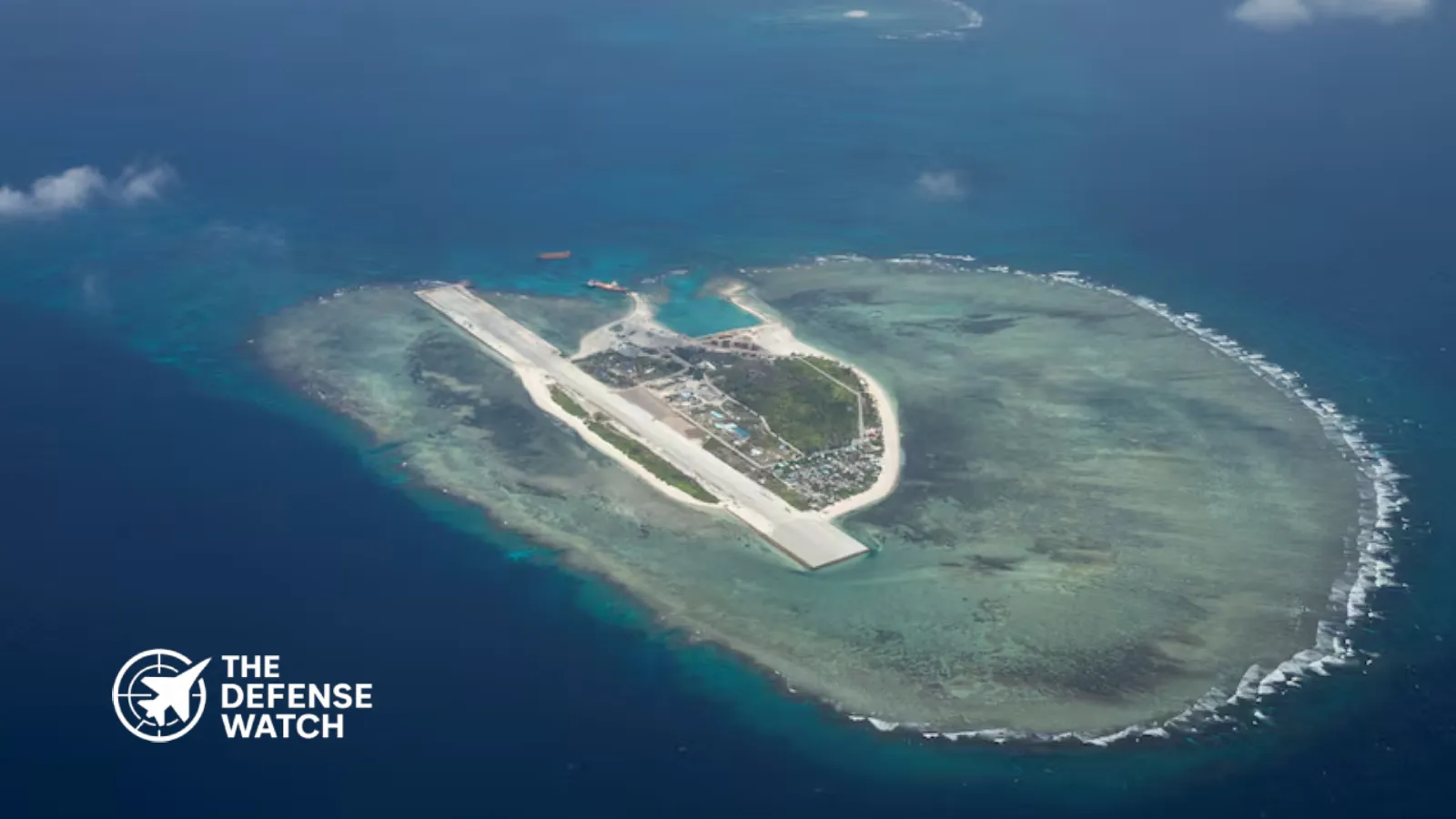
An aerial view shows the Philippine-occupied Thitu Island, locally known as Pag-asa
SHARE

South China Sea Drills Reinforce Trilateral Security Ties

The United States, Australia and the Philippines completed their second joint South China Sea drills of 2026, conducting a four-day maritime exercise from April 9 to April 12 that brought warships, fighter jets and surveillance aircraft together in coordinated operations aimed at bolstering collective defense capabilities.

Contents
  • South China Sea Drills Reinforce Trilateral Security Ties
    • The Big Picture
    • What’s Happening
    • Why It Matters
    • Strategic Implications
    • Competitor View
    • What To Watch Next
    • Capability Gap
    • The Bottom Line
¦ KEY FACTS AT A GLANCE
  • The United States, Australia, and the Philippines conducted four-day joint maritime drills from April 9 to 12, 2026 in the South China Sea. :contentReference[oaicite:0]{index=0}
  • The exercises included Philippine FA-50 fighter jets, Australian P-8A Poseidon aircraft, and the US dock landing ship USS Ashland. :contentReference[oaicite:1]{index=1}
  • The drills signal deepening defense cooperation and interoperability among the three militaries amid sustained regional tensions with China. :contentReference[oaicite:2]{index=2}
  • This activity preceded the larger annual Balikatan war games scheduled to begin April 20, now including Japan as a full participant. :contentReference[oaicite:3]{index=3}
  • China has routinely criticized such exercises, contending they heighten regional tensions. :contentReference[oaicite:4]{index=4}

The Big Picture

Trilateral military activities in the South China Sea come as part of broader efforts by Washington to reassure allies and partners in the Indo Pacific amid persistent maritime disputes with China. Beijing’s expansive territorial claims and frequent confrontations with Southeast Asian navies have driven Manila, Canberra and Washington closer in practical security cooperation. China’s military modernization and expanding naval operations in regional waters add strategic weight to these joint exercises.

These drills precede the annual Balikatan war games between the United States and the Philippines, scheduled to start April 20, 2026, which for the first time include Japan as a full participant. The expansion reflects a widening multilateral engagement among like-minded states on defense and deterrence in the Western Pacific.

What’s Happening

The April 9–12 activity saw combined maritime operations involving the Philippine Air Force’s FA-50 fighter jets, Royal Australian Air Force P-8A Poseidon maritime patrol aircraft and the U.S. Navy’s USS Ashland, a dock landing ship.

- Advertisement -

Operational elements included coordinated manoeuvres and interoperability drills designed to improve communication, situational awareness and maritime domain surveillance. This iteration builds on earlier Maritime Cooperative Activities conducted in early 2026 under U.S. Indo-Pacific Command auspices, reinforcing routine integrated presence in the region.

Why It Matters

The deployment of multi-domain assets in these exercises underscores the allies’ commitment to shared security objectives in one of the world’s most contested maritime zones. For the United States, such activities reaffirm its forward presence strategy and support for alliance frameworks in the Indo Pacific. For Australia, participation signals a sustained engagement beyond its immediate maritime approaches. For the Philippines, the drills provide critical training alongside partners as it modernizes its forces and counters pressure from Beijing.

These drills enhance tactical interoperability that would be vital in crisis scenarios, from coordinated patrols to combined responses to gray-zone coercion or humanitarian missions. Training alongside U.S. and Australian forces also helps the Armed Forces of the Philippines integrate allied communication protocols and logistics procedures.

Strategic Implications

At a strategic level, repeated trilateral activities contribute to deterrence by increasing the costs of coercive actions against allies and partners in the region. They also buttress collective resolve amid broader U.S. efforts to maintain stability along key maritime routes essential to global trade. Engagements like these support the concept of a free and open Indo Pacific, though Beijing frames them as provocative.

China’s routine opposition to multinational drills highlights how such activities factor into broader diplomatic contestation over regional order. Beijing claims its actions in the South China Sea are lawful and professional, even as it asserts sovereignty over contested features.

Competitor View

From Beijing’s perspective, regular high-profile exercises involving extra-regional powers may be viewed as efforts to encircle or contain China’s influence. Chinese military spokespeople have publicly condemned such drills and maintain a continuous patrol presence during allied activities. This dual messaging seeks to reaffirm China’s claim and signal a commitment to defend its maritime rights and interests.

For regional stakeholders, particularly Southeast Asian claimants, these drills present a visible demonstration of external security support without direct involvement in territorial claims, balancing deterrence with respect for Manila’s sovereign rights.

What To Watch Next

Attention now turns to the Balikatan exercises starting April 20, where Japan’s full participation for 2026 will add complexity and depth to allied interoperability. Observers will watch for expanded air and maritime operations, and how these activities integrate Japan’s Self-Defense Forces into existing frameworks.

- Advertisement -

Future iterations of joint drills and cooperative activities may also explore advanced anti-access/area-denial training, humanitarian assistance scenarios and combined logistics operations.

Capability Gap

These exercises seek to address gaps in real-world interoperability among regional forces, particularly in long-range maritime domain awareness and joint operations planning. The inclusion of surveillance assets such as the P-8A and coordinated action with Philippine air and naval units enhances shared sensor-to-shooter chains, a capability often limited by disparate systems and training standards.

The Bottom Line

Enhanced joint operations by the United States, Australia and the Philippines in the South China Sea strengthen allied readiness and deter coercive actions in a key strategic theatre.


TAGGED:Australia defenceIndo Pacific securityPhilippines defenceSouth China SeaUS military
Share This Article
Facebook Copy Link Print
BySamuel Drake | Defense Analyst
Follow:
Samuel Drake is a defense analyst at TheDefenseWatch.com covering naval warfare, military ordnance, maritime technology, fleet modernization, and defense procurement. His reporting focuses on documented capabilities, procurement programs, and military technology.
Leave a Comment

Leave a Reply Cancel reply

Your email address will not be published. Required fields are marked *

Latest Defense Systems

  • SU-57 Felon Stealth Fighter SU-57 Felon Stealth Fighter
  • Boeing F/A-XX Fighter Boeing F/A-XX Fighter
  • JF-17 Thunder Fighter Jet JF-17 Thunder Fighter Jet
  • Gaurav Glide Bomb Gaurav Glide Bomb
  • F-47 Fighter Jet F-47 Fighter Jet
  • Spirit UAS Spirit UAS
  • GBU-43/B MOAB Bomb GBU-43/B MOAB Bomb
  • John F. Kennedy Aircraft Carrier John F. Kennedy Aircraft Carrier
  • Voyager Tanker Voyager Tanker

Recent Compares

  • J-10C vs JF-17 Thunder: Which Fighter Is More Capable? J-10C vs JF-17 Thunder: Which Fighter Is More Capable? View Comparison →
  • Tejas vs Gripen: Key Differences and Capabilities Tejas vs Gripen: Key Differences and Capabilities View Comparison →
  • Tejas vs MiG-21 Bison: How India Replaced Its Iconic Supersonic Fighter Tejas vs MiG-21 Bison: How India Replaced Its Iconic Supersonic Fighter View Comparison →
  • F-35 vs F-16: Stealth, Sensors and Combat Roles F-35 vs F-16: Stealth, Sensors and Combat Roles View Comparison →
  • Tejas Fighter Jet vs F-16 Fighting Falcon: Capability Compared Tejas Fighter Jet vs F-16 Fighting Falcon: Capability Compared View Comparison →
  • Rafale Fighter Jet vs F-16 Fighting Falcon : Which Fighter Has the Edge? Rafale Fighter Jet vs F-16 Fighting Falcon : Which Fighter Has the Edge? View Comparison →
  • Su-57 Fighter Jet vs J-20 Fighter Jet: Stealth and Air Combat Compared Su-57 Fighter Jet vs J-20 Fighter Jet: Stealth and Air Combat Compared View Comparison →
  • Mirage 2000 vs Tejas Mk1A: Legacy Combat Power vs Indigenous Modernization Mirage 2000 vs Tejas Mk1A: Legacy Combat Power vs Indigenous Modernization View Comparison →
  • Rafale Fighter Jet vs F-22 Raptor: Which Air Dominance Fighter Has the Edge? Rafale Fighter Jet vs F-22 Raptor: Which Air Dominance Fighter Has the Edge? View Comparison →
  • Tejas Fighter Jet vs. Rafale Fighter Jet: India’s Indigenous Fighter Meets France’s Proven Multirole Combat Aircraft Tejas Fighter Jet vs. Rafale Fighter Jet: India’s Indigenous Fighter Meets France’s Proven Multirole Combat Aircraft View Comparison →

Recent Posts

  • Department of War and Lockheed Martin Sign 10-Year F-35 Agreement With $7 Billion Investment Commitment
  • Pentagon Approves Active Denial System for Potential U.S. Southern Border Use
  • U.S. Air Force Plans Larger F-35 Role in 1,509-Aircraft Fighter Fleet
  • Raytheon Wins Two-Year Extension for AN/TPY-2 Radar Support
  • Space Force Selects Northrop Grumman, True Anomaly for New Orbital Reconnaissance Satellites

You Might Also Like

war with North Korea
Global News

Rising Tensions Renew Questions Over a Possible War with North Korea in 2025

November 26, 2025
Iran US bases warning
Global News

G7 Foreign Ministers Condemn Iran Crackdown on Protests

January 15, 2026
Qatar PM Washington meeting
Global News

Qatar PM to Meet U.S. Officials After Israeli Strike in Doha Escalates Tensions

September 12, 2025
Iran strikes US military bases
Global News

US-Iran Escalation: Iran Strikes Multiple US Military Bases Across Gulf After US-Israeli Attacks

February 28, 2026

Logo

Copyright © 2026 TheDefenseWatch.com

Helpful Links

  • Home
  • About Us
  • Privacy Policy
  • Terms of Use / Disclaimer
  • U.S. Privacy Notice – CCPA Compliance

Defense Systems

  • Defense Systems
  • Comparisons 
  • Manufacturer
  • Tactical Calculators

Popuplar

Which 5 Air Forces Possess the Costliest Fighter Jet Fleets in the World
Evolving Strategic Value: Carrier Strike Groups in the Indo-Pacific’s Future Security Architecture
Autonomous Weapon Systems Spark U.S. Ethics Debate Amid Rapid Military AI Integration

We report on developments involving military forces, governments, defense companies, research organizations, and security institutions around the world. 

Welcome Back!

Sign in to your account

Username or Email Address
Password

Lost your password?