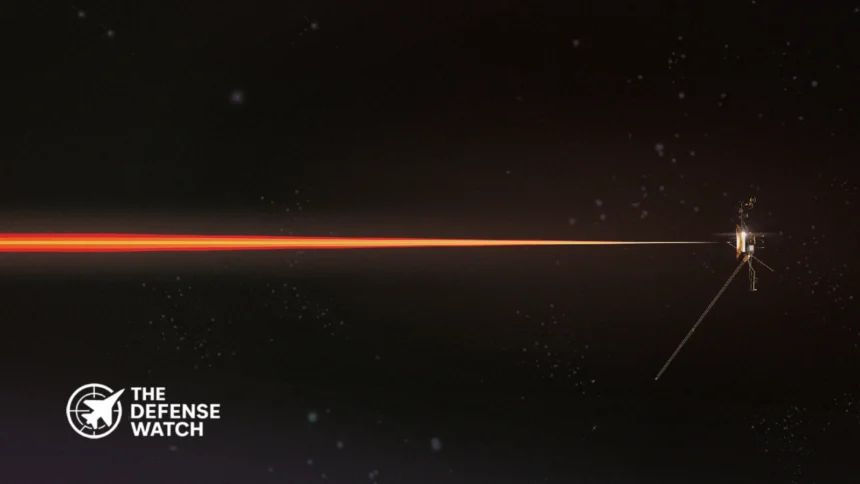
NASA’s Voyager 1 spacecraft has crossed a distance milestone that illustrates the extraordinary scale of interstellar exploration. The probe reached a position approximately 16.1 billion miles (25.9 billion kilometers) from Earth on November 18, 2026, putting it one light-day away from its home planet.
The milestone means a radio signal now requires approximately 24 hours to travel between Earth and Voyager 1 in either direction. A command sent from mission control therefore takes about a day to reach the spacecraft, while its response requires another day to return.
NASA confirmed the achievement in a November 19 announcement. The spacecraft has been traveling through space for more than 49 years since its launch in 1977, making it the most distant human-made object from Earth.
The achievement comes while engineers at NASA’s Jet Propulsion Laboratory (JPL) are dealing with a technical issue affecting the spacecraft’s transmission of scientific and engineering data.
A distance milestone with a 24-hour communications delay
A light-day describes the distance light travels in 24 hours, rather than a measurement of time experienced by the spacecraft.
Light travels at approximately 186,000 miles (299,000 kilometers) per second in a vacuum. At that speed, Voyager 1’s distance from Earth is equivalent to roughly 16.1 billion miles.
The communications delay has practical consequences for mission operations. Engineers cannot interact with the spacecraft in real time, and troubleshooting requires patience because every command and response must cross the enormous distance separating the probe from Earth.
NASA’s Jet Propulsion Laboratory has explained that a complete command-and-response exchange can take approximately 48 hours, excluding the additional time needed for engineers to assess the returned information and prepare subsequent instructions.
This delay also demonstrates the limitations of conventional spacecraft operations at interstellar distances. Automated systems aboard Voyager must maintain essential functions without immediate intervention from Earth.
Voyager 1 is still transmitting, but scientific data remain unavailable
The historic distance milestone coincided with a communications problem that NASA was already investigating.
According to NASA’s November 18 mission update, Voyager 1 stopped returning science and engineering data on November 14. Ground controllers were still able to detect its carrier signal, which normally carries information from the spacecraft to receiving antennas on Earth.
The continued carrier signal provided important evidence that parts of the communications system remained functional.
NASA said the spacecraft’s attitude-control system was maintaining its orientation toward Earth, while its antenna and radio transmission equipment continued operating. However, the absence of science and engineering data suggested a problem with the onboard computer responsible for collecting information from spacecraft subsystems and preparing it for transmission.
Engineers are investigating the cause and possible corrective actions. NASA has not publicly established the precise cause of the latest data interruption.
The situation also illustrates how difficult fault diagnosis becomes when a spacecraft operates billions of miles away. Engineers must work with incomplete information and allow for the long communications delay between individual troubleshooting steps.
A spacecraft designed for the outer planets became an interstellar explorer
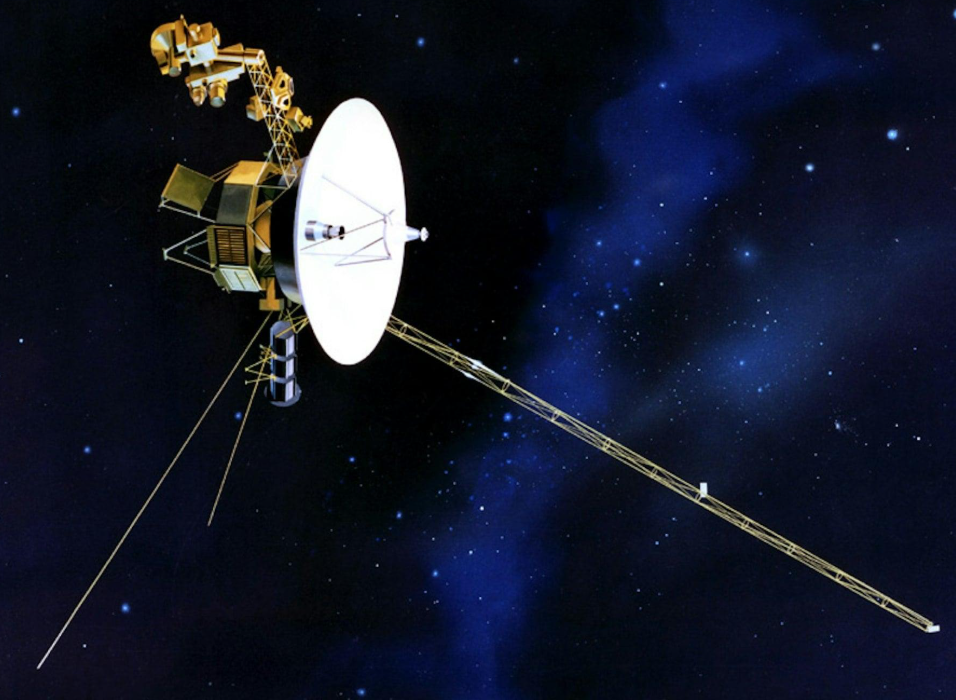
Voyager 1 launched on September 5, 1977, as part of NASA’s twin Voyager planetary exploration program. Its original mission focused on studying the outer planets, particularly Jupiter and Saturn.
The spacecraft returned detailed observations of these distant worlds and their moons, helping scientists improve their understanding of the outer solar system.
Its twin, Voyager 2, launched earlier, on August 20, 1977. Voyager 2 went on to visit Jupiter, Saturn, Uranus and Neptune, becoming the first spacecraft to conduct close-up investigations of the two ice giants.
Voyager 1 followed a different trajectory after its encounters with Jupiter and Saturn, continuing outward toward interstellar space.
In 2012, it became the first human-made spacecraft to cross the heliopause, the boundary separating the Sun’s heliosphere from the surrounding interstellar environment. Voyager 2 crossed the boundary in 2018.
Both spacecraft are now conducting measurements in interstellar space, providing direct observations of an environment that cannot be studied in the same way using measurements from inside the heliosphere.
Keeping a 49-year-old spacecraft operational
Voyager 1 was designed for a much shorter primary planetary mission. Its continued operation depends on engineering solutions that compensate for aging equipment and a steadily declining electrical power supply.
The spacecraft receives electricity from a radioisotope thermoelectric generator (RTG). The system converts heat produced by the radioactive decay of plutonium into electrical power.
Unlike solar-powered spacecraft operating closer to the Sun, Voyager 1 cannot rely on solar panels to generate sufficient electricity at its present distance.
NASA says the Voyagers lose approximately four watts of available electrical power each year as their plutonium fuel decays. This gradual reduction has forced engineers to switch off equipment and prioritize the systems needed to maintain communications and scientific operations.
In September 2026, engineers completed an energy-saving operation known as Big Bang. The effort involved switching off three devices and replacing them with three lower-power alternatives.
The changes were designed to reduce electricity consumption while maintaining the spacecraft’s thermal conditions. NASA expects the adjustments to help preserve the remaining scientific instruments until at least the spacecraft’s 50th launch anniversary in 2027.
The engineering challenge is becoming increasingly difficult. Every instrument or subsystem that is switched off reduces the spacecraft’s ability to collect information or perform certain functions.
However, keeping the remaining scientific equipment operational is particularly important because Voyager 1 and Voyager 2 are the only spacecraft that have directly explored interstellar space.
Why Voyager 1 still matters to space science
Voyager 1’s importance extends beyond the distance it has traveled.
Its instruments have provided measurements of magnetic fields, charged particles and cosmic radiation outside the Sun’s protective heliosphere. These observations help researchers understand how the solar wind interacts with the interstellar environment.
The spacecraft has also helped scientists investigate how far the Sun’s influence extends into surrounding space.
NASA continues to use the Voyager mission as part of its broader heliophysics research effort. Its observations provide a reference point for understanding the boundary between the solar environment and interstellar space.
The mission also demonstrates the value of long-duration spacecraft engineering. Voyager 1’s continued operation has required successive generations of engineers to understand aging hardware, preserve limited electrical power and maintain communication across unprecedented distances.
For future deep-space missions, these lessons have practical relevance. Spacecraft traveling far beyond Earth will need reliable autonomous systems, long-lasting power sources and communication architectures capable of operating with substantial delays.
Voyager 1’s experience does not provide a direct blueprint for every future mission, but it offers decades of operational evidence about the challenges of maintaining spacecraft far from Earth.
The next challenge is extending the mission
NASA has not announced a fixed date for ending Voyager 1 operations. The mission team intends to continue collecting scientific information for as long as the spacecraft’s remaining systems allow.
Its immediate challenge is resolving the November data transmission problem while preserving limited power reserves.
The Deep Space Network, which uses large radio antennas at facilities around the world, remains essential to maintaining contact with Voyager 1 and its twin.
As the spacecraft continues outward, communication will become increasingly difficult. Eventually, declining power or an unresolvable hardware problem will end its ability to transmit information.
For now, Voyager 1 remains an operational interstellar spacecraft, although its latest data interruption limits what scientists can currently receive.
Reaching one light-day from Earth is not a new physical phase for the probe. It does, however, establish a clear measure of how far human engineering has carried a working spacecraft, and how difficult maintaining contact becomes at interstellar distances.
Enjoying our coverage?
Make The Defense Watch a preferred source on Google to see more of our geopolitical and defense insights when relevant to you.