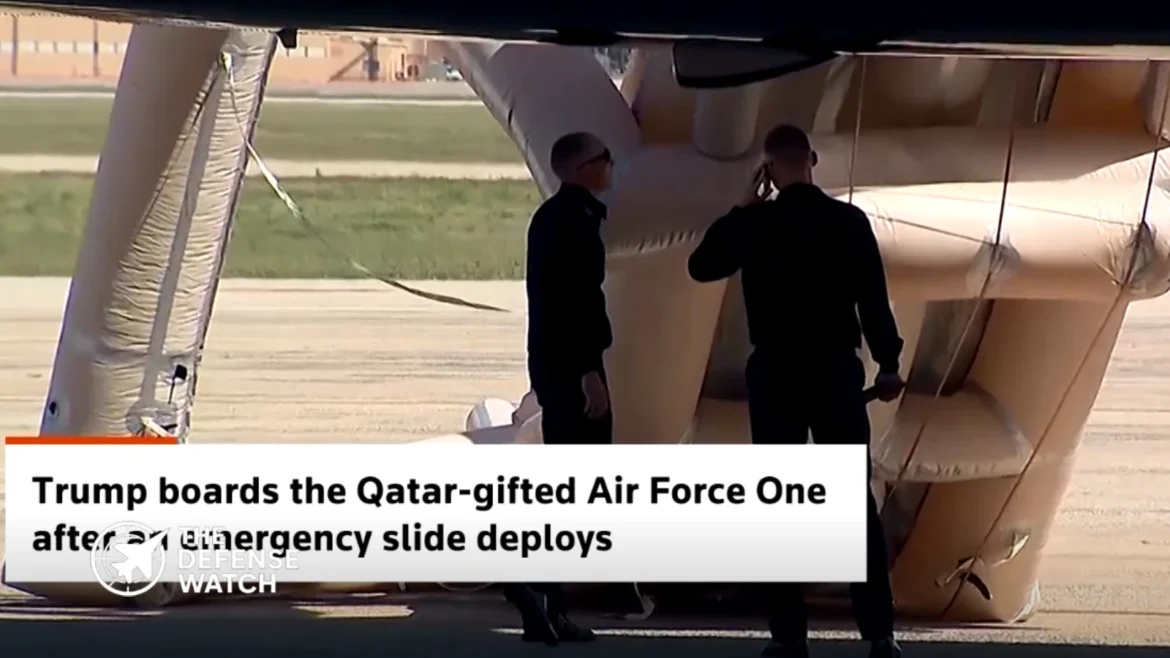
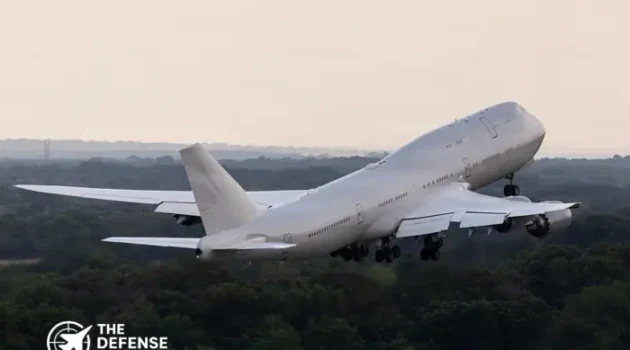
An accidental emergency slide deployment briefly delayed President Donald Trump’s departure aboard the Qatar-gifted Boeing 747, highlighting the safety checks required on the aircraft now serving as an interim presidential transport.
Takeaways
The Qatari-gifted Air Force One experienced an accidental emergency slide deployment before President Donald Trump’s September 9 departure from Joint Base Andrews.
Qatari-Gifted Air Force One Experiences Emergency Slide Deployment
The Qatari-gifted Air Force One experienced an accidental emergency slide deployment on September 9 as President Donald Trump prepared to depart Joint Base Andrews, Maryland, for Dallas, Texas.
The incident caused a short delay before the aircraft departed. Reuters reported that the inflatable evacuation slide was accidentally deployed by military personnel shortly before boarding. The slide was removed before takeoff, and Trump subsequently traveled aboard the aircraft.
The incident involved one of the aircraft’s emergency evacuation slides. Reuters reported that the Boeing 747 has 12 inflatable evacuation slides intended to provide emergency evacuation capability for passengers.
The U.S. Air Force had not publicly provided a detailed explanation of the incident at the time of the Reuters report.
Trump Continues To Use Qatar-Gifted Aircraft
The aircraft involved is a Boeing 747-8 that was provided by Qatar and subsequently modified for presidential transportation.
Trump began using the aircraft on July 1, following an accelerated refurbishment program. The aircraft has been used as an interim presidential transport while the U.S. Air Force moves toward its longer-term replacement for the aging VC-25A fleet.
The Air Force identified the modified aircraft as a VC-25B Bridge aircraft when it arrived at Joint Base Andrews in June. The service said the aircraft had received government modifications and would undergo commissioning flights to validate safety, security and communications systems before entering presidential service.
The distinction is important because Air Force One is technically a radio call sign used when the president is aboard a U.S. Air Force aircraft. The aircraft itself is a presidential transport platform.
The existing VC-25A fleet consists of two heavily modified Boeing 747-200B aircraft assigned to the Presidential Airlift Group at Joint Base Andrews. The Air Force describes their mission as providing presidential air transportation with specialized communications and other systems.
Why The Emergency Slide Incident Matters
An accidental evacuation slide deployment is primarily a safety and maintenance issue based on the information currently available. There is no evidence in the Reuters report that the incident was caused by a structural failure, hostile action or an aircraft-wide safety problem.
The timing nevertheless matters because the aircraft is being used for one of the most sensitive transportation missions in the U.S. government.
Presidential aircraft must combine conventional aviation safety with secure communications, specialized mission systems and procedures designed to support the continuity of government. That makes commissioning, inspection and maintenance particularly important for an aircraft that has been rapidly converted for presidential use.
The U.S. Air Force said in June that the VC-25B Bridge aircraft was beginning commissioning flights to validate safety, security and communications systems. The service described the aircraft as a temporary capability intended to reduce pressure on the aging VC-25A fleet while the longer-term presidential aircraft program continues.
The September 9 slide deployment therefore does not, by itself, establish a broader aircraft safety deficiency. It does show why operational checks remain important when a modified commercial widebody aircraft is introduced into the presidential airlift mission.
Additional Security Upgrades Remain Planned
The emergency slide incident comes after months of attention surrounding the security configuration of the Qatari-gifted aircraft.
In July, Trump said the aircraft would undergo additional upgrades after questions were raised about its defensive capabilities. Reuters subsequently reported that experts had questioned whether a short upgrade period would be sufficient to significantly enhance the aircraft’s defenses.
The exact configuration of presidential security systems is not publicly disclosed, and specific capabilities should therefore not be inferred from the aircraft’s commercial origins or from the emergency slide incident.
Trump has also said the aircraft would be taken out of service for additional work. Reuters reported on September 9 that the aircraft was expected to undergo a 60-day period of unspecified security upgrades beginning in October.
This planned work is separate from the emergency slide deployment. No public evidence currently connects the two events.
Air Force One Role And Aircraft Transition
The Qatari-gifted aircraft is being used during a transition period for the U.S. presidential airlift fleet.
The current VC-25A aircraft have served presidents since the early 1990s. The Air Force says the aircraft include specialized communications equipment, medical facilities, presidential accommodations and the ability to support in-flight refueling.
The VC-25B Bridge aircraft provides an interim option while the next-generation presidential aircraft program progresses.
That transition creates a practical requirement for the Air Force to balance availability with the extensive testing and certification requirements associated with presidential transportation.
For the Qatari-gifted aircraft, the September 9 incident was resolved before departure, and the aircraft completed the planned flight to Dallas.
What Happens Next
The immediate issue is expected to remain focused on determining why the emergency slide deployed and confirming that the aircraft is ready for continued operation.
The incident should not be treated as evidence of a larger technical failure without additional findings from the Air Force or other authorities.
More significant for the aircraft’s longer-term role will be the planned security and mission-system upgrades scheduled for the coming months. Those modifications are expected to determine how the aircraft is configured for future presidential missions and how long it remains in the interim fleet.
For now, the Qatari-gifted Air Force One remains an operational presidential transport. The accidental slide deployment caused a delay, but the aircraft departed after the issue was addressed.
Iran Missile Attack On Jordan Puts Patriot Defense Under Pressure
The Iran missile attack on Jordan has highlighted both the effectiveness and the cost of modern ballistic missile defense after Iranian forces launched 20 ballistic missiles toward Jordan overnight.
Takeaways
Jordan confirmed that 18 of 20 Iranian ballistic missiles were intercepted during the latest attack, while claims of extensive Patriot interceptor use remain unverified.
The Jordanian Armed Forces said its air defense systems intercepted and destroyed 18 of the incoming missiles. The remaining two missiles fell in unpopulated areas, and Jordan reported no casualties from the attack.
The attack targeted the Al-Azraq area, where the U.S.-used Muwaffaq Salti Air Base is located. Iran’s Islamic Revolutionary Guard Corps claimed that its operation targeted facilities associated with U.S. aircraft, including F-35, F-16 and F-15 fighter operations.
Iran also claimed that the strike caused heavy damage. Those claims have not been independently verified. A U.S. official cited in current reporting said the Iranian attack was ineffective and that all American personnel were accounted for.
What The Jordanian Military Confirmed
The most reliable figure currently available is the Jordanian military’s account of the engagement.
According to the Jordanian Armed Forces, 20 ballistic missiles were launched from Iranian territory toward Jordan. Eighteen were intercepted and destroyed, while two reached areas away from population centers.
Jordanian authorities said specialized teams were deployed to deal with missile debris and warned residents not to approach unidentified fragments.
The 18 successful interceptions represent a 90 percent interception rate based on the number of missiles Jordan says were launched.
That figure does not, however, tell us how many interceptor missiles were fired.
How Many Patriot Missiles Were Fired?
Video footage circulating online shows multiple Patriot air defense launch sequences during the Iranian attack.
Open-source analysts have attempted to count individual launches visible in nighttime footage. One current OSINT estimate places the number of Patriot interceptor launches between approximately 60 and more than 100.
That estimate should be treated cautiously.
Video footage can contain overlapping launches from different batteries, multiple camera angles can capture the same engagement, and launch flashes do not by themselves establish the specific interceptor variant used. It is therefore not possible to state as fact that 60 to 100 PAC-3 MSE missiles were fired.
Neither the U.S. military nor the Jordanian government has publicly released an official interceptor expenditure figure for this engagement.
That distinction is important when assessing the financial impact of the Iran missile attack on Jordan.
What Would 60 To 100 PAC-3 MSE Interceptors Cost?
The PAC-3 MSE is one of the most expensive interceptors in the U.S. air defense inventory.
Reuters reported in 2025 that the U.S. Army’s $9.8 billion Patriot contract covered 1,970 PAC-3 MSE interceptors and associated hardware, with the missile costing about $4 million each according to Army budget documents.
The Center for Strategic and International Studies has similarly estimated the PAC-3 MSE at about $4.1 million per missile.
Using a simplified $4 million per interceptor calculation:
60 interceptors × $4 million = $240 million
100 interceptors × $4 million = $400 million
If a $5 million per missile assumption is used, the equivalent range becomes approximately $300 million to $500 million.
Those numbers should not be described as the confirmed cost of the Jordan engagement.
They represent the estimated procurement value of the number of interceptors assumed to have been launched. Actual costs can differ depending on procurement contracts, accounting methods, missile configuration and other associated expenses.
Why The Numbers Matter
The Iran missile attack on Jordan illustrates a central challenge in modern air defense.
Defenders may need to fire several interceptors against a single incoming ballistic missile when the threat is considered sufficiently dangerous. That can create a major imbalance between the cost of the attacking weapon and the defensive interceptor.
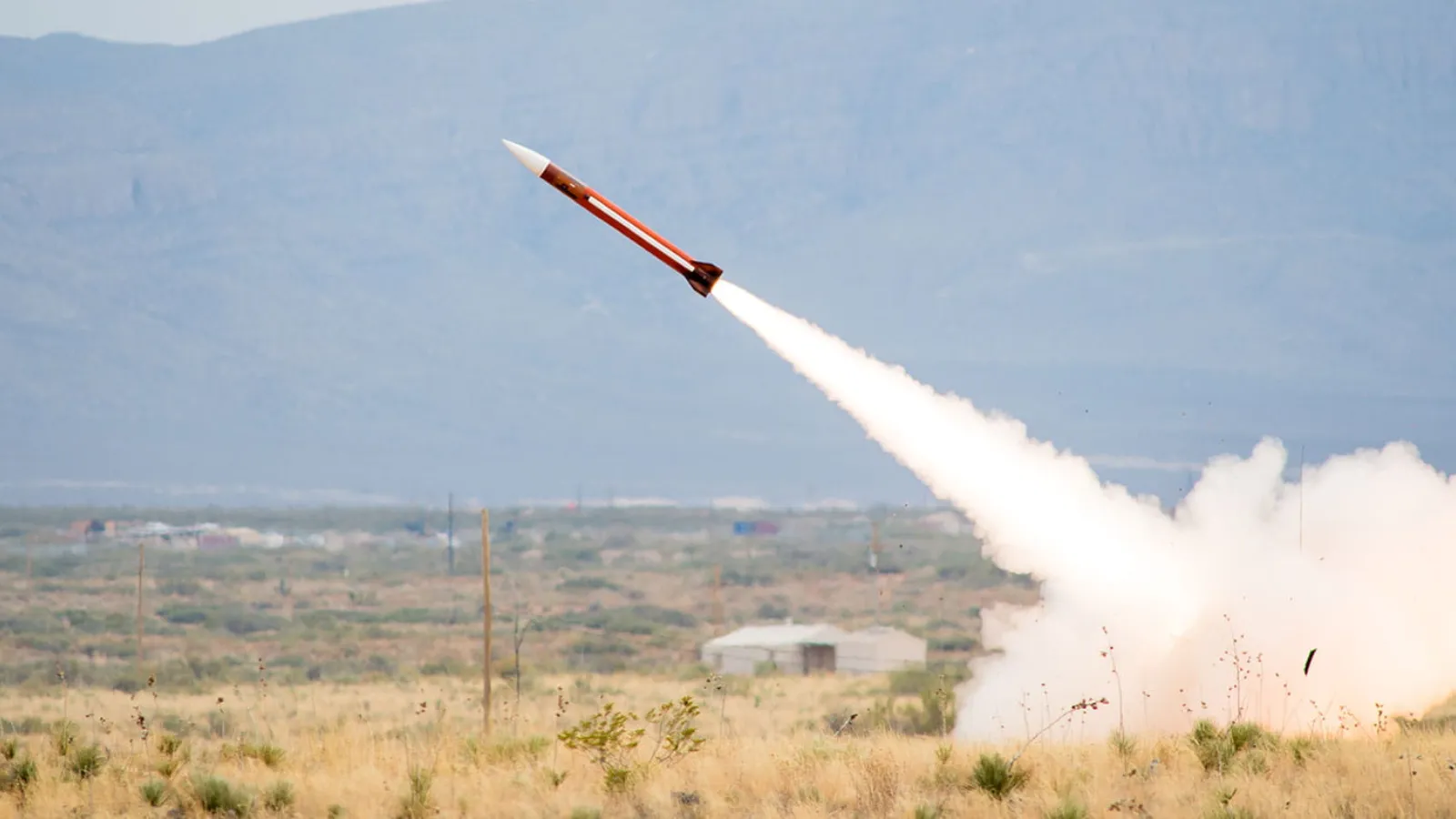
The Patriot system is designed to provide a high-end defensive layer against ballistic missiles and other airborne threats. PAC-3 interceptors use hit-to-kill technology, meaning the interceptor is designed to destroy the incoming target through direct collision rather than relying primarily on a conventional explosive warhead.
The system’s effectiveness comes with a significant logistical burden.
The U.S. and its allies are already expanding Patriot interceptor production because of demand from multiple theaters. In September 2025, Lockheed Martin received a $9.8 billion U.S. Army contract covering 1,970 PAC-3 MSE missiles and associated hardware.
In July 2026, Lockheed Martin also announced the PAC-3 ACE, a lower-cost interceptor intended to reduce the cost burden associated with using high-end Patriot missiles against a wider range of threats. Reuters reported that the new interceptor is expected to cost less than half as much as the PAC-3 MSE.
The development reflects a wider problem facing missile defense forces: expensive interceptors can provide effective protection, but sustained high-volume attacks can place pressure on missile inventories and industrial production.
A Larger Escalation Between Iran And The United States
The Iran missile attack on Jordan followed a sharp escalation involving Iranian oil tankers and U.S. forces.
Reuters reported that the United States had destroyed five Iranian oil tankers after accusing Iran of targeting a U.S. Navy warship with ballistic missiles. Iran subsequently launched the ballistic missile attack toward Jordan.
The sequence demonstrates how military pressure has expanded beyond direct exchanges between U.S. and Iranian forces.
Jordan has become an important geographic location because of its cooperation with the United States and its role in regional military operations. The Al-Azraq facility has been used by U.S. and allied forces for operations in the Middle East.
The latest attack also comes amid wider Iranian threats and attacks involving shipping around the Strait of Hormuz, adding another layer of risk to an already volatile regional security environment.
What Remains Unknown
Several important details remain unavailable.
It is not publicly known how many Patriot batteries participated in the engagement, how many interceptors were fired by each battery, or whether every visible launch in the circulating footage involved a PAC-3 MSE.
The identities of the specific Iranian ballistic missiles used in the attack have also not been independently established in the available reporting.
Likewise, there is no confirmed public evidence supporting Iran’s claim of heavy damage to U.S. facilities at Al-Azraq.
For that reason, the most defensible assessment is that Jordan successfully intercepted the overwhelming majority of the reported Iranian missile salvo, while the precise scale and financial cost of the Patriot response remain unconfirmed.
Defense Industry Implications
The engagement could add to pressure on the U.S. defense industrial base to produce more affordable missile interceptors at higher rates.
The issue is not limited to Iran. Patriot systems are heavily committed across several theaters, while the United States and its allies are simultaneously seeking additional air and missile defense capacity.
A high-volume ballistic missile exchange can therefore consume interceptors far faster than peacetime planning assumptions might suggest.
The reported 60 to 100 plus launches, if later confirmed, would represent a significant expenditure in a single engagement. But until the U.S. military releases an official expenditure figure, the number should remain classified as an open-source estimate.
That distinction is essential for accurate reporting and for understanding the real cost of modern missile defense.
Bottom Line
The latest Iran missile attack on Jordan was a significant ballistic missile engagement, but the confirmed facts are narrower than some social media claims suggest.
Jordan says Iran launched 20 ballistic missiles and that 18 were intercepted, with two landing in unpopulated areas and no reported casualties. Iran claims it struck U.S.-linked military facilities, while U.S. officials have described the attack as ineffective.
OSINT analysis of video footage suggests that dozens of Patriot interceptors may have been launched, potentially exceeding 100 according to some estimates. That figure has not been officially confirmed.
At approximately $4 million per PAC-3 MSE interceptor, 60 to 100 launches would correspond to a notional missile value of roughly $240 million to $400 million. Using a $5 million assumption would increase that calculation to as much as $500 million.
The episode nevertheless demonstrates the growing financial and industrial challenge of defending against large missile salvos with high-end interceptors.
Iran Claims US Destroyers Were Hit
The claim that Iran attacks US destroyers successfully is not supported by available U.S. military evidence. Iran’s Islamic Revolutionary Guard Corps has claimed that its forces struck two U.S. Navy destroyers in retaliation for American attacks on Iranian oil tankers, but U.S. Central Command says Iranian missile attacks against American warships failed.
Takeaways
Iran claims it struck two U.S. Navy destroyers, but available U.S. military reporting shows that Iranian attacks failed and no U.S. warship has been confirmed hit.
The IRGC identified the American vessels as USS Delbert D. Black, DDG-119, and USS John Paul Jones, DDG-53, according to Iranian state media reports. Tehran claimed its ballistic missile attacks caused significant damage.
There is no independent evidence supporting that claim.
Instead, U.S. Central Command has repeatedly stated that Iranian attacks against U.S. Navy vessels were unsuccessful. On Sept. 5, CENTCOM said an American aircraft carrier and a guided-missile destroyer successfully evaded multiple Iranian ballistic missile attacks, with no American personnel injured.
On Sept. 8, CENTCOM reported another attempted Iranian missile attack against a U.S. Navy warship. The American vessel successfully evaded the attack and continued operating in regional waters. No U.S. personnel were harmed.
No U.S. Warship Has Been Confirmed Hit
The distinction between an attempted attack and a successful strike is critical.
Iranian forces have launched ballistic missiles toward U.S. naval assets during the latest escalation. However, available U.S. military reporting indicates that the attacks failed to hit their intended targets.
CENTCOM’s Sept. 5 statement specifically said an American aircraft carrier and guided-missile destroyer evaded multiple attacks. The command subsequently destroyed three Iranian crude oil carriers in retaliation.
The latest U.S. operation on Sept. 8 followed another two attempted missile attacks against a U.S. Navy warship. Again, CENTCOM said the ship was not hit.
Reuters likewise reported that Iran had claimed attacks against two U.S. vessels, while U.S. officials said Iranian attacks against American warships had been ineffective.
As a result, the IRGC’s assertion that it successfully struck two U.S. destroyers should be treated as an unverified Iranian claim, not as a confirmed battlefield event.
US Has Destroyed Eight Iranian Oil Tankers In Four Days
While Iran claims to have damaged U.S. warships, the United States has carried out confirmed strikes against Iranian oil carriers.
CENTCOM said U.S. forces destroyed three Iranian crude oil carriers on Sept. 5 after the IRGC attempted to attack two U.S. Navy warships. The vessels were M/T Downy, M/T Stark 1 and M/T Kylo, also known as Noxen.
On Sept. 8, American forces destroyed another five Iranian crude oil carriers.
CENTCOM identified those vessels as M/T Kaviz, M/T Charminar, M/T Horizon 1, M/T Riesco and M/T Derya. Four were struck in the Gulf of Oman, while M/T Derya was attacked near Iran’s Kharg Island.
That brings the total reported by CENTCOM to eight Iranian oil tankers destroyed or rendered inoperable since Sept. 5.
The distinction matters because reports circulating online have referred to 10 Iranian tankers. Current CENTCOM material reviewed for this report supports a total of eight in the Sept. 5 and Sept. 8 operations.
Tankers Linked To IRGC Financing Network
Washington says the targeted vessels were not simply commercial ships caught in the fighting.
CENTCOM described the Iranian tankers as part of a multibillion-dollar shadow network used to generate revenue for the IRGC and its regional partners. The command said Iran has limited ability to protect the exposed oil fleet from U.S. military action.
The U.S. campaign therefore combines military retaliation with economic pressure.
The basic pattern has become clear. Iranian forces attempt to attack U.S. naval assets, while American forces respond by imposing costs on Iranian oil infrastructure and shipping connected to the IRGC.
That dynamic has turned commercial oil carriers into an increasingly important part of the military confrontation around the Strait of Hormuz.
Iran Retaliates Around Strait Of Hormuz
Iran has responded to the tanker strikes with attacks against shipping in the Gulf and around the Strait of Hormuz.
The IRGC claimed it attacked two American vessels and eight oil tankers after the U.S. strikes. Iranian forces also said they targeted additional vessels attempting to cross what Tehran described as a prohibited or unsafe area.
Those claims come as commercial shipping faces increasing danger in the region.
The United Kingdom Maritime Trade Operations agency reported that several merchant vessels in the northern Gulf and Gulf of Oman were hit by disabling fire during overnight military activity. UKMTO said it could not immediately confirm casualties or environmental consequences.
The incidents underline the widening risk to commercial shipping as the U.S. and Iran increasingly use maritime pressure as part of the conflict.
Iran Also Fired Missiles At US Forces In Jordan
The latest Iranian response was not limited to the maritime domain.
Iran launched ballistic missiles toward the Al Azraq area in Jordan following the U.S. tanker strikes. Jordanian authorities said most of the missiles were intercepted, while others fell in unpopulated areas. No casualties were reported in the initial accounts.
Iranian state media subsequently claimed damage to U.S. military facilities in Jordan.
Those claims also require careful attribution. The available reporting does not establish that Iran inflicted the level of damage claimed by Iranian authorities.
The broader pattern is nevertheless clear: Tehran is responding to U.S. pressure through a combination of missile attacks, maritime operations and threats against commercial shipping.
Why The US Navy Destroyer Claims Matter
The claim that Iran attacks US destroyers successfully would represent a major escalation if independently confirmed.
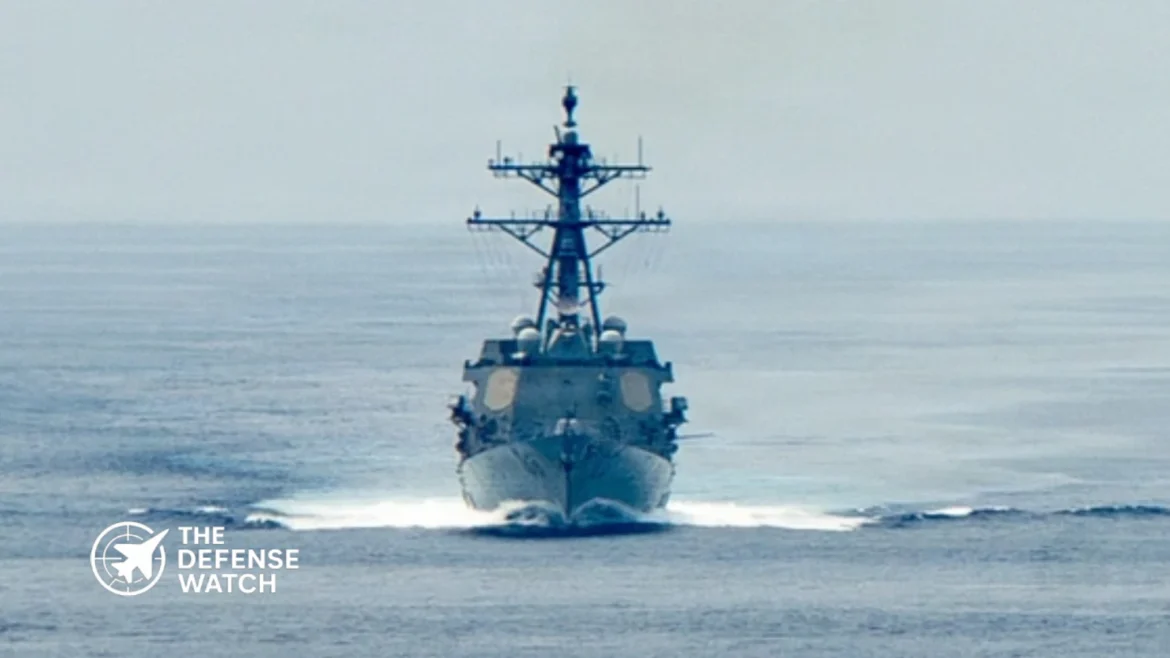
Arleigh Burke-class guided-missile destroyers are among the U.S. Navy’s principal surface combatants. They provide air defense, missile defense, anti-surface warfare and escort capabilities for larger naval formations.
Iran’s ability to launch ballistic missiles against these ships therefore remains a significant operational concern even when the attacks fail.
The available evidence, however, currently points to unsuccessful Iranian attacks rather than confirmed damage to U.S. warships.
This distinction is particularly important because battlefield claims can spread quickly during an active conflict. Images, videos and statements released by either side may not independently establish the outcome of an attack.
For TheDefenseWatch, the most defensible assessment is straightforward: Iran attempted to strike U.S. Navy warships, but no U.S. Navy warship has been confirmed struck in these incidents.
US Retaliation Has Produced A Different Result
The contrast between the two sides’ claims is notable.
Iran has claimed successful attacks against American naval vessels, while U.S. officials say those attacks failed.
At the same time, CENTCOM has released footage and official statements documenting American strikes against Iranian oil carriers. The command has confirmed three tanker losses from Sept. 5 and five more from Sept. 8.
That makes the latest exchange more than a conventional missile-for-missile confrontation.
It is also an economic battle focused on Iran’s oil-export capacity.
The United States is attempting to impose direct costs on a maritime network Washington says supports the IRGC, while Iran is attempting to make the waters around the Strait of Hormuz dangerous for U.S.-linked and commercial shipping.
What Happens Next
The immediate military question is whether Iran will attempt another attack against U.S. naval forces.
The maritime question is equally important.
The Strait of Hormuz remains one of the world’s most strategically important energy routes, and continued attacks on shipping could further reduce commercial traffic and increase pressure on global oil markets. Reuters reported that shipping activity through the strait has already fallen sharply amid the recent exchanges.
The latest incidents also demonstrate the limits of relying on battlefield claims alone.
Iran says it struck two U.S. destroyers. U.S. officials say Iranian attacks failed. Independent reporting has not established that any American destroyer was hit.
What is confirmed is that Iranian forces attempted attacks against U.S. naval assets and that U.S. forces subsequently destroyed eight Iranian oil tankers in operations announced by CENTCOM on Sept. 5 and Sept. 8.
For now, that is the clearest verified picture of the latest U.S.-Iran maritime confrontation.
Iran has claimed a new round of attacks on U.S. naval vessels as the confrontation around the Strait of Hormuz intensifies following U.S. strikes on Iranian oil tankers.
Takeaways
Iran claims it attacked two U.S. destroyers after Washington struck Iranian oil tankers, but the alleged damage has not been independently confirmed.
Iran Claims Attacks On Two US Destroyers
Iran’s Islamic Revolutionary Guard Corps, or IRGC, says it attacked two U.S. naval vessels and eight oil tankers in the Persian Gulf in retaliation for American strikes on Iranian crude carriers. The claims mark another escalation in a rapidly intensifying confrontation around the Strait of Hormuz.
The IRGC said Wednesday that its naval forces targeted two American vessels and eight oil tankers after U.S. forces struck five Iranian oil tankers the previous day. Iranian state media said the attacks caused significant damage, but Tehran did not provide independently verifiable evidence showing that either U.S. warship was hit.
The latest claims come after the U.S. military said Iranian forces had twice attempted to attack a U.S. Navy warship with ballistic missiles over two days. Washington said the attacks failed and that no American personnel were injured.
US Strikes Five Iranian Oil Tankers
The immediate trigger for the latest Iranian claims was a major U.S. military operation against Iranian oil shipping.
U.S. Central Command said American forces destroyed five Iranian crude oil carriers on Sept. 8 in the Gulf of Oman and near Iran’s Kharg Island. CENTCOM said the crews were directed to abandon the vessels before the strikes and that the ships were rendered inoperable.
The operation followed what CENTCOM described as repeated ballistic missile attacks by the IRGC against a U.S. Navy warship.
The tanker strikes expanded an earlier U.S. campaign against Iranian oil shipping. On Sept. 5, CENTCOM said it struck three Iranian crude carriers after Iran launched ballistic missiles toward two U.S. Navy warships operating in regional waters.
According to CENTCOM, the U.S. permanently disabled the M/T Downy near Kharg Island and the M/T Stark 1 near Jask. It also destroyed the unladen M/T Kylo, also known as the Noxen, in the Gulf of Oman.
CENTCOM said the three vessels were connected to what it described as a multibillion-dollar network supporting the IRGC and its regional partners.
Iran Claims Damage To US Warships
Iran’s latest statement raises the stakes because it specifically claims attacks against U.S. naval combatants.
Iranian reporting identified the vessels in some accounts as the guided-missile destroyers DDG-119 and DDG-53. DDG-119 is the Arleigh Burke-class USS Delbert D. Black, while DDG-53 is USS John Paul Jones. However, the identification and alleged damage have not been independently confirmed by the U.S. military.
The distinction is important.
Iran has made claims of successful attacks during the current conflict, while U.S. officials have described previous Iranian attacks against American warships as unsuccessful. CENTCOM said its aircraft carrier and guided-missile destroyer evaded multiple Iranian attacks during the Sept. 5 incident.
As of the latest available reporting, there was no U.S. confirmation that two destroyers had been damaged or disabled in the latest Iranian operation.
That makes the IRGC’s claim a reported battlefield assertion rather than an independently established fact.
Strait Of Hormuz Becomes Central Flashpoint
The confrontation is increasingly centered on the Strait of Hormuz and surrounding waters.
Iran has warned commercial vessels about operating in areas it considers restricted or unsafe. The IRGC said it had also targeted 10 other vessels that attempted to enter a restricted area around the strait, accusing them of operating with U.S. military support.
The waterway is one of the world’s most important energy corridors, linking the Persian Gulf with the Gulf of Oman and the Arabian Sea.
The growing military confrontation is already affecting energy markets. Reuters reported that uncertainty over the volume of oil moving through the Strait of Hormuz has increased sharply as competing blockades, attacks and vessel-tracking disruptions make normal shipping estimates difficult.
Brent crude also moved sharply higher as the latest attacks raised concerns about further disruptions to regional energy supplies.
Iran Also Targeted A US Base In Jordan
The maritime claims came alongside an Iranian missile attack against U.S. forces in Jordan.
Iran said it launched ballistic missiles at the Al Azraq area in retaliation for the U.S. strikes on Iranian oil tankers. Jordan said its air defenses intercepted 18 of 20 missiles, with the remaining two falling in unpopulated areas. No casualties were reported from that attack, according to Reuters.
Iranian state media subsequently reported the claims against U.S. naval vessels and commercial tankers, broadening the scope of Tehran’s stated response beyond the immediate maritime confrontation.
The sequence illustrates how quickly the conflict is spreading across multiple domains, including naval operations, ballistic missile attacks and commercial shipping.
What The Latest Claims Mean For The US Navy
The reported attacks on two U.S. destroyers should be treated cautiously until independently confirmed.
U.S. guided-missile destroyers are designed for multiple missions, including air defense, ballistic missile defense, anti-surface warfare and protection of larger naval formations. The ships can operate independently or as part of carrier and expeditionary strike groups.
Their presence in the region is particularly important as Washington attempts to protect maritime traffic while applying military and economic pressure against Iran.
The latest escalation also demonstrates the interaction between military and economic pressure. Washington has targeted Iranian oil shipping after attacks on U.S. naval forces, while Tehran has responded by threatening American vessels and commercial shipping.
That cycle creates a wider risk for merchant traffic operating around the Persian Gulf, Strait of Hormuz and Gulf of Oman.
The Key Question Is Verification
For now, the central unanswered question is whether any U.S. warship sustained damage in the latest Iranian operation.
The IRGC says it attacked two American vessels and eight tankers. Iranian state media has presented the claims as retaliation for U.S. attacks on Iranian oil shipping.
The United States, however, has not publicly confirmed that two destroyers were struck or suffered damage in the reported incident.
That distinction should remain central to coverage of the developing confrontation.
The confirmed sequence is already significant: Iranian ballistic missile attacks on U.S. naval forces, U.S. strikes against Iranian oil tankers, an Iranian missile attack on U.S. forces in Jordan, and new Iranian claims against American warships and commercial vessels.
If the reported attacks on U.S. destroyers are subsequently confirmed, the incident would represent another major escalation in the maritime confrontation. Until then, the claims remain unverified.
General Dynamics Demonstrates LR-PGK Precision Beyond 50 Kilometers
General Dynamics Ordnance and Tactical Systems has demonstrated its Long Range Precision Guidance Kit, or LR-PGK, guiding 155mm XM1113 rocket assisted projectiles beyond 50 kilometers during a field test at U.S. Army Yuma Proving Ground. General Dynamics said the September 2 demonstration was the first U.S. guidance kit demonstration of accurate 155mm cannon artillery guidance at a range exceeding 50 kilometers.
Takeaways
General Dynamics Ordnance and Tactical Systems demonstrated its LR-PGK guidance technology with XM1113 155mm rocket assisted projectiles at ranges beyond 50 kilometers.
The result is significant because the Army is trying to extend cannon artillery reach while maintaining precision and improving the ability of artillery units to operate against capable adversaries. The demonstration also comes as the service accelerates development of more mobile cannon systems and longer range ammunition.
What the LR-PGK Demonstration Shows
During the Yuma test, LR-PGK guided XM1113 rocket assisted projectiles at ranges greater than 50 kilometers. General Dynamics said the demonstrated accuracy substantially exceeded requirements associated with legacy guidance systems.
The demonstration should be distinguished from the maximum range of the projectile itself. XM1113 provides the rocket assisted propulsion and aerodynamic characteristics needed for extended range, while the LR-PGK provides course correction and guidance.
That distinction matters operationally. Extending artillery range without maintaining acceptable accuracy can increase ammunition expenditure and reduce the practical value of the additional reach. A guidance kit allows the Army to pair longer range projectiles with a precision capability rather than treating range and accuracy as separate requirements.
The Army’s current portfolio documentation identifies LR-PGK as a course correcting fuze with enhanced GPS anti-jam capability. The documentation lists the system with XM1113, XM1128 and M795 projectiles and identifies compatibility with M109A6/A7 Paladin, M777A2 and the Mobile Tactical Cannon.
XM1113 Is the Long Range Component
The XM1113 is a 155mm high explosive rocket assisted projectile intended to replace the older M549A1 rocket assisted round in 39 caliber artillery systems.
Earlier Army documentation established a nominal 40 kilometer maximum range for XM1113 when fired from 39 caliber systems. The projectile uses a larger rocket motor and a streamlined external configuration to produce substantially greater range than conventional 155mm ammunition.
The Army’s current ammunition portfolio lists XM1113 with a 37 kilometer range when paired with PGK in 39 caliber systems, 40 kilometers unguided from those systems, and 52 kilometers from 52 caliber weapon systems.
The latest LR-PGK demonstration goes beyond those previously published figures in a different sense. General Dynamics demonstrated the guidance kit controlling an XM1113 projectile beyond 50 kilometers, showing that the guidance technology can function at distances where projectile flight time, navigation error, atmospheric effects and communication with the weapon system become increasingly important.
LR-PGK Brings Precision to Extended Range Fires
The LR-PGK program has been designed around the Army’s requirement for longer range precision cannon fires.
The Army describes the XM1171 and XM1172 LR-PGK configurations as course correcting fuzes with enhanced GPS anti-jam capability. Current Army documentation gives an accuracy threshold of less than 30 meters circular error probable, or CEP, with an objective of less than 10 meters. It also lists a published range of 58 kilometers with XM1113, XM1128 and M795 projectiles.
Those figures provide useful context for the new demonstration.
| Capability | Current Army information |
|---|---|
| Projectile | 155mm XM1113 |
| Guidance system | LR-PGK |
| Demonstrated range | Greater than 50 km |
| Army listed LR-PGK range | 58 km with specified projectiles |
| Accuracy threshold | Less than 30 m CEP |
| Accuracy objective | Less than 10 m CEP |
| GPS capability | Peer threat environment |
| Compatible platforms listed | M109A6/A7, M777A2, Mobile Tactical Cannon |
| Projected full materiel release | FY2031 |
The distinction between demonstrated performance and an acquisition requirement is important. The Yuma event establishes a test result reported by General Dynamics. It does not by itself mean the system has completed every Army qualification, acquisition or fielding step.
Why the 50 Kilometer Threshold Matters
The U.S. Army is rebuilding its cannon artillery architecture around longer range, greater mobility and increased survivability.
Traditional 155mm artillery has generally operated at shorter ranges, creating a tradeoff between the position of friendly artillery units and the depth of targets they can reach. Longer range reduces that constraint and can allow fires units to influence targets farther behind an adversary’s forward positions.
But range alone is not enough.
Modern artillery operations increasingly take place in environments where counter-battery sensors, unmanned aircraft, electronic warfare and long range fires can expose artillery positions. A cannon unit that can reach farther but cannot rapidly move, maintain accurate targeting data or function under electronic attack can remain vulnerable.
That is why the LR-PGK demonstration is relevant beyond the projectile itself. The Army is attempting to combine range, precision, navigation resilience and platform mobility into a broader fires architecture.
Connection to the Mobile Tactical Cannon
The timing of the demonstration is particularly relevant to the Army’s Mobile Tactical Cannon program.
In August 2026, the Army announced an agreement with Hanwha Defense USA for development of Mobile Tactical Cannon prototypes. The agreement covers up to 18 wheeled self propelled howitzer systems for rapid prototyping, testing and Soldier experimentation, with an initial six systems and an option for 12 more.
The Army says MTC is intended to improve mobility, lethality, reliability and survivability, with potential replacement of M777 towed artillery in selected formations if the system is approved for fielding.
The LR-PGK program fits into this modernization effort because Army documentation specifically lists the Mobile Tactical Cannon as an intended integration platform.
This creates an important systems level relationship. A more mobile cannon can reposition faster, while extended range ammunition can allow it to engage targets from greater distances. Precision guidance can then reduce the number of rounds needed to achieve an intended effect, although actual ammunition expenditure will depend on target type, mission conditions and rules of engagement.
GPS Contested Operations Remain a Central Challenge
One of the most important elements of LR-PGK is not simply its maximum range. It is its intended operation in a GPS contested environment.
The Army identifies enhanced GPS anti-jam capability as a core characteristic of the LR-PGK. The program is intended to support operations against peer threats where satellite navigation signals could be degraded, disrupted or interfered with.
This requirement reflects lessons from modern warfare, where electronic warfare can affect navigation and communications across large areas.
A precision artillery projectile traveling more than 50 kilometers has a longer flight path and more time during which guidance errors can accumulate. Maintaining useful accuracy therefore requires not only an effective guidance mechanism but also a navigation architecture capable of dealing with degraded positioning information.
That makes anti-jam performance a major part of the system’s military value rather than a secondary feature.
From XM1113 to the Next Generation of Army Cannon Fires
The Army’s long range artillery effort extends beyond XM1113.
The service has been developing the XM1210, formerly known as XM1113 Extended Range, as a follow-on rocket assisted projectile intended for longer range weapon systems. Army documentation identifies the XM1210 as a follow-on to XM1113 and gives it a maximum effective range of more than 70 kilometers with precision.
The Army’s 2026 budget documentation also describes supercharge propellant development as part of its cannon transformation strategy. The effort is intended to support ranges beyond 50 kilometers from self propelled howitzers using cannon lengths greater than 52 calibers, with a stated objective of achieving lethality out to 70 kilometers with future long range precision fires systems.
This points to an evolutionary approach rather than a single weapon program.
The Army is simultaneously working on projectiles, propelling charges, guidance kits, cannon systems and mobile platforms. The goal is to ensure that improvements in one component do not become constrained by limitations elsewhere in the artillery chain.
The Technical Challenge Is More Than Range
Long range cannon artillery places significant demands on the entire weapon system.
Higher propellant energy creates greater pressure and thermal stress on gun components. Rocket assisted projectiles introduce additional mechanical and thermal considerations because the projectile must survive launch forces before the rocket motor operates during flight.
The Army has previously identified projectile reliability, rocket motor performance, rotating band behavior and protection of the explosive fill from excessive heat as important test areas for XM1113.
Guidance introduces another layer of complexity. The fuze has to survive launch acceleration, operate reliably after firing and provide course corrections without compromising projectile stability or the intended terminal trajectory.
The Yuma demonstration therefore represents one part of a larger engineering problem. Demonstrating precision beyond 50 kilometers is important, but the military value ultimately depends on repeatability, reliability, production capacity, platform integration and performance under operational conditions.
What the Demonstration Means for U.S. Artillery
The LR-PGK test gives the Army another data point in its effort to increase the reach of conventional cannon artillery.
The immediate significance is the demonstrated ability to guide an XM1113 projectile beyond 50 kilometers. The broader significance is the potential to combine extended range ammunition with a guidance system designed for contested navigation environments and newer mobile artillery platforms.
For U.S. forces, this could strengthen the role of cannon artillery between conventional close support and longer range missile systems. Cannon ammunition generally offers a different cost, logistics and volume of fire model from more complex missile weapons, making improvements in range and precision relevant to the Army’s effort to generate massed fires.
The capability is also being developed with allied interoperability in mind. General Dynamics identifies the LR-PGK and associated artillery technologies as solutions intended for the U.S. military and allies, while the Army continues to operate a broad family of NATO standard 155mm systems.
The next measure will be whether the demonstrated performance can translate into repeatable qualification results, production and eventual operational fielding.
For now, the Yuma test establishes a clear milestone: General Dynamics says its LR-PGK has demonstrated guided 155mm artillery beyond the 50 kilometer mark, while the U.S. Army continues to develop the ammunition, propellant and mobile cannon architecture needed to turn extended range precision fires into an operational capability.
The latest U.S. strikes mark a significant escalation after Iranian attacks involving missiles, drones and attempted maritime activity around the Strait of Hormuz.
Takeaways
The latest U.S. operation focuses on Iranian military systems that support air defense, maritime operations, surveillance and mine warfare around the Strait of Hormuz.
U.S. Strikes On Iran Target IRGC Military Network
U.S. strikes on Iran have expanded the military confrontation around the Strait of Hormuz, with U.S. Central Command saying its forces completed a new wave of attacks against Iranian military targets on September 1.
According to CENTCOM, the operation struck Islamic Revolutionary Guard Corps, or IRGC, air defense sites, radar systems, maritime assets and facilities, mine-laying capabilities and communications sites. The command said the strikes followed attempted Iranian attacks against commercial shipping in the Strait of Hormuz and against American service members.
The operation represents more than a response to an individual attack. The target categories indicate an effort to reduce several layers of Iran’s ability to conduct and coordinate military operations along its southern coastline.
Why The Strait Of Hormuz Matters
The Strait of Hormuz is at the center of the latest escalation.
The narrow waterway connects the Persian Gulf with the Gulf of Oman and the wider Indian Ocean. It is one of the world’s most important maritime energy routes. Reuters reported that the latest confrontation followed attacks on two tankers leaving the strait, while oil prices rose by more than $4 per barrel on September 1.
The military significance is equally important.
Iran has developed a broad range of capabilities suited to operations in the confined waters of the Gulf. These include coastal surveillance, missiles, unmanned systems, fast attack craft and naval mines. Such systems can complicate the movement of larger naval forces and commercial vessels without requiring Iran to achieve conventional naval superiority.
That helps explain the emphasis on mine-laying capabilities in the latest U.S. target list.
Naval mines can be relatively inexpensive compared with the cost of the ships and specialized forces required to locate and clear them. Even a limited mining threat can slow commercial traffic, increase operational risk and force military planners to devote additional assets to surveillance and mine countermeasures.
Air Defense And Radar Systems Targeted
The U.S. strikes also focused on Iranian air defense and radar infrastructure.
Radar systems provide detection and tracking functions that can support air defense networks and maritime surveillance. Communications infrastructure allows information to move between sensors, command centers and combat units.
Targeting those systems can therefore affect the wider network rather than only destroying individual weapons.
This is an important distinction in assessing the latest operation. The United States is not simply targeting launchers or individual naval assets. The target selection indicates an effort to degrade the supporting architecture that allows Iranian forces to detect threats, exchange information and protect military assets.
For U.S. aircraft operating over or near Iranian territory, suppressing air defense and radar systems can also reduce the threat posed by surviving surface-to-air missile units.
However, the effect of such strikes depends on how quickly Iran can repair, relocate or replace damaged equipment. Distributed systems, mobile launchers and redundant communications can make it difficult to permanently eliminate an adversary’s ability to generate military effects.
Iran Retaliates Against U.S. Positions
The latest U.S. strikes triggered Iranian retaliation across the region.
Reuters reported that Iran launched attacks against U.S. assets in Jordan, Bahrain and Iraq. Jordanian authorities said 13 ballistic missiles entered the country’s airspace, with 10 intercepted and three landing in remote areas. Bahrain also reported intercepting Iranian drones.
The IRGC claimed that its forces also attacked U.S. facilities in Erbil, Iraq, using a combination of missiles and drones. The claims included damage to a repair facility, technical equipment warehouses and other infrastructure, but Reuters reported that neither Iraq nor the United States had independently confirmed those claims at the time.
The difference between confirmed information and battlefield claims remains important. Iran has made claims about damage and casualties that have not been independently verified, while U.S. officials have provided different assessments of the effects of some Iranian attacks.
For defense reporting, this distinction matters because initial claims made during active combat can change as governments release additional information.
U.S. Forces Remain Deployed Across The Region
CENTCOM said more than 50,000 U.S. service members are currently operating across the Middle East and remain prepared to conduct additional operations directed by the president.
That deployment creates a significant force protection requirement.
U.S. bases, aircraft, ships and personnel remain exposed to Iranian missiles, drones and maritime threats. Tehran’s ability to conduct attacks across a wide geographic area also means that the consequences of the conflict extend beyond Iranian territory.
The latest U.S. target set appears designed partly around this force protection problem. Reducing Iranian radar coverage, communications networks, air defense systems and maritime capabilities can make it more difficult for Tehran to coordinate attacks against U.S. positions.
At the same time, the continued Iranian response demonstrates that previous strikes have not removed the country’s ability to retaliate.
Escalation Raises Shipping And Energy Risks
The military exchange is taking place alongside growing pressure on commercial shipping.
Reuters reported that shipping traffic through the Strait of Hormuz remained substantially below its recent average, while the waterway’s importance to global oil supplies has made each military incident a concern for energy markets.
The latest developments therefore have consequences beyond the immediate battlefield.
A prolonged threat to commercial vessels could increase insurance costs, encourage ships to delay or reroute voyages and complicate energy deliveries. Reuters reported that more than 17 million barrels of oil had still passed through the strait on Monday, although traffic remained vulnerable to further disruption.
For the United States and its partners, keeping the waterway open involves more than protecting individual ships. It requires persistent surveillance, air defense, naval presence and the ability to respond to missile, drone and mine threats.
What The Latest U.S. Operation Shows
The latest U.S. strikes on Iran show a clear emphasis on the systems that enable Iranian military activity rather than a narrow focus on one category of weapon.
Air defenses, radars, communications, maritime infrastructure and mine-laying capabilities all contribute to Iran’s ability to operate around the Strait of Hormuz. Striking those elements together can reduce the effectiveness of the wider network even when individual Iranian weapons or units survive.
That does not mean the Iranian threat has been eliminated.
Iran retains missile and drone capabilities and continues to possess tools for imposing costs on U.S. forces and commercial shipping. The challenge for Washington is therefore not simply destroying existing Iranian equipment. It is preventing Iran from restoring enough of its military network to continue coordinated operations around the Gulf.
This creates a cycle in which each side attempts to degrade the other’s ability to conduct the next operation.
The United States is using air and maritime power to suppress Iranian military infrastructure and protect its forces and commercial shipping. Iran is responding through missiles, drones and maritime pressure, seeking to preserve its ability to impose costs despite U.S. military superiority.
The latest U.S. strikes on Iran therefore have both immediate and longer-term implications. Their immediate purpose is tied to force protection and maritime security. Their longer-term significance will depend on whether Iran can rebuild the capabilities targeted by U.S. forces and whether further Iranian attacks lead Washington to expand its campaign.
For now, the Strait of Hormuz remains the central operational and strategic pressure point. Continued attacks on military or commercial targets in and around the waterway could increase the risk of another round of U.S. and Iranian strikes while placing additional pressure on one of the world’s most important energy corridors.
A new exchange of strikes between Washington and Tehran has raised tensions around the Strait of Hormuz after the United States carried out its first publicly acknowledged attack on Iranian territory in weeks.
Takeaways
The latest U.S.-Iran exchange centers on Larak Island, the Strait of Hormuz and Iranian missile strikes against U.S. military positions in Jordan.
Iran strikes U.S. military targets in Jordan after the United States attacked Iranian rocket launchers on Larak Island, opening a new phase of direct military escalation around the strategically important Strait of Hormuz.
Iran’s Islamic Revolutionary Guard Corps said it launched ballistic missiles against two U.S. military air bases in Jordan on Monday. Iranian state media identified the targets as King Hussein and Al Azraq air bases and claimed the strikes caused heavy damage.
Jordan’s military, however, said it intercepted eight missiles that entered its airspace. The statement did not identify the origin of the missiles or provide details on damage at the bases.
The exchange followed a U.S. operation against two Iranian rocket launchers on Larak Island, located near the Strait of Hormuz. A U.S. official told Reuters that Iranian Islamic Revolutionary Guard Corps forces had been observed preparing to launch rockets carrying sea mines into the strategic waterway.
U.S. Strike Targeted Iranian Mine-Laying Threat
The U.S. military described the operation as a limited action intended to address an imminent threat to shipping.
U.S. Central Command said its forces conducted limited and precise action against IRGC forces involved in mine-laying activities in the Strait of Hormuz. CENTCOM said the operation was intended to protect civilian mariners, commercial shipping and the free flow of international commerce.
The strike was significant because it represented the first publicly acknowledged U.S. military attack on Iranian territory since late July.
According to Reuters, the U.S. operation specifically targeted two launchers on Larak Island after American forces detected preparations to fire rockets carrying sea mines into the Strait of Hormuz.
The location is strategically important. Larak Island sits near one of the world’s most important energy shipping routes, making any effort to deploy mines in the area a potential threat to commercial vessels and naval forces operating in the waterway.
Iran Responds With Ballistic Missile Strikes
Iranian officials described the U.S. action as an attack that required retaliation.
The IRGC said its Aerospace Force targeted the King Hussein and Al Azraq facilities in Jordan using ballistic missiles as part of a combined missile and drone operation. Iranian officials claimed the attacks struck technical infrastructure, maintenance facilities and areas associated with fighter aircraft. Those damage claims have not been independently verified.
Jordan provided a different measure of the attack, reporting that its air defenses intercepted eight missiles. There were no immediate independently confirmed reports establishing the extent of damage to U.S. facilities in Jordan.
The incident demonstrates the importance of regional air and missile defense for U.S. forces stationed across the Middle East. Jordan’s geographic position makes the country an important location for U.S. military operations and regional air activity.
Iran Also Claims Attack On UAE Base
Iranian state television separately reported that Iranian forces attacked the Al Minhad Air Base in the United Arab Emirates with drones.
The Iranian military said the operation targeted locations where U.S. forces and helicopters were stationed. As of the latest reports, the UAE had not publicly confirmed the Iranian claim.
That distinction is important. The reported attack on the UAE should therefore be treated as an Iranian claim rather than an independently confirmed strike.
The wider pattern shows how military activity connected to the Strait of Hormuz can quickly extend beyond Iran’s immediate coastline. U.S. forces operate from multiple locations across the Gulf region, while Iran has previously targeted American facilities and regional partners during periods of heightened confrontation.
Why The Strait Of Hormuz Matters
The latest escalation is closely tied to the security of the Strait of Hormuz, a narrow maritime passage connecting the Persian Gulf with the Gulf of Oman and the Arabian Sea.
The waterway is a critical route for global energy shipments. Any sustained disruption could affect oil transportation, shipping insurance, regional trade and energy prices.
U.S. Central Command said it had completed clearing sea mines from international shipping routes in the strait during the previous week. CENTCOM also said American forces remained prepared to protect the free flow of commerce through the waterway.
That makes the reported Larak Island launchers particularly significant from a military perspective. Rocket-launched mines could create a maritime hazard without requiring Iran to directly attack commercial vessels. Mine warfare can also force ships to alter routes and compel naval forces to conduct lengthy clearance operations.
For the United States, preventing the placement of mines is therefore both a force-protection mission and a broader maritime security objective.
A New Test For U.S. Regional Defenses
The latest Iran strikes U.S. military targets episode also highlights the challenge of defending widely distributed American forces.
U.S. bases across the Middle East operate within range of Iranian ballistic missiles, cruise missiles and unmanned aircraft. Jordan, Iraq, the Gulf states and other regional partners have all become strategically important to U.S. force posture.
The reported interception of eight missiles by Jordan demonstrates the role of layered air defense in reducing the potential impact of ballistic missile attacks. At the same time, the incident reinforces the need for early warning, integrated radar coverage, interceptor systems and coordination between U.S. and partner forces.
For Iran, launching ballistic missiles against U.S. facilities provides a means of responding directly to American attacks while attempting to impose costs beyond Iran’s borders. The effectiveness of such attacks depends not only on the number of weapons launched but also on whether they penetrate regional air defenses and cause meaningful damage.
Escalation Around Hormuz
The latest exchange comes after months of military confrontation between the United States and Iran and follows a period in which Washington had placed greater emphasis on economic pressure.
The April ceasefire reduced the intensity of the broader fighting, while diplomatic efforts involving regional mediators, including Pakistan and Qatar, continued. However, continued clashes around the Strait of Hormuz have prevented the situation from returning to a stable ceasefire environment.
The Larak Island strike is therefore important beyond the immediate military action. It shows that Washington remains willing to use force when it assesses that Iranian activity poses a direct threat to shipping or U.S. forces.
Iran’s response shows that Tehran remains prepared to strike American military positions in the region following attacks on Iranian forces.
The immediate question is whether the exchange remains limited or triggers another cycle of strikes. Neither side has indicated that it intends to abandon its stated objectives around the Strait of Hormuz.
For commercial shipping and regional military forces, the central concern remains the same: whether the waterway can remain open without renewed attacks, mine threats or retaliatory strikes.
What Happens Next
The reported strikes leave the Strait of Hormuz at the center of the latest U.S.-Iran confrontation.
The United States has made clear that it intends to protect maritime traffic and prevent Iranian forces from laying mines in critical shipping lanes. Iran, meanwhile, has demonstrated that attacks against its forces can trigger missile and drone operations against U.S. positions in neighboring countries.
The reported Iranian strikes on U.S. military targets in Jordan should therefore be viewed as part of a broader contest over access, deterrence and control around one of the world’s most strategically important waterways.
For now, the extent of damage from the Iranian attacks remains unclear, while Iran’s separate claim of a drone strike against the Al Minhad Air Base has not been independently confirmed.
Further U.S. or Iranian military action could determine whether the latest exchange remains an isolated confrontation or develops into a broader escalation across the region.
Takeaways
SPY-6 demonstrated its role in multinational integrated air and missile defense during Pacific Dragon 2026.
1. SPY-6 Supported Pacific Dragon 2026
Raytheon’s AN/SPY-6 radar operated aboard USS Jack H. Lucas during the U.S. Navy’s multinational Pacific Dragon 2026 ballistic missile defense exercise.
2. First Flight III Destroyer Participated
USS Jack H. Lucas is the Navy’s first Arleigh Burke-class Flight III destroyer and combines SPY-6 with the Aegis Baseline 10 combat system.
3. Seven Allied and Partner Navies Took Part
Pacific Dragon 2026 included forces from Australia, Chile, Italy, Japan, South Korea and Spain alongside U.S. forces, with Chile and Spain participating for the first time.
4. Exercise Focused on Information Sharing
The exercise tested multinational ballistic missile defense, tactical data links and integrated air and missile defense procedures in the Indo-Pacific.
5. SPY-6 Production Is Expanding
Raytheon says SPY-6 is expected to reach more than 50 U.S. Navy ships over the next decade, while the company is expanding production capacity.
SPY-6 Radar Takes Part In Pacific Dragon 2026
Raytheon’s SPY-6 radar supported multinational missile defense operations aboard USS Jack H. Lucas during Pacific Dragon 2026, demonstrating the role of the U.S. Navy’s newest destroyer radar in integrated air and missile defense operations with allied and partner forces.
The U.S. Navy said Pacific Dragon 2026 was conducted by U.S. 3rd Fleet with support from the Missile Defense Agency from August 6 through August 13 around the Hawaiian Islands. The biennial exercise focused on ballistic missile defense, tactical data link information sharing and coordination between participating forces.
USS Jack H. Lucas, designated DDG 125, served as the U.S. Navy’s principal Flight III destroyer participant. The ship is equipped with the AN/SPY-6 radar and Aegis Baseline 10, giving the Navy a platform specifically designed to expand shipboard air and missile defense capacity.
Why USS Jack H. Lucas Matters
The participation of USS Jack H. Lucas is significant because DDG 125 represents the transition from earlier Arleigh Burke-class configurations to the Flight III standard.
The Flight III upgrade is centered on the AN/SPY-6(V)1 Air and Missile Defense Radar. The Navy also increased the ship’s electrical generation and cooling capacity to support the radar and associated combat-system requirements.
The Navy describes SPY-6 as providing significantly greater detection and tracking capacity than the radar systems associated with earlier destroyer configurations. That capability is particularly important for a destroyer expected to perform multiple missions while operating inside a network of ships, aircraft and other sensors.
The radar is not an interceptor by itself. Its importance comes from its ability to provide sensing and tracking information to the ship’s combat system, which can then support defensive engagements and the broader integrated air and missile defense architecture.
Pacific Dragon Tests The Network, Not Just The Ship
Pacific Dragon is designed around a problem that cannot be solved by a single radar or warship.
Ballistic missile defense depends on detecting a threat, developing an accurate track, sharing that information and coordinating an appropriate response. A multinational exercise therefore tests not only individual sensor performance but also the procedures and data links that connect different national systems.
The U.S. Navy said PD26 improved interoperability through shared tactical data links and coordinated ballistic missile defense operations. The exercise also included a multi-mission event combining ballistic missile defense and integrated air and missile defense scenarios.
Participating maritime forces included the Australian destroyer HMAS Sydney, Chilean frigate Almirante Cochrane, Italian frigate Giovanni delle Bande Nere, Japanese destroyer JS Kongo, South Korean destroyer ROKS Jeongjo the Great and Spanish frigate SPS Álvaro de Bazán.
U.S. aircraft participating in the exercise included P-8A Poseidon aircraft, F/A-18 Hornets, MQ-9 Reapers and BQM-177A subsonic aerial targets.
Chile and Spain were new participants in this year’s exercise, broadening the multinational component of the event.
What SPY-6 Brings To The Fight
The AN/SPY-6(V)1 is an active electronically scanned array radar developed for the U.S. Navy’s air and missile defense mission.
Unlike a mechanically steered radar, an electronically scanned array can direct its energy electronically, allowing the radar to manage multiple detection and tracking tasks rapidly.
For the Navy, the value of the system is therefore broader than a simple increase in detection range. The radar is intended to support a higher volume of air and missile defense activity while operating as part of the Aegis combat system.
The Flight III configuration also required changes beyond the radar itself. Navy documentation identifies upgrades to electrical power generation, cooling and associated ship systems as essential parts of the configuration.
That integration requirement illustrates an important point about modern naval air defense: improving the sensor often requires changes to the platform that carries it.
SPY-6 Is Becoming A Fleet-Wide Program
The Pacific Dragon demonstration comes as Raytheon continues expanding production of the SPY-6 family.
In July 2026, Raytheon announced a $1.8 billion contract extension covering SPY-6 hardware production and sustainment for the U.S. Navy. Options could increase the cumulative value of the arrangement to $3.3 billion.
Raytheon said SPY-6 was then aboard two commissioned U.S. Navy ships and installed on 11 additional ships undergoing testing. The company expects the radar family to be deployed on more than 50 Navy ships over the next decade.
The company also said it has invested more than $800 million to modernize radar manufacturing facilities and expand production capacity, with the goal of doubling SPY-6 output by 2028.
This production effort matters because the Navy’s air and missile defense architecture depends on deploying capable sensors across a sufficient number of combatants. A radar that exists only on a small number of ships provides less network depth than one deployed across a large portion of the fleet.
SPY-6 Also Supports Destroyer Modernization
The SPY-6 family is not limited to newly built Flight III destroyers.
Raytheon is also supporting installation of the SPY-6(V)4 on modernized Flight IIA Arleigh Burke-class destroyers. In August 2026, the company announced installation of the first SPY-6(V)4 array at the Navy’s Surface Combat Systems Center at Wallops Island, Virginia.
The Wallops facility will be used for testing the radar and its interfaces before installation aboard USS Pinckney, DDG 91, the first ship scheduled to receive the SPY-6(V)4 backfit.
This creates two parallel paths for expanding SPY-6 across the surface fleet. Flight III ships receive the radar as part of their new-build configuration, while selected Flight IIA ships can receive the SPY-6(V)4 through modernization.
The Strategic Importance For The Indo-Pacific
For U.S. forces operating in the Indo-Pacific, the ability to coordinate missile defense across multiple ships and national forces has particular operational importance.
The region is geographically large, and naval formations can operate across substantial distances. A distributed defense architecture can allow information generated by one sensor or platform to contribute to a wider operational picture.
Pacific Dragon is therefore useful as a test of the command, control and information-sharing layer that connects individual capabilities.
The exercise also gives the Missile Defense Agency an opportunity to work with partner nations in a realistic operational environment. The MDA has used Pacific Dragon as a venue for advancing regional ballistic missile defense and maritime theater missile defense capabilities with partner countries.
The central lesson is that integrated missile defense increasingly depends on interoperability. A sophisticated radar can provide high-quality tracks, but those tracks have greater operational value when allied forces can receive, interpret and act on relevant information through established networks and procedures.
A Broader Shift Toward Integrated Air And Missile Defense
The U.S. Navy’s investment in Flight III destroyers and SPY-6 reflects a wider shift toward integrating sensors, combat systems, weapons and data networks.
DDG 125 was designed to conduct anti-air warfare and ballistic missile defense while retaining the broader multi-mission functions expected from an Arleigh Burke-class destroyer. The Navy identifies anti-submarine warfare and anti-surface warfare among the class’s other missions.
That multi-mission requirement places significant demands on the ship’s combat system. The destroyer must manage air and missile defense tasks without becoming a single-purpose platform.
For the U.S. Navy, the significance of SPY-6 therefore extends beyond its radar specifications. Its value is tied to how effectively the radar operates with Aegis, shipboard weapons, tactical data links and other sensors in a distributed force.
What Pacific Dragon 2026 Demonstrated
Pacific Dragon 2026 did not represent the deployment of a new missile interceptor or the first operational use of SPY-6. Instead, its importance lies in demonstrating how the radar and Aegis-equipped Flight III destroyer fit into a multinational missile defense network.
The exercise brought together U.S. and allied maritime forces to practice ballistic missile defense, integrated air and missile defense and information sharing. The presence of USS Jack H. Lucas provided an opportunity to employ the Navy’s newest destroyer configuration within that multinational environment.
As the Navy expands its SPY-6-equipped fleet, exercises such as Pacific Dragon will remain important for validating the procedures that connect individual platforms into a wider defensive network.
The combination of more capable sensors, modernized combat systems and greater interoperability is becoming central to how the United States and its allies approach missile defense in the Indo-Pacific.
Key SPY-6 And Pacific Dragon 2026 Facts
Item Details Radar AN/SPY-6 family U.S. ship USS Jack H. Lucas, DDG 125 Ship configuration Arleigh Burke-class Flight III Combat system Aegis Baseline 10 Exercise Pacific Dragon 2026 Exercise period August 6-13, 2026 Primary location Waters around the Hawaiian Islands Exercise focus Ballistic missile defense, IAMD and tactical data links U.S. lead U.S. 3rd Fleet MDA role Support for multinational BMD activities New participants Chile and Spain Future SPY-6 fleet More than 50 U.S. Navy ships expected over the next decade Bottom Line
Pacific Dragon 2026 provided another demonstration of the U.S. Navy’s effort to build a more integrated missile defense architecture with allies and partners.
USS Jack H. Lucas, equipped with SPY-6 and Aegis Baseline 10, represents the technical foundation of the Navy’s Flight III destroyer program. Its participation also shows why sensor capability and multinational interoperability increasingly have to be developed together.
With SPY-6 production expanding and the radar moving onto both new Flight III destroyers and modernized Flight IIA ships, the system is positioned to become an increasingly important component of the U.S. Navy’s surface fleet air and missile defense architecture.
Lockheed Martin Corp. and Lockheed Martin Aeronautics Co. have received a $24.128 million modification to expand retrofit and modification support for F-35 Joint Strike Fighter aircraft operated by U.S. services and international customers. The award covers material modification kits, specialized test and tooling equipment, aircraft induction, depot site support and regional depot modification installations.
The modification, designated P00008, was issued by the Naval Air Systems Command (NAVAIR), Patuxent River, Maryland, against order N0001925F2558 under basic ordering agreement N0001924G0010. Work will be performed in Fort Worth, Texas, and is scheduled for completion in October 2028.
Takeaways
Lockheed Martin receives additional funding for F-35 retrofit and depot modification support
1. $24.1 Million F-35 Modification
Lockheed Martin has received a $24.128 million modification covering additional F-35 retrofit and modification requirements.
2. Depot Retrofit Infrastructure
The work includes modification kits, special test and tooling equipment, aircraft induction, depot site support and regional depot installations.
3. U.S. and International Fleet Support
The modification supports F-35 aircraft operated by the Air Force, Marine Corps, Navy, FMS customers and other international participants.
4. International Funding Is Significant
Non-U.S. Department of War participants and FMS customers provide $12.206 million, or about 50.6% of the obligated amount.
5. Work Runs Through October 2028
Work will be performed in Fort Worth, Texas, with completion expected in October 2028, extending the F-35 retrofit support pipeline.
Why the F-35 Retrofit Pipeline Matters
The award is part of the less visible infrastructure required to keep the F-35 fleet technologically relevant as aircraft move through successive modification and modernization cycles. Unlike new aircraft production, retrofit work requires existing airframes to be inducted into maintenance facilities, equipped with the necessary modification hardware, tested and returned to operational units.
That requirement is becoming more important as the F-35 fleet transitions toward newer hardware and software configurations. Lockheed Martin identifies Technology Refresh 3 (TR-3) as the computing and avionics foundation for future Block 4 capabilities. TR-3 provides greater processing capacity, additional memory and an updated architecture intended to support more advanced sensors, electronic warfare capabilities, weapons and data-processing functions.
The broader modernization effort also illustrates why retrofit capacity is strategically important. Block 4 encompasses more than 70 planned capability upgrades across the three F-35 variants, including improved target recognition, electronic warfare capabilities and increased weapons capacity. Existing aircraft therefore require a continuing pathway for hardware and software insertion rather than relying solely on new production aircraft.
This modification does not identify the individual F-35 modifications or aircraft affected. It therefore should not be interpreted as funding for a specific Block 4 capability. Instead, the contract language points to the enabling infrastructure needed to execute a range of retrofit activities across the U.S. and international F-35 enterprise.
Contract Breakdown & Financial Allocation
$24.128 Million Modification
The total modification value is $24,128,282. The funding is divided among U.S. Air Force and Navy aircraft procurement accounts, international participant funding and Foreign Military Sales accounts.
The obligated funding is allocated as follows:
- Fiscal 2024 Air Force aircraft procurement: $30,440, approximately 0.1%
- Fiscal 2024 Navy aircraft procurement: $2,615,826, approximately 10.8%
- Fiscal 2025 Air Force aircraft procurement: $5,450,402, approximately 22.6%
- Fiscal 2026 Air Force aircraft procurement: $1,266,039, approximately 5.2%
- Fiscal 2026 Navy aircraft procurement: $2,559,538, approximately 10.6%
- Non-U.S. Department of War participant funds: $9,096,785, approximately 37.7%
- Foreign Military Sales customer funds: $3,109,252, approximately 12.9%
The international component is notable. Combined non-U.S. Department of War participant and FMS funding totals $12.206 million, representing about 50.6% of the amount obligated at award.
Retrofit Kits and Depot Equipment
The modification provides material modification kits and specialized test and tooling equipment. These items are essential to converting engineering requirements into repeatable depot-level work.
The inclusion of aircraft induction and depot site support indicates that the effort extends beyond the delivery of individual hardware kits. Aircraft must be scheduled, inducted into the modification process, physically altered, inspected and tested before returning to the fleet.
Regional depot modification installations also point to a distributed support model. Such an approach can reduce the need to route every aircraft requiring modification through a single facility and can help align retrofit capacity with the geographic distribution of the expanding F-35 fleet.
Completion in October 2028
All work under the modification is expected to be completed by October 2028. The multi-year schedule reflects the nature of F-35 modification work, which must be coordinated with aircraft availability, depot capacity, configuration management, tooling and customer-specific requirements.
The F-35 program already operates across a large international user base, making standardized retrofit processes increasingly important for maintaining common aircraft configurations and interoperability.
Industry Impact & Acquisition Insight
The contract was not competed, which is consistent with the prime contractor’s central role in F-35 aircraft design, production, modification engineering and configuration management. Lockheed Martin is therefore positioned to provide the engineering and material integration required to modify aircraft whose configuration is controlled within the F-35 program.
The underlying order uses a cost-plus-fixed-fee and firm-fixed-price structure. A firm-fixed-price portion generally places greater cost-performance risk on the contractor because the price is established in advance. A cost-plus-fixed-fee element reimburses allowable costs while providing a predetermined fee, making it more suitable for work where the final effort or technical requirements carry greater uncertainty. The combination allows the government to structure different elements of the modification according to their cost and execution characteristics.
The award also highlights the increasingly global nature of F-35 sustainment and modernization. Lockheed Martin’s 2025 annual report identified continued investment in F-35 upgrades, including Block 4 enhancements, sensors, electronic warfare and data links.
For the F-35 enterprise, retrofit capacity is effectively part of combat capability. Advanced software and hardware provide limited operational value if aircraft cannot be efficiently inducted, modified, tested and returned to units. The Fort Worth award therefore supports an essential layer of the program’s long-term modernization architecture.
Executive Summary: U.S. Special Operations Forces are conducting Polar Dagger 2026 across western Alaska from August 15 through August 31. The exercise tests the ability of small teams to operate from remote Arctic locations near the Bering Strait, strengthening U.S. readiness for homeland defense in a difficult and strategically important region.
U.S. Special Operations Forces Expand Arctic Operations
U.S. Special Operations Forces are deploying across western Alaska for Polar Dagger 2026, placing personnel at several remote locations close to the Bering Strait and Russia’s Far East. The annual operation is designed to demonstrate and refine the ability of special operations forces to deploy rapidly, operate in austere Arctic conditions, and integrate with broader U.S. Northern Command capabilities.
According to Army Recognition, the 2026 operation runs from August 15 through August 31 and includes activity at Little Diomede Island, St. Lawrence Island, Wales, Tin City, Nome, and Point Hope. The deployment creates a dispersed operating network stretching from the Bering Sea toward the Chukchi Sea.
The locations are significant because western Alaska has limited infrastructure, long distances between communities, difficult weather, and few conventional transportation routes. These conditions make the region a demanding environment for military forces that must move personnel, equipment, fuel, communications systems, and medical support over large distances.
U.S. Special Operations Command’s 2026 Fact Book confirms that Special Operations Command North executes Polar Dagger annually to demonstrate rapidly deployable special operations forces in the Arctic. The command also identifies Arctic operations as a continuing component of its homeland defense responsibilities.
Little Diomede Highlights the Exercise’s Geographic Importance
Among the locations involved, Little Diomede is particularly important.
The island sits in the Bering Strait, directly across from Russia’s Big Diomede Island. The two islands are separated by only a few miles, placing the U.S. operating area close to Russian territory.
That geography gives Little Diomede value as a training location for small-unit operations in an environment where communications, transportation, resupply, and evacuation can become major operational challenges.
The exercise should not be interpreted simply as a forward deployment against Russia. Polar Dagger is an established training and readiness activity. Its broader purpose is to determine how U.S. special operations forces can contribute to Arctic situational awareness and homeland defense under demanding conditions.
The distinction is important. The presence of U.S. personnel near Russia reflects the geography of the Bering Strait as much as any particular tactical message.
Western Alaska Creates a Difficult Military Environment
Wales and Tin City provide additional positions on the Seward Peninsula, while St. Lawrence Island extends the exercise farther into the Bering Sea. Nome provides a more developed logistical base for moving personnel and equipment into western Alaska.
Point Hope adds another operating location farther north along the Chukchi Sea coast. Together, the sites create a broad area in which U.S. forces can examine how dispersed teams function across the Arctic.
The operational challenge is not simply reaching these locations.
A small team may be able to arrive quickly, but maintaining that team is more difficult. Personnel need dependable communications, transportation, resupply, medical support, weather information, and reliable links to commanders and other military units.
That makes sustainment a central measure of Arctic readiness.
Previous Polar Dagger operations have tested long-range movement, infiltration and extraction, critical infrastructure protection, personnel recovery, resupply, communications, and special operations integration. A 2023 SOCNORTH exercise also involved more than 150 joint special operations personnel conducting activities across Alaska, including reconnaissance, long-range movements, infrastructure assessments, rapid resupply, and personnel recovery.
Polar Dagger Builds on Earlier Arctic Exercises
Polar Dagger 2026 is part of a wider pattern of U.S. military activity in Alaska.
During the 2024 iteration, Special Operations Command North deployed forces aboard the USS John L. Canley for operations around the Bering Sea, Arctic Circle, and St. Lawrence Island. The exercise was intended to refine rapidly deployable special operations capabilities and response options in support of U.S. Northern Command’s homeland defense mission.
Earlier Polar Dagger activity also integrated Navy special warfare personnel with the USS John P. Murtha in the Bering Sea. The operation demonstrated the ability of special operations forces to work from austere Arctic locations while supporting critical infrastructure defense and joint-force interoperability.
Official U.S. military imagery from the 2024 exercise shows Special Operations Command North personnel operating at Little Diomede and Wales, highlighting the importance of local knowledge and cooperation with Alaska Native communities in Arctic operations.
Tundra Merlin Adds a Larger Joint-Force Layer
The importance of Polar Dagger becomes clearer when viewed alongside other U.S. Arctic activities.
The 2026 operation complements Tundra Merlin, another activity in western Alaska that has involved larger conventional capabilities. The publication reported that U.S. forces used Nome as a staging area for personnel, an M142 HIMARS launcher, and an AN/TPQ-53 radar, with Royal Canadian Air Force C-17 aircraft supporting the movement of equipment.
The wider Arctic defense picture also includes fighter aircraft and aerial refueling assets. Recent U.S. training in Alaska has involved F-35A Lightning II and F-16 fighters, KC-135 tankers, HIMARS, and ground-based radar capabilities.
This combination illustrates a key feature of modern Arctic defense: no single unit can cover the region alone.
Small special operations teams can provide local presence and potentially contribute to reconnaissance and infrastructure security. Larger aircraft, radars, missile systems, ships, and command networks provide the reach and firepower needed to respond to information generated across the region.
Communications Could Be the Critical Test
For Polar Dagger 2026, communications may be as important as mobility.
A team positioned on a remote island has limited value if it cannot reliably transmit information to commanders, aircraft, ships, intelligence networks, or other joint forces.
The Arctic creates additional complications. Sparse infrastructure, severe weather, long distances, and limited terrestrial communications can make conventional command-and-control arrangements difficult.
SOCNORTH has not publicly identified all special operations units, aircraft, maritime platforms, unmanned systems, sensors, or communications equipment participating in Polar Dagger 2026. That means specific claims about the exercise’s operational equipment should be treated cautiously until the U.S. military releases additional information.
This lack of detailed disclosure is normal for a special operations exercise and does not indicate that particular systems are or are not being used.
Why Polar Dagger Matters for U.S. Arctic Defense
The strategic value of Polar Dagger extends beyond cold-weather training.
The Bering Strait connects the North Pacific and Arctic regions and represents one of the most important geographic approaches between Alaska and the Russian Far East. As activity in the Arctic increases, the United States needs forces capable of operating across large areas where permanent military infrastructure is relatively limited.
Special operations forces can help address part of that challenge because they are structured to operate in small formations and can deploy into locations that are difficult for larger units to occupy continuously.
The key test is therefore not how many personnel are deployed. It is whether relatively small teams can arrive quickly, establish communications, operate safely, collect and share useful information, and remain supported over time.
That is a more meaningful measure of Arctic readiness than simply maintaining a temporary presence.
The U.S. military has continued to expand Arctic-focused training and integration. In February and March 2026, NORAD and U.S. Northern Command conducted Arctic Edge 2026 across Alaska and Greenland, bringing together U.S. forces, Canadian and Danish partners, the Alaska National Guard, and other organizations for multidomain Arctic training.
Polar Dagger fits within that broader effort by focusing specifically on the special operations component of Arctic and homeland defense.
What to Watch as Polar Dagger 2026 Continues
The most important developments will be the systems and units that become publicly identified as the exercise progresses.
Particular attention should be given to aviation support, unmanned systems, maritime operations, satellite and tactical communications, Arctic mobility equipment, and integration with conventional forces.
The exercise could also provide useful information about how the United States intends to connect dispersed Arctic forces with the wider homeland defense architecture.
For now, the clearest conclusion is that Polar Dagger 2026 is focused on operational readiness rather than a new permanent U.S. military deployment. The exercise demonstrates the value Washington places on being able to move specialized forces rapidly into remote areas of western Alaska and keep them connected to the broader joint force.
As Arctic competition and military activity continue to receive greater attention, the ability to operate from difficult terrain may become an increasingly important part of U.S. homeland defense planning.