

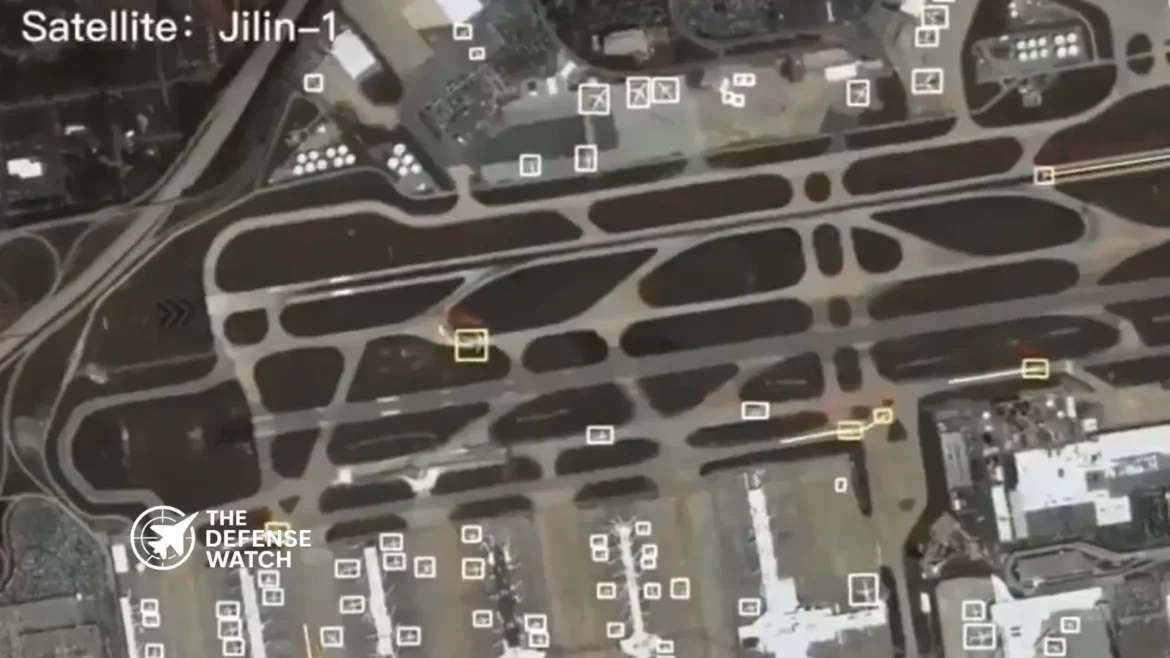
- China’s Jilin-1 satellite constellation reportedly observing US military activity linked to strikes on Iranian targets.
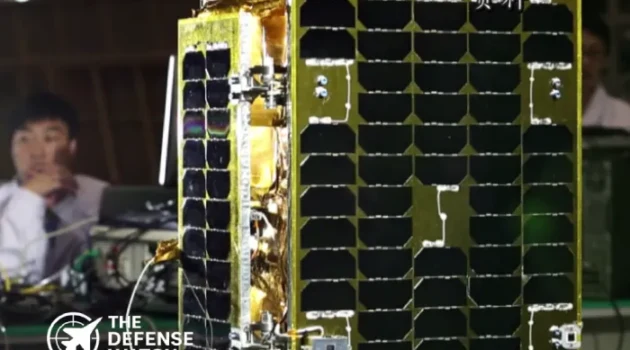
- The network includes more than 300 commercial remote sensing satellites capable of high-frequency imaging.
- Analysts say such observations could allow China to study US operational patterns and logistics cycles.
- Satellite data could capture launch patterns, aircraft movement, and potential air defense activity.
- Growing commercial satellite constellations are reshaping intelligence collection in modern warfare.
China Jilin-1 Satellites Monitoring US War Operations
China’s Jilin-1 satellite constellation is reportedly observing US war operations connected to military strikes against Iranian targets, highlighting how commercial space assets are increasingly used to monitor modern conflict in near real time.
Defense analysts note that large satellite constellations can collect frequent imagery of military activity across wide areas. In this case, China’s Jilin-1 network, operated by Chang Guang Satellite Technology, has grown into one of the world’s largest commercial Earth observation systems.
(adsbygoogle = window.adsbygoogle || []).push({});With hundreds of satellites in orbit, the constellation can revisit locations multiple times per day, enabling analysts to track military movements, infrastructure activity, and operational patterns during an active conflict.
The development underscores how space based observation is becoming a major intelligence factor in contemporary warfare.
The Big Picture
Space based surveillance has become a central component of modern military intelligence. Both governments and commercial companies now operate large constellations capable of producing high resolution imagery with rapid revisit times.
China has invested heavily in expanding its Earth observation capabilities as part of its broader push to strengthen military space infrastructure and intelligence collection.
The Jilin-1 program reflects this effort. Developed by Chang Guang Satellite Technology, the constellation has steadily expanded since its first launch in 2015.
Chinese officials have previously stated that the program aims to deploy hundreds of satellites to provide near real time global imaging coverage.
Such capabilities allow analysts to monitor military bases, ports, airfields, missile launch sites, and troop movements across large regions.
What’s Happening
Reports circulating among defense analysts suggest that Jilin-1 satellites are collecting imagery of US military operations connected to strikes on Iranian facilities.
The constellation now includes more than 300 satellites capable of capturing optical imagery at relatively short intervals.
High frequency coverage allows analysts to observe operational indicators such as:
Aircraft movement at airbases
Fueling or logistical activity
Missile launch preparations
Damage assessments after strikes
Air defense deploymentsBecause satellite imagery can be captured repeatedly throughout the day, analysts can construct timelines of operational activity.
This form of intelligence analysis is commonly known as pattern of life observation.
Military planners often use such data to understand how forces operate during both routine and combat scenarios.
Why It Matters
Modern conflicts generate enormous amounts of observable data. Satellites can record aircraft launches, missile trajectories, runway activity, and movement of military vehicles.
When analyzed over time, these observations reveal operational patterns.
For example, analysts could identify how quickly aircraft are refueled between missions, how frequently airbases launch sorties, or how air defense units reposition after attacks.
(adsbygoogle = window.adsbygoogle || []).push({});Such insights help military planners understand an opponent’s operational doctrine.
Even when sensitive systems remain classified, external observation can still reveal useful information about how forces are deployed and sustained.
Large satellite constellations increase this capability by dramatically shortening the time between observations.
Strategic Implications
The growth of commercial satellite constellations is transforming the intelligence environment.
During past conflicts, governments controlled most high resolution imagery systems. Today, private companies operate many of the world’s most active Earth observation networks.
These systems can provide persistent monitoring of conflict zones.
For military planners, this means operational secrecy is becoming harder to maintain.
Even routine activities such as aircraft refueling, munitions loading, or base preparation can be captured in satellite imagery.
In a high intensity conflict, this data could reveal logistical capacity and operational tempo.
For China, access to large volumes of imagery could support long term military research and development.
Defense analysts often study real world operations to understand how modern forces conduct combat missions.
Such insights can influence training models, war games, and system development.
Competitor View
Chinese military analysts closely study US military operations to understand operational concepts used by American forces.
Observing real combat activity provides valuable data that cannot be fully replicated through simulations.
China has emphasized the importance of studying foreign military doctrine in several official defense publications.
Satellite imagery allows analysts to observe deployment patterns, base activity, and potential response timelines during crises.
Other nations also monitor conflicts using satellite data. Russia, European countries, and private intelligence firms regularly analyze imagery during major military operations.
This expanding intelligence ecosystem means that most modern conflicts are observed by multiple actors simultaneously.
Capability Gap
Persistent satellite observation highlights an operational challenge for modern militaries.
Traditional operational security measures focused on communications interception and espionage. Today, constant imaging from space adds another layer of exposure.
Military forces must assume that adversaries can observe large scale deployments or base activity.
To mitigate this risk, armed forces increasingly rely on deception techniques, dispersed basing, and rapid operational movement.
Even so, complete concealment is difficult when hundreds of satellites may pass over a region each day.
What To Watch Next
Several trends will shape how satellite intelligence affects future conflicts.
Satellite constellation expansion
Both China and the United States continue launching new observation satellites to improve coverage.Commercial intelligence markets
(adsbygoogle = window.adsbygoogle || []).push({});
Private companies increasingly sell satellite imagery to governments and defense organizations.AI assisted imagery analysis
Artificial intelligence tools are being used to rapidly analyze large volumes of satellite data.These developments suggest that space based monitoring will play a growing role in global military competition.
The Bottom Line
Large satellite constellations such as China’s Jilin-1 are reshaping military intelligence by allowing near continuous observation of modern warfare from space.

China Advances South China Sea Militarization With Antelope Reef Development
Satellite imagery confirms China has begun militarizing Antelope Reef in the contested South China Sea, marking Beijing’s latest expansion of military infrastructure in disputed waters. According to the Asia Maritime Transparency Initiative (AMTI), dredging operations started after mid-October 2025, with January 2026 satellite images showing substantial infrastructure changes including roll-on/roll-off berths and access ways for heavy equipment.
The development coincides with unprecedented Chinese fishing militia operations demonstrating coordinated naval blockade capabilities near Taiwan, signaling Beijing’s evolving maritime control strategy.
Strategic Location Positions New Military Outpost
Antelope Reef sits at coordinates 16°27’45″N, 111°35’20″E in the Paracel Islands, approximately 250 miles east of Vietnam’s Hue and 175 miles southeast of China’s Sanya Naval Base on Hainan Island. AMTI characterizes Antelope Reef as “little more than a sandbar” that previously hosted only a couple of buildings.
Once completed, the installation could function as a helipad, radar station, and anchorage point for People’s Liberation Army Navy warships and China Coast Guard vessels. The facility would join China’s existing network of 20 military outposts in the Paracels, including sophisticated bases like Woody Island.
China seized the Paracel chain from Vietnam in 1974, establishing territorial control that remains disputed by Hanoi and other regional claimants.
Construction Timeline and Infrastructure Development
Newsweek reported that dredging focused on the eastern and southern edges of the reef’s lagoon, with January 2026 imagery revealing new infrastructure and specialized berthing facilities designed to accommodate heavy construction equipment. These roll-on/roll-off capabilities enable efficient transport of dredging machinery and materials necessary for land reclamation operations.
The construction pattern mirrors China’s previous South China Sea island-building campaigns. In the Spratly Islands south of the Paracels, China has created 3,200 acres of new land across seven military outposts, demonstrating Beijing’s engineering capabilities and strategic commitment to territorial consolidation.
China also controls Scarborough Shoal, seized from the Philippines in 2012, further extending its network of forward operating locations throughout the contested maritime region.
Fishing Militia Demonstrates New Blockade Tactics
Concurrent with the Antelope Reef construction, China conducted unprecedented fishing militia operations showcasing coordinated maritime control capabilities. In late December 2025, approximately 2,000 Chinese vessels formed two massive L-shaped “floating barriers” spanning 290 miles in waters northeast of Taiwan.
The geospatial intelligence firm ingeniSPACE first identified this formation, which occurred December 25-27, just three days before China announced Exercise Justice Mission-2025—a major military drill encircling Taiwan designed to rehearse naval blockade implementation.
A second operation from January 9-12 involved 1,400 Chinese fishing boats creating a 200-mile-long barrier maintained for over 30 hours, according to automatic identification system tracking data. These coordinated maneuvers required fishing vessels to halt normal commercial operations and assemble into dense, precisely-coordinated formations.
People’s Armed Forces Maritime Militia Role
These fishing fleet operations illustrate the expanding role of China’s People’s Armed Forces Maritime Militia (PAFMM) in Beijing’s maritime strategy. A Congressional Research Service report published in May 2025 acknowledged that the PAFMM serves to defend Chinese maritime claims, representing a critical component of China’s gray-zone operations.
The report’s authors noted that “the PAFMM – even more than China’s navy or coast guard – is the leading component of China’s maritime forces for asserting its maritime claims, particularly in the South China Sea.
In peacetime, the PAFMM advances Beijing’s territorial claims through presence operations and intimidation. During wartime scenarios, these forces would “support combat operations by conducting reconnaissance or creating obstacles and providing logistical support to other PLA forces.
Taiwan Contingency Implications
During a Taiwan crisis, fishing militia floating barriers could overwhelm maritime traffic, block commercial ports, disrupt naval operations, serve as decoys, and create target saturation overwhelming adversary defenses. This capability provides Beijing with flexible, deniable options below the threshold of conventional military action.
The coordinated nature of these operations—involving thousands of vessels maintaining precise formations for extended periods—demonstrates sophisticated command and control capabilities extending from military headquarters to civilian fishing fleets.
Regional Response and Countermeasures
Vietnam has responded to Chinese expansion by strengthening its own South China Sea infrastructure. Defense News previously reported that Vietnam is completing militarized outposts throughout the Spratly Islands, improving defensive capabilities and demonstrating Hanoi’s commitment to maintaining territorial claims.
The Philippines, Japan, and the United States have increased joint naval exercises and freedom of navigation operations in response to Chinese militarization. Recent trilateral drills involving the Philippine Navy, U.S. Navy, and Japanese Maritime Self-Defense Force demonstrated allied coordination in contested waters.
Strategic Significance
The Antelope Reef development represents China’s systematic approach to establishing permanent military infrastructure throughout the South China Sea. Each new outpost extends Beijing’s surveillance coverage, anti-access/area-denial capabilities, and power projection range.
Combined with fishing militia tactics, these installations create layered defensive networks complicating adversary operations while enabling Chinese forces to operate with logistical support and protected anchorages throughout the region.
The timing of construction—amid heightened tensions over Taiwan and ongoing territorial disputes with Southeast Asian nations—signals Beijing’s determination to consolidate control regardless of international criticism or legal challenges.
International Law and Territorial Disputes
China’s claims to approximately 90% of the South China Sea, demarcated by the “nine-dash line,” remain contested by Vietnam, the Philippines, Malaysia, Brunei, and Taiwan. A 2016 international arbitration tribunal ruled against China’s historic claims, a decision Beijing rejected.
The ongoing militarization directly contradicts Chinese pledges not to militarize contested features, undermining regional trust and escalating security competition.

Trump Threatens 100% Tariff on Canada Over China Trade Deal
U.S. President Donald Trump threatened on Saturday to impose a 100% tariff on Canadian goods if Canada moves forward with a trade agreement with China. The warning, delivered via the social media platform Truth Social, signals a sharp escalation in trade tensions between Washington and Ottawa.
Trump wrote that Canada’s potential deal with China would “completely devour” Canadian businesses, social structures, and the general way of life. He added that any Canadian goods entering the United States would be immediately subject to the new tariffs if the trade agreement proceeds.
Canadian Prime Minister Mark Carney traveled to China earlier this month to reset relations and reached a trade deal with China, Canada’s second-largest trading partner after the United States. Initially, Trump appeared supportive of the move, stating on January 16 that a Canadian-China trade deal would be beneficial.
However, relations soured after Carney criticized Trump’s pursuit of Greenland and suggested during the World Economic Forum in Davos that middle powers must act collectively in a world where a rules-based global order is under pressure. Carney emphasized that countries like Canada must participate in global decision-making or risk being marginalized.
Escalating Trade Pressure
Trump’s tariff threat targets Canadian industrial sectors including metals, automotive, and machinery. He also suggested that China could attempt to use Canada as a “drop-off port” to circumvent U.S. tariffs, warning Ottawa against serving as a transit point for Chinese goods into the United States.
The threat comes just days after Trump revoked Canada’s invitation to his Board of Peace, a platform aimed at addressing international conflicts and regional security, highlighting growing political friction.
Despite early cordiality between the two leaders following Carney’s election last year, U.S.-Canada relations have become tense over trade, geopolitical strategy, and leadership style differences. Trump has also dismissed the North American trade renegotiations set for July as irrelevant, adding further uncertainty for the region’s economic landscape.
Implications for Global Trade
A 100% tariff would mark an unprecedented escalation in U.S.-Canada trade relations. Analysts warn that such a move could have ripple effects across North America, affecting supply chains, industrial output, and bilateral investment flows.
Canada’s trade with the United States is heavily integrated, with automotive, metals, and machinery among the top sectors reliant on cross-border trade. A sudden tariff of this magnitude would increase costs for Canadian producers, potentially disrupt supply chains, and pressure Canadian companies to reassess market strategies.
Policy Perspective
Experts note that Trump’s statement may also be designed to send a broader signal to other U.S. allies considering deals with China. By highlighting economic consequences, Washington is underlining the risks of engaging with China in ways that could challenge U.S. trade and strategic interests.
Canadian officials have not yet responded to the tariff threat. However, Ottawa faces a delicate balancing act between expanding trade with China and maintaining long-standing economic ties with the United States, which remains Canada’s largest trading partner.
Looking Ahead
The coming weeks will be critical in determining the future of Canada-China-U.S. trade relations. Observers expect further statements from both governments and potential negotiations to clarify the economic and diplomatic consequences. For Canadian industries, the threat of a 100% tariff introduces significant uncertainty, potentially reshaping trade planning for 2026 and beyond.

NATO Europe Commander on Arctic Threats
NATO Europe commander General Alexus Grynkewich says NATO sees a growing Russian and Chinese threat in the Arctic, where melting ice and new sea lanes are raising geopolitical competition. Grynkewich described the High North as a “front line for strategic competition” in remarks to a security forum in Sweden.
Grynkewich told delegates that Russian and Chinese vessels are increasingly conducting joint patrols in Arctic waters and that China’s icebreakers and research ships are active far from home. He said that the Chinese activity is not purely scientific but aimed at gaining a military edge, and that Russia continues testing advanced capabilities in the Barents Sea.
Arctic at Strategic Crossroads
The commander’s comments reflect NATO’s growing focus on the High North, where seven of the eight Arctic states are alliance members. Russia stands outside that group, and China remains present through expanding naval and research operations, according to NATO officials.
NATO Secretary General Mark Rutte told reporters that allies agree on the importance of Arctic security and are discussing practical steps to keep the region safe. Rutte noted that the alliance has been more engaged on Arctic issues since 2025, responding to increased activity by Russia and China.
Shifting Security Dynamics
Expanding sea access as polar ice recedes is drawing competition for new shipping routes and resources. Grynkewich said Russia and China are deepening cooperation in the High North, a trend that NATO views as a strategic challenge.
The Arctic’s security profile has become a touchpoint in broader alliance discussions, alongside debates over how to balance deterrence with cooperation. Allies are exploring joint operations and surveillance efforts to enhance situational awareness and deterrence in the region.

Taiwan High Alert as Chinese Ships Pull Back After Massive Drills
Taiwan stayed on high alert as Chinese ships pull back after massive drills, keeping emergency response centers active while monitoring remaining military movements. Authorities in Taipei said coast guard and defence response facilities remain on stand-by, even as Beijing’s vessels withdraw from areas near the island.
Maritime Situation Calms, Alert Continues
Beijing’s “Justice Mission 2025” exercises involved extensive warships, coast guard vessels and military aircraft near Taiwan, prompting Taiwan to sustain heightened surveillance. Taiwan’s Ocean Affairs Council said Chinese ships have been moving away but China has not formally announced an end to operations.
Taipei’s coast guard reported all 11 Chinese coast guard ships have left waters close to Taiwan and are continuing to withdraw. Taiwan security officials said military and coast guard response centers remain on active duty as a precaution.
Scope of the Drills
Taiwan’s defence ministry reported 77 Chinese aircraft and 25 naval and coast guard vessels operating around the island in the past 24 hours, with 35 aircraft crossing the Taiwan Strait median line marking the de facto boundary. Scope of the Drills
Taiwan’s defence ministry reported 77 Chinese aircraft and 25 naval and coast guard vessels operating around the island in the past 24 hours, with 35 aircraft crossing the Taiwan Strait median line marking the de facto boundary.
The drills are among the largest Beijing has staged near Taiwan, forcing cancellation of domestic flights and prompting Taiwan to dispatch jets and warships for monitoring.
Taipei Condemns Provocations
Taipei condemned the drills as a threat to regional security and stability. The exercises followed a recent U.S. arms package for Taiwan and drew concern from Western allies, including Britain and the European Commission.
China’s Taiwan Affairs Office described the drills as necessary to safeguard sovereignty and warned against separatist forces and external interference

China Conducts Live-Fire Military Drills Around Taiwan
China launched large-scale live-fire military exercises around Taiwan on Monday, deploying troops, warships, fighter jets, and artillery in what the People’s Liberation Army (PLA) calls “Justice Mission 2025” drills.
The Eastern Theatre Command concentrated forces north and southwest of the Taiwan Strait, carrying out simulated strikes on land and maritime targets. Drills are set to continue Tuesday, including exercises to blockade Taiwan’s main ports and encircle the island.
According to a senior Taiwan security official, dozens of Chinese military ships and aircraft operated near Taiwan, some deliberately closing in on its 24-nautical-mile contiguous zone.
This marks the sixth major PLA exercise around Taiwan since 2022 and follows heightened Chinese rhetoric over Beijing’s territorial claims. The drills come 11 days after the U.S. approved $11.1 billion in arms sales to Taiwan, the largest package in history, prompting Beijing to warn of “forceful measures.
Taiwan condemned the exercises and posted a video demonstrating U.S.-made HIMARS rocket systems capable of striking China’s coastal targets, highlighting its readiness to defend the island. The island’s coast guard also deployed large vessels to protect maritime routes and fishing areas.
Taiwan’s aviation authority reported China had designated a temporary danger zone in Taipei’s airspace for ten hours of live-fire drills. Taiwan’s military remains on high alert and has begun rapid response exercises to ensure swift troop movement if the drills escalate into an attack.
“This serves as a serious warning to ‘Taiwan Independence’ separatist forces and external interference forces,” said Shi Yi, spokesperson for the Eastern Theatre Command.
China Sanctions US Defense Firms Over Taiwan Arms Deal
China has imposed sanctions on 20 U.S. defense companies and 10 executives in response to Washington’s $11.1 billion arms sale to Taiwan, Beijing’s largest arms transaction with the island to date. The move freezes assets in China and bars domestic entities from doing business with the targeted firms, according to the Chinese foreign ministry.
Boeing’s St. Louis branch, Northrop Grumman Systems Corporation, L3Harris Maritime Services, and other leading defense contractors are included. Individuals sanctioned include the founder of Anduril Industries and nine senior executives. These individuals are also banned from entering China.
A Chinese foreign ministry spokesperson stated, The Taiwan issue is the core of China’s core interests and the first red line that cannot be crossed in China-U.S. relations. The statement emphasized any provocative actions crossing this line would receive a strong response.
The sanctions follow Washington’s announcement of the $11.1 billion package, which includes advanced aircraft, missile systems, and other defense equipment intended to strengthen Taiwan’s self-defense capabilities. U.S. law requires support for Taiwan’s defense, but these sales consistently provoke Beijing.
Analysts note the sanctions are largely symbolic, aimed at signaling Beijing’s opposition while limiting direct business interactions. Companies affected include some of the largest U.S. defense contractors with substantial global operations.
US Approves Record Taiwan Arms Sale
The United States has approved an 11.15 billion arms sale to Taiwan, marking the largest weapons package ever authorized for the self governed island. The approval was announced on Thursday in Washington and comes at a time of heightened military activity around Taiwan and growing strain in US China relations.
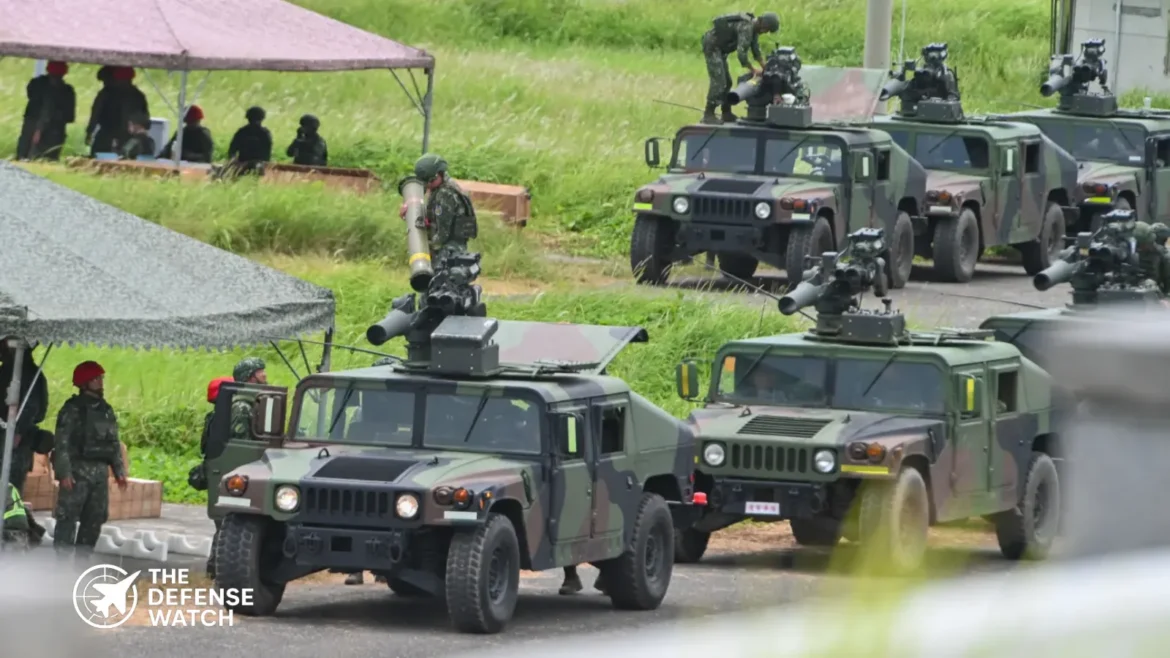
According to US officials, the Taiwan arms sale includes a mix of artillery systems, antitank missiles, and spare parts for helicopters currently operated by Taiwan’s armed forces. The package is intended to support Taiwan’s self defense capabilities and maintain operational readiness amid increasing regional security pressures.
Rising Military Activity Near Taiwan
The approval follows a period of intensified Chinese military operations near Taiwan. Just two days before the announcement, China’s newest aircraft carrier, Fujian, transited the Taiwan Strait for the first time since entering service. The passage through the sensitive waterway drew close attention from regional observers and defense analysts.
In the past 24 hours, Taiwan’s Ministry of National Defense reported that the People’s Liberation Army conducted 40 aircraft sorties near the island. More than half of those aircraft crossed the unofficial median line of the Taiwan Strait, a boundary that had long served as a tacit buffer between the two sides.
Beijing Responds to the Arms Package
China reacted strongly to the approval of the Taiwan arms sale. Foreign Ministry spokesperson Guo Jiakun said the deal seriously undermines the One China Principle and warned that the United States would ultimately harm itself by continuing military cooperation with Taiwan.
Beijing has consistently opposed US arms sales to Taiwan, arguing that such transactions interfere in China’s internal affairs. Chinese officials have repeatedly called on Washington to halt all military sales and contacts with the island.
Background on US Taiwan Defense Ties
The United States has been Taiwan’s primary source of military equipment for decades under the Taiwan Relations Act. The law obliges Washington to provide Taipei with defensive arms and services necessary to maintain a sufficient self defense capability.
Recent years have seen a steady increase in the scale and frequency of US approved arms packages. These sales have focused on asymmetric systems designed to counter potential amphibious or airborne operations, including missiles, artillery, and command and control upgrades.
The latest Taiwan arms sale reflects a broader US strategy to strengthen deterrence in the Indo Pacific region amid China’s expanding military capabilities.
Strategic Context and Policy Signals
Defense analysts note that the timing and size of the package send a clear policy signal. The approval comes as military communication channels between Washington and Beijing remain fragile, raising concerns about crisis management and miscalculation.
US officials have emphasized that the Taiwan arms sale is defensive in nature and consistent with long standing policy. They maintain that the goal is to preserve stability across the Taiwan Strait rather than alter the status quo.
At the same time, China’s growing confidence and increased operational tempo around Taiwan have reshaped the regional security environment. The convergence of large scale arms transfers and heightened military activity has added new complexity to US China relations.
What Comes Next
The arms sale will now move into the implementation phase, which typically involves contract negotiations, production timelines, and delivery schedules. Some systems may take several years to reach Taiwan due to manufacturing and training requirements.
Further diplomatic exchanges between Washington and Beijing are expected, as China has often responded to similar approvals with formal protests and potential countermeasures.
As cross strait tensions continue to rise, the record Taiwan arms sale underscores the central role of defense cooperation in shaping the future security landscape of East Asia.

United States Deploys Two Aircraft Carrier Strike Groups to the Western Pacific
The United States Navy has confirmed that two US aircraft carrier strike groups are now operating simultaneously in the Western Pacific. The deployment took place in late 2025 and marks a rare concentration of high value naval power in a region central to growing strategic competition with China. The move is aimed at reinforcing regional deterrence, supporting allies, and ensuring freedom of navigation across critical sea lanes.
According to official US Navy statements, the carrier strike groups are conducting routine operations and scheduled exercises across the Western Pacific, including areas near the Philippine Sea and waters east of Taiwan. US defense officials described the deployment as consistent with long standing US commitments to stability and security in the Indo Pacific region.
Background to the Dual Carrier Deployment
Aircraft carrier strike groups remain the core of US naval power projection. Each group typically includes a nuclear powered aircraft carrier, guided missile cruisers, destroyers, submarines, and a carrier air wing made up of fighter aircraft, electronic warfare platforms, and airborne early warning assets.
The presence of two US aircraft carrier strike groups in the Western Pacific comes amid increased Chinese naval and air activity across the region. Over the past several years, China has expanded its naval capabilities, launched additional aircraft carriers, and increased military exercises near Taiwan and in the South China Sea. These developments have raised concerns among US allies such as Japan, the Philippines, and South Korea.
The US Navy has repeatedly stated that forward deployed naval forces are essential to maintaining a rules based maritime order and preventing miscalculation.
Details of the US Navy Operations
The two US aircraft carrier strike groups are operating under the US Indo Pacific Command area of responsibility. Navy officials confirmed that the carriers are conducting flight operations, joint maritime drills, and integrated training with allied naval forces.
Carrier air wings are flying daily sorties that include air defense training, maritime strike missions, and intelligence surveillance and reconnaissance tasks. Surface escorts are carrying out anti submarine warfare drills and coordinated maneuvers designed to improve readiness in contested maritime environments.
Pentagon officials emphasized that the deployment is not linked to a single event, but rather reflects broader operational planning and force posture decisions. The US Navy regularly deploys carrier strike groups to the Western Pacific, but simultaneous operations by two carriers highlight the scale of current naval activity.
Strategic Signaling Toward China
While US officials avoided direct references to Beijing, the strategic message of the deployment is widely understood. The Western Pacific remains a focal point of US China military competition, particularly around Taiwan and key maritime chokepoints.
China has increased patrols by the Peoples Liberation Army Navy and expanded missile forces designed to hold large surface ships at risk. In response, US Navy doctrine emphasizes distributed operations, joint force integration, and the ability to sustain combat power across vast distances.
The presence of two US aircraft carrier strike groups demonstrates the ability of the United States to rapidly concentrate naval forces despite global commitments in Europe and the Middle East. Defense analysts note that such deployments are intended to reassure allies while complicating any potential adversary planning.
Allied Engagement and Regional Cooperation
US Navy officials confirmed that allied navies are participating in portions of the ongoing operations. Japanese Maritime Self Defense Force units and other regional partners are expected to take part in combined exercises focused on interoperability and maritime domain awareness.
These activities support broader US efforts to strengthen alliances and partnerships across the Asia Pacific. Regular carrier operations allow allied forces to train with US naval aviation and practice coordinated responses to potential crises.
From a policy standpoint, the deployment aligns with the US strategy of integrated deterrence, which combines military presence, alliance cooperation, and diplomatic engagement to prevent conflict.
What Comes Next
The US Navy has not disclosed how long the two aircraft carrier strike groups will remain in the Western Pacific. Historically, such deployments last several weeks to a few months, depending on operational requirements and global force management needs.
As regional security dynamics continue to evolve, the sustained presence of US aircraft carrier strike groups is expected to remain a central element of US naval strategy. Future operations are likely to include additional multinational exercises and port visits aimed at reinforcing regional partnerships.

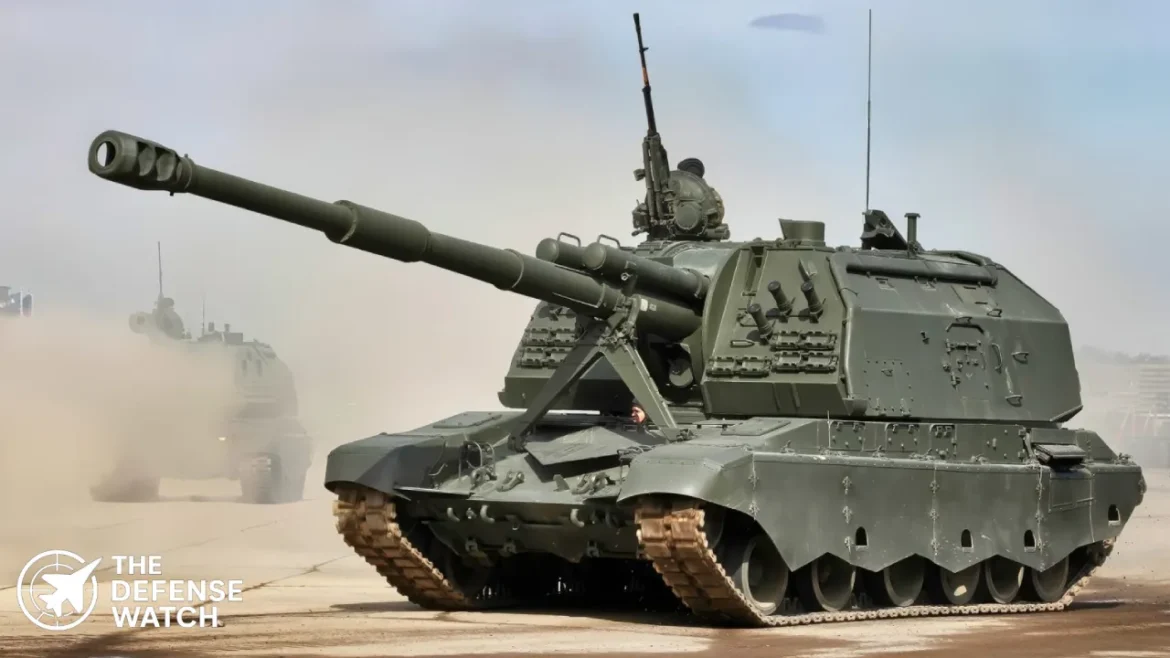
Recent leaks of Russian military export documents indicate that Beijing has, since early 2022, embarked on a clandestine procurement program of Russian military hardware — including air-deployable armored vehicles, parachute systems, and airborne training — reportedly meant to expand and modernize the airborne capabilities of the People’s Liberation Army (PLA).
According to analysis of the leaks by Western think-tanks and investigative media outlets, the deal aligns with a broader Chinese plan to achieve invasion readiness for Taiwan by around 2027 — a milestone that coincides with the centenary of the PLA’s founding.
Context: Why This Matters
For years, analysts of Asian security have flagged the PLA’s limited airborne and rapid-insertion capabilities as a barrier to any credible large-scale cross-strait assault. Traditional amphibious landings across the Taiwan Strait are fraught with risk: Taiwan’s air defenses, coastal fortifications, and geography render seaborne invasions costly and uncertain.
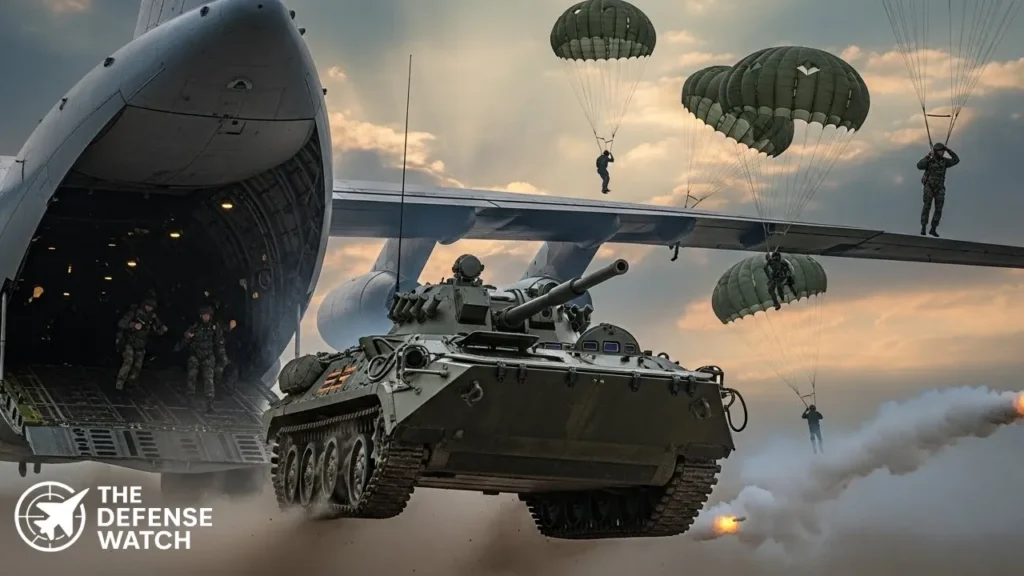
By acquiring air-deployable equipment and high-altitude parachute systems, China could mitigate some of these risks. Armored vehicles parachuted near Taiwan’s ports or airfields — or inserted via high-altitude, long-range parachute drops — would give airborne troops direct access to strategic terrain, bypassing coastal defenses and potentially negating the advantage held by conventional amphibious invasion plans.
What the Leaked Documents and Reports Reveal
- According to the analysis, Russia agreed to supply China with 37 BMD-4M light amphibious assault vehicles, 11 Sprut-SDM1 anti-tank guns, and 11 BTR-MDM “Rakushka” airborne armored personnel carriers, along with command, observation vehicles, and air-deployable support systems.
- Additionally, Moscow committed to delivering high-altitude parachute systems known as “Dalnolyot”, capable of delivering payloads up to 190 kg from altitudes as high as 8,000 m (roughly 26,000 ft). Under favorable conditions, such systems could allow loads — including vehicles or equipment — to glide 30–80 km after drop.
- The agreement reportedly includes a comprehensive training package: Russian instructors will train a battalion of Chinese paratroopers for operation of the vehicles and air-drop procedures, with collective exercises scheduled on Chinese territory.
- The official estimated value of the contract — before finalization — was approximately US$584 million, with a later breakdown listing the main hardware at over US$210 million.
- According to a report by the Royal United Services Institute (RUSI), these deliveries and capabilities could compress China’s airborne modernization timeline by a decade or more — effectively accelerating PLA’s capability to conduct large-scale airborne or airdrop operations.
Taken together, these provisions could significantly shift the balance of options available to the PLA in any potential Taiwan contingency.
Strategic Implications and Expert Observations
According to the RUSI analysis — based on roughly 800 pages of leaked contracts and supporting documents from a hacktivist group known as Black Moon — the procurement is part of a broader campaign of military modernization.
RUSI analysts suggest that the greatest advantage lies not necessarily in the hardware per se, but in the procedures and training being transferred: Russia brings decades of combat-proven airborne doctrine and operational experience, something the PLA’s airborne branch has historically lacked.
However, some analysts caution that capability gaps remain. Previous Russian airborne operations — such as early attempts to seize Ukrainian airfields during the 2022 invasion — ran into stiff resistance and heavy losses when helicopters and air-drops were disrupted before force consolidation.
In that respect, even with enhanced gear and training, the success of an airborne invasion against a defended island like Taiwan would still depend heavily on air superiority, suppression of air defenses, and secure follow-on supply and reinforcement — factors that remain uncertain.
What This Means Going Forward
The procurement and training effort significantly enhances the PLA’s airborne capabilities and broadens China’s options for projecting force in a potential Taiwan contingency. If deliveries and training continue as scheduled, and if China completes integration of Russian hardware with its own communications, ammunition, and command systems, the PLA could field a more robust, airdrop-capable force potentially capable of seizing key terrain on Taiwan quickly.
That said, technical, operational, and geopolitical obstacles remain. Effectively using airborne operations against Taiwan would require not only the hardware, but also suppression of Taiwan’s air defenses, control of air and sea lanes, and secure logistics — all under the watchful eyes of regional powers and likely U.S. intervention.