

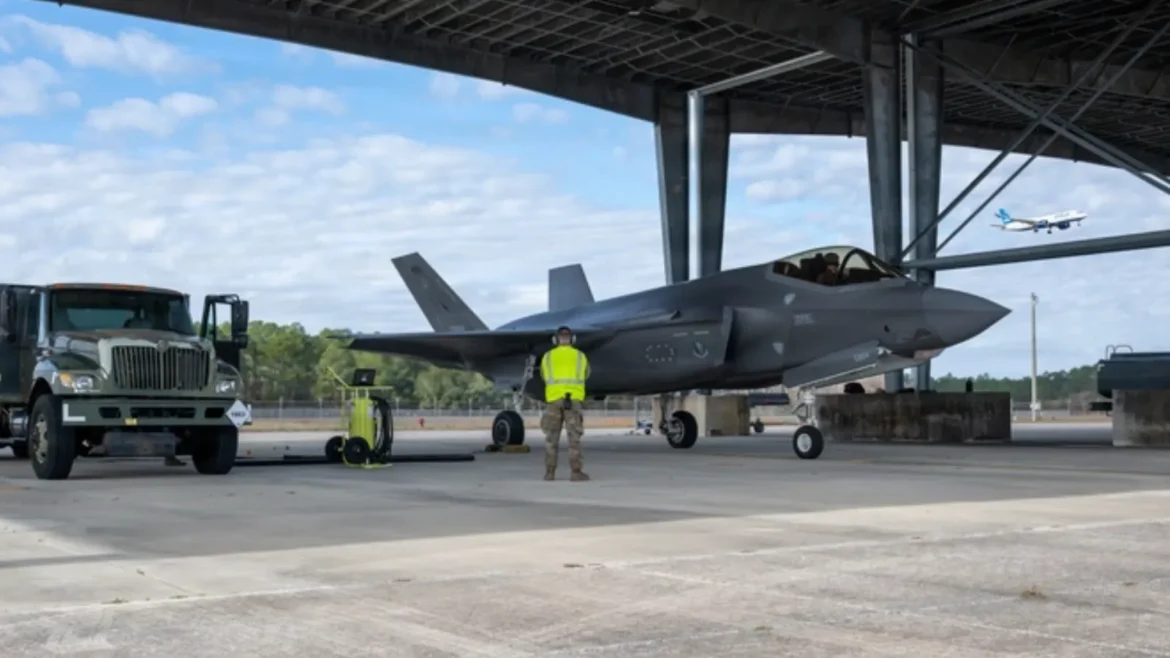
Lockheed Martin has received a 47.7 million dollar contract modification to continue work on F 35 ALIS and ODIN modernization, reinforcing long term efforts to improve sustainment, mission data, and fleet readiness across the global F 35 enterprise. The award reflects the US Navy and joint program office focus on modernizing digital infrastructure that supports the world’s largest fifth generation fighter fleet.
The modification was issued by Naval Air Systems Command and expands an existing contract vehicle to support continued development, integration, testing, and delivery of the Autonomic Logistics Information System and its replacement, the Operational Data Integrated Network.
Contract details and scope
The modification, identified as P00007 under contract N0001920D0007, increases the contract ceiling by 47,753,808 dollars. It supports a cost plus fixed fee, level of effort, indefinite delivery indefinite quantity structure. No funding was obligated at the time of award, with funds to be released through individual task orders as work progresses.
According to the award notice, the effort covers ongoing development, installation, integration, testing, training, and delivery activities for both ALIS and ODIN. The scope also includes new capability development and updates to existing software, ensuring continuity of support during the transition period between the two systems.
Work will be performed primarily in Orlando, Florida, accounting for 95 percent of the effort, with the remaining 5 percent in Fort Worth, Texas. The work is scheduled for completion in December 2026.
Why ALIS to ODIN matters for the F 35
ALIS has long served as the backbone of F 35 sustainment, managing maintenance data, parts tracking, mission planning, and training support. However, the system has faced persistent criticism from operators and maintainers for reliability issues, slow performance, and limited flexibility.
ODIN was introduced to address those challenges by adopting modern information technology practices. It is designed to be lighter, faster, more secure, and easier to update. ODIN relies on cloud based architecture, open systems, and continuous software delivery models that better align with how modern military networks operate.
This contract modification continues the ALIS to ODIN re architecture effort, ensuring that legacy functions remain supported while new ODIN capabilities are fielded across the fleet.
Support across US services and partners
The contract explicitly supports the US Air Force, Marine Corps, and Navy, as well as Foreign Military Sales customers and F 35 Cooperative Program Partners. This highlights the global nature of the F 35 program and the need for a common logistics and mission data framework that works across different services and nations.
More than a dozen allied countries operate or have ordered the F 35, making ODIN a critical enabler for coalition operations, shared sustainment, and data interoperability. Ensuring consistent software standards and secure data handling across partners is a core requirement for the program.
Orlando and Fort Worth roles
Orlando, Florida, has become a major hub for F 35 sustainment and training software development. Lockheed Martin’s facilities there focus on mission systems, logistics software, and simulation technologies. The heavy concentration of work in Orlando aligns with that role.
Fort Worth, Texas, remains the center of F 35 production and overall program management. The smaller share of work there reflects integration and oversight functions tied directly to the aircraft manufacturer.
Contracting approach and competition
The Navy confirmed that the contract action was not competed. This is typical for highly specialized F 35 software and sustainment work, where Lockheed Martin is the original system developer and holds unique technical data and integration authority.
Naval Air Systems Command at Patuxent River, Maryland, serves as the contracting activity, acting on behalf of the joint program office and participating services.
Broader modernization context
The ALIS to ODIN transition is part of a wider push by the Department of Defense to modernize software acquisition and sustainment. Programs are increasingly adopting agile development, modular architectures, and continuous updates rather than large, infrequent software releases.
For the F 35, this shift is especially important. The aircraft relies heavily on software for sensor fusion, electronic warfare, mission planning, and sustainment. Modernizing the digital backbone that supports the jet is seen as essential to maintaining combat readiness and controlling long term operating costs.
ODIN is also expected to better support future upgrades, including Block 4 capabilities, by reducing the time and complexity required to push new software and mission data to the fleet.
What comes next
With the contract now extended through late 2026, Lockheed Martin will continue fielding ODIN capabilities while sustaining ALIS where still required. The parallel approach is intended to minimize operational disruption as units transition to the new system.
The pace of ODIN deployment will remain closely watched by Congress, operators, and partner nations, given the system’s direct impact on aircraft availability and maintenance efficiency.
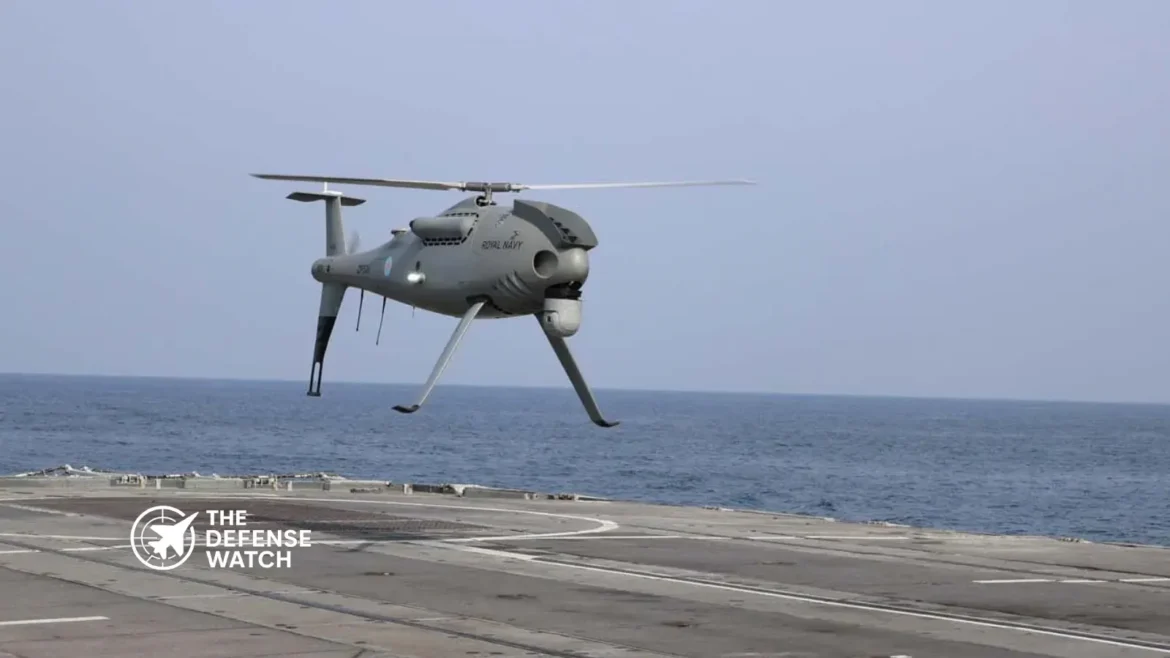
A Royal Navy drone pilot has been recognized with the first aircrew commendation ever awarded to a remote aircraft operator after preventing a £2.5 million Peregrine unmanned helicopter from crashing into the sea off the Gulf of Oman.
Quick Takeaways
Royal Navy’s 700X Naval Air Squadron flight commander Lieutenant Commander Adrian Hill intervened when an autonomous Peregrine drone suddenly dropped toward the water.
Hill took manual control, stabilized the aircraft at low altitude, and safely landed it aboard the UK frigate HMS Lancaster.
The rescue earned the pilot a “Green Endorsement” safety award, the first for a drone operator in Royal Navy or Royal Air Force history.
Peregrine Incident Details
The Peregrine, a 10-foot-long naval variant of the Schiebel S-100 Camcopter equipped with military sensors and systems, was conducting routine autonomous surveillance at about 60 feet above the sea when the anomaly struck.
According to the Royal Navy, the drone suddenly suffered a system error and dropped toward the water while preparing for recovery on HMS Lancaster.
Hill, already positioned to take manual control, reacted instantly. He engaged the flight controls and raised the drone to a safe altitude before completing a controlled deck landing.
In his statement, Hill said the drone was only one or two feet above the water when he noticed the descent and realized any impact would likely mean a total loss of the asset.
Historic Recognition
Hill’s Green Endorsement is described by the Royal Navy as the highest safety accolade in the Fleet Air Arm and Royal Air Force. Until this event, no remotely piloted aircraft operator had received a Green Endorsement.
Rear Admiral Anthony Rimington, head of the Fleet Air Arm, presented the commendation. The citation highlighted Hill’s sharp situational awareness, professional skill, and quick reactions that preserved a high-value aerial asset.
Broader Context: UK Naval Drone Operations
The Peregrine program reflects the Royal Navy’s increasing use of unmanned systems for maritime surveillance and operations. In recent years the Navy has expanded drone use for logistical tasks such as ship-to-ship deliveries and surveillance missions.
Other Royal Navy units have also advanced drone integration, including joint training with allied forces and developing autonomous crewless helicopters to complement traditional platforms.
Why It Matters
This award underlines a shift in naval aviation roles where remote pilots not only execute missions but also must be prepared to take split-second action in complex situations. Preserving high-cost unmanned assets helps maintain operational tempo and reduces lifecycle losses.
Quick, confident manual intervention in autonomous system failures underscores the need for skilled operators even as autonomy grows across defense aviation.
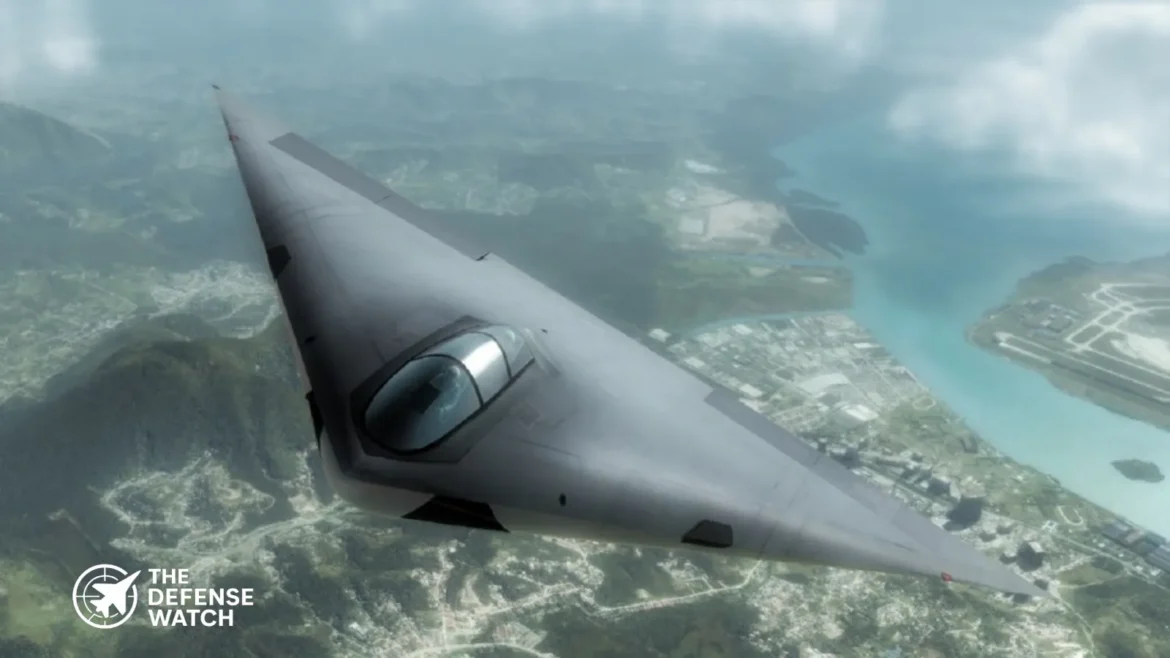
The revived debate around the A-12 Avenger II bomber is not about nostalgia or canceled programs. It points to a deeper and unresolved problem in U.S. naval strategy. Large aircraft carriers remain central to American power projection, yet the systems designed to find and strike them keep getting better. The A-12 Avenger II, often called the flying dorito, symbolizes a class of long range stealthy naval strike aircraft that could exploit this tension.
The strategic challenge is simple to describe and hard to solve. How does the United States protect high value carriers in an era of dense sensors, long range missiles, and precision strike networks. The A-12 debate matters because it forces planners to confront limits in current carrier defense concepts rather than assuming technological dominance will always hold.
Strategic Context
The A-12 Avenger II was conceived during the Cold War as a stealth attack aircraft designed to penetrate heavy defenses and strike enemy fleets and coastal targets. Its cancellation in the early 1990s reflected budget pressure, technical risk, and the belief that the carrier air wing faced no near peer threat.
That assumption no longer holds. China and Russia have invested heavily in anti access area denial systems built around satellites, over the horizon radars, submarines, bombers, and long range anti ship missiles. These networks aim to hold U.S. Navy aircraft carriers at risk hundreds or even thousands of kilometers from shore.
Recent conflicts and exercises reinforce this trend. Precision strike, real time targeting, and layered sensors are no longer theoretical. Even regional powers now field capabilities that complicate carrier operations. In this environment, the A-12 Avenger II represents a capability gap rather than a historical curiosity. The U.S. Navy still lacks a true long range, stealthy, carrier based strike aircraft optimized for naval targets.
Military Balance and Strike Reach
The first major driver is range. Modern anti ship missiles often outrange carrier based aircraft, forcing carriers closer to contested areas to generate combat power. This increases exposure and reduces operational flexibility.
The A-12 Avenger II bomber was designed to reverse that equation. Its long range and stealth would have allowed carriers to remain farther from enemy sensors while still threatening surface fleets and land targets. Without such an aircraft, the carrier strike group must rely on tanking, stand off weapons, or joint force support, all of which add complexity and risk.
This imbalance matters because carriers are not just combat platforms. They are symbols of commitment. If adversaries believe carriers can be pushed back or neutralized, U.S. deterrence credibility suffers.
Political and Budget Constraints
A second obstacle is political reality. Aircraft carriers are deeply embedded in U.S. defense culture, industrial planning, and alliance signaling. Any suggestion that their dominance is fading triggers resistance across Congress, industry, and parts of the military.
Developing an A-12 like platform today would require major investment, long timelines, and acceptance of technical risk. These factors compete with other priorities such as submarines, missiles, space systems, and cyber capabilities. Budget tradeoffs are unavoidable, and carriers remain politically protected programs.
This creates a strategic trap. Acknowledging carrier vulnerability without funding the tools to mitigate it leaves U.S. naval power exposed by design rather than by necessity.
Alliance Dynamics and Operational Assumptions
Allied strategy is the third driver. Many U.S. allies depend on carrier presence as a visible security guarantee. Forward deployed carriers reassure partners in the Indo Pacific, Middle East, and Europe.
If carriers are forced to operate farther from contested zones, the perception of U.S. commitment may weaken even if strike capability remains. An A-12 Avenger II type aircraft would help bridge this gap by extending reach without abandoning presence.
Without it, the burden shifts to land based aircraft and allied bases, which may be politically sensitive or vulnerable themselves. This complicates coalition planning and crisis response.
Technological and Industrial Limits
The final factor is industrial capacity. Building a stealthy, carrier capable strike aircraft is among the hardest tasks in aerospace engineering. Weight limits, corrosion, deck handling, and maintenance all constrain design choices.
The A-12 program struggled with these realities decades ago. Today, while technology has advanced, the complexity remains. This makes incremental upgrades to existing platforms more attractive in the short term, even if they do not fully address the strategic problem.
Strategic Implications
These constraints are difficult to change because they are structural. Geography, physics, budgets, and politics all shape naval power. Ignoring them does not make them disappear.
For U.S. defense planning, the lesson is not that carriers are obsolete. It is that their effectiveness depends on complementary systems that restore initiative and range. Without a credible long range naval strike aircraft, carrier strike group vulnerability becomes a planning assumption rather than a contingency.
For allies, the implication is a need for deeper integration. Shared sensors, distributed basing, and joint strike concepts become more important as single platforms face greater risk.
Conclusion
The A-12 Avenger II bomber debate highlights a strategic tension at the heart of modern naval warfare. Aircraft carriers remain indispensable, yet increasingly contested. Resolving this tension will require choices about force structure, investment, and operational concepts.
There is no quick fix. The future will likely involve a mix of longer range aircraft, unmanned systems, and tighter integration across domains. What matters is recognizing that the problem is real and persistent. The flying dorito may never return, but the message it carries about carrier vulnerability cannot be ignored.
Key Takeaways
- The A-12 Avenger II symbolizes a missing long range naval strike capability.
- Carrier strike group vulnerability is growing due to anti access area denial systems.
- Political and budget pressures limit radical changes to carrier centric strategy.
- U.S. and allied security depends on restoring range, flexibility, and deterrence credibility.
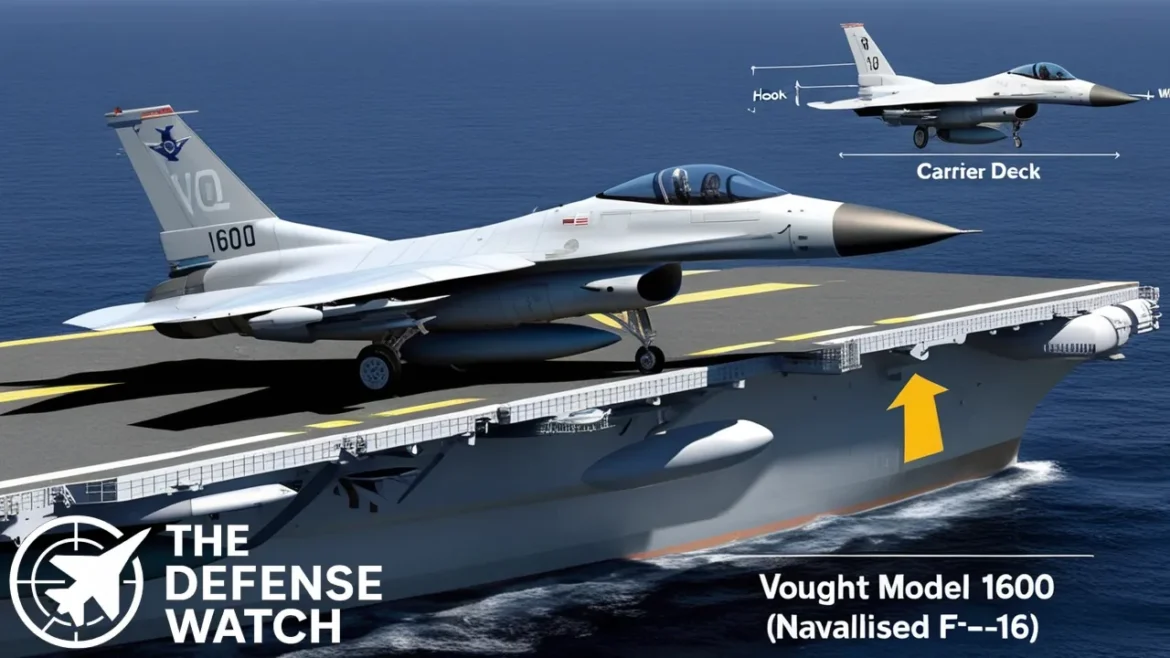
In the mid-1970s the United States Navy (USN) weighed a bold concept: adapt the highly successful General Dynamics F‑16 Fighting Falcon for carrier operations. The result was the proposed Vought Model 1600 – a navalized derivative developed by LTV Aerospace (Vought) in partnership with General Dynamics. Despite real advantages in cost, maintenance and sortie generation, the Model 1600 lost to what became the McDonnell Douglas F/A‑18 Hornet. This article explores the design, the decision and its enduring lessons.
Background: The Navy’s Carrier Fighter Challenge
After the troubles with earlier programs and cost pressures, the Navy launched the Navy Air Combat Fighter (NACF) competition in the 1970s to field a next-generation carrier fighter. The intention: improve fleet readiness, aircraft availability and long-term sustainment. General Dynamics, riding the success of the F-16 (which had won the Air Force’s Lightweight Fighter competition), offered a navalized variant. Vought brought carrier aircraft expertise (having built the F-8 Crusader and A-7 Corsair II) to the partnership.
Design Concept of the Model 1600
The Model 1600 aimed to adapt the F-16’s strengths—light weight, fuel‐efficient design, high sortie rate—to the harsh demands of carrier operations. Key modifications included:
- Structural strengthening of the airframe to handle catapult launches and arrested recoveries.
- A robust undercarriage (main and nose gear) plus an arrestor hook for carrier traps.
- A larger wing (increased span) and modified fuselage to improve low-speed handling and approach performance.
- Three engine options studied: the Pratt & Whitney F401 (primary in the 1600), an upgraded F100 in the 1601 variant, and a General Electric F101 in the 1602.
- Integration of air-to-air weapons suited for carrier operations, including BVR (beyond-visual-range) missiles such as the AIM-7 Sparrow, and AIM-9 Sidewinder rails on the intake sides.
In short: what might have been called the “Sea Falcon” was a pragmatic attempt to bring F-16 performance to the carrier deck.
Why the Navy Passed: Key Factors
Despite its promise, the Model 1600 was not selected. The Navy’s decision came down to several interlocking factors:
Single Engine vs Twin Engine
The Navy historically placed a premium on twin-engine fighters for carrier use, citing reliability over the open ocean and redundancy in case of engine failure. The Model 1600 retained a single engine whereas its competitor offered two.
Integration Risk & Schedule
Adapting a land-based fighter to the carrier environment entailed significant redesigns — avionics, structure, systems corrosion resistance, deck handling. In contrast, the eventual winner was purpose-designed for the Navy. According to one retrospective:
“The service picked the airplane it believed it could fly and sustain at sea with the least risk.”
Mission Suitability
Some Navy leadership judged the naval F-16 as not fully meeting certain carrier-fighter mission requirements — for instance, all-weather interception and deck suitability (low-speed performance, approach visibility, handling of heavier weapons loads). A specific concern: the low-position intake of the F-16 design posed ingestion risk on the deck.
Industrial Momentum
Once the team of Northrop/McDonnell Douglas paired on the YF-17-derived design, momentum tilted toward their submission. The Navy awarded the contract on 2 May 1975 to the Model 267 (which evolved into the F/A-18).
What If the Model 1600 Had Been Selected?
While hypothetical, history watchers still debate what the Navy might have become had the Model 1600 entered service. Some possible implications:
- Lower operating cost for carrier air wings — the F-16’s simplicity might have meant less maintenance and higher sortie generation. One commentary argues: “A lean single-engine fighter with fighter-sized tanks is gold in the Pacific… a naval F-16 would have been formidable.”
- Greater fleet numbers – a cheaper and simpler fighter might have enabled more aircraft per deck, shifting strategy toward quantity and readiness rather than pure margin performance.
- Impacts on later fighter development – if the Navy had gone with a single-engine design, projects such as the F/A-18E/F Super Hornet or joint service fighters might have followed a different trajectory.
Yet, meeting deck ORs, two-engine reliability, and complete suitability for carrier operating environments proved decisive. The Navy’s choice of the twin-engine F/A-18 stemmed in part from those pragmatic constraints.
Lessons for Contemporary Naval Air Power
Although the Model 1600 never flew, the story remains relevant for current and future naval aviation. Key take-aways:
- Affordability and readiness matter. Even high-end platforms succeed only if they can fly often and sustain high availability.
- Carrier suitability is non-negotiable. Strengthening land-based jets for sea duty is costly and risky — purpose-built designs often win out.
- Single-engine designs may face skepticism in Navy contexts, particularly over long over-water missions and survivability concerns.
- Designing for commonality across services is tempting but comes with trade-offs — the Navy weighed that and prioritised deck-specific performance.
In an era of budget constraints and distributed maritime operations, the Model 1600’s ethos — a capable but cost-conscious fighter for the carrier deck — may yet be instructive.
Conclusion
The Vought Model 1600 remains a compelling “what-if” in modern naval aviation history. It promised the agility, cost-efficiency and maintenance ease of the F-16 on the carrier deck. Yet the U.S. Navy opted for the twin-engine, purpose-designed F/A-18 — a choice driven by survivability, deck compatibility and risk management. While the Model 1600 never advanced beyond the drawing board, its story offers enduring lessons about the balance between innovation, cost, risk and operational suitability in naval aviation.
FAQs
It was a proposed naval version of the F-16, developed by Vought/General Dynamics for the Navy’s NACF competition in the 1970s.
Key reasons include the single‐engine configuration, carrier suitability concerns, integration risk, and the Navy’s preference for a twin‐engine design built from the deck up.
On 2 May 1975 the Navy awarded the contract to the YF-17-derived Model 267 design, which evolved into the F/A-18 Hornet.
No — the design remained a proposal and did not proceed to prototype or flight testing.
The Model 1600’s concept underscores themes of cost, readiness, service commonality and carrier suitability — all still central to today’s naval fighter and unmanned combat aircraft discussions.