

Executive Summary
The U.S. Army has tested a next generation battlefield network designed to connect AH 64 Apache helicopters directly with ground forces in real time. The effort aims to improve targeting, situational awareness, and combat coordination across multi domain operations as the Army modernizes for future high intensity conflicts.
U.S. Army Advances Battlefield Networking With Apache Integration
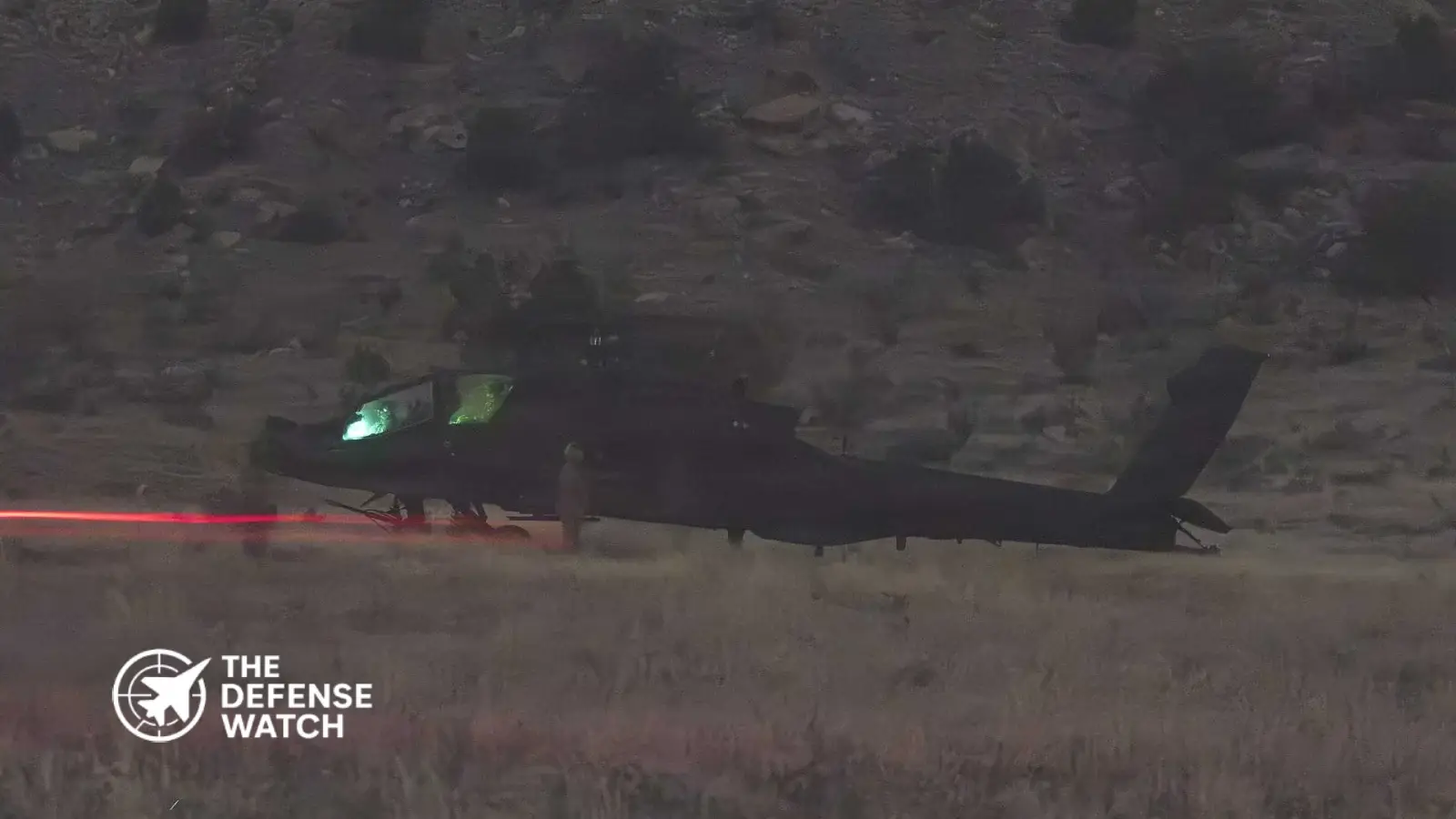
The U.S. Army battlefield network modernization effort took another step forward after the service tested a new communications architecture linking AH 64 Apache attack helicopters with ground combat forces.
The demonstration focused on improving real time information sharing between aviation units and soldiers operating on the ground. The initiative reflects the Army’s broader push toward integrated multi domain warfare and faster battlefield decision making.
The testing effort centered on enabling Apache crews to exchange operational data directly with tactical ground units, reducing delays in identifying threats and coordinating combat actions. The Army continues to prioritize resilient battlefield communications as modern conflicts increasingly depend on rapid data transmission and network survivability.
Why The Battlefield Network Matters
The U.S. Army battlefield network has become a core pillar of the service’s modernization strategy. Future combat operations are expected to involve highly contested electromagnetic environments where communications systems may face jamming, cyber attacks, and degraded connectivity.
By integrating airborne and ground assets into a unified network, commanders can shorten sensor to shooter timelines and improve operational awareness across dispersed formations. In practical terms, this allows Apache helicopter crews to identify threats, transmit targeting data, and coordinate with troops on the ground more efficiently.
The Army has repeatedly emphasized that future warfare will require seamless coordination between manned aircraft, drones, artillery systems, armored units, and command elements. The latest network testing appears designed to support that broader operational concept.
The AH 64 Apache remains one of the Army’s primary attack helicopter platforms. Built for reconnaissance, close air support, and anti armor missions, the aircraft continues to receive upgrades focused on sensors, weapons integration, and digital connectivity.
Multi Domain Operations Drive Army Modernization
The Army’s modernization strategy increasingly revolves around Multi Domain Operations, often referred to as MDO. The doctrine focuses on synchronizing military capabilities across land, air, sea, cyber, and space domains to counter technologically advanced adversaries.
Integrated battlefield networking plays a critical role in that concept. Without secure and reliable communications, forces may struggle to coordinate precision strikes, electronic warfare activities, or intelligence sharing during high intensity combat.
The latest testing effort also aligns with the Army’s broader investments in command and control modernization. Programs tied to tactical data sharing, artificial intelligence assisted targeting, and resilient communications infrastructure have received increased attention in recent years.
Analysts note that lessons learned from conflicts in Eastern Europe and the Middle East continue to influence U.S. military modernization priorities. The importance of rapid battlefield intelligence distribution, drone integration, and survivable communications networks has become increasingly clear in modern combat operations.
Apache Helicopters Remain Central To Army Combat Operations
The AH 64 Apache continues to serve as a critical component of U.S. Army aviation forces. The aircraft has undergone multiple upgrades since entering service, including improved radar systems, enhanced targeting capabilities, and expanded networking functions.
The latest battlefield network testing demonstrates how the Army is seeking to evolve the Apache beyond its traditional attack role into a more connected battlefield node capable of sharing intelligence across the force.
The service has also explored integrating manned and unmanned teaming concepts, allowing Apache crews to work alongside drones for reconnaissance and targeting support. Combining those capabilities with advanced networking systems could significantly expand operational flexibility during future combat scenarios.
Defense officials have consistently argued that data connectivity and decision speed will be decisive factors in future conflicts against peer adversaries. As a result, networking upgrades are increasingly viewed as equally important as weapons modernization.
Strategic Implications For Future Warfare
The U.S. Army battlefield network initiative reflects a wider Pentagon effort to create interconnected combat ecosystems capable of operating under contested conditions.
Modern military operations increasingly depend on distributed sensors, real time intelligence, and rapid targeting cycles. Linking helicopters, armored vehicles, infantry units, and command centers through resilient networks could provide operational advantages in future conflicts.
The Army’s latest testing also underscores the growing overlap between aviation modernization and digital warfare capabilities. Platforms are no longer evaluated solely by firepower or survivability, but also by their ability to collect, process, and distribute data across the battlefield.
While the Army has not released full technical details regarding the network architecture tested, the demonstration signals continued momentum behind next generation command and control initiatives.



Executive Summary:
Anduril Industries has announced a $5 billion Series H funding round aimed at expanding production of autonomous military systems and AI-enabled defense technologies. The investment underscores growing Pentagon and investor interest in scalable defense manufacturing and software-defined warfare capabilities.
Anduril Series H Funding Signals Major Expansion In Defense Manufacturing
Anduril Industries announced a $5 billion Series H funding round, marking one of the largest capital raises by a U.S. defense technology company in recent years. The company said the investment will support expansion of manufacturing infrastructure, development of autonomous military systems, and scaling of AI-driven defense capabilities.
According to the company, the funding round values Anduril at approximately $30.5 billion and reflects increasing demand for rapidly deployable defense technologies amid evolving global security challenges.
The latest raise comes as the U.S. Department of Defense continues prioritizing autonomous systems, artificial intelligence, and resilient industrial capacity under broader modernization initiatives.
Autonomous Defense Systems Drive Investor Interest
Anduril has positioned itself as a major player in autonomous defense systems, particularly in areas including unmanned aerial systems, counter-drone technologies, autonomous underwater vehicles, and AI-enabled command-and-control software.
The company stated that proceeds from the Series H raise will be used to scale production and accelerate delivery timelines for defense customers. A key focus includes expansion of manufacturing capabilities tied to autonomous platforms and software-defined military systems.
The funding announcement also highlights broader shifts within the U.S. defense sector. Traditional procurement timelines are increasingly being challenged by demand for faster innovation cycles, modular systems, and commercially derived technologies.
Unlike legacy defense primes that often rely on lengthy acquisition programs, Anduril has built its business model around rapid development and vertically integrated production. That strategy has attracted growing attention from both defense agencies and private investors seeking exposure to defense technology modernization.
Growing Pentagon Focus On AI And Autonomous Warfare
The Anduril Series H funding round aligns with wider Pentagon efforts to integrate artificial intelligence and autonomous capabilities across military operations.
Recent U.S. defense strategies have emphasized unmanned systems for surveillance, strike missions, logistics support, maritime operations, and air defense. Programs linked to attritable drones, autonomous sensors, and AI-enabled targeting continue receiving significant investment from the Department of Defense.
Anduril has already secured multiple U.S. military contracts tied to border security systems, counter-UAS technologies, loitering munitions, and autonomous surveillance platforms.
Its flagship software platform, Lattice, is designed to integrate sensor networks and autonomous systems into a unified operational picture. The company argues that software-centric architectures will play a central role in future battlefield operations.
The funding announcement also arrives amid increasing geopolitical competition involving the United States, China, and Russia, where defense planners are accelerating investments in autonomous warfare and advanced military technologies.
Manufacturing Capacity Becomes Strategic Priority
One of the most significant aspects of the funding round is its emphasis on industrial scale.
Defense analysts have increasingly warned that Western defense industrial capacity remains constrained for sustained high-volume production during prolonged conflicts. The war in Ukraine has amplified concerns surrounding munitions production, supply chain resilience, and manufacturing throughput.
Anduril’s expansion plans appear designed to address those concerns through highly automated production facilities capable of rapidly manufacturing autonomous systems at scale.
The company has previously announced investments in advanced production facilities intended to accelerate manufacturing for drones, underwater systems, and autonomous weapons.
This reflects a broader trend across the defense sector, where manufacturing speed is becoming nearly as important as technological sophistication.
Strategic Implications For The U.S. Defense Sector
The size of the Anduril Series H funding round demonstrates how venture-backed defense firms are becoming increasingly influential within the U.S. military technology ecosystem.
Historically, defense procurement has been dominated by large prime contractors. However, companies focused on software, autonomy, and rapid iteration are gaining larger roles as defense agencies seek adaptable and lower-cost systems.
The funding could also intensify competition within the autonomous defense market, particularly in areas involving AI-enabled drones, collaborative combat aircraft, maritime autonomy, and counter-UAS networks.
From a strategic perspective, the investment signals continued confidence in defense technology startups despite broader economic uncertainty affecting parts of the venture capital sector.
For the Pentagon, partnerships with firms capable of rapidly scaling autonomous defense production may become increasingly important as military planners prepare for high-intensity conflict scenarios requiring large quantities of affordable autonomous systems.
Executive Summary:
Belgian defense technology company IDDEA has introduced an offline artificial intelligence system designed to identify military equipment in real time on the battlefield. The platform aims to support troops operating in electronically contested environments where internet access and cloud connectivity may be unavailable.
Belgium Introduces Offline AI Battlefield Identification Capability
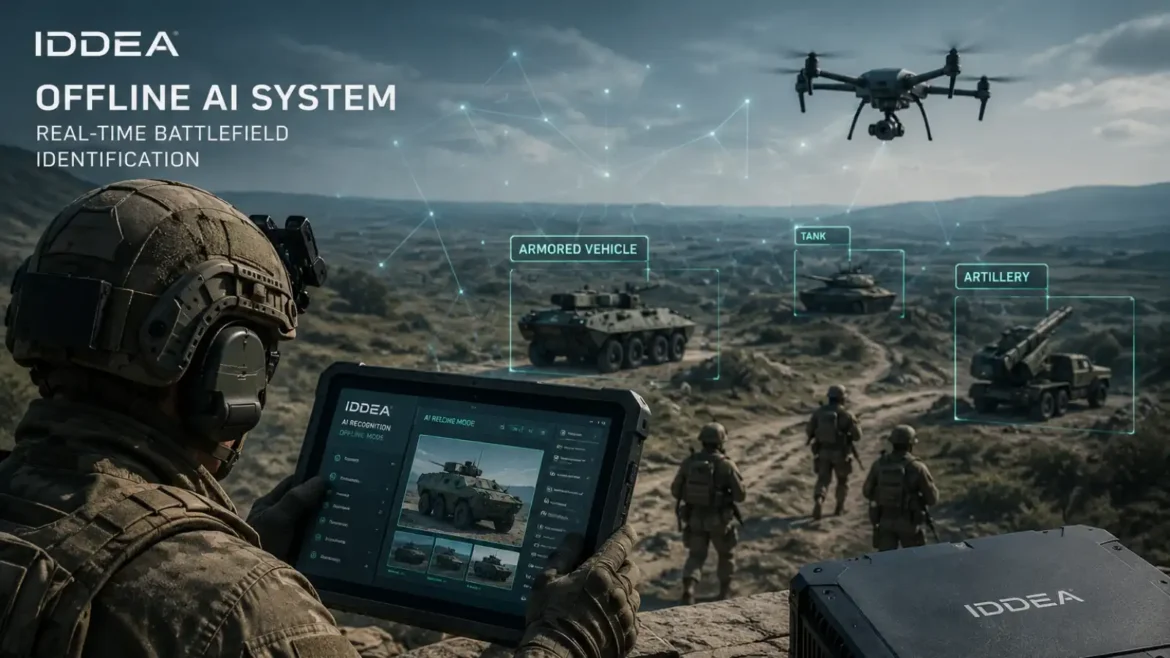
Belgium-based defense technology company IDDEA has unveiled a new offline AI battlefield identification system designed to recognize military vehicles and equipment in real time during combat operations.
The platform uses onboard artificial intelligence algorithms to analyze and classify military assets without relying on cloud infrastructure or internet connectivity. The capability is intended for use in high-intensity operational environments where communications networks may be degraded, jammed, or completely unavailable.
The announcement reflects a broader shift across NATO and allied defense sectors toward edge-based AI systems capable of operating independently in contested electromagnetic environments.
Designed For Contested And Disconnected Battlefields
The offline AI battlefield identification system is built to support frontline troops, reconnaissance teams, unmanned systems operators, and command units requiring rapid target recognition under battlefield conditions.
Modern conflicts, particularly in electronically contested theaters, have highlighted the vulnerability of cloud-dependent systems. Military forces increasingly face GPS disruption, communications jamming, and cyber attacks targeting data links and centralized networks.
By processing data locally, IDDEA’s system reduces dependency on remote servers and external communications infrastructure. This allows battlefield units to continue identifying vehicles, armored platforms, artillery systems, and other military assets even during electronic warfare operations.
The company stated that the platform can operate on compact computing hardware integrated into tactical vehicles, drones, observation posts, or mobile command systems.
Growing Demand For Edge AI In Defense Operations
The introduction of offline AI battlefield identification technology comes as defense organizations accelerate investment in edge computing and autonomous battlefield analytics.
The war in Ukraine and other recent conflicts have demonstrated the operational value of rapid sensor-to-shooter decision cycles. Militaries are seeking technologies that can shorten identification times while reducing the cognitive burden on operators.
Unlike traditional AI architectures that rely heavily on cloud computing resources, edge AI systems process information directly at the tactical level. This reduces latency and enables faster responses in dynamic combat scenarios.
The move also aligns with wider NATO modernization priorities focused on resilient command-and-control networks, distributed sensing, and AI-enabled operational awareness.
Analysts note that battlefield identification remains one of the most critical challenges in modern warfare, particularly in environments crowded with drones, armored vehicles, decoys, and mixed civilian infrastructure.
AI Identification Systems Becoming Core Military Capability
Defense companies across Europe and North America are increasingly developing AI-powered recognition tools capable of identifying vehicles, aircraft, naval assets, and troop formations from sensor feeds.
These systems often combine computer vision, machine learning, thermal imaging analysis, and pattern recognition technologies to classify targets from live battlefield data.
IDDEA’s offline approach may offer advantages for expeditionary and forward-deployed forces operating in denied environments where satellite communications or secure networks cannot be guaranteed.
The platform could also support unmanned aerial vehicles and autonomous reconnaissance systems by enabling onboard processing without requiring continuous remote connectivity.
As militaries integrate larger numbers of autonomous platforms into operational structures, AI-based recognition systems are expected to become a central component of future battlefield management architectures.
Strategic Implications For NATO And European Defense
The unveiling of Belgium’s offline AI battlefield identification system highlights Europe’s growing role in defense AI development amid rising geopolitical tensions and increased military modernization spending.
European defense firms are under pressure to deliver sovereign technologies that reduce reliance on external infrastructure and strengthen operational resilience.
For NATO forces, offline AI capabilities may prove especially important during operations involving electronic warfare threats from peer adversaries capable of disrupting communications and satellite networks.
The development also reflects a broader transition toward distributed intelligence models in military operations, where frontline units can process and act on information independently rather than relying solely on centralized command systems.
While details regarding deployment timelines, operational testing, or procurement plans were not disclosed, the system demonstrates continued momentum in AI-enabled military technologies designed for real-world combat conditions.
Original Analysis: Why Offline AI Matters In Future Warfare
The significance of IDDEA’s system is not simply the use of AI itself, but the decision to prioritize offline operation. Many commercial AI systems remain dependent on cloud connectivity, which creates a critical vulnerability in military environments.
In modern peer-level conflicts, communications infrastructure is likely to become an immediate target. Satellite disruption, cyber attacks, spectrum denial, and electronic jamming can isolate frontline units within hours of combat initiation.
An offline AI battlefield identification platform directly addresses this operational reality.
The concept also aligns with emerging military doctrine emphasizing distributed lethality, decentralized decision-making, and autonomous battlefield sensing. Instead of sending raw sensor data to remote servers for processing, future forces are increasingly expected to process intelligence at the edge.
This reduces both response times and network exposure.
Another important aspect is scalability. Compact offline AI systems can potentially be integrated across drones, armored vehicles, infantry systems, and reconnaissance platforms without requiring permanent network infrastructure.
That flexibility could make such systems especially valuable for NATO rapid deployment forces and expeditionary units operating in austere environments.