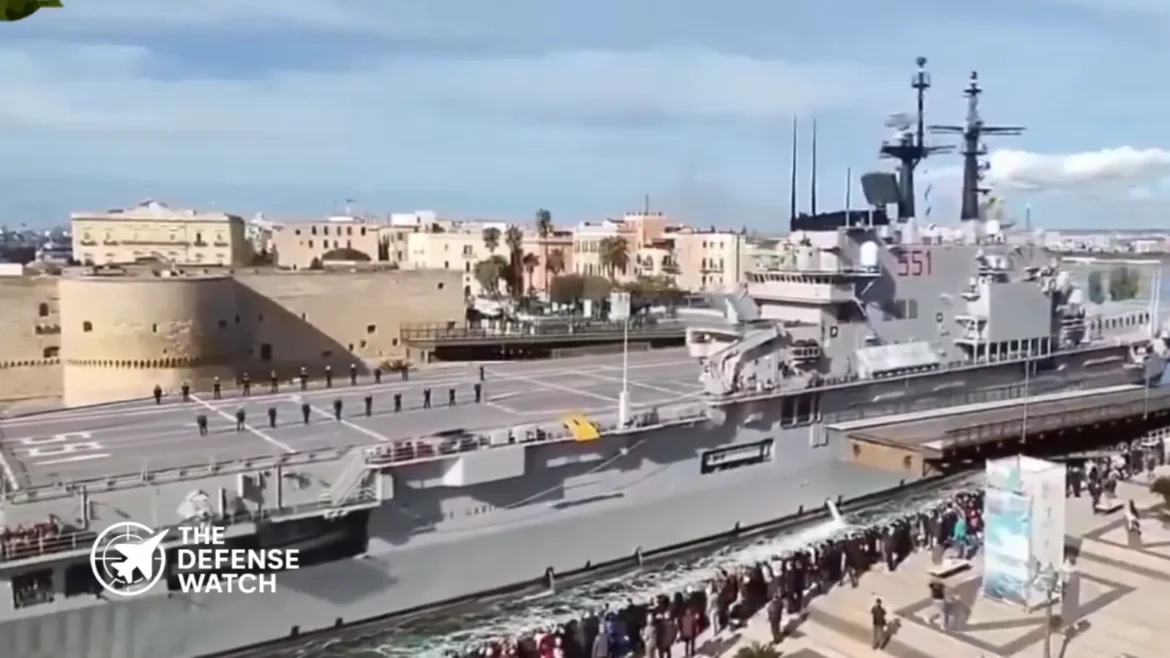
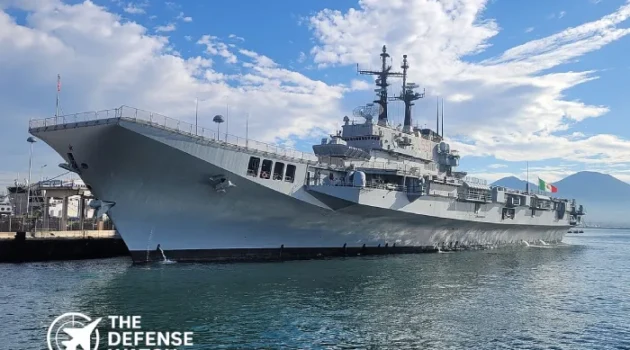
- ► Indonesia has approved a $450 million deal to acquire the aircraft carrier Giuseppe Garibaldi from Italy.
- ► The Italian Navy decommissioned the carrier in October 2023 after nearly 40 years of service.
- ► The 14,000 ton ship features a ski jump deck designed for short takeoff aircraft.
- ► It can operate up to 16 AV 8B Harrier II attack aircraft or 18 helicopters.
- ► The move signals a significant step in Indonesia naval modernization efforts.
Indonesia Approves Purchase Of Aircraft Carrier Giuseppe Garibaldi
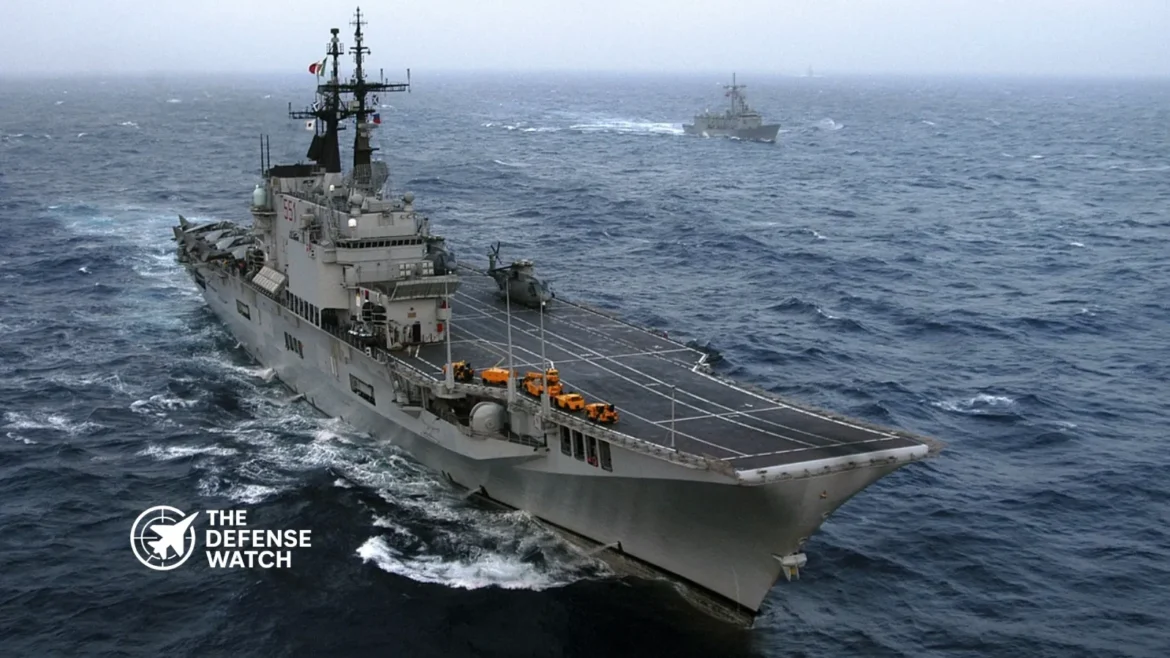
Indonesia has approved the purchase of the aircraft carrier Giuseppe Garibaldi in a $450 million agreement with Italy, marking a major step in Jakarta efforts to expand its maritime and naval aviation capabilities.
The vessel, formerly operated by the Italian Navy, was formally decommissioned in October 2023 after nearly four decades of service. The decision to transfer the ship reflects growing defense ties between Rome and Jakarta and Indonesia broader push to modernize its armed forces.
According to official Italian defense statements at the time of decommissioning, Giuseppe Garibaldi served as the flagship of the fleet and participated in multiple NATO and international missions throughout its operational life.
Ship Specifications And Capabilities
The aircraft carrier Giuseppe Garibaldi displaces approximately 14,000 tons and features a ski jump flight deck optimized for short takeoff aircraft. The configuration enables the ship to operate up to 16 AV 8B Harrier II attack jets or as many as 18 helicopters, depending on mission requirements.
Originally commissioned in 1985, the carrier was designed during the Cold War to provide Italy with a flexible sea based air capability. Over the years, it supported operations in the Balkans, Afghanistan, and the Mediterranean.
Its aviation facilities, combined with onboard command and control systems, allow it to function as both a strike platform and a flagship for maritime task groups.
Strategic Implications For Indonesia
The Indonesia aircraft carrier purchase represents a notable shift in the country maritime posture. Indonesia, the world largest archipelagic state, has long prioritized sea lane security and territorial defense across its vast maritime domain.
While the Indonesian Navy currently operates amphibious and helicopter capable vessels, the addition of a fixed wing capable aircraft carrier would expand options for air cover, disaster response, and regional presence operations.
Defense analysts note that operating a ski jump carrier requires not only pilot training and aircraft acquisition but also significant logistical and maintenance infrastructure. Jakarta future plans regarding embarked aircraft have not been formally disclosed.
Italian Navy Transition
The decommissioning of Giuseppe Garibaldi followed the induction of newer assets into Italian service, including the aircraft carrier Cavour and the amphibious assault ship Trieste. These platforms are designed to operate advanced aircraft, including the F 35B short takeoff and vertical landing variant.
The transfer of Giuseppe Garibaldi allows Italy to streamline its fleet while providing Indonesia with a ready made capital ship.
Regional Context
Indonesia has steadily increased defense spending in recent years, approving multiple procurement programs across air, land, and sea domains. The Indonesia aircraft carrier purchase adds a high visibility platform to that effort.
Given Southeast Asia strategic maritime routes and growing regional naval capabilities, the acquisition is likely to draw close attention from neighboring states.
At this stage, no delivery timeline or refit details have been publicly confirmed.
Sweden Procures Rheinmetall SeaSnake 30 Naval Weapon System
Sweden has become the first NATO customer to procure the Rheinmetall SeaSnake 30 naval weapon system, marking a significant step in the country’s ongoing naval modernization program.
(adsbygoogle = window.adsbygoogle || []).push({});The announcement was made by Rheinmetall, which confirmed that Sweden selected the SeaSnake 30 as part of efforts to strengthen the close-in protection of its surface vessels. The system is designed to counter aerial threats, unmanned systems, and fast attack craft in complex maritime environments.
The procurement underscores Sweden’s commitment to enhancing fleet survivability following its accession to NATO in 2024.
Strengthening Close-Range Naval Defense
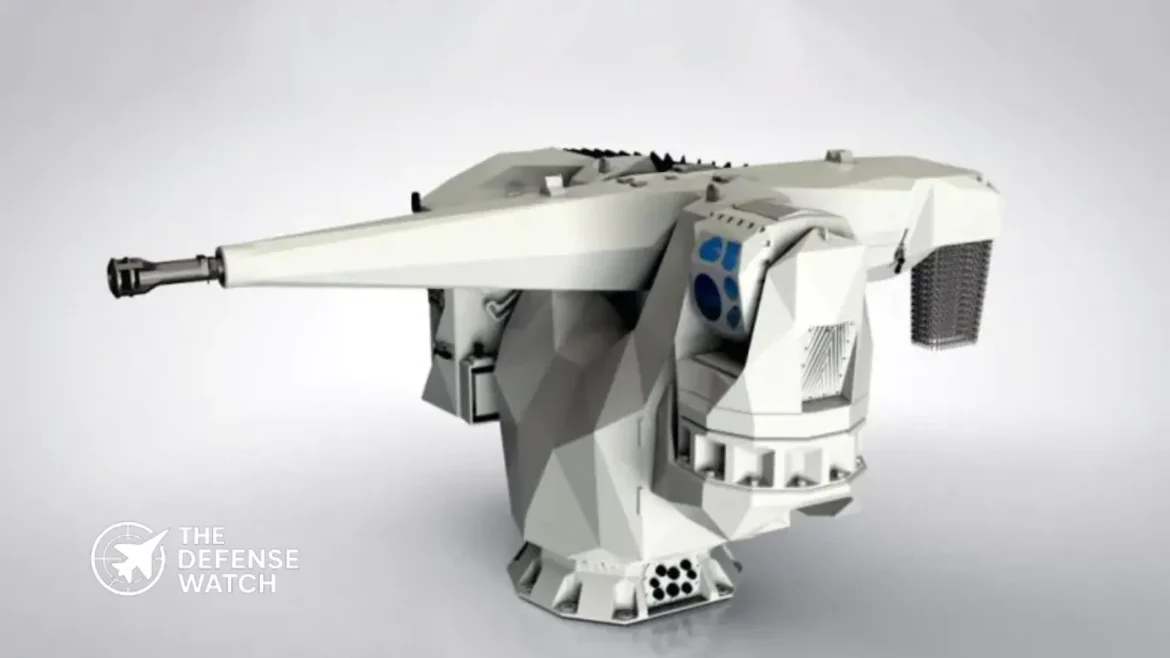
The Rheinmetall SeaSnake 30 naval weapon system is a remotely operated, stabilized naval gun mount built around a 30mm automatic cannon. It is optimized for short-range engagements against asymmetric and conventional threats.
According to Rheinmetall, the SeaSnake 30 integrates modern fire control, electro-optical sensors, and programmable ammunition options. The system can be configured for both manual and automated engagement modes, allowing rapid response to evolving threat scenarios.
The 30mm caliber provides a balance between firepower and integration flexibility, making it suitable for patrol vessels, corvettes, and larger surface combatants.
Sweden’s decision to adopt the SeaSnake 30 aligns with a broader European trend toward modular, digitally integrated naval weapon systems capable of operating within networked combat environments.
Integration Into Swedish Naval Platforms
While specific platform details have not been publicly disclosed, the SeaSnake 30 is expected to be installed on Swedish Navy surface vessels undergoing upgrades or entering service in the coming years.
The Swedish Armed Forces have prioritized modernization across naval, air, and ground domains as part of long-term defense expansion plans. According to Sweden’s Ministry of Defence, Stockholm is increasing defense spending to meet and exceed NATO’s 2 percent of GDP benchmark.
The SeaSnake 30 will likely complement existing naval armament systems, providing an additional defensive layer against drones, helicopters, low-flying aircraft, and small boat swarms.
This layered approach reflects lessons observed in recent maritime conflicts, where low-cost unmanned systems and precision-guided munitions have posed significant challenges to surface fleets.
A Milestone For Rheinmetall In NATO Markets
For Rheinmetall, securing Sweden as the first NATO customer for the SeaSnake 30 represents a notable commercial and strategic milestone.
(adsbygoogle = window.adsbygoogle || []).push({});The company has expanded its naval systems portfolio in recent years, leveraging experience in land-based cannon systems and adapting them for maritime use. The SeaSnake family is positioned as a flexible solution for navies seeking modern close-in weapon capabilities without the size and cost footprint of larger caliber systems.
Rheinmetall has emphasized interoperability with NATO standards, a key factor for alliance members seeking common operational frameworks and logistical compatibility.
Sweden’s selection may strengthen the SeaSnake 30’s visibility among other NATO navies evaluating short-range naval defense upgrades.
NATO Context And Regional Security
Sweden’s accession to NATO has reshaped security dynamics in Northern Europe, particularly in the Baltic Sea region. Enhanced naval capabilities are central to Stockholm’s strategy of contributing to collective defense while protecting national waters.
The Baltic Sea remains a strategically sensitive area due to its dense shipping lanes, critical infrastructure, and proximity to multiple NATO and non-NATO states.
Modern naval gun systems such as the Rheinmetall SeaSnake 30 are intended to provide credible deterrence and rapid-response capability against a range of conventional and hybrid threats.
Defense analysts note that close-in weapon systems have gained renewed importance as unmanned aerial and surface threats proliferate across maritime theaters.
Technical Overview Of The Rheinmetall SeaSnake 30
Key characteristics of the SeaSnake 30 naval weapon system include:
- 30mm automatic cannon
- Stabilized remote-controlled turret
- Integrated electro-optical targeting suite
- Compatibility with programmable ammunition
- Modular architecture for different ship classes
The system is designed for high reliability in harsh maritime conditions, including saltwater corrosion environments and high sea states.
(adsbygoogle = window.adsbygoogle || []).push({});Rheinmetall states that the SeaSnake 30 can be integrated into existing combat management systems, supporting networked operations and coordinated defense.
What This Means For Sweden’s Naval Modernization
Sweden’s procurement of the Rheinmetall SeaSnake 30 signals continued investment in layered maritime defense. As threats evolve, navies are increasingly prioritizing systems capable of engaging small, fast, and unmanned platforms at short range.
By becoming the first NATO customer to procure the Rheinmetall SeaSnake 30 naval weapon system, Sweden positions itself at the forefront of adopting next-generation close-in maritime protection solutions within the alliance framework.
The move reflects a broader shift across NATO navies toward modernized, digitally integrated weapon systems that enhance readiness and interoperability.
US Japan SPY 7 Radar Manufacturing Activated For Aegis System Equipped Vessels
The US Japan SPY 7 radar partnership has formally entered the manufacturing phase, marking a key milestone in bilateral missile defense cooperation tied to Aegis system equipped vessels.
(adsbygoogle = window.adsbygoogle || []).push({});According to information released by industry and defense officials, the activation of manufacturing centers on localized production and integration of the AN/SPY-7(V)1 radar for Japan’s next generation Aegis platforms. The effort supports both operational readiness and long term supply chain resilience.
The radar will be produced in cooperation with Lockheed Martin and Japanese industry partners as part of Tokyo’s broader missile defense modernization plan.
What The SPY 7 Radar Brings To Aegis Platforms
The SPY 7 is an advanced solid state radar designed for ballistic missile defense, air surveillance, and integrated fire control. It is built on scalable Gallium Nitride technology, enabling higher sensitivity, improved discrimination, and better tracking of complex missile threats.
Japan selected SPY 7 for its new Aegis system equipped vessels following earlier plans for land based Aegis Ashore sites. The maritime configuration is intended to provide persistent coverage while offering greater flexibility.
The radar integrates with the Aegis Combat System, which forms the backbone of US and allied naval missile defense architecture. Aegis enables simultaneous tracking and engagement of multiple air and missile threats.
According to program details previously released by Lockheed Martin and Japan’s Ministry of Defense, SPY 7 is optimized for ballistic missile defense missions, including detection and tracking of medium and intermediate range ballistic missiles.
(adsbygoogle = window.adsbygoogle || []).push({});Strengthening US Japan Missile Defense Cooperation
The US Japan SPY 7 radar manufacturing initiative reflects deepening defense industrial integration between the two allies. Japan has long operated Aegis destroyers equipped with earlier SPY radar variants, but local production of SPY 7 marks a step forward in industrial collaboration.
The move aligns with commitments under the US Japan security alliance, which remains a central pillar of regional stability in the Indo Pacific. Missile defense cooperation has expanded steadily in response to evolving regional threat dynamics.
Officials have repeatedly emphasized the importance of interoperable systems. By aligning SPY 7 production and integration standards, both nations aim to ensure seamless operational compatibility across fleets.
(adsbygoogle = window.adsbygoogle || []).push({});The manufacturing activation also supports Japan’s broader defense posture reforms, including increased defense spending and new counterstrike capabilities.
Industrial Footprint And Technology Transfer
Under the arrangement, Japanese industry will play a growing role in component production and system integration. This includes radar module assembly and potential sustainment activities over the lifecycle of the system.
Lockheed Martin has described SPY 7 as a modular radar architecture adaptable for naval and land based configurations. Beyond Japan, variants of SPY 7 have been selected by other allied nations for advanced air and missile defense missions.
Local production helps mitigate supply chain risks and reduces long term maintenance dependence on overseas facilities. It also aligns with Japan’s stated objective of strengthening its domestic defense industrial base.
Operational Role On Japan’s Aegis System Equipped Vessels
Japan’s new Aegis system equipped vessels are expected to provide continuous ballistic missile defense coverage around the archipelago. These ships will supplement existing Aegis destroyers operated by the Japan Maritime Self Defense Force.
The SPY 7 radar will serve as the primary sensor for long range detection and tracking, feeding data into intercept systems capable of engaging incoming threats in midcourse or terminal phases.
(adsbygoogle = window.adsbygoogle || []).push({});Through integration with the broader Aegis architecture, SPY 7 supports layered missile defense. This includes coordination with interceptor missiles and command and control networks.
The US Navy has extensive experience operating Aegis equipped ships, and interoperability remains a core objective. The shared radar lineage enhances joint operational planning and combined exercises.
Broader Regional Implications
The activation of SPY 7 radar manufacturing comes amid heightened missile development activity across the Indo Pacific. Regional actors continue to field advanced ballistic and cruise missile systems, increasing the demand for sophisticated detection and tracking capabilities.
Missile defense cooperation between Washington and Tokyo has expanded over the past decade, including joint development of interceptor technologies and sensor networks.
(adsbygoogle = window.adsbygoogle || []).push({});The SPY 7 program reinforces a broader strategic alignment focused on deterrence and collective defense. By deepening technology sharing and industrial coordination, both governments aim to sustain long term readiness.
Program Outlook
While officials have not publicly detailed full production timelines, manufacturing activation signals the transition from planning and design to sustained industrial output.
Future milestones are expected to include radar module delivery, system integration testing, and sea trials aboard Japan’s Aegis system equipped vessels.
As the US Japan SPY 7 radar program advances, it is likely to remain a focal point of allied missile defense cooperation in the region.

USS Idaho Virginia-Class Submarine Set For April 2026 Commissioning
The USS Idaho Virginia-Class submarine will be commissioned into the U.S. Navy in April 2026, marking another step forward in the service’s undersea modernization strategy.
(adsbygoogle = window.adsbygoogle || []).push({});According to reporting from U.S. Navy and defense industry sources, the vessel represents the eighth Block IV boat delivered under the Virginia-Class production program. The commissioning ceremony formalizes its entry into operational service following construction, sea trials, and delivery.
The Virginia-Class remains the backbone of America’s fast-attack submarine force, designed to perform a broad range of missions including anti-submarine warfare, anti-surface warfare, intelligence collection, and precision strike operations.
A Key Addition To The Virginia-Class Fleet
The future USS Idaho is part of the broader Virginia-class submarine program, which has steadily replaced aging Los Angeles-class submarines in the U.S. inventory.
Block IV submarines were specifically designed to reduce lifecycle maintenance requirements. Compared to earlier blocks, Block IV boats are built to deploy more frequently with fewer major maintenance periods over their service life. The design reduces the number of depot maintenance availabilities from four to three, increasing operational availability.
(adsbygoogle = window.adsbygoogle || []).push({});This improvement is central to the Navy’s strategy of sustaining undersea force levels as older submarines retire faster than new hulls are delivered.
Construction And Industrial Base
USS Idaho was built through the long-standing teaming arrangement between General Dynamics Electric Boat and Huntington Ingalls Industries Newport News Shipbuilding. The two shipyards jointly produce Virginia-Class submarines under a split-construction model, which distributes major modules between facilities before final assembly.
This cooperative production framework has been a cornerstone of U.S. submarine industrial capacity for decades. It also supports workforce stability and supplier networks critical to maintaining submarine output.
The Virginia program continues at a time when the industrial base faces increasing demand, including production of the forthcoming Columbia-Class ballistic missile submarines and commitments under the AUKUS security partnership.
Block IV Capabilities And Mission Set
As a Block IV submarine, USS Idaho integrates the mature combat systems and payload flexibility that define the class.
Virginia-Class submarines are equipped with advanced sonar arrays, photonics masts in place of traditional periscopes, and enhanced stealth characteristics. Their modular construction enables adaptability across multiple mission profiles.
A key capability includes the launch of the Tomahawk cruise missile, providing long-range precision strike options against land targets. The boats also deploy heavyweight torpedoes for anti-submarine and anti-surface warfare.
(adsbygoogle = window.adsbygoogle || []).push({});Additionally, Virginia-Class submarines support special operations forces through lock-in and lock-out chambers and can conduct intelligence, surveillance, and reconnaissance missions in contested maritime environments.
The Block IV design focuses less on new hardware compared to Block III and more on sustainment efficiency. The result is greater operational availability over the submarine’s projected 33-year service life.
Strategic Context: Undersea Competition Intensifies
The commissioning of USS Idaho comes amid intensifying undersea competition globally. Peer adversaries continue to modernize their submarine fleets, expand naval presence, and invest in anti-access and area denial systems.
The U.S. Navy has repeatedly emphasized the importance of maintaining a credible and survivable undersea force. Attack submarines remain among the most survivable assets in the U.S. arsenal due to their stealth and endurance.
Senior Navy leadership has stated in posture hearings and strategic guidance documents that submarine demand from combatant commanders consistently exceeds supply. The commissioning of each new Virginia-Class boat therefore carries operational significance beyond symbolic fleet growth.
Fleet Structure And Force Goals
The Navy’s long-term force structure plans call for a robust mix of attack submarines and ballistic missile submarines. However, the service faces a projected attack submarine shortfall in the coming decade as older Los Angeles-class boats retire faster than Virginia-Class replacements can be delivered.
Block IV submarines such as USS Idaho help mitigate this gap by maximizing deployable time per hull. The increased deployment ratio allows the Navy to generate more operational presence without proportionally increasing fleet size.
(adsbygoogle = window.adsbygoogle || []).push({});Future blocks, including Block V variants with the Virginia Payload Module, will further expand strike capacity. Block IV boats remain essential transitional assets bridging current force levels and next-generation enhancements.
Industrial And Budget Considerations
Submarine procurement remains one of the most resource-intensive components of the Navy’s shipbuilding budget. Maintaining steady production rates is considered critical to preserving skilled labor and supplier chains.
Congress has consistently supported Virginia-Class funding in recent defense authorization acts. Lawmakers frequently cite the program’s strategic importance and its role in maintaining U.S. technological advantage in undersea warfare.
The April 2026 commissioning of USS Idaho reflects both program continuity and the Navy’s broader modernization trajectory.
What Commissioning Means
Commissioning is the formal ceremony that places a ship or submarine into active service. Upon commissioning, the crew assumes full responsibility for operating the vessel as a commissioned unit of the fleet.
(adsbygoogle = window.adsbygoogle || []).push({});For USS Idaho, this milestone follows sea trials that validate propulsion systems, combat systems, and operational readiness.
Once commissioned, the submarine will join the active fleet and begin workups before deployment cycles under U.S. Fleet Forces or Pacific Fleet command structures, depending on assignment.
Strengthening U.S. Undersea Readiness
The addition of USS Idaho reinforces the steady expansion of the Virginia-Class force, which remains central to U.S. maritime strategy.
(adsbygoogle = window.adsbygoogle || []).push({});While individual submarine deliveries may appear incremental, each hull contributes to sustained deterrence, global presence, and operational flexibility. In a maritime environment defined by stealth competition and long-range strike capabilities, fast-attack submarines remain among the most strategically valuable assets in the U.S. arsenal.
As the Navy continues to balance modernization priorities with industrial capacity constraints, the commissioning of USS Idaho represents both continuity and commitment to maintaining undersea superiority.

Greece To Equip FDI Frigates With CAMCOPTER S-100 UAV
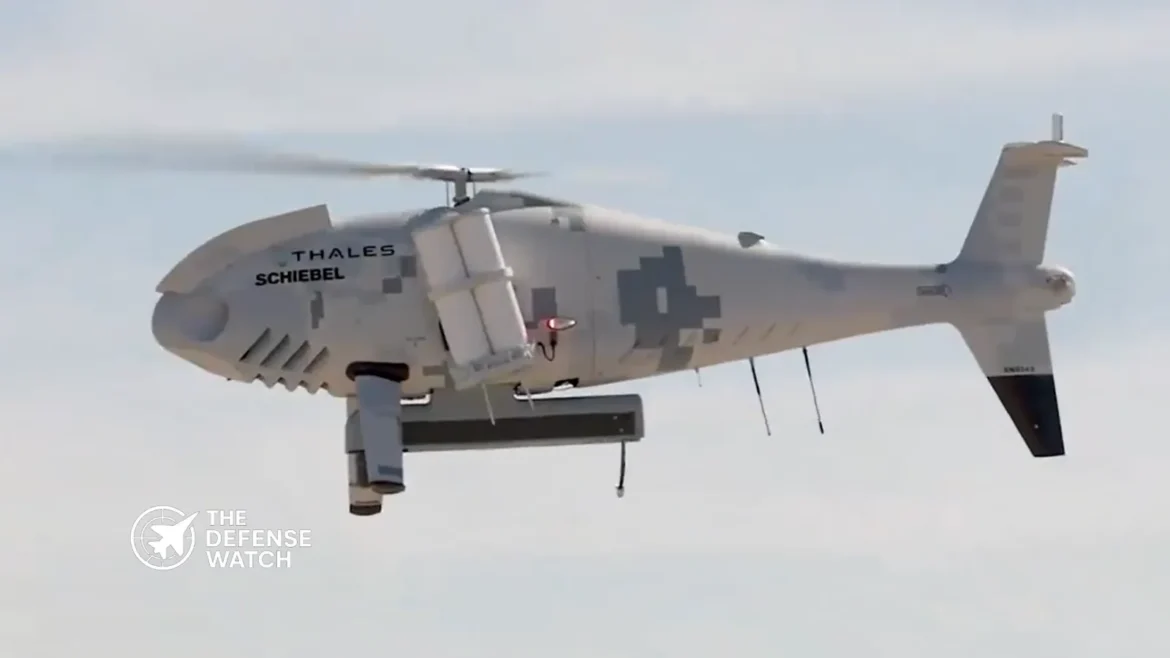
The CAMCOPTER S-100 UAV will soon operate aboard the Hellenic Navy’s new FDI Belharra-class frigates under a freshly signed supply contract aimed at strengthening Greece’s maritime surveillance and targeting capabilities.
According to official disclosures from the Hellenic Navy and manufacturer sources, rotary-wing S-100 systems will be deployed on three FDI frigates: HS Kimon, HS Nearchos, and HS Formion. The vessels are being constructed in France by Naval Group as part of Greece’s broader naval modernization program.
(adsbygoogle = window.adsbygoogle || []).push({});The first of the class, HS Kimon, arrived in Greece last month. Integration of the CAMCOPTER S-100 UAV aboard the ship is scheduled for spring 2026. Delivery of HS Nearchos is targeted for late 2026, while HS Formion is expected in early 2027.
Strengthening Greek Naval ISR Capabilities
The CAMCOPTER S-100 UAV is produced by Austria-based Schiebel. The rotary-wing platform is designed for vertical takeoff and landing operations, eliminating the need for a runway and making it suitable for deployment from frigate-sized decks.
Onboard the FDI frigates, the UAV will provide maritime surveillance, intelligence gathering, reconnaissance, and targeting support. These capabilities are increasingly critical in contested maritime environments, particularly in the Eastern Mediterranean.
The integration of an organic UAV capability allows the frigates to extend sensor reach beyond the ship’s radar horizon. This enhances situational awareness and supports anti-surface and anti-submarine operations.
(adsbygoogle = window.adsbygoogle || []).push({});The CAMCOPTER S-100 UAV has been widely deployed in naval operations worldwide and has accumulated extensive operational hours in maritime missions. Its modular design enables integration of electro-optical, infrared, and maritime radar payloads, depending on mission requirements.
FDI Belharra-Class Frigates: A Modern Surface Combatant
The FDI, also known as the Belharra class, represents one of the most advanced surface combatants entering European service. Developed by France’s Naval Group for the French Navy and export customers, the platform incorporates advanced radar, air defense, and anti-submarine warfare systems.
For Greece, the FDI frigates form the backbone of a fleet renewal strategy aimed at replacing aging surface vessels and enhancing deterrence in the region.
HS Kimon, the lead ship for the Hellenic Navy, marks a significant milestone in the program. The addition of the CAMCOPTER S-100 UAV enhances the vessel’s multi-domain operational profile.
(adsbygoogle = window.adsbygoogle || []).push({});With integrated sensors, modern combat management systems, and now organic UAV support, the FDI frigates are positioned to conduct high-end maritime operations, including air defense, surface warfare, and ISR missions.
Training And Operational Readiness
In addition to the three shipborne systems, one CAMCOPTER S-100 UAV system will be allocated for land-based training.
Initial crew training is expected to conclude in spring 2026, aligning with the planned operational integration timeline aboard HS Kimon.
Land-based training ensures that flight crews and mission operators gain proficiency prior to shipboard deployment. This approach reduces operational risk and accelerates the transition to full operational capability.
(adsbygoogle = window.adsbygoogle || []).push({});The phased delivery schedule aligns UAV integration with ship acceptance timelines, supporting a structured capability buildup.
Expanding The Role Of Naval UAVs
The decision to deploy the CAMCOPTER S-100 UAV aboard FDI frigates reflects a broader trend across NATO and partner navies. Shipborne UAVs are increasingly viewed as force multipliers that enhance reach and persistence without requiring larger flight decks or manned helicopters.
For mid-sized surface combatants, rotary-wing UAVs offer flexibility in surveillance and targeting roles. They can support maritime domain awareness, assist in search and rescue missions, and contribute to over-the-horizon targeting for anti-ship missiles.
As regional maritime activity intensifies, ISR capabilities have become central to naval deterrence strategies. Greece’s adoption of the CAMCOPTER S-100 UAV signals continued investment in integrated sensor networks and multi-domain awareness.
Strategic Context In The Eastern Mediterranean
The Eastern Mediterranean remains a strategically sensitive region, marked by overlapping maritime claims, energy exploration interests, and increased naval deployments.
(adsbygoogle = window.adsbygoogle || []).push({});By equipping its new-generation FDI frigates with organic UAV systems, the Hellenic Navy improves its ability to monitor sea lanes and conduct persistent surveillance operations.
The integration of unmanned systems complements broader defense modernization efforts underway in Greece, including fleet renewal and expanded cooperation with European defense partners.

Qatar’s Second Guided Missile Fast Attack Craft Launched
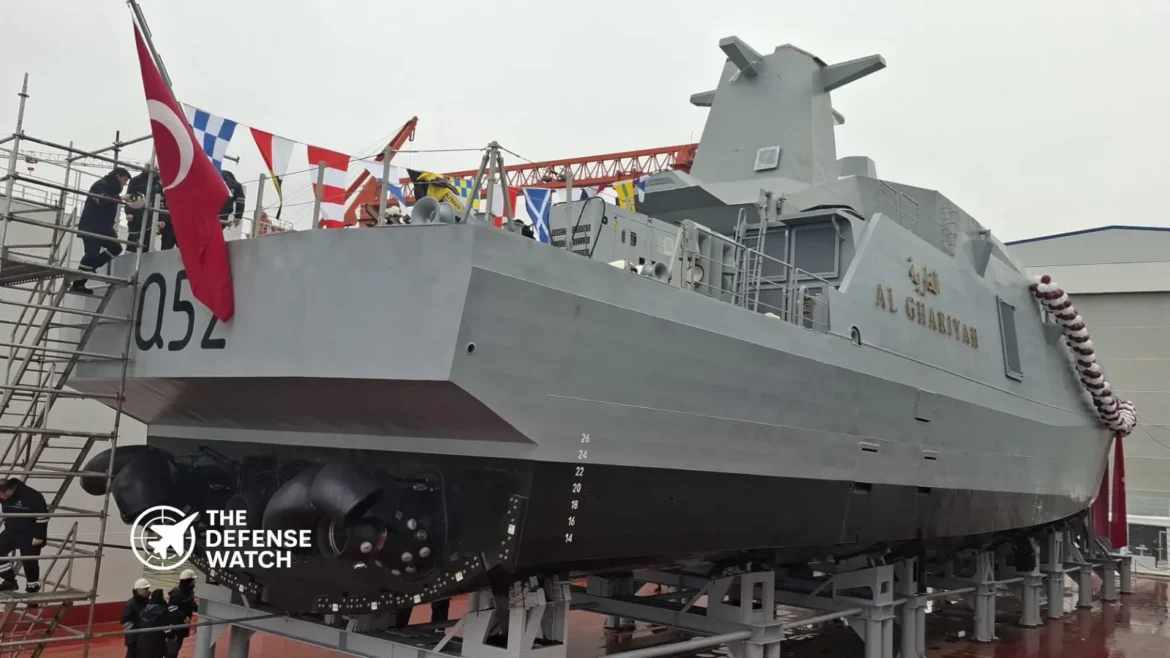
The second guided missile fast attack craft built by DEARSAN Gemi İnşaat Sanayi A.Ş. for the Qatar Armed Forces was launched into the sea on February 14, 2026.
The vessel, designated Q52 Al Ghariyah, entered the water during a ceremony held at Dearsan Shipyard in Türkiye. The launch marks another milestone in the bilateral naval cooperation agreement covering two 50 meter guided missile fast attack craft.
The program forms part of Qatar’s broader naval modernization efforts aimed at strengthening coastal defense and maritime security capabilities in the Persian Gulf region.
Contract Background And Program Scope
The contract between DEARSAN and the Qatar Armed Forces calls for the construction of two 50 meter guided missile fast attack craft. The agreement reflects Doha’s continued investment in fast, heavily armed surface combatants capable of operating in littoral and near shore environments.
Fast attack craft play a critical role in regional maritime security. Their compact size, high speed, and missile armament make them effective platforms for coastal defense, anti surface warfare, and deterrence missions.
The launch of Q52 Al Ghariyah follows the completion of hull construction and outfitting phases. The vessel will now enter the fitting out, systems integration, and sea trials phase before delivery.
Platform Capabilities And Operational Role
While detailed technical specifications have not been publicly disclosed, 50 meter class guided missile fast attack craft typically feature:
- High speed propulsion systems for rapid response operations
- Advanced radar and combat management systems
- Anti ship missile launchers
- Naval gun systems for surface engagements
- Integrated communications and electronic warfare suites
Such vessels are designed to operate in confined maritime environments, including chokepoints and coastal waters. For Qatar, this capability is particularly relevant given the strategic importance of Gulf shipping lanes and offshore energy infrastructure.
The addition of Q52 Al Ghariyah strengthens Qatar’s ability to conduct maritime patrol, deterrence missions, and rapid response operations.
Qatar’s Expanding Naval Modernization Efforts
Qatar has steadily expanded its naval forces over the past decade. The modernization drive includes investments in offshore patrol vessels, corvettes, amphibious platforms, and fast attack craft.
The country’s naval development strategy aligns with broader Gulf trends, where regional states are enhancing maritime security to protect energy exports, territorial waters, and strategic sea lines of communication.
Türkiye has emerged as a significant defense partner for Qatar across land, air, and naval domains. Turkish defense firms have secured multiple contracts in shipbuilding, armored vehicles, and training programs.
The guided missile fast attack craft program further deepens that cooperation.
Regional Maritime Security Context
The Persian Gulf remains one of the world’s most strategically sensitive maritime regions. Commercial shipping, oil and gas exports, and naval operations converge in relatively narrow waters.
Fast attack craft are widely used by Gulf states due to their cost effectiveness and operational flexibility. Compared to larger frigates or destroyers, these vessels offer:
- Lower operating costs
- Faster deployment cycles
- Enhanced maneuverability in shallow waters
- Strong missile strike capability relative to size
For smaller navies, missile armed fast attack craft provide a credible deterrent against larger surface combatants operating near national waters.
Industrial And Strategic Significance For DEARSAN
For DEARSAN, the launch of Q52 Al Ghariyah reinforces its position as an export focused naval shipbuilder. Turkish shipyards have expanded their footprint in Africa, the Middle East, and Asia over the past decade.
Export programs such as this one demonstrate Türkiye’s growing role in the global naval defense market. The country’s shipbuilding sector has focused on modular construction, competitive pricing, and tailored designs for regional requirements.
The successful launch of the second vessel suggests the program remains on schedule.
What Comes Next
Following launch, Q52 Al Ghariyah will undergo harbor acceptance tests and sea trials. These phases validate propulsion performance, navigation systems, combat systems integration, and weapons functionality.
Once trials are completed, the vessel will be formally delivered to the Qatar Armed Forces and integrated into operational service.
Delivery timelines have not been publicly detailed, but launch typically precedes commissioning by several months.
Strategic Outlook
The launch of Qatar’s second guided missile fast attack craft underscores Doha’s continued emphasis on maritime defense.
In a region where naval capabilities are closely watched, incremental additions such as Q52 Al Ghariyah contribute to layered coastal defense and deterrence architecture.
As Gulf states modernize their fleets, fast attack craft remain a central element of naval force structure due to their speed, flexibility, and strike capacity.
Mexican Navy Multipurpose Vessel Program Advances With 37 Percent Completion
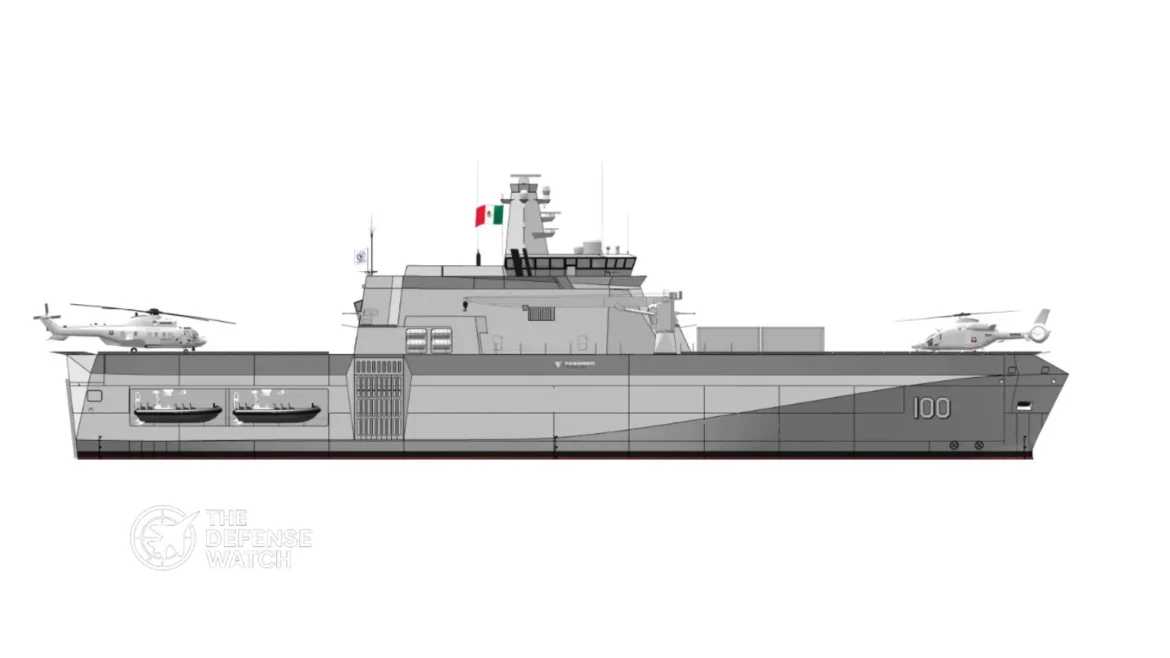
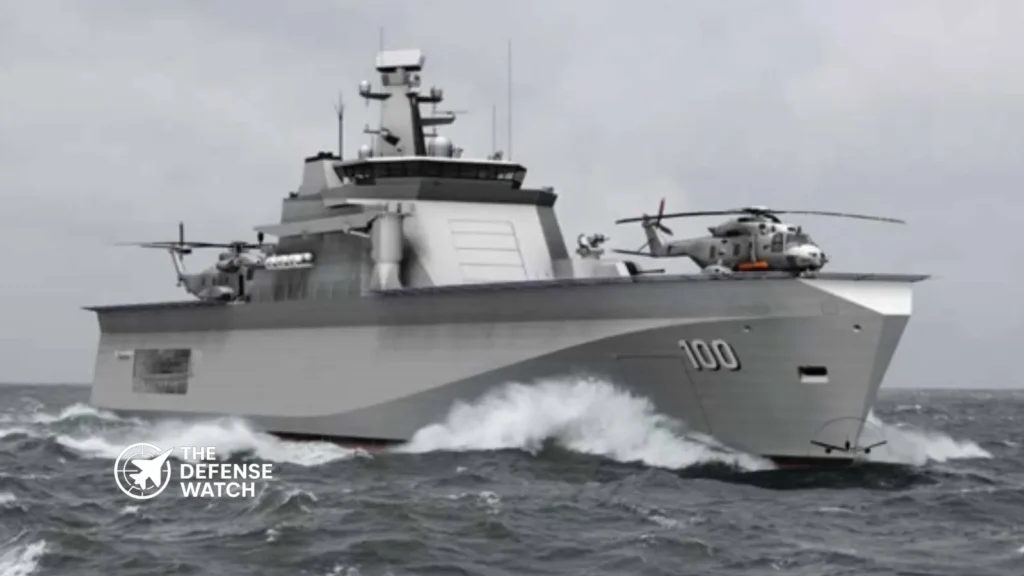
The Mexican Navy Multipurpose Vessel program has reached 37 percent completion of the structural steel acquired in 2024, marking a key milestone in Mexico’s ongoing naval modernization efforts.
The new class of Multipurpose Vessel, or MPV, is designed to support long-range maritime surveillance, humanitarian assistance operations, and emergency response missions under Mexico’s Plan Marina framework.
According to official statements from the Secretaría de Marina, construction progress reflects steady advancement in hull assembly and structural integration. The program forms part of a broader effort to strengthen Mexico’s maritime domain awareness and disaster response capacity.
A Modern Design Focused On Multi-Mission Flexibility
The Mexican Navy Multipurpose Vessel is intended as a flexible platform capable of operating across multiple mission sets. These include:
- Extended maritime patrol and surveillance
- Search and rescue operations
- Humanitarian assistance and disaster relief
- Logistical support during national emergencies
The vessel’s design emphasizes endurance and operational range, allowing it to patrol distant maritime zones and support civil authorities during natural disasters. Mexico faces recurring hurricanes, earthquakes, and flooding, which make rapid maritime response a national priority.
Plan Marina, the Navy’s operational doctrine for civil protection and disaster response, has historically played a central role during emergencies. The new MPV class is expected to enhance those capabilities by providing greater lift capacity, improved command and control spaces, and expanded medical and logistical facilities.
Supporting Plan Marina And National Emergency Operations
Plan Marina, formally managed by the Secretaría de Marina, coordinates naval assets during domestic crises. The framework enables rapid deployment of ships, aircraft, and personnel to affected areas.
The Mexican Navy Multipurpose Vessel is specifically configured to support this mission. In disaster scenarios, the vessel can transport relief supplies, deploy medical teams, and serve as a floating coordination platform.

Mexico’s geographic exposure to both Atlantic and Pacific storm systems has increased the operational demand on naval forces. Enhanced sealift and surveillance platforms are therefore central to the country’s maritime strategy.
Shipbuilding Progress And Industrial Implications
With 37 percent of the structural steel acquired in 2024 now integrated into the hull, the Mexican Navy Multipurpose Vessel program demonstrates measurable progress in domestic shipbuilding.
Mexico has steadily expanded its naval industrial base in recent years, investing in modern shipyard facilities and local production capacity. By advancing construction internally, the Navy supports national industry while maintaining control over design specifications and operational requirements.
Although detailed technical specifications have not been fully disclosed, the MPV is described as a modern design platform optimized for endurance and versatility. The emphasis on long-range surveillance suggests integration of advanced radar systems and maritime domain awareness technologies.
Strengthening Maritime Domain Awareness
Maritime surveillance remains a priority for Mexico due to:
- Counter-narcotics operations
- Illegal fishing enforcement
- Protection of offshore infrastructure
- Border and exclusive economic zone monitoring
The Mexican Navy Multipurpose Vessel will likely complement existing offshore patrol vessels and logistics ships already in service.
See also: Mexican Navy modernization programs and offshore patrol vessel developments.
By expanding long-range patrol capacity, the Navy improves its ability to maintain presence in distant waters while preserving readiness for humanitarian missions.
Broader Naval Modernization Context
The Mexican Navy has pursued gradual modernization focused on:
- Fleet recapitalization
- Enhanced maritime surveillance
- Improved amphibious and logistical support
- Greater domestic production capability
The introduction of the Multipurpose Vessel class aligns with these objectives. Rather than focusing on high-end combat capabilities, Mexico’s naval strategy emphasizes sovereignty protection, law enforcement, and civil protection roles.
This approach reflects Mexico’s operational environment, where maritime security threats are often asymmetric and humanitarian missions are frequent.
What Comes Next
With structural assembly approaching the halfway mark, the next phases will likely include:
- Superstructure integration
- Systems installation
- Internal compartment fitting
- Sea trials following launch
While no official delivery timeline has been publicly confirmed, steady construction progress suggests the program remains active and funded.
As the Mexican Navy Multipurpose Vessel program advances, it signals continued investment in maritime resilience and domestic shipbuilding capability.
Italy’s Former Aircraft Carrier Giuseppe Garibaldi Could Join Indonesian Navy By October 2026
The Giuseppe Garibaldi aircraft carrier could join the Indonesian Navy by October 2026, according to reporting by Army Recognition, citing discussions surrounding a potential transfer of the retired Italian flagship to Jakarta.
(adsbygoogle = window.adsbygoogle || []).push({});If completed, the move would mark a significant milestone for Indonesia’s naval modernization plans and expand its capacity for maritime aviation operations across Southeast Asia.
Background On Giuseppe Garibaldi
The Italian aircraft carrier Giuseppe Garibaldi served as the flagship of the Italian Navy for decades. Commissioned in 1985, the vessel was Italy’s first aircraft carrier built after World War II.
Displacing around 14,000 tons at full load, the ship was designed as a light aircraft carrier capable of operating short takeoff and vertical landing aircraft, including the AV-8B Harrier II. It also supported helicopters for anti-submarine warfare, maritime patrol, and amphibious operations.
The carrier has participated in multiple NATO and coalition missions, including deployments in the Mediterranean and support operations linked to conflicts in the Balkans and Libya.
(adsbygoogle = window.adsbygoogle || []).push({});Italy formally decommissioned Giuseppe Garibaldi in 2024 after nearly four decades of service, following its replacement by the larger Italian aircraft carrier Cavour, which now serves as Italy’s primary carrier platform and has been upgraded to operate F-35B aircraft.
Indonesia’s Naval Modernization Push
The potential acquisition of the Giuseppe Garibaldi aircraft carrier aligns with Indonesia’s broader efforts to strengthen maritime defense capabilities.
The Indonesian Navy, known as TNI-AL, has been pursuing fleet upgrades across surface combatants, submarines, and amphibious assets. Jakarta has emphasized maritime domain awareness and sea control, reflecting Indonesia’s status as the world’s largest archipelagic state.
Indonesia sits astride critical sea lanes, including routes linking the Indian and Pacific Oceans. Modernizing naval forces has been a strategic priority in light of regional security dynamics and increased naval activity in the broader Indo-Pacific.
(adsbygoogle = window.adsbygoogle || []).push({});While Indonesia does not currently operate a fixed-wing aircraft carrier, it fields amphibious assault ships and helicopter-capable vessels that support maritime security and humanitarian missions.
Potential Operational Role
If transferred, the Giuseppe Garibaldi aircraft carrier could provide Indonesia with a platform for helicopter operations, maritime patrol support, disaster relief missions, and potentially short takeoff and vertical landing aircraft, depending on configuration and budget decisions.
Defense analysts note that integrating a light carrier would require infrastructure, training pipelines, and sustainment planning. Aircraft procurement and crew training would be central to operational viability.
Indonesia has not publicly confirmed final terms of any agreement. Financial arrangements, refit requirements, and aviation components remain key considerations.
Strategic Implications
A transfer would represent one of the most significant naval platform acquisitions in Southeast Asia in recent years.
(adsbygoogle = window.adsbygoogle || []).push({});For Italy, the move would conclude the operational lifecycle of Giuseppe Garibaldi while potentially strengthening defense ties with Indonesia. Rome has increasingly engaged Indo-Pacific partners through defense exports and industrial cooperation.
For Indonesia, the acquisition would signal an evolution in maritime posture. Even as a light carrier, Giuseppe Garibaldi would offer expanded aviation reach compared to existing Indonesian surface combatants.
However, officials have not detailed a finalized timeline or contract structure. As of early 2026, discussions appear ongoing.
Broader Regional Context
Southeast Asia has seen steady naval modernization across multiple states. Countries in the region are investing in submarines, frigates, and maritime patrol capabilities.
(adsbygoogle = window.adsbygoogle || []).push({});Indonesia’s long-term defense planning emphasizes minimum essential force requirements, with phased modernization across services. Naval investments are central to securing territorial waters, exclusive economic zones, and key maritime chokepoints.
Should the Giuseppe Garibaldi aircraft carrier enter Indonesian service by October 2026, it would represent a notable development in regional naval balance, particularly in terms of aviation-enabled maritime operations.
US Navy Warship Collision With Supply Vessel USNS Supply – What We Know
A US Navy warship collision with supply vessel USNS Supply occurred as the guided-missile destroyer USS Truxtun was taking on fuel and stores in a routine replenishment-at-sea operation, US Southern Command confirmed. This US Navy warship collision in the Caribbean left two personnel with minor injuries and is under official review.
The collision unfolded on February 11, 2026, when the Arleigh Burke-class destroyer USS Truxtun and the fast combat support ship USNS Supply were conducting a standard underway replenishment. In this evolution, ships sail side-by-side at close range while fuel and supplies are transferred aboard via cables and hoses.
Officials say the two sailors who reported injuries are in stable condition and neither required evacuation to a separate medical facility. Both Truxtun and USNS Supply continued sailing under their own power after the impact and showed no immediate loss of seaworthiness, according to the statement.
Ships Involved and Operation Context
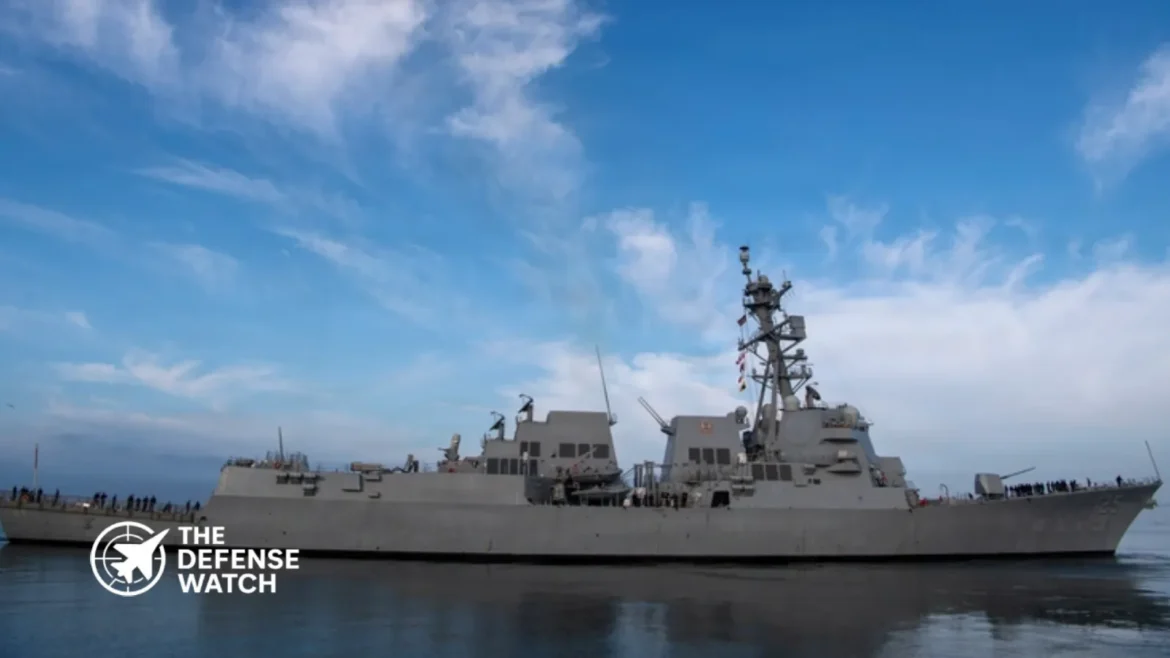
USS Truxtun (DDG-103) is an Arleigh Burke-class guided-missile destroyer commissioned in 2009, with a displacement of around 9,200 tons and a crew of roughly 380. It carries an Aegis combat system with a Mk 41 vertical launch system, naval guns, and anti-air and missile defense sensors.
USNS Supply (T-AOE-6) is a Supply-class fast combat support ship operated by the Military Sealift Command. At about 48,800 tons and 755 feet long, it provides fuel, munitions, food, and other stores to carrier strike groups and other deployed units.
The replenishment at sea during which the collision occurred is one of the most challenging routine evolutions for the Navy. Vessels maneuver in close proximity while underway, making precise navigation and helm control essential to safety.
Operational Setting
The incident took place in the Southern Command area of responsibility, which covers the Caribbean Sea and parts of the South Atlantic. The ships were part of a larger US naval presence in the region tasked with ongoing security operations.
Investigation and Safety
US Southern Command said the cause of the US Navy warship collision is under investigation. No details on contributing factors such as weather conditions, mechanical issues, or procedural errors were released at the time of the announcement.
Collisions between Navy vessels are relatively rare but have occurred in recent years. For example, a 2025 collision between the aircraft carrier USS Harry S. Truman and a merchant vessel near the Suez Canal resulted in minor damage but no injuries.
What Comes Next
Naval authorities will likely review watchstanding procedures, helm control inputs and communications leading up to the contact. Both Truxtun and Supply are expected to undergo damage assessments and any necessary maintenance before returning to full operational status.
China’s Next-Generation Type 09V Nuclear Attack Submarine Appears At Bohai Shipyard
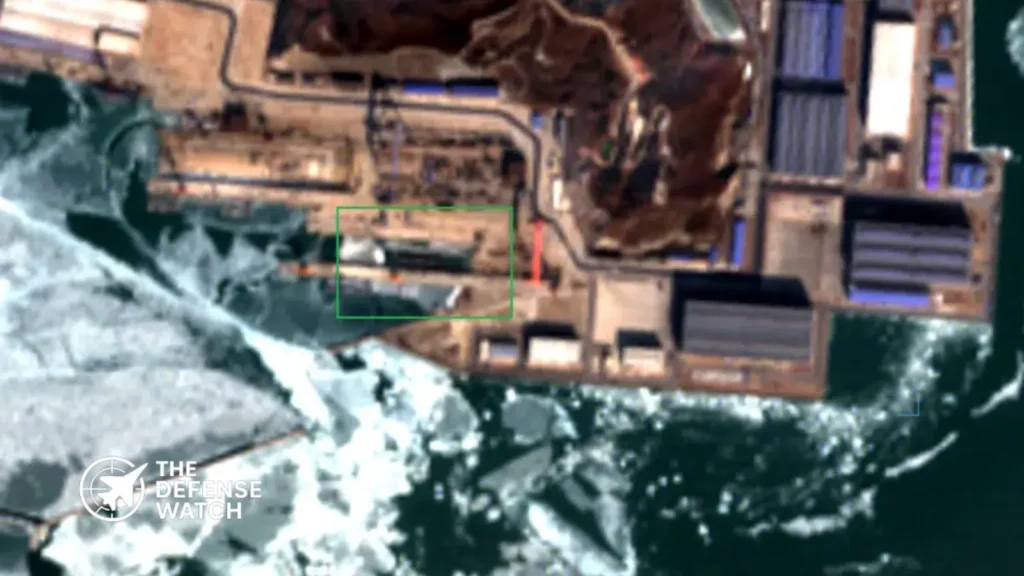
Bohai Shipbuilding has moved the first Chinese Type 09V nuclear-powered attack submarine into the launch bay at its Huludao facility, according to satellite imagery obtained by Naval News. The new nuclear attack submarine represents a significant advancement in China’s submarine capabilities, featuring design elements not previously seen on People’s Liberation Army Navy vessels.
(adsbygoogle = window.adsbygoogle || []).push({});Satellite images dated February 9, 2026, show the Type 09V SSN in a flooded drydock at the Bohai facility. The submarine’s appearance marks a milestone in China’s ongoing submarine modernization program, which has seen accelerated production of nuclear-powered vessels over the past several years.
Design Features Distinguish Type 09V From Previous Classes
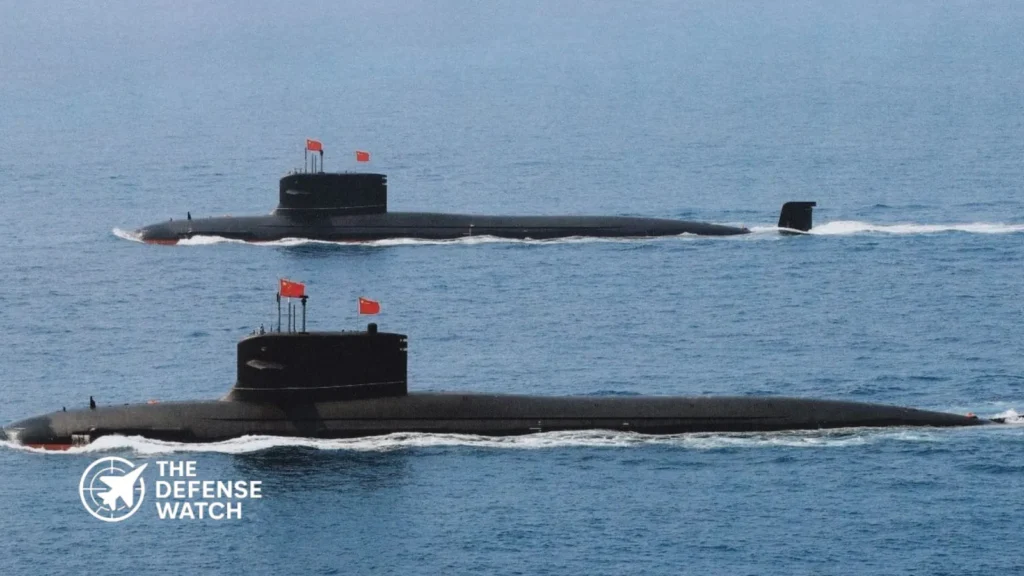
The Chinese Type 09V nuclear submarine measures approximately 110-115 meters in overall length with an estimated beam of 12-13 meters. These dimensions represent a notable departure from previous Chinese nuclear submarine designs, particularly in terms of hull width. The increased beam suggests a submerged displacement of 9,000 to 10,000 tons, considerably larger than the approximately 7,000-ton Type 09III-family submarines.
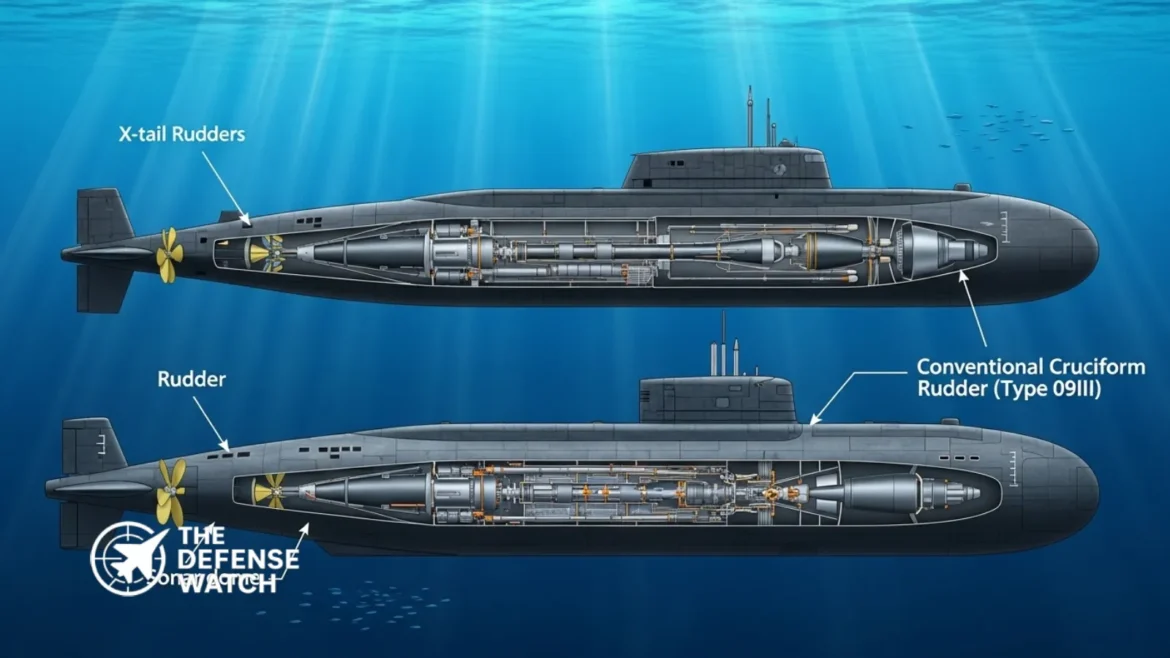
The most distinctive feature visible in satellite imagery is the prominent X-tail rudder arrangement with large control surfaces. This configuration represents the first use of X-form stern controls on a Chinese nuclear-powered submarine. The design choice aligns with modern submarine architecture trends favored by several Western navies for improved maneuverability and reduced acoustic signature.
Naval analysts note the X-tail configuration previously appeared on a smaller submarine design observed at Wuchang Shipbuilding in 2024, designated “Type 041” or “Zhou-class” by U.S. officials. The adoption of this arrangement on the Type 09V suggests China is implementing consistent design philosophies across its new-generation submarine programs.
Weapons Systems And Propulsion Configuration
Analysis of available satellite imagery indicates an unfinished compartment behind the sail that likely houses a vertical launch system for anti-ship and land-attack missiles. This arrangement would mirror the configuration on the preceding Type 09IIIB guided missile submarine, which reportedly carries 18 launchers in a three-abreast configuration.
(adsbygoogle = window.adsbygoogle || []).push({});The Type 09V almost certainly employs a pump-jet propulsion system rather than a traditional skewback propeller. This assessment aligns with the propulsion method used on the Type 09IIIB and meets performance expectations for a next-generation nuclear attack submarine design. Pump-jet propulsion offers reduced acoustic signatures compared to conventional propellers, a critical advantage for submarine operations.
The visible red-painted lower hull suggests reduced reserve buoyancy compared to earlier Chinese submarine designs. This characteristic may indicate a single-hull construction approach, departing from the double-hull arrangement used on all previous PLAN submarines. Single-hull designs maximize internal space efficiency but require more sophisticated hydrodynamic shaping.
Production Capacity And Strategic Implications
Since 2022, Bohai Shipbuilding has launched an estimated seven to eight Type 09IIIB guided missile nuclear submarines for the Chinese Navy. The facility’s demonstrated production capacity indicates China’s commitment to rapidly expanding its nuclear submarine fleet. The appearance of the Type 09V nuclear attack submarine suggests this expansion will continue with increasingly sophisticated designs.
Defense analysts assess that Bohai Shipyard possesses substantial capacity for simultaneous production of multiple nuclear submarine classes. The wider beam of the Type 09V likely provides insights into China’s prospective Type 09VI ballistic missile submarine, which may adapt a derivative hull design.
Regional Responses To PLAN Submarine Expansion
The Chinese Type 09V nuclear submarine development is compelling regional responses from Indo-Pacific nations. Australia is pursuing a future fleet of nuclear-powered attack submarines under the AUKUS agreement with the United States and United Kingdom. Japan and South Korea have both considered nuclear submarine programs in recent defense policy discussions.
(adsbygoogle = window.adsbygoogle || []).push({});South Korea appears particularly likely to pursue its own nuclear attack submarine fleet, possibly with U.S. collaboration. Countries unable to operate nuclear-powered submarines are expected to enhance conventional submarine capabilities and invest in anti-submarine warfare systems.
The Type 09V represents China’s determination to field a modern, capable nuclear submarine force that can operate across the Indo-Pacific region. Regional navies are likely to increase investments in sea- and airborne ASW capabilities in response to the expanding PLAN submarine fleet.
Technical Specifications Remain Partially Undetermined
Several technical aspects of the Chinese Type 09V nuclear submarine remain speculative based on available satellite imagery. The torpedo tube arrangement, sonar array configuration, and exact missile armament specifications have not been confirmed through open-source intelligence.
The submarine’s dive plane configuration is not visible in current imagery. Naval analysts suggest the Type 09V may use retractable hull-mounted dive planes rather than the fairwater planes employed on previous Chinese submarines. This assessment contrasts with standard Chinese submarine design practice but aligns with modern SSN architecture.
The reactor type and power output remain unknown. Previous Chinese nuclear submarines have faced challenges with reactor noise levels and reliability. Whether the Type 09V incorporates new reactor technology represents a critical question for assessing its operational capabilities.
Comparative Analysis With Western Submarines
The Type 09V’s estimated displacement of 9,000-10,000 tons places it in a similar size category to the U.S. Navy’s Virginia-class submarines (7,800 tons) and the larger Russian Yasen-class (13,800 tons). The X-tail configuration is similar to that employed on Virginia-class submarines, suggesting Chinese designers are adopting proven Western design concepts.
(adsbygoogle = window.adsbygoogle || []).push({});The submarine’s length-to-beam ratio appears optimized for a balance between internal volume and hydrodynamic efficiency. This design philosophy reflects modern submarine architecture trends emphasizing reduced acoustic signatures and improved sensor integration.
Future PLAN Submarine Fleet Composition
The introduction of the Type 09V nuclear attack submarine indicates China’s submarine force will include multiple specialized classes rather than a single standardized design. The Type 09IIIB guided missile submarines provide land-attack and anti-surface warfare capabilities, while the Type 09V appears optimized for hunter-killer missions against enemy submarines and surface vessels.
China’s ballistic missile submarine force currently relies on the Type 09IVA (Jin-class) SSBN, which carries JL-2 submarine-launched ballistic missiles. The prospective Type 09VI SSBN may incorporate design elements from the Type 09V hull, potentially offering improved acoustic performance and deeper diving capabilities.
Implications For U.S. Naval Strategy
The Chinese Type 09V nuclear submarine represents a capability advancement that U.S. Navy planners must account for in force structure and operational planning. The submarine’s larger size suggests improved sensor suites, greater weapons payload, and extended operational range compared to previous PLAN attack submarines.
(adsbygoogle = window.adsbygoogle || []).push({});U.S. Indo-Pacific Command faces an expanding Chinese submarine threat that includes both nuclear and conventional platforms. The Type 09V adds to existing PLAN submarine capabilities that already include the Type 09III/09IIIA/09IIIB nuclear attack submarines and multiple classes of advanced conventional submarines including the Type 039A/B/C (Yuan-class).
The acceleration of Chinese submarine construction at Bohai and other facilities suggests the PLAN submarine fleet will continue growing in both quantity and quality throughout the 2020s and into the 2030s.