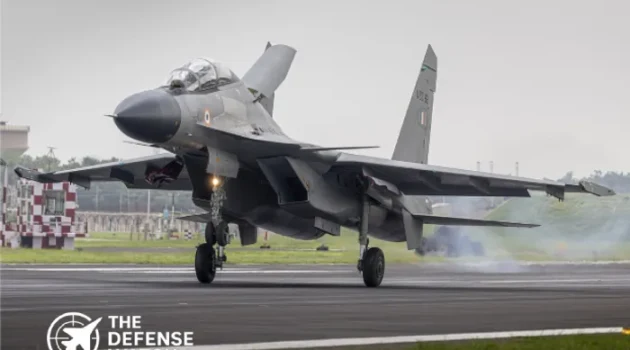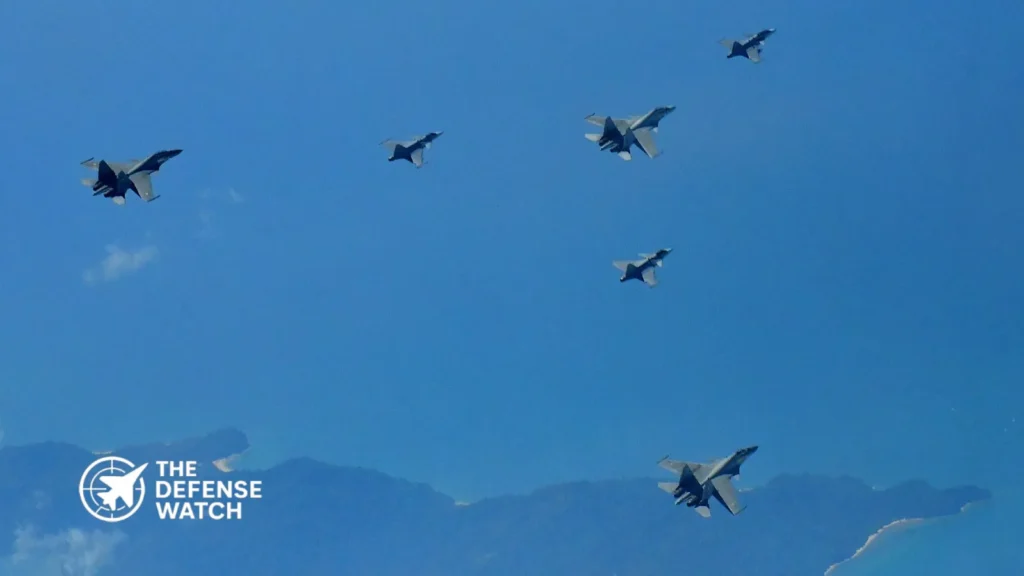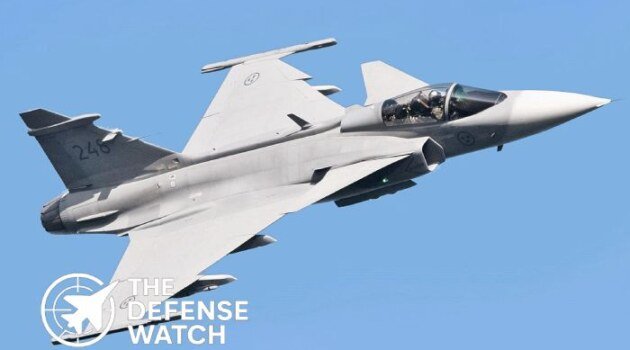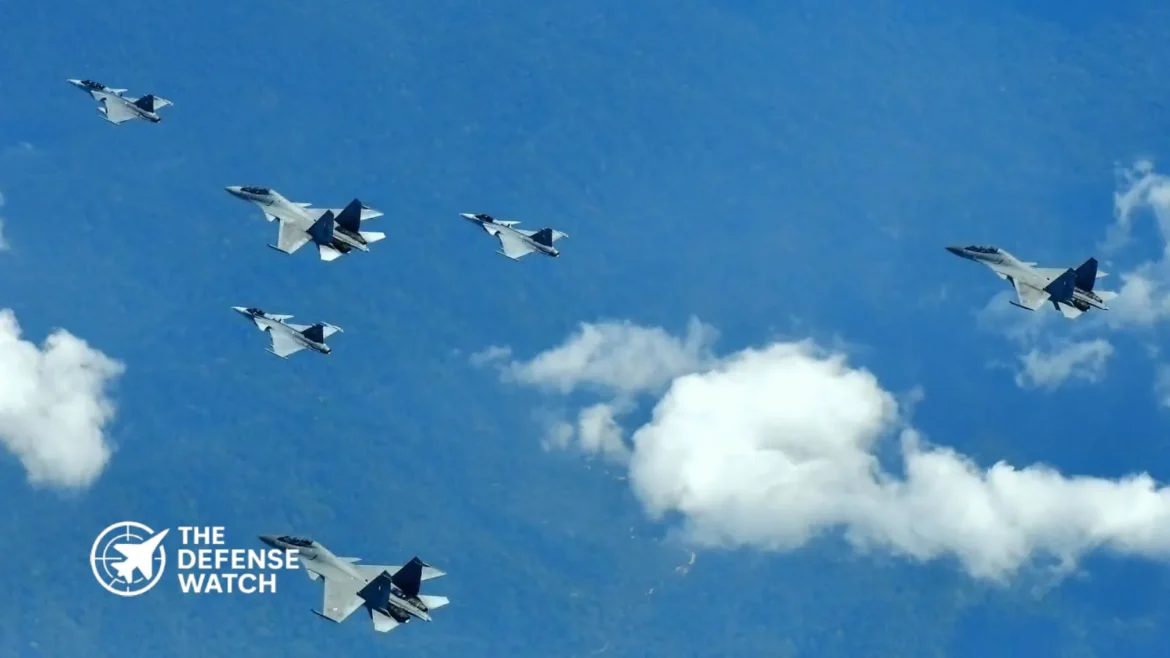
- ► India’s Su-30MKI and Thai Gripen jets carried out a joint patrol over the eastern Indian Ocean.
- ► Aircraft from the Indian Air Force and Royal Thai Air Force participated.
- ► The patrol focused on maritime domain awareness and interoperability.
- ► The mission signals deeper India Thailand defense cooperation in the Indo Pacific.
- ► Activity comes amid expanding regional security coordination across maritime Asia.
India’s Su-30MKI And Thai Gripen Jets Conduct Indian Ocean Patrol
India’s Su-30MKI and Thai Gripen jets conducted a coordinated Indian Ocean patrol, underscoring growing Indo Pacific airpower cooperation between New Delhi and Bangkok.
(adsbygoogle = window.adsbygoogle || []).push({});The patrol involved aircraft from the Indian Air Force and the Royal Thai Air Force operating over key maritime corridors in the eastern Indian Ocean.
The mission reflects a broader trend of regional air forces deepening interoperability as maritime competition intensifies across the Indo Pacific.
Expanding Airpower Coordination In The Indo Pacific
The India Su-30MKI Indian Ocean patrol marks a notable step in bilateral air cooperation. The Sukhoi Su-30MKI remains the backbone of India’s air dominance fleet, optimized for long range missions, maritime strike, and air superiority roles.
Thailand deployed its Saab JAS 39 Gripen fighters, operated by the Royal Thai Air Force. The Gripen’s network centric design and advanced data link architecture support coordinated maritime surveillance and joint mission planning.

Joint patrols over open ocean airspace require coordination in communications, refueling planning, and shared tactical procedures. These are not symbolic flyovers. They test practical interoperability.
The mission focused on enhancing maritime situational awareness and strengthening operational coordination between the two air forces.
Why The Indian Ocean Matters
The Indian Ocean sits at the center of global trade flows. Sea lanes connecting the Middle East, Africa, and Asia pass through this region. Energy shipments, commercial traffic, and naval deployments all converge here.
India has steadily expanded its maritime security footprint, aligning air and naval capabilities to protect sea lines of communication. The Su-30MKI plays a central role in maritime strike operations, often operating in coordination with the Indian Navy.
Thailand, while geographically anchored in Southeast Asia, has shown increasing interest in broader Indo Pacific security frameworks. Joint air patrols signal that Bangkok is willing to work with regional partners beyond traditional land based exercises.
(adsbygoogle = window.adsbygoogle || []).push({});This India Su-30MKI Indian Ocean patrol therefore carries strategic weight beyond the immediate tactical mission.
Platform Capabilities And Operational Implications
The Su-30MKI offers long endurance and heavy payload capacity. Its range, especially when supported by aerial refueling, allows deep maritime coverage. Equipped with advanced radar and anti ship weapon options, it serves as both a deterrent and a surveillance asset.
The Gripen, though lighter, integrates advanced avionics and real time data sharing. Its design philosophy emphasizes distributed operations and network connectivity. In a maritime context, that allows rapid sharing of targeting data and airspace coordination.
When Su-30MKI and Gripen jets operate together, the combination merges endurance and payload with agile network centric capabilities.
For regional observers, the operational takeaway is interoperability. Shared patrols improve communication protocols, standard operating procedures, and joint response readiness.
Broader Geopolitical Context
The Indo Pacific has seen a steady increase in multinational exercises, patrols, and defense dialogues. Countries are investing in partnerships aimed at ensuring freedom of navigation and maritime security.
India has deepened defense ties with Southeast Asian states as part of its Act East policy. Thailand remains an important regional actor with strategic access to key maritime corridors.
While the patrol does not represent a formal alliance shift, it reflects practical cooperation. Regularized engagements build habits of coordination that can scale during crises.
In the current security environment, airpower signaling matters. Joint patrols communicate readiness, shared interests, and mutual trust.
Strategic Assessment
From a defense modernization standpoint, the India Su-30MKI Indian Ocean patrol highlights three trends.
First, air forces are extending their role into maritime domain awareness, traditionally dominated by naval forces.
(adsbygoogle = window.adsbygoogle || []).push({});Second, mid sized powers are expanding bilateral cooperation independent of larger bloc structures.
Third, interoperability is increasingly defined by data sharing and operational integration, not just joint flight hours.
The mission also underscores how legacy heavy fighters like the Su-30MKI remain relevant when paired with modern network enabled platforms such as the Gripen.
For Washington based defense observers, the development fits within a wider Indo Pacific pattern. Regional partners are reinforcing layered security relationships, even when formal treaty alliances remain unchanged.
What Comes Next
Future patrols may expand in scope, potentially integrating maritime patrol aircraft or naval assets. If sustained, such cooperation could evolve into more complex exercises involving air defense drills or coordinated maritime strike scenarios.
For now, the India Su-30MKI Indian Ocean patrol stands as a clear indicator of growing India Thailand air cooperation in a strategically vital region.
 ■ KEY FACTS AT A GLANCE
- ► US relocates personnel from Al‑Udeid Air Base in Qatar amid rising Iran tensions. :contentReference[oaicite:0]{index=0}
- ► US forces also pulled troops from facilities linked to the Navy’s Fifth Fleet in Bahrain. :contentReference[oaicite:1]{index=1}
- ► Around 30,000‑40,000 US troops remain deployed across Middle Eastern bases. :contentReference[oaicite:2]{index=2}
- ► Iran’s leadership has publicly signaled military readiness to respond to a possible attack. :contentReference[oaicite:3]{index=3}
- ► US officials frame moves as precautionary amid uncertainty over direct conflict. :contentReference[oaicite:4]{index=4}
US Moves Forces, Iran Signals Response
The United States military has begun relocating personnel at key installations in the Middle East as tensions with Iran remain high. According to reporting by The New York Times, hundreds of troops were moved from Al‑Udeid Air Base in Qatar and from facilities associated with the US Navy’s Fifth Fleet in Bahrain amid concerns over possible escalation with Tehran.
US Central Command has not publicly confirmed specifics, but the movement of forces is widely seen in defense circles as precautionary planning against potential retaliation rather than an outright drawdown. US officials have emphasized that most of the roughly 30,000 to 40,000 troops deployed across the region remain in place to maintain readiness and deterrence.
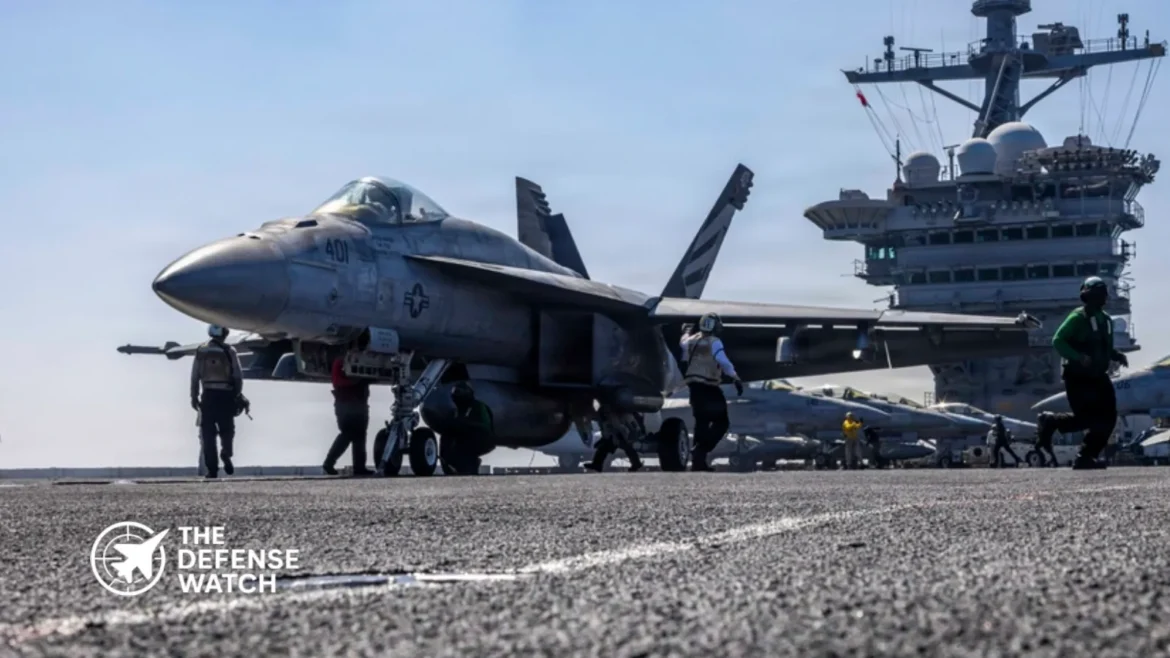
The relocations occur in the context of ongoing indirect talks between Washington and Tehran, where key nuclear and security issues have yet to be resolved. US military assets in the region, including carrier strike groups and air defense systems, remain positioned to support a range of operations if needed.
Pentagon Frames Moves as Precautionary
Pentagon sources cited by news outlets have described the personnel shifts as routine adjustments amid a heightened alert status. US defenses across bases in Iraq, Kuwait, Saudi Arabia, Jordan, and the UAE continue under standard operations with no official announcement of large‑scale evacuations.
Defense analysts note that moving forces out of potentially exposed positions can reduce risk to personnel ahead of any sharp escalation. But they also point to the continued robust US presence as evidence of strategic resolve in the face of regional security challenges.
Iran Signals Strong Defensive Posture
Iranian leadership has publicly reinforced its military readiness amid the standoff. Recent Iranian statements warned that any hostile action directed against Tehran would be met with a powerful response targeting US forces and assets across the region. These messages come alongside military drills in sensitive zones such as the Strait of Hormuz, underscoring Tehran’s dual approach of deterrence and diplomacy.
The Iranian stance reflects concerns over both the nuclear dispute and broader security dynamics involving US and allied military activities. Tehran’s rhetoric points to a posture focused on defense and regional signaling rather than unilateral escalation. Independent diplomatic channels continue to pursue avenues for de‑escalation, though progress has been uneven.
Regional Implications and Outlook
US force realignments and Iranian warnings have implications for Gulf security and global energy markets. Military planners in allied capitals are watching closely, with some governments adjusting contingency plans for transport and trade routes. The Strait of Hormuz, a critical chokepoint for oil shipments, saw heightened activity during recent Iranian drills.
Analysts caution that while precautionary troop relocations do not signal inevitable conflict, they reflect a tense strategic environment. Ongoing diplomacy, regional cooperation, and clear communication between capital governments will shape whether tensions ease or escalate further.
■ KEY FACTS AT A GLANCE- ► North Korea has suffered approximately 6,000 casualties fighting alongside Russian forces in Ukraine, according to South Korean intelligence.
- ► South Korea’s military reported in September 2025 that Russia may have supplied North Korea with two to three nuclear submarine propulsion modules salvaged from decommissioned Russian vessels.
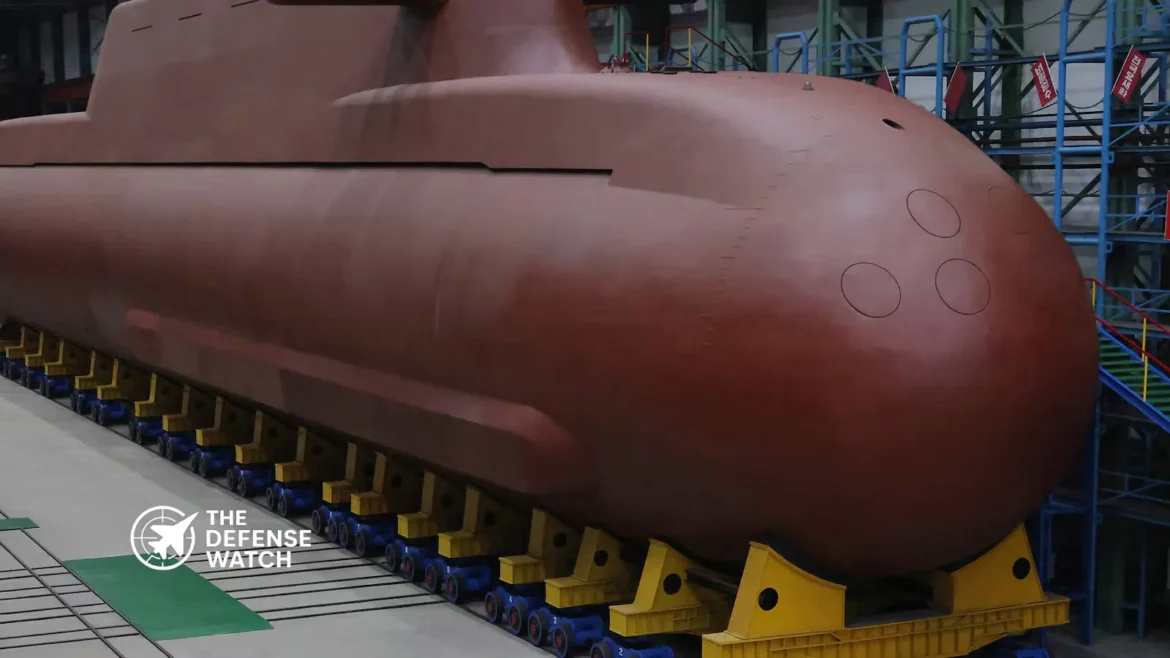
- ► Kim Jong Un publicly unveiled an 8,700-ton nuclear-powered guided missile submarine in December 2025, with analysts estimating sea trials could begin within months.
- ► Expert Peter Roberts, testifying before U.K. Parliament, called nuclear submarine operating knowledge Russia’s “crown jewels of military knowledge” — once considered untradeable.
- ► Analysts warn a functional North Korean nuclear submarine would complete Pyongyang’s nuclear triad, fundamentally altering regional deterrence in the Indo-Pacific.
Russia May Be Offering Nuclear Submarine Secrets to North Korea in Exchange for War Support in Ukraine
The Russia-North Korea nuclear quid pro quo is no longer a fringe concern among defense analysts — it is now the subject of formal testimony before Western legislatures. As Moscow’s dependence on Pyongyang deepens on the battlefields of Ukraine, experts are raising alarms that the Kremlin may be prepared to share what was once considered its most closely guarded military knowledge: the technology and expertise behind nuclear-powered submarines.
(adsbygoogle = window.adsbygoogle || []).push({});The warning came from Peter Roberts, associate fellow at the University of Exeter’s Centre for Public Understanding of Defence and Security, during a Feb. 10 hearing before the U.K. Parliament focused on undersea activity. Roberts stated that Russia has already transferred ballistic missile technology to North Korea and is now potentially moving toward offering nuclear submarine expertise to states including North Korea and Iran — in exchange for mass drone manufacturing capabilities and engineering support on the front lines in Ukraine.
North Korea’s Price for Putin’s War
North Korea’s contribution to Russia’s war effort has been substantial and growing. South Korean intelligence estimates Pyongyang has suffered around 6,000 military casualties fighting for Russian forces. The DPRK has also supplied millions of 152mm artillery shells, short-range ballistic missiles, and a range of military equipment and vehicles.
In exchange, Russia appears to be offering more than cash. Roberts told British lawmakers that the transactional calculus has evolved: having already transferred ballistic missile knowledge, Moscow now appears to be leaching submarine expertise toward its partners. Previously, nuclear submarine operating knowledge was something you never shared,” Roberts said. “These were the crown jewels of military knowledge.”
Kim’s Nuclear Triad Ambitions
North Korea has been building toward a nuclear triad — the ability to deliver nuclear weapons from land, air, and sea — for years. On Dec. 25, 2025, North Korean state media broadcast footage of Kim Jong Un personally inspecting an 8,700-ton nuclear-powered strategic guided missile submarine at the Sinpo shipyard. Seoul-based analysts noted the vessel appeared fully assembled externally, with reactor installation likely complete. A former South Korean submarine officer estimated the vessel could be ready for sea trials within months.
(adsbygoogle = window.adsbygoogle || []).push({});John Ford, a research associate at the James Martin Center for Nonproliferation Studies in California, described North Korea’s effort as building a “jank triad” — not sophisticated by great-power standards, but potentially sufficient to complicate any adversary’s calculus about a first strike. For subs, there’s a lot that can go wrong,” Ford told Defense News. “You’re basically taking all that previous stuff, and then you’re amplifying it — now it needs to be underwater.”
How Credible Is the Technology Transfer?
In September 2025, South Korea’s military reported intelligence indicating Russia had supplied North Korea with two to three nuclear submarine propulsion modules, reportedly salvaged from decommissioned Russian submarines, including a reactor, turbine, and cooling system. Seoul said it was still working to verify the claim.
Ford expressed skepticism about the most alarming scenarios. “Nuclear weapons designs: impossible,” he said. “Propulsion? More possible, but still very unlikely.” He pointed to a structural reason for Russian restraint: intelligence transferred to North Korea could leak to South Korea via human intelligence networks, giving Seoul — and by extension Washington — a window into Russian reactor designs.
Even if Russia shared propulsion data, Ford noted, North Korea would face an enormous practical gap. Operating a nuclear submarine requires skills the DPRK simply does not yet possess. The Soviet Union and the United States each took decades to develop that operational expertise during the Cold War. “The actual skill of operating underwater is something that they just don’t have,” Ford said. And unless Russian navy submariners are doing ride-alongs and training them — which I don’t think would be happening — even then, it would take a really long time.
There is also a meaningful distinction between handing over blueprints outright and providing incremental technical support — confirming component placement, answering technical questions — a more covert and deniable form of proliferation. Ford noted that this kind of tacit assistance has precedent, pointing to informal U.S. support while France developed its own nuclear weapons program.
Institutional Barriers and Strategic Leverage
Russia’s transfer of military knowledge to North Korea also faces internal resistance. Ford emphasized that those within Russia’s defense and scientific establishment responsible for protecting that information will object — though Putin retains the authority to override them.
(adsbygoogle = window.adsbygoogle || []).push({});Russia also likely holds more leverage in the relationship than commonly assumed. Ford argued that cash payments remain the primary compensation Pyongyang receives from Moscow. North Korea, subject to some of the world’s most stringent UN sanctions, channels that revenue into domestic development — manufacturing capacity, infrastructure, and military programs. Technical assistance, if it exists, is probably more limited and constrained than the most alarmist assessments suggest.
Strategic Implications for the Indo-Pacific
Whether or not the most sensitive transfers have already occurred, North Korea’s nuclear submarine program is advancing. Kim Jong Un has visited the Sinpo shipyard repeatedly, elevated the program to a stated political priority, and invoked the language of a “nuclear shield.” Analysts at the Center for Nonproliferation Studies have flagged new construction at North Korea’s Yongbyon nuclear research center that may represent a submarine reactor testbed.
A functional North Korean nuclear-powered submarine — even a rudimentary one — would complete the DPRK’s nuclear triad. That capability would extend Pyongyang’s second-strike threat beneath the ocean’s surface, making any adversary far less confident about eliminating North Korea’s nuclear arsenal in a preemptive strike. For U.S. and allied defense planners in the Indo-Pacific, this is not a distant hypothetical. It is a capability that may be closer to operational than most public assessments acknowledge.
(adsbygoogle = window.adsbygoogle || []).push({});The Russia-North Korea nuclear quid pro quo represents a convergence of two destabilizing trends: Russia’s willingness to erode longstanding non-proliferation norms to sustain its war effort, and North Korea’s accelerating drive toward a credible nuclear triad. The full extent of what has already been exchanged between Moscow and Pyongyang may not be known for years — but the strategic consequences are already beginning to take shape.
China Shows Missile-Armed Robotic Dog At World Defense Show 2026
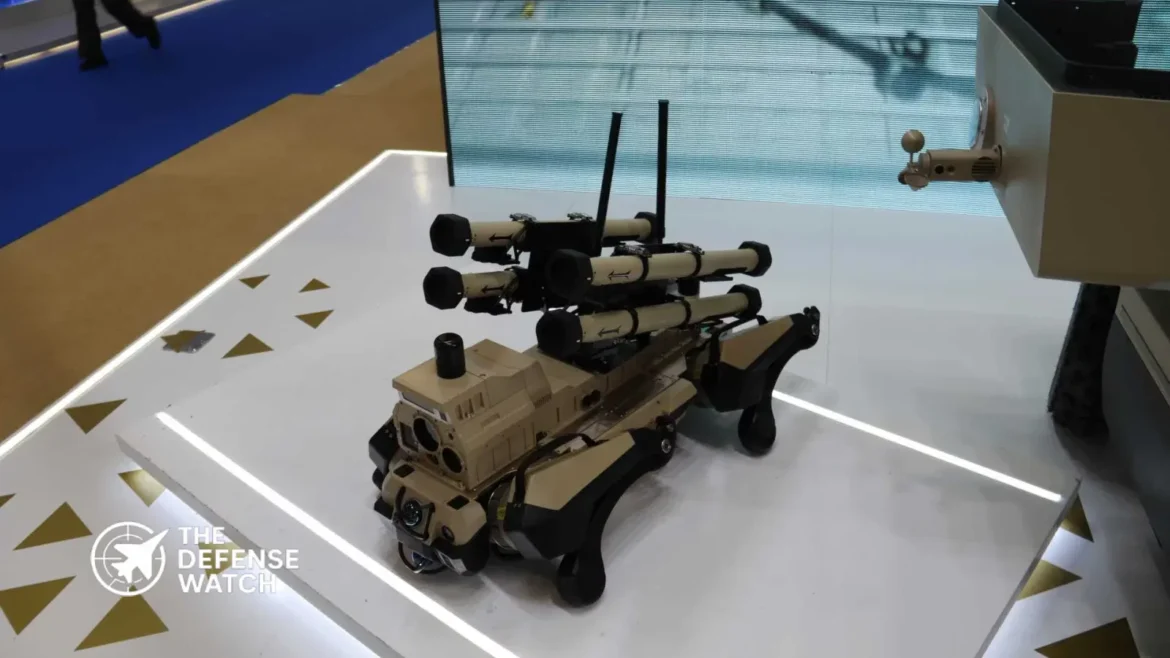
At the World Defense Show 2026 in Riyadh, a Chinese state-linked defense firm publicly displayed a new robotic dog equipped with four compact anti-tank guided missiles, marking a significant expansion of China’s unmanned ground combat offerings.
The system comprised a medium-sized quadruped unmanned ground vehicle (UGV) with two twin-launch missile pods mounted on its back. Company representatives at the show described it as a mobile remote fire-support asset tailored for high-risk urban and complex terrain missions.
System Design And Missile Capability
The robotic dog retained the agile stance and low profile seen in earlier Chinese UGV prototypes, but its new missile integration moves it beyond reconnaissance roles. The four launch tubes are believed to be compatible with lightweight short-range anti-tank guided missiles adapted from existing Chinese man-portable systems.
Each launcher can fire fire-and-forget or semi-automatic guided missiles, depending on configuration. Industry observers at the event suggested the maximum effective range could lie between 2 and 4 kilometers, aligning with typical infantry anti-armor engagement distances.
The front end carries an electro-optical targeting suite with day and thermal imaging sensors plus a laser rangefinder. A stabilized sensor head allows target tracking while the platform is stationary or moving at slower speeds. An autonomous navigation package supports waypoint movement, obstacle avoidance, and remote teleoperation.
Operational Role And Tactical Use
Chinese engineers emphasized semi-autonomous combat modes with a human operator in the loop for weapons release. The missile-armed dog could add new options for infantry units in confined environments where larger armored vehicles are less effective.
Compared with traditional anti-armor teams, a remote UGV can operate forward of troops with lower risk to personnel. Its small size and quieter profile may make detection and targeting by adversaries more difficult than larger tracked vehicles.
Broader Context
The unveiling reflects broader trends in China’s unmanned systems development, where robotics increasingly figure in army modernization plans alongside aerial and maritime autonomous systems. Earlier Chinese robotic dogs have been shown with small arms or grenade launchers in drills.
In exercises with the People’s Liberation Army, quadruped robots have been used for reconnaissance and, in some cases, equipped with rifles to support infantry movements.
Global Market And Export Potential
At the World Defense Show, delegations from Middle Eastern and Asian countries examined the system closely. No export contracts were announced publicly, but industry sources indicated that unarmed configurations might be offered for border security and counter-terror roles, while armed variants would require government export approvals.
Implications For UGV Development
The development highlights ongoing global interest in integrating autonomy and precision strike for ground combat. The Chinese system’s missile armament moves robotic dogs farther into direct combat roles from earlier reconnaissance and support tasks.
China Expands Defense Aviation Presence at Asia’s Largest Aerospace Exhibition
China leveraged Singapore Airshow 2026 to demonstrate military and aviation capabilities, attracting significant attention from regional delegations as Beijing intensifies its Southeast Asian influence campaig. The February 3-8 exhibition at Changi Exhibition Centre marked a strategic moment for Chinese defense manufacturers, occurring against a backdrop of evolving regional security calculations and uncertainty regarding U.S. alliance commitments under the Trump administration.
(adsbygoogle = window.adsbygoogle || []).push({});The biennial Singapore Airshow represents Asia’s most influential international aerospace and defense exhibition, with over 100,000 expected attendees and more than 1,000 companies from 50 countries. This year’s event provided Chinese state-owned manufacturers an unprecedented platform to showcase advanced military platforms alongside commercial aviation products.
J-35A Stealth Fighter Makes International Exhibition Debut
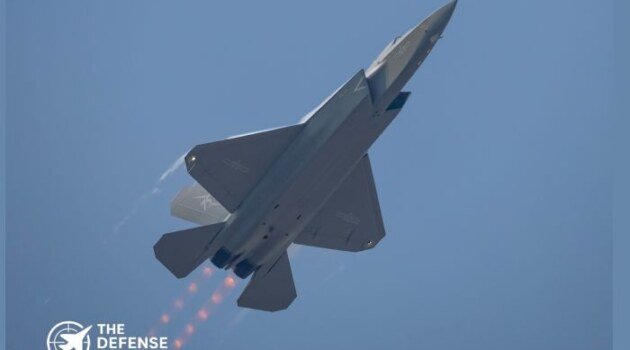
Aviation Industry Corporation of China (AVIC) displayed a detailed scale model of the J-35A stealth fighter alongside the J-10CE export variant marking the most comprehensive public presentation of the land-based fifth-generation aircraft to international observers. The J-35A represents China’s second indigenous stealth fighter platform, designed to complement the heavier J-20 in People’s Liberation Army Air Force (PLAAF) operations.
Chinese defense analysts characterized the J-35A as offering balanced performance, reliability, maintainability and cost considerations based on PLAAF feedback from J-20 operations. The twin-engine configuration differs from carrier-capable J-35 variants, optimizing the platform for conventional runway operations and mainland air defense integration.
AVIC indicated the J-35A’s primary mission focuses on achieving and maintaining air superiority, with secondary strike capabilities against land and maritime targets The platform is designed for engagement of hostile aircraft including fighters and bombers, cruise missile intercept, and neutralization of adversary air defense systems.
Defense industry observers note the Singapore presentation signals program maturity and China’s readiness to position the aircraft for international procurement consideration beyond Western fifth-generation platforms.
PLAAF Bayi Aerobatic Team Demonstrates J-10C Capabilities
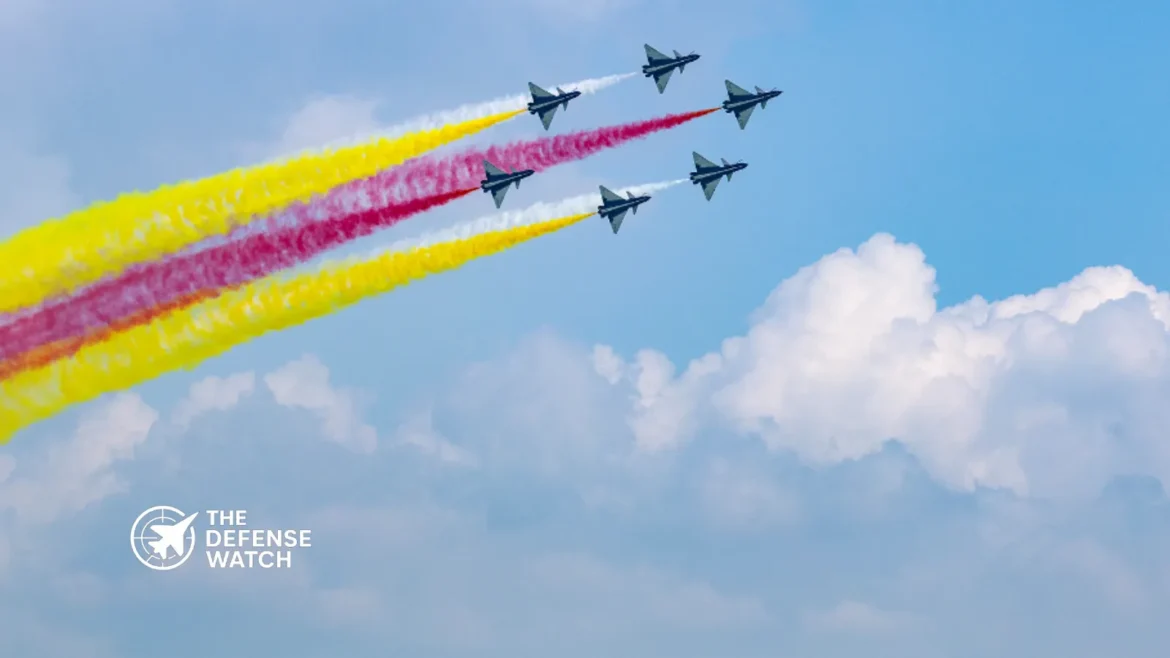
The PLAAF’s Bayi Aerobatic Team conducted its Singapore Airshow debut flying J-10C fighters, executing multiple performances showcasing aircraft maneuverability and controllability. The team deployed six aircraft—three J-10SY and three J-10CY variants—performing various formations, solo maneuvers and colored smoke displays.
The aerobatic team flew directly to Singapore from southwestern China utilizing in-flight refueling support from a YU-20A tanker aircraft, demonstrating extended-range operational capabilities and combat-oriented training standards now widely adopted across PLAAF units.
The J-10C features AESA radar and diverterless intake configurations compared to earlier variants. The platform gained international attention following its May 2025 combat debut with Pakistan Air Force during clashes with Indian forces, where the export J-10CE variant reportedly engaged Indian Rafale fighters.
(adsbygoogle = window.adsbygoogle || []).push({});Chinese aviation experts indicated the flight demonstrations provide potential international customers direct observation of J-10C flight characteristics, potentially increasing interest in the export-configured J-10CE.
COMAC Advances Commercial Aviation Export Campaign
State-owned Commercial Aircraft Corporation of China (COMAC) continued its international commercial aviation push, conducting flight demonstrations of the C919 narrowbody airliner while showcasing C929 widebody development models.
The C919 seats 158 to 192 passengers with range between 4,075 and 5,555 kilometers. COMAC also presented specialized C909 regional aircraft variants, including medical rescue and firefighting configurations, targeting niche aviation markets.
COMAC secured orders for six C909 firefighting aircraft during the exhibition, including three firm contracts and three letters of intent with Shanxi Victory General Aviation. Indonesian airline TransNusa displayed an operational C909, demonstrating international service capability.
Chinese delegates indicated Southeast Asia represents a priority target market for COMAC, with Indonesian attendees among those inquiring about aircraft procurement. However, Western analysts note establishing the global support infrastructure and certification necessary to challenge Airbus and Boeing dominance will require extended timeframes.
Geopolitical Context Shapes Regional Defense Procurement Considerations
The Chinese aviation展示 occurred during a politically sensitive period, with Southeast Asian governments expressing increased concern regarding U.S. security commitments under a more isolationist Washington administration.
President Trump’s vocal criticism of U.S. allies and implementation of tariffs has created potential openings for Chinese defense manufacturers. A senior Western arms company official noted that while delegation attendance remained consistent, the nature of procurement discussions had fundamentally shifted.
China defense specialist Bradley Perrett assessed that Chinese arms manufacturers may perceive opportunities if countries lose confidence in American procurement reliability, though most U.S. customers would likely prioritize European, South Korean and Japanese equipment when seeking alternative suppliers.
Asia-Pacific defense spending continues expanding as regional nations respond to China’s sustained military modernization and increasingly assertive regional posture. The strategic calculations driving procurement decisions now incorporate concerns regarding supplier reliability and alliance stability alongside traditional capability and interoperability considerations.
U.S. Defense Industry Maintains Regional Presence
Multiple U.S. drone manufacturers made Singapore Airshow debuts, seeking to expand business beyond Pentagon contracts into Asian markets increasingly concerned about Chinese military capabilities. Companies including Anduril Industries and Shield AI showcased unmanned systems and artificial intelligence-enabled military technologies.
(adsbygoogle = window.adsbygoogle || []).push({});The lethal effectiveness of unmanned systems in Ukraine has driven significant Silicon Valley investment in drone and military AI startups, reshaping major airshow character beyond traditional manned platforms. U.S. manufacturers emphasized providing regional partners advanced capabilities for countering evolving aerial threats.
Despite geopolitical tensions and tariff concerns, American defense contractors maintained substantial exhibition presence, highlighting continued commitment to Indo-Pacific partnerships and technology transfer programs supporting allied defense modernization.
Analysis and Strategic Implications
Singapore Airshow 2026 reflected fundamental shifts in regional defense industrial dynamics and procurement considerations. China’s expanded presence—combining fifth-generation fighter technology, proven fourth-generation platforms with combat experience, and commercial aviation alternatives—demonstrates sustained commitment to establishing credibility as comprehensive aerospace supplier.
The J-35A presentation signals Chinese confidence in fifth-generation technology maturity and willingness to compete internationally in advanced combat aircraft markets previously dominated by American platforms. For nations unable to procure F-35s due to political considerations or budgetary constraints, the J-35A may eventually represent an alternative fifth-generation option.
However, significant barriers remain before Chinese military aviation products achieve mass international adoption. These include certification requirements, establishing global maintenance and logistics infrastructure, integration with existing Western-equipped forces, and ongoing concerns regarding technology transfer implications and political dependencies.
The geopolitical context—particularly uncertainty regarding U.S. alliance commitments and trade policies—creates conditions potentially favorable to Chinese defense export expansion. Regional nations may increasingly pursue procurement diversification strategies, reducing dependence on single suppliers while maintaining interoperability with primary security partners.
(adsbygoogle = window.adsbygoogle || []).push({});Industry observers anticipate continued Chinese investment in international airshow presence and customer engagement, particularly targeting markets where political considerations complicate Western defense procurement or where cost-effectiveness considerations prioritize capable fourth-generation platforms over more expensive fifth-generation alternatives.
The Singapore exhibition demonstrated that while Western defense manufacturers retain technological advantages and established customer relationships, China has achieved capability levels warranting serious consideration in specific market segments and geographic regions, fundamentally altering the competitive landscape for defense aviation exports across the Indo-Pacific.
U.S. Accelerates Taiwan Arms Deliveries as HIMARS, Harpoon, MQ-9B Systems Target Defense Gaps
The United States is accelerating Taiwan arms deliveries, including HIMARS rocket launchers, Harpoon coastal missiles and MQ-9B drones as part of Taipei’s effort to strengthen its layered defense against growing pressure from China, Taiwan’s defense minister said.
(adsbygoogle = window.adsbygoogle || []).push({});Taipei Defense Minister Wellington Koo told reporters that Washington is moving to ease long delays in weapons shipments this year as U.S. defense production bottlenecks improve and administrative processes for Taiwan cases are streamlined.
Faster deliveries could help Taiwan close what Koo described as critical capability gaps in long-range precision fires, coastal defense and persistent surveillance, officials said.
What Taiwan Expects
Taipei anticipates phased shipments later this year will include:
- HIMARS multiple rocket launcher systems, capable of mobile long-range precision fires.
- Harpoon coastal defense missile systems, configured for over-the-horizon sea denial.
- MQ-9B drones for extended surveillance and targeting support.
- Javelin anti-armor missiles following plan schedules.
Officials said the aim of sped-up deliveries is to help Taiwan implement a denial strategy that disperses firepower and complicates any potential amphibious assault.
HIMARS launchers provide mobility, rapid fire and relocation options. The system can fire guided rockets and Army Tactical Missile System rounds, giving Taiwan the ability to strike at greater distances across likely approach corridors.
Harpoon coastal defense missiles, configured for mobile land launch, give Taiwan forces the ability to hold Chinese surface combatants and amphibious ships at risk as they move toward the island’s littoral zones.
MQ-9B drones extend Taipei’s surveillance reach, with high endurance enabling persistent monitoring of maritime approaches and early cueing for ground and coastal missile units.
Context and Strategic Drivers
The push to speed up deliveries comes after months of high-level discussions and policy changes in Washington that aim to ease procedural delays. Taiwan’s defense minister said improvements in U.S. defense industry production and streamlined export processes have reduced some bottlenecks.
(adsbygoogle = window.adsbygoogle || []).push({});Taipei is also navigating a domestic budget debate over a proposed supplementary defense budget worth about $40 billion that would fund advanced U.S. weapons packages and other systems. Delays in budget approval risk slowing or stalling planned acquisitions, officials warn.
In December 2025, the United States announced a record $11.1 billion set of proposed arms sales to Taiwan covering HIMARS, howitzers, drones and related equipment, reflecting growing U.S. support for Taipei’s asymmetric defense posture amid persistent cross-Strait tensions.
China regularly protests U.S. arms sales to Taiwan, calling them destabilizing, but Washington says these transfers support Taiwan’s right to self-defense under U.S. law and help maintain peace in the region.
Outlook
Officials in Taipei and Washington expect the improved delivery pace to continue, but stress that actual arrival dates will depend on a mix of industrial production capacity, export processing and Taiwan’s own funding decisions. Experts say the accelerated schedule aims to ensure key systems are fielded before potential crisis scenarios tighten timelines.
US Navy Seeks Commercial Satellites for Nighttime Earth Observation
The US Navy is asking industry for information on commercial satellites that can perform nighttime Earth observation with advanced optical sensors, according to a Naval Research Laboratory Request for Information.
In a move that underscores growing interest in commercial space data, the Navy wants existing or imminent systems ready for possible future demonstration and acquisition.
What the Navy Is Looking For
The RFI, posted on SAM.gov and open through February 22, seeks data on space-based electro-optical (EO) sensors that can image Earth at night with a Technology Readiness Level (TRL) of 6 or higher. TRL 6 generally means a working prototype has been demonstrated in a relevant environment.
Respondents must describe:
• Sensor type and spectral range, including whether systems are panchromatic or multispectral.
• Imaging performance, including frames per second.
• Onboard processing and tasking interfaces for user requests.
• Data processing, exploitation, and dissemination methods.
• Data security measures and ground station locations, with a preference for continental United States facilities.The Navy emphasized the focus on commercial providers and mature systems, not government-developed satellites.
Why Nighttime Imaging Matters
Nighttime Earth observation provides a different look than daytime imagery. It can detect artificial lights, thermal signatures, and other phenomena that are invisible in daylight. Government and civilian users already collect such data through platforms like NASA and NOAA’s Visible Infrared Imaging Radiometer Suite (VIIRS), which tracks nocturnal light and near-infrared data for scientific and humanitarian use.
For defense and intelligence customers, nighttime imaging offers:
• Detection of ship wakes and movement at sea under darkness.
• Monitoring of ground lights to assess grid outages or damage after strikes.
• Support to planning and assessment in large-scale operations where darkness limits other sensors.These capabilities could fill gaps between traditional reconnaissance assets and emerging commercial offerings.
Commercial Space on the Rise
The Navy’s RFI comes amid broader Department of Defense interest in tapping commercial space data to supplement military needs. The US Space Force has been expanding programs that leverage commercial imagery and analytics for tactical surveillance and other missions.
Commercial Earth observation companies like Planet Labs also already supply vessel detection and other maritime imaging services to Navy platforms under separate contracts.
What Comes Next
Because this is an RFI, the Navy is gathering information and not yet soliciting formal proposals or awarding contracts. Responses will help the service assess what commercial systems can offer and how they might be used in future demonstrations or acquisitions.
The deadline for submissions is February 22, 2026.
PL-17 Missile Emerges from Secrecy
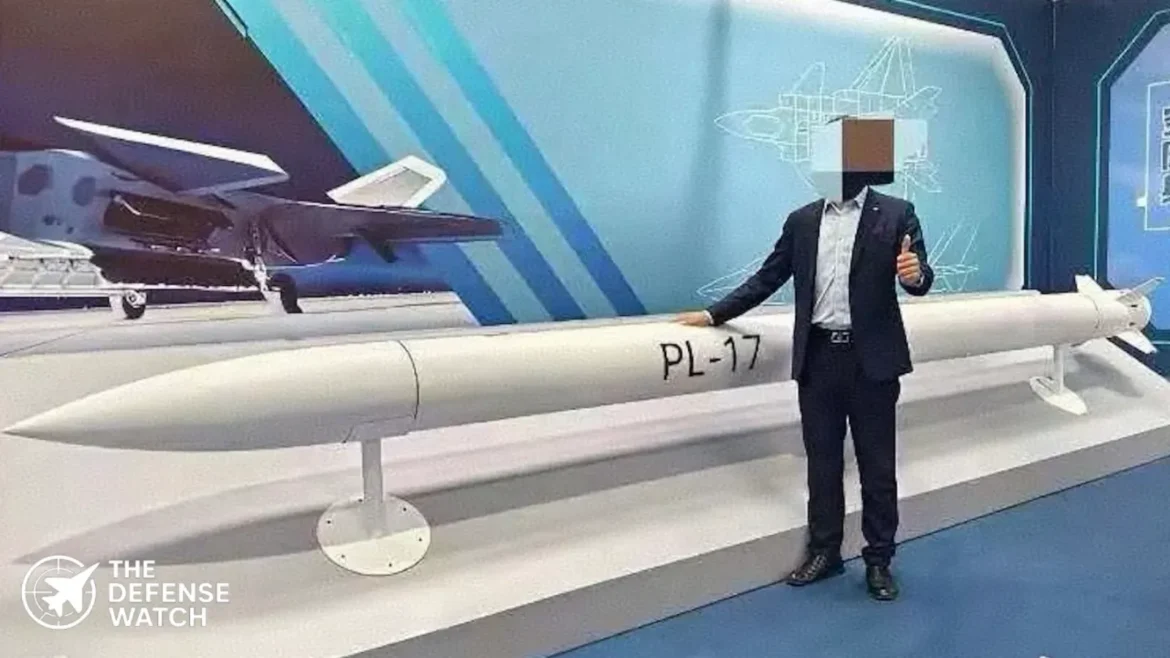
A recently surfaced photograph provides the first detailed close-quarters view of China’s PL-17 very long-range air-to-air missile, one of the most secretive weapons in the People’s Liberation Army Air Force arsenal. The image shows a full-scale mock-up of the approximately 20-foot-long weapon on display at what appears to be a defense exhibition or tradeshow, though the specific date and location remain unconfirmed.
(adsbygoogle = window.adsbygoogle || []).push({});The photograph, shared by respected defense analyst Andreas Rupprecht on social media, depicts a man posing in front of the PL-17 mock-up with his face censored, while a promotional board for China’s J-20 stealth fighter appears in the background. While the authenticity of the image appears credible based on known characteristics of the missile, defense analysts note the photograph cannot be independently verified at this time.
This public appearance marks a significant departure from the decade-long secrecy surrounding the PL-17 since blurry images first emerged in 2016. The weapon system has been a subject of intense Western military interest due to its potential to threaten high-value assets including aerial refueling tankers and airborne early warning aircraft at unprecedented ranges.
Technical Capabilities and Design Features
The PL-17, designated CH-AA-12 Auger under Western reporting conventions, represents a major advancement in Chinese air-to-air missile technology. Defense publications including the International Institute for Strategic Studies estimate the weapon’s maximum range at approximately 250 nautical miles, though actual engagement ranges vary significantly based on target altitude, speed, and countermeasures employed.
The missile’s design incorporates several advanced features. A dual-pulse rocket motor provides extended range capability, while flight control relies on four relatively compact tail fins combined with a thrust-vectoring nozzle for enhanced maneuverability. Maximum velocity is believed to exceed Mach 4, according to technical assessments by defense analysts.
Guidance systems reportedly include a two-way datalink for mid-course updates and an active electronically scanned array seeker designed to resist electronic countermeasures. Some reports suggest the missile may incorporate a passive anti-radiation seeker to target emissions from airborne radar platforms, though this capability has not been officially confirmed.
Initial speculation about a potential infrared optical window in the nose section has not been substantiated by the recent display photograph. The mock-up reveals no visible evidence of such a sensor system.
Operational Employment and Platform Integration
The People’s Liberation Army Air Force has publicly released imagery showing the PL-17 operationally deployed on J-16 multirole fighter aircraft. Official PLAAF photographs from 2023 depicted J-16 formations carrying mixed loadouts including PL-10 short-range, PL-12 medium-range, PL-15 long-range, and PL-17 very long-range missiles, demonstrating comprehensive engagement capability across multiple distance bands.
(adsbygoogle = window.adsbygoogle || []).push({});Defense analysts assess the PL-17 would typically rely on off-board targeting data for maximum-range engagements. China’s extensive investment in airborne early warning platforms, ground-based radar networks, and satellite systems provides potential targeting infrastructure to support long-range missile employment beyond the launch aircraft’s sensor range.
While current operational use appears limited to the J-16 platform, military observers anticipate potential integration with China’s J-20 stealth fighter in external carriage configurations. The missile’s dimensions preclude internal carriage in current Chinese aircraft, raising questions about export prospects given compatibility limitations with smaller fighter types like the J-10 or J-35.
Future integration possibilities include China’s developmental J-36 sixth-generation fighter, which features substantial internal weapons capacity that could accommodate the PL-17’s size.
Impact on U.S. Military Development
The PL-17’s capabilities have prompted significant U.S. responses aimed at maintaining air superiority. The highly classified AIM-260 Joint Advanced Tactical Missile represents the Pentagon’s primary counter-development program, though limited technical details have been publicly released.
In 2024, the U.S. Navy fielded the AIM-174B, an air-launched variant of the SM-6 surface-to-air missile system. While exact range specifications remain classified, defense analysts estimate the AIM-174B can engage large aerial targets at ranges potentially exceeding twice that of the current AIM-120D Advanced Medium-Range Air-to-Air Missile, possibly reaching multiple hundreds of nautical miles against appropriate targets.
Additional U.S. programs include Boeing’s modular air-to-air missile concept, which received Air Force funding for continued development. These initiatives collectively reflect Pentagon concerns about China’s progress in reducing historical Western advantages in beyond-visual-range air combat capabilities.
Strategic Implications
The PL-17’s development aligns with broader Chinese military modernization efforts focused on anti-access/area denial strategies. Very long-range air-to-air missiles enhance China’s ability to threaten critical enablers of U.S. air operations, particularly aerial refueling tankers and airborne early warning and control aircraft operating in the Western Pacific theater.
Military analysts note that successful employment of weapons like the PL-17 requires sophisticated targeting networks and coordination between multiple sensor platforms. China’s investments in integrated air defense systems, space-based surveillance, and datalink technologies support these operational requirements.
(adsbygoogle = window.adsbygoogle || []).push({});The weapon’s public display, while unofficial, suggests increased Chinese confidence in the system’s operational status. Historical patterns indicate Chinese willingness to selectively reveal military capabilities once systems achieve operational maturity, though official technical specifications typically remain classified.
Regional Balance Considerations
The PL-17’s capabilities contribute to evolving air combat dynamics across the Indo-Pacific region. U.S. Air Force and Navy planners must account for extended threat ranges when positioning support assets during potential conflicts. This operational reality influences basing decisions, tanker routing, and airborne early warning patrol patterns.
Allied air forces operating in the region, including Japan, South Korea, and Australia, face similar considerations when planning air operations in scenarios involving Chinese forces equipped with very long-range air-to-air missiles. These nations maintain close coordination with U.S. forces on countering emerging Chinese capabilities.
The missile’s development also reflects broader trends in air combat technology, including increased engagement ranges, networked operations, and emphasis on targeting high-value assets. These trends drive procurement priorities and training requirements across multiple air forces globally.
Future Developments
Despite this new visual evidence, numerous technical questions about the PL-17 remain unanswered. Specific details regarding warhead design, electronic counter-countermeasure capabilities, and actual operational range under various engagement conditions have not been publicly disclosed.
The appearance of the mock-up at what appears to be a semi-public venue may indicate Chinese willingness to provide additional information about the system. Historical precedent suggests selective disclosure of capability information serves both deterrent purposes and supports potential export marketing, though the PL-17’s size may limit export applications.
Western intelligence services and defense analysts will continue monitoring for additional information about the PL-17’s technical characteristics, operational employment, and integration with other Chinese military systems. The missile represents a significant component of China’s expanding air combat capabilities that will shape regional military planning for years to come.
China Advances South China Sea Militarization With Antelope Reef Development
Satellite imagery confirms China has begun militarizing Antelope Reef in the contested South China Sea, marking Beijing’s latest expansion of military infrastructure in disputed waters. According to the Asia Maritime Transparency Initiative (AMTI), dredging operations started after mid-October 2025, with January 2026 satellite images showing substantial infrastructure changes including roll-on/roll-off berths and access ways for heavy equipment.
The development coincides with unprecedented Chinese fishing militia operations demonstrating coordinated naval blockade capabilities near Taiwan, signaling Beijing’s evolving maritime control strategy.
Strategic Location Positions New Military Outpost
Antelope Reef sits at coordinates 16°27’45″N, 111°35’20″E in the Paracel Islands, approximately 250 miles east of Vietnam’s Hue and 175 miles southeast of China’s Sanya Naval Base on Hainan Island. AMTI characterizes Antelope Reef as “little more than a sandbar” that previously hosted only a couple of buildings.
Once completed, the installation could function as a helipad, radar station, and anchorage point for People’s Liberation Army Navy warships and China Coast Guard vessels. The facility would join China’s existing network of 20 military outposts in the Paracels, including sophisticated bases like Woody Island.
China seized the Paracel chain from Vietnam in 1974, establishing territorial control that remains disputed by Hanoi and other regional claimants.
Construction Timeline and Infrastructure Development
Newsweek reported that dredging focused on the eastern and southern edges of the reef’s lagoon, with January 2026 imagery revealing new infrastructure and specialized berthing facilities designed to accommodate heavy construction equipment. These roll-on/roll-off capabilities enable efficient transport of dredging machinery and materials necessary for land reclamation operations.
The construction pattern mirrors China’s previous South China Sea island-building campaigns. In the Spratly Islands south of the Paracels, China has created 3,200 acres of new land across seven military outposts, demonstrating Beijing’s engineering capabilities and strategic commitment to territorial consolidation.
China also controls Scarborough Shoal, seized from the Philippines in 2012, further extending its network of forward operating locations throughout the contested maritime region.
Fishing Militia Demonstrates New Blockade Tactics
Concurrent with the Antelope Reef construction, China conducted unprecedented fishing militia operations showcasing coordinated maritime control capabilities. In late December 2025, approximately 2,000 Chinese vessels formed two massive L-shaped “floating barriers” spanning 290 miles in waters northeast of Taiwan.
The geospatial intelligence firm ingeniSPACE first identified this formation, which occurred December 25-27, just three days before China announced Exercise Justice Mission-2025—a major military drill encircling Taiwan designed to rehearse naval blockade implementation.
A second operation from January 9-12 involved 1,400 Chinese fishing boats creating a 200-mile-long barrier maintained for over 30 hours, according to automatic identification system tracking data. These coordinated maneuvers required fishing vessels to halt normal commercial operations and assemble into dense, precisely-coordinated formations.
People’s Armed Forces Maritime Militia Role
These fishing fleet operations illustrate the expanding role of China’s People’s Armed Forces Maritime Militia (PAFMM) in Beijing’s maritime strategy. A Congressional Research Service report published in May 2025 acknowledged that the PAFMM serves to defend Chinese maritime claims, representing a critical component of China’s gray-zone operations.
The report’s authors noted that “the PAFMM – even more than China’s navy or coast guard – is the leading component of China’s maritime forces for asserting its maritime claims, particularly in the South China Sea.
In peacetime, the PAFMM advances Beijing’s territorial claims through presence operations and intimidation. During wartime scenarios, these forces would “support combat operations by conducting reconnaissance or creating obstacles and providing logistical support to other PLA forces.
Taiwan Contingency Implications
During a Taiwan crisis, fishing militia floating barriers could overwhelm maritime traffic, block commercial ports, disrupt naval operations, serve as decoys, and create target saturation overwhelming adversary defenses. This capability provides Beijing with flexible, deniable options below the threshold of conventional military action.
The coordinated nature of these operations—involving thousands of vessels maintaining precise formations for extended periods—demonstrates sophisticated command and control capabilities extending from military headquarters to civilian fishing fleets.
Regional Response and Countermeasures
Vietnam has responded to Chinese expansion by strengthening its own South China Sea infrastructure. Defense News previously reported that Vietnam is completing militarized outposts throughout the Spratly Islands, improving defensive capabilities and demonstrating Hanoi’s commitment to maintaining territorial claims.
The Philippines, Japan, and the United States have increased joint naval exercises and freedom of navigation operations in response to Chinese militarization. Recent trilateral drills involving the Philippine Navy, U.S. Navy, and Japanese Maritime Self-Defense Force demonstrated allied coordination in contested waters.
Strategic Significance
The Antelope Reef development represents China’s systematic approach to establishing permanent military infrastructure throughout the South China Sea. Each new outpost extends Beijing’s surveillance coverage, anti-access/area-denial capabilities, and power projection range.
Combined with fishing militia tactics, these installations create layered defensive networks complicating adversary operations while enabling Chinese forces to operate with logistical support and protected anchorages throughout the region.
The timing of construction—amid heightened tensions over Taiwan and ongoing territorial disputes with Southeast Asian nations—signals Beijing’s determination to consolidate control regardless of international criticism or legal challenges.
International Law and Territorial Disputes
China’s claims to approximately 90% of the South China Sea, demarcated by the “nine-dash line,” remain contested by Vietnam, the Philippines, Malaysia, Brunei, and Taiwan. A 2016 international arbitration tribunal ruled against China’s historic claims, a decision Beijing rejected.
The ongoing militarization directly contradicts Chinese pledges not to militarize contested features, undermining regional trust and escalating security competition.
Pakistan Combat-Tested Jets Boost Weapons Sales
Pakistan’s combat-tested jets and military gear are drawing interest from at least 13 countries, as Islamabad pushes defense exports following a major 2025 air conflict with India, Reuters reports.
Talks with six to eight nations are at advanced stages, focused on exports of the JF-17 fighter developed with China, training aircraft, drones, and other weapons systems, according to multiple Pakistani sources familiar with the negotiations.
Rising Interest in Pakistani Hardware
Sources say Pakistan’s defense industry is fielding queries from countries in the Middle East, Africa, and Asia, including Saudi Arabia, Indonesia, Morocco, Ethiopia, and Nigeria, with formal talks also under way with Bangladesh and Iraq.
The JF-17 Block III, a multi-role combat aircraft, features in most discussions, along with training platforms, reconnaissance and attack drones, air defense gear, and armored vehicles.
Production and Cost Factors
Pakistan’s annual JF-17 output stands near 20 aircraft, but officials aim to increase capacity by late 2027 to meet potential export demand.
The jets’ lower acquisition cost, about 30 million to 40 million USD each, positions them as a budget-friendly alternative to pricier Western types.
Strategic Context
Analysts link the sales push to broader shifts in global arms sourcing, with several nations seeking non-Western suppliers amid supply chain disruptions and regional conflicts.
Pakistan’s effort to expand exports comes with geopolitical hurdles, including possible objections from China on certain deals and arms embargo constraints for some prospective buyers.