The U.S. Navy recently demonstrated a significant milestone in its directed energy weapons (DEW) program, using a ship-mounted laser system to engage an aerial drone. Meanwhile, the Navy has also awarded a contract for a new, modular high-power laser initiative called “Songbow.” These developments reflect renewed momentum in deploying directed energy lasers on naval surface combatants as a supplement or potential alternative to conventional missile defenses.
HELIOS Laser System Scores First Drone Engagement
What the Test Accomplished
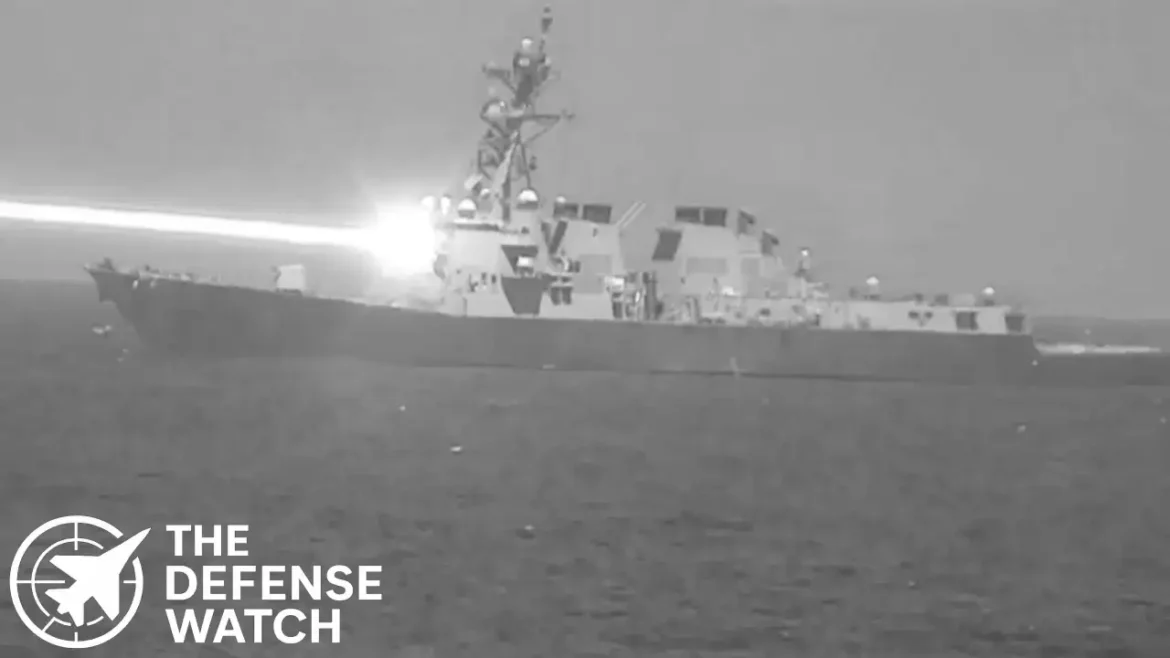
According to the Office of the Director, Operational Test & Evaluation (DOT&E), a recent fiscal year 2024 test aboard the USS Preble (DDG-88) validated the HELIOS (High Energy Laser with Integrated Optical Dazzler and Surveillance) system against an unmanned aerial vehicle. The Center for Countermeasures collected imagery to analyze system performance and confirm the engagement.
Though the published report did not specify the exact timing or location of the test, the Preble had departed San Diego in late 2024 and joined its forward-deployed squadron in Yokosuka in early October. A black-and-white image in the DOT&E report shows a streak of light emanating from the ship’s deck into the sky — the HELIOS laser in action.
HELIOS in the Navy’s Laser Portfolio
HELIOS is part of the Surface Navy Laser Weapon System Increment 1 (SNLWS Increment 1) and is integrated with the Aegis combat system, enabling it to target, track, and engage threats using existing ship sensors and fire control. The system is built with modular fiber lasers and spectral beam combining, operated nominally at 60 kW with potential scaling toward 120 kW.
Other laser systems in the Navy’s R&D portfolio include ODIN (Optical Dazzling Interdictor, Navy) — a dazzler capability already installed on multiple Arleigh Burke destroyers — and the now-concluded SSL-TM (Solid State Laser Technology Maturation) program. The Navy’s longer-term ambition is HELCAP (High Energy Laser Counter Anti-Ship Cruise Missile), aiming for a 300+ kW class laser for missile defense applications.
The HELSI (High Energy Laser Scaling Initiative) effort, managed at the Department of Defense level, intends to accelerate scaling, power efficiency, and beam quality improvements across services.
Songbow: New Contract for Fiber Laser Scaling
Project Overview
On June 10, 2025, the Navy awarded Coherent Aerospace & Defense nearly $30 million to develop the Songbow laser project. Songbow is tasked with advancing pulsed fiber lasers, wavefront control, and beam combination to realize a system targeting 400 kW, built via integration of multiple 50 kW modules. The contract includes a 20-month base plus optional follow-on periods, with completion targeted by January 2027.
Strategic Rationale
Shipboard missile defense is stretching conventional interceptors to limits, especially in contested littoral areas where saturation attacks and drone swarms are expected. In operations in the Red Sea and Gulf of Aden since late 2023, U.S. Navy vessels expended dozens of expensive missiles to counter drones and missiles — some costing millions per shot. A laser that can engage threats at a fraction of the cost per shot is attractive if the technical hurdles (power, cooling, beam control, pointing stability) can be overcome.
Songbow is part of a broader effort to diversify the Navy’s directed energy portfolio beyond HELIOS and to lay groundwork for future 100 kW+ and even 300–400 kW lasers.
Benefits, Challenges, and the Road Ahead
Why Directed Energy Weapons Matter
- Cost per shot: Lasers use electricity, not consumable rounds, so the operational “ammo” is far cheaper than missiles.
- Deep magazine: As long as power is available, a ship does not “run out” of shots in the same way it might exhaust missile stocks.
- Speed-of-light engagement: Directed energy engages at the speed of light, with minimal time of flight delay.
- Precision & scalability: Lasers can be tuned for hard kills (heating, structural damage) or soft kills (sensor dazzling) depending on the target.
Persistent Technical and Operational Hurdles
- Power & cooling: High-power lasers demand substantial electrical generation and heat dissipation capacity, often taxing shipboard power systems.
- Beam control & atmospheric effects: Turbulence, aerosols, humidity, and particulates degrade beam quality over distance.
- Pointing stability: Maintaining precise aim on fast-moving, small targets over long distances is nontrivial.
- Integration & survivability: Lasers must cohabit with other systems (radars, missiles, EW), survive shock and vibration, and demonstrate reliability in maritime environments.
The Congressional Research Service (CRS) has repeatedly flagged these issues, questioning whether ship designs have the margin (in terms of weight, volume, power) to integrate high-energy lasers sustainably.
Future Trajectory
In the near term, the Navy is likely to continue incremental evaluations of HELIOS, field installations on additional DDGs, and iterative testing against swarms of drones and small craft. HELCAP and Songbow are key bets for scaling to heavier engagements against anti-ship cruise missiles.
Looking toward the next-generation surface combatant DDG(X), conceptual renders already envision built-in electrical and structural capacity for future directed energy weapons — potentially in the 150 to 600 kW class. In that sense, current laser R&D is not just an add-on but a pathfinder for future ship design.
Analysis & Strategic Implications
The HELIOS drone engagement test confirms that the U.S. Navy is steadily moving from laboratory prototypes toward operational validation of laser weapons. However, its significance is as much symbolic as technical: it demonstrates to adversaries and Congress that directed energy is not just hype but a plausible emerging capability.
With the launch of Songbow, the Navy is hedging across multiple technologies — fiber lasers, beam combining, modular scaling — to avoid overreliance on a single approach. That pluralism could be prudent in a fast-moving technological domain. The real test will come in contested environments (e.g. littorals, near-peer adversary zones) where atmospheric interference, countermeasures, and operational stressors expose the full spectrum of weaknesses.
Ultimately, if lasers prove reliable and economical, they may transform naval defense doctrine, pushing the boundary of what ships can defend against, especially in unmanned and missile-rich threat environments. But adoption will remain cautious until performance, integration, and cost metrics are met over time.
FAQs
HELIOS (High Energy Laser with Integrated Optical Dazzler and Surveillance) is a 60 kW class modular fiber laser system developed by Lockheed Martin and integrated with Aegis-equipped surface warships. It can perform both hard-kill (damage target structure) and soft-kill (optical dazzling) functions.
As of now, HELIOS has undergone developmental testing from USS Preble, but it is not yet a fully operational, combat-deployed system. The 2024 test was one of its first real-world threat engagements.
Songbow is a Navy initiative awarded in 2025 to Coherent Aerospace & Defense to develop modular pulsed fiber lasers, beam combining, and control, with the objective of scaling toward a 400 kW system.
Not immediately. Directed energy weapons are currently viewed as complementary to, rather than replacements for, missile interceptors. They may relieve pressure on missile inventories and provide layered defense, but performance and reliability in contested, complex environments remain to be proven.
Key challenges include provision of sufficient onboard power and cooling, mitigating atmospheric beam degradation, ensuring pointing accuracy and stability, and surviving harsh maritime environments. Integration and cost trade-offs are also significant.