Russia Bastion Coastal Defense System Reinforces Arctic Strategy
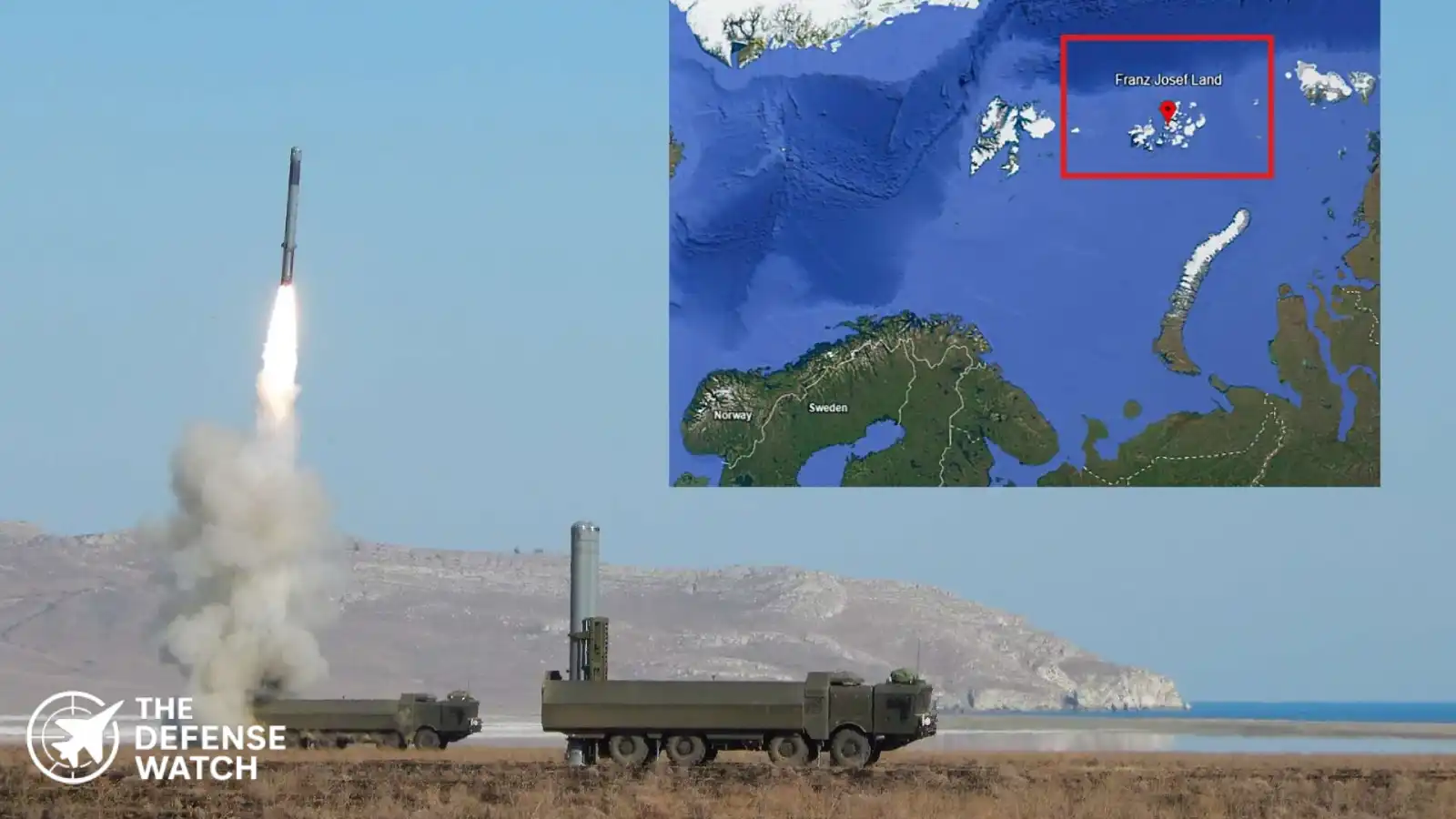
Russia’s Bastion coastal defense system is playing a central role in Moscow’s evolving Arctic naval denial strategy, as demonstrated during recent exercises at the remote Franz Josef Land archipelago. According to reporting by Army Recognition, Russian forces conducted drills simulating the defense of critical Arctic approaches using the Bastion system, a mobile anti-ship missile platform designed to engage high-value naval targets at extended ranges.
- Russia rehearsed Arctic naval denial operations using the Bastion coastal defense system at Franz Josef Land.
- The Bastion system is equipped with P-800 Oniks supersonic anti-ship missiles capable of striking maritime targets at long range.
- The deployment supports Russia’s strategy to secure the Northern Sea Route and restrict adversary naval access.
- Arctic bases are being upgraded to host advanced missile systems and sustain year-round operations.
- The move reflects growing geopolitical competition in the Arctic region involving NATO and Russia.
The exercise underscores Russia’s focus on securing its northern maritime frontier, particularly as melting ice expands access to the Arctic and intensifies competition over shipping routes and natural resources.
Strategic Importance of Bastion Deployment in the Arctic
The Bastion system, known in Russia as K-300P, deploys the P-800 Oniks supersonic cruise missile, a weapon capable of striking targets at ranges exceeding 300 kilometers. Its mobility and rapid deployment capability make it well suited for remote Arctic environments, where fixed defenses are harder to maintain.
By stationing Bastion systems at forward outposts such as Franz Josef Land, Russia is effectively extending its anti-access and area denial umbrella across key segments of the Arctic Ocean. This allows Moscow to monitor and potentially restrict naval movement along the Northern Sea Route, a shipping corridor that is gaining strategic and economic importance.
From a military perspective, this deployment reflects a layered defense concept. Coastal missile batteries, supported by radar systems and air defense networks, create overlapping zones of control. This approach complicates any adversary’s ability to operate freely in contested Arctic waters.
Arctic Militarization and Infrastructure Expansion
Russia’s Arctic posture has evolved steadily over the past decade. The country has reopened Soviet-era bases and constructed new facilities designed to operate in extreme conditions. Franz Josef Land, located deep in the Arctic Ocean, has become a key node in this network.
Infrastructure upgrades include reinforced airstrips, radar installations, and logistics hubs capable of supporting year-round operations. These developments enable sustained deployment of advanced systems like Bastion, ensuring readiness even in harsh winter conditions.
The emphasis on Arctic readiness is not limited to missile systems. Russia has also expanded its fleet of icebreakers, including nuclear-powered vessels, to ensure access and mobility across frozen waters. This integrated approach strengthens both military and economic control over the region.
Geopolitical Context and NATO Response
The deployment of the Bastion coastal defense system must be viewed within the broader context of rising geopolitical competition in the Arctic. NATO members, particularly the United States, Canada, and Norway, have increased their own military presence and surveillance activities in the region.
Western analysts note that Russia’s anti-ship missile deployments are intended to deter NATO naval operations and protect strategic assets, including submarine bastions used for nuclear deterrence. The Arctic remains a critical domain for second-strike capabilities, making its defense a priority for Moscow.
At the same time, the Northern Sea Route is becoming more viable for commercial shipping due to climate change. Control over this route offers both economic leverage and strategic advantage, further motivating Russia’s military investments.
Operational Implications of Naval Denial Strategy
Russia’s use of the Bastion system highlights a broader shift toward denial-based strategies rather than traditional power projection. Instead of seeking to dominate distant theaters, Moscow is focusing on securing its periphery and limiting adversary access.
In practical terms, this means creating contested zones where the cost of entry for opposing forces is significantly increased. The Bastion system, with its long-range precision strike capability, plays a key role in this concept by threatening surface vessels operating within its engagement envelope.
This approach is particularly effective in the Arctic, where geography and climate already pose challenges for naval operations. By combining natural barriers with advanced weapon systems, Russia enhances its defensive posture without requiring large-scale force deployments.
Analysis: Why the Arctic Matters Now
The renewed focus on Arctic military capabilities reflects a convergence of factors. Climate change is opening new sea lanes, resource competition is intensifying, and great power rivalry is extending into previously less contested regions.
Russia’s investment in systems like Bastion suggests a long-term strategy aimed at shaping the Arctic security environment. By establishing credible denial capabilities early, Moscow is positioning itself to influence future access and governance of the region.
For the United States and its allies, this development raises important questions about deterrence and freedom of navigation. Countering such systems requires a mix of technological solutions, including long-range strike capabilities, stealth platforms, and enhanced situational awareness.
Davos, Switzerland — U.S. President Donald Trump abruptly reversed course on threats to impose tariffs on European allies over Greenland, announcing a framework for a future deal on the strategic Danish territory following discussions at the World Economic Forum on January 21, 2026.
(adsbygoogle = window.adsbygoogle || []).push({});The move de-escalates tensions that had strained NATO relations and risked broader trade disruptions, as Trump shifted focus to long-term Arctic security amid growing Russian and Chinese activity in the region.
Trump, speaking during his appearance at Davos, explicitly ruled out military force in any effort to gain U.S. influence over Greenland. “People thought I would use force, but I don’t have to use force. I don’t want to use force. I won’t use force,” he stated in remarks to global leaders.
Earlier rhetoric from Trump had described Greenland as essential for national security, including demands for a “Golden Dome” missile-defense system and access to the island’s critical minerals. He had previously called the acquisition a “small ask” over a “piece of ice” and warned Denmark that refusal could have consequences.
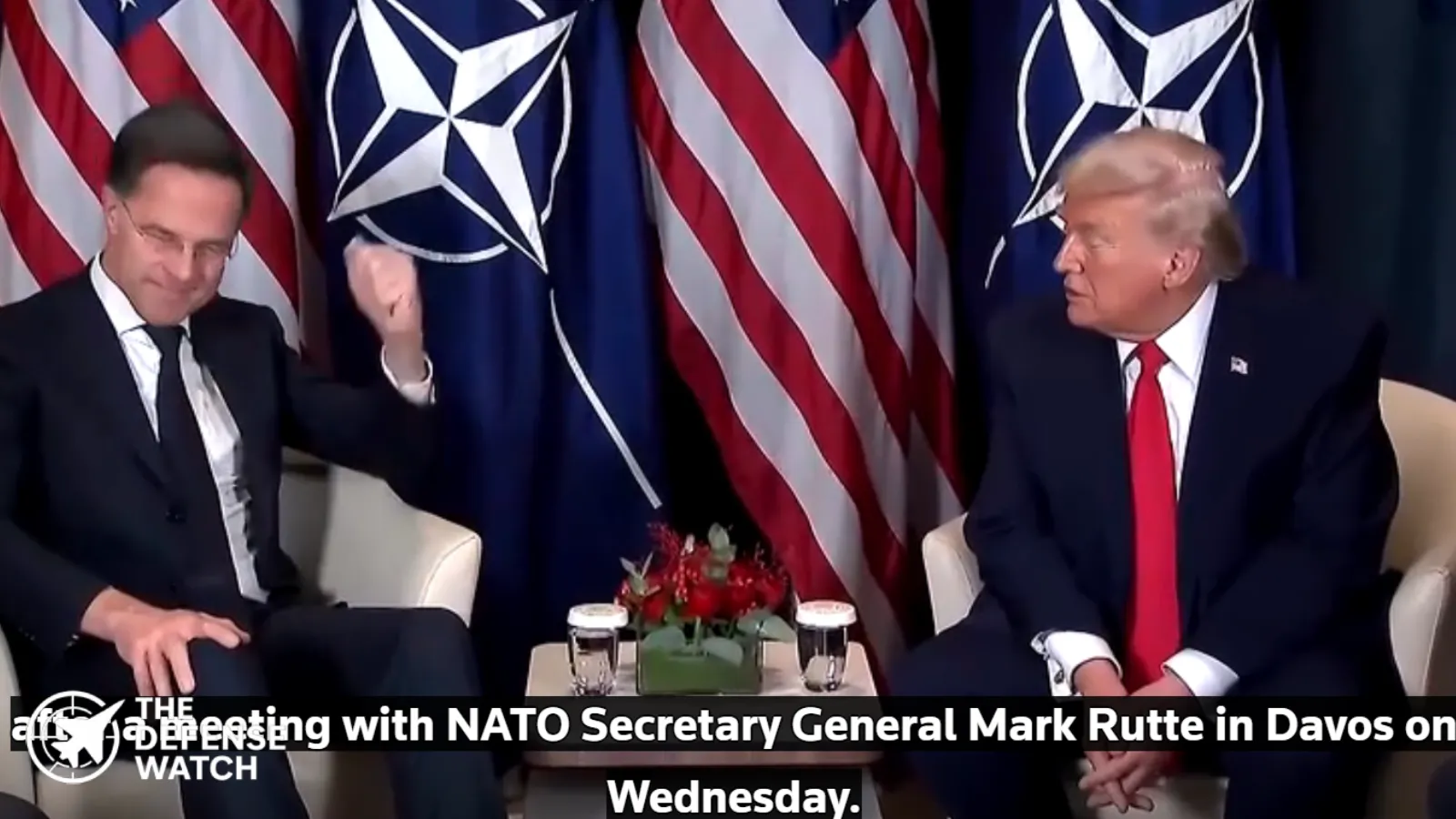
Following a meeting with NATO Secretary General Mark Rutte, Trump posted on Truth Social that the U.S. and NATO had “formed the framework of a future deal with respect to Greenland and, in fact, the entire Arctic Region.” He confirmed the cancellation of tariffs on eight European countries — originally set for February 1 — that he had threatened as leverage.
Negotiations involving Denmark, Greenland, and the United States are set to continue, with Trump assigning Vice President JD Vance, Secretary of State Marco Rubio, and envoy Steve Witkoff to the talks. The framework aims to prevent Russia and China from establishing economic or military footholds in Greenland.
(adsbygoogle = window.adsbygoogle || []).push({});NATO’s Rutte emphasized the alliance’s priority on Arctic protection. He is very much focused on what do we need to do to make sure that that huge Arctic region — where change is taking place at the moment, where the Chinese and the Russians are more and more active — how we can protect it,” Rutte said.
Denmark’s Foreign Minister Lars Lokke Rasmussen stressed respect for sovereignty and self-determination. “What is crucial for us is that we get to end this with respect for the integrity and sovereignty of the kingdom (of Denmark) and the right of the Greenlandic people to self-determination,” he noted.
Greenland officials did not immediately comment.
The dispute highlights Greenland’s strategic value in the rapidly changing Arctic, where melting ice opens new shipping routes and resource opportunities. The U.S. already maintains Pituffik Space Base (formerly Thule Air Base) there for missile warning and space surveillance.
Trump’s Davos speech, which lasted over an hour, included broader criticisms of European allies on issues like defense spending, trade, and energy policy. He positioned the U.S. as indispensable for Western security while downplaying the Greenland issue as non-threatening to NATO.
The reversal follows internal White House pushback against escalation, sources indicated, and came amid market relief — the S&P 500 recorded its largest one-day gain in two months after the tariff cancellation.
(adsbygoogle = window.adsbygoogle || []).push({});While details of the framework remain limited, it appears to prioritize enhanced U.S. military access and mineral partnerships over outright territorial acquisition, aligning with broader efforts to bolster Arctic defenses against adversarial powers.
This development underscores ongoing U.S. focus on countering great-power competition in the High North, where strategic assets like rare earth elements and positioning for missile defense are increasingly vital.