HÜRJET Turkish Air Force Aircraft Completes Maiden Flight
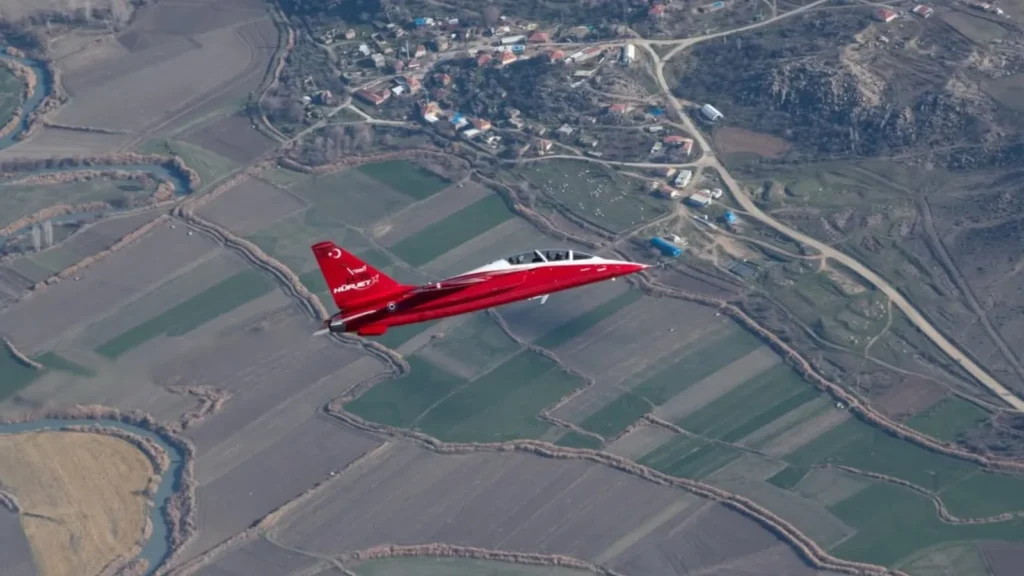
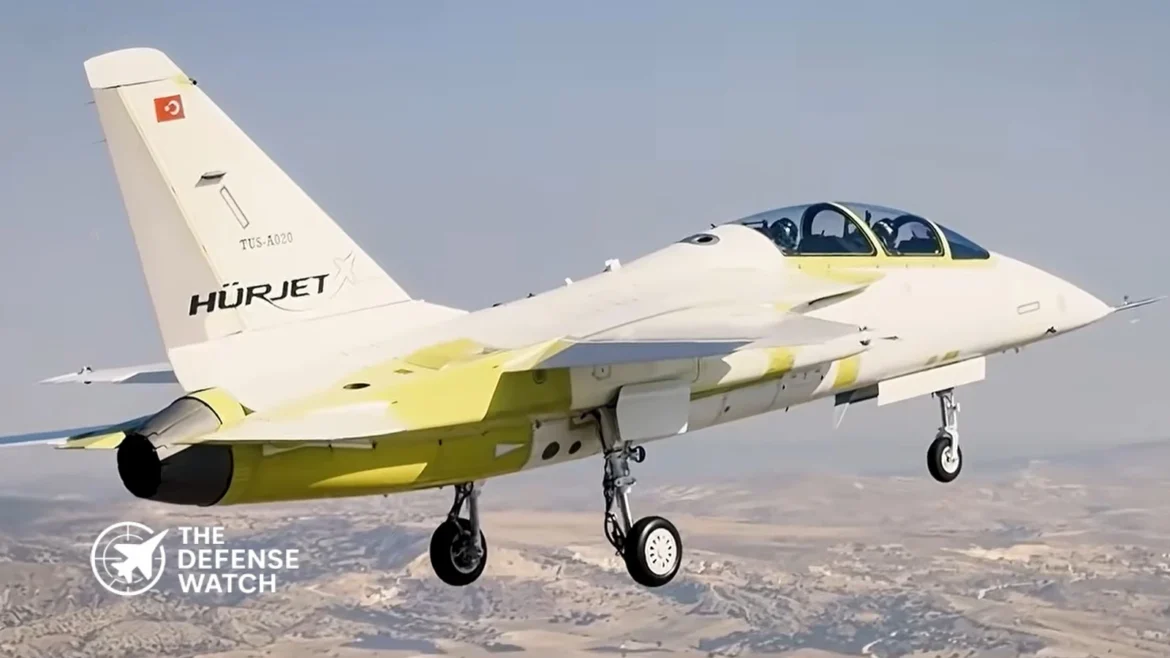
The first production-configured HÜRJET Turkish Air Force aircraft completed its maiden flight on August 30, marking a significant transition for Turkish Aerospace’s advanced jet trainer program from prototype development toward aircraft intended for military service. The aircraft flew for 18 minutes after completing final assembly, ground checks and taxi testing, according to reporting on the milestone and statements from Türkiye’s Presidency of Defense Industries.
atOptions = { ‘key’ : ‘e7d18db8b7513fb2a224cf4c3f18bbf0’, ‘format’ : ‘iframe’, ‘height’ : 90, ‘width’ : 728, ‘params’ : {} };Takeaways
The first production HÜRJET destined for the Turkish Air Force has flown for the first time, marking the transition from prototype development toward testing aircraft built for operational service.
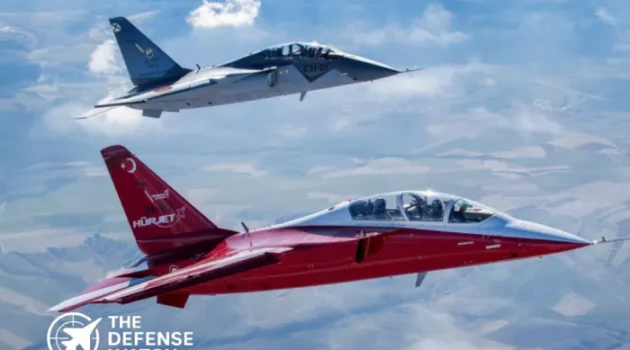
The flight was deliberately timed to coincide with Türkiye’s Victory Day. The production aircraft was accompanied by HÜRJET’s first development prototype during the sortie, providing a visible demonstration of the program’s progression from test aircraft to production-standard platforms.
The event is important because this was not HÜRJET’s original maiden flight. The first prototype flew on April 25, 2023, while a second prototype subsequently joined the flight-test campaign. Turkish Aerospace says the two development aircraft have now completed more than 500 test flights.
From Development Prototype To Production Aircraft
The latest flight represents a different phase of the program. Development prototypes are primarily used to expand the aircraft’s flight envelope, validate systems and support certification work, while the new aircraft is being prepared for eventual delivery to the Turkish Air Force.
That distinction matters for a military aircraft program. Once customer-configured production aircraft begin flying, testing can increasingly focus on the configuration that the operator will actually receive, including production processes, maintainability and acceptance requirements.
The HÜRJET program was initiated in 2017 under the coordination of Türkiye’s Presidency of Defense Industries to address the Turkish Air Force’s advanced jet-training requirement. Turkish Aerospace describes the aircraft as a replacement for the service’s T-38 fleet and the F-5 aircraft used for aerobatic duties.
- (adsbygoogle = window.adsbygoogle || []).push({});
The aircraft is intended to bridge the gap between basic jet training and frontline fighter conversion. That role becomes particularly important as air forces transition pilots toward increasingly complex combat aircraft with digital cockpits, advanced sensors and high-performance flight characteristics.
HÜRJET Technical Profile
HÜRJET is a single-engine, tandem-seat aircraft with a modern avionics suite and a design optimized for advanced jet training. Turkish Aerospace also describes it as capable of light combat missions, giving the platform utility beyond the training role.
Specification HÜRJET Length 13.6 m Wingspan 9.5 m Height 4.1 m Wing area 25 m² Maximum speed Mach 1.4 Service ceiling 45,000 ft Range 1,060 nm Payload capacity 7,500 lb Engine GE F404-GE-104 Engine thrust 17,700 lb G limits +8g / -3g The aircraft’s stated Mach 1.4 maximum speed places it firmly in the supersonic trainer category. Turkish Aerospace also reports that the first development aircraft exceeded 45,000 feet and passed the sound barrier during testing.
The use of a GE Aerospace F404 family engine also gives HÜRJET a proven propulsion architecture, although the overall aircraft’s military value depends on the integration of its flight-control system, avionics, cockpit, training systems and other mission equipment.

Source: Turkish Aerospace Why The Production Flight Matters
For the Turkish Air Force, HÜRJET is more than a replacement for an aging trainer. It provides a domestically developed platform that can support the progression of pilots toward modern fighter aircraft.
This has particular relevance as Türkiye expands its indigenous combat-aircraft portfolio. A domestic advanced trainer provides greater control over training-system development, aircraft configuration and long-term support than relying entirely on imported platforms.
The production flight also demonstrates that the program is moving beyond the limited number of development aircraft. Turkish Aerospace’s official HÜRJET data says series production is continuing, with deliveries to the Air Force scheduled for 2026.
However, official planning documents have previously provided a more detailed production schedule. Türkiye’s 2024-2028 defense industry strategy document identified deliveries of four Block 0 aircraft in 2027 and 12 Block 1 aircraft during 2028 and 2029 under the then-existing contract.
The different dates illustrate why a maiden flight should not automatically be treated as an operational entry date. The aircraft must still progress through additional flight testing, qualification, acceptance and delivery activities before becoming an established training asset.
HÜRJET And The Turkish Fighter Pilot Pipeline
The aircraft’s most important contribution may ultimately be in pilot preparation.
Modern fighter pilots require training that extends well beyond basic aircraft handling. Advanced trainers must provide an environment in which pilots can develop skills associated with high-performance flight, tactical maneuvering, instrument procedures and transition toward frontline fighter systems.
HÜRJET’s performance allows it to provide a more demanding training environment than conventional subsonic trainers. Its tandem cockpit also preserves the instructor-student arrangement commonly used during advanced flight instruction.
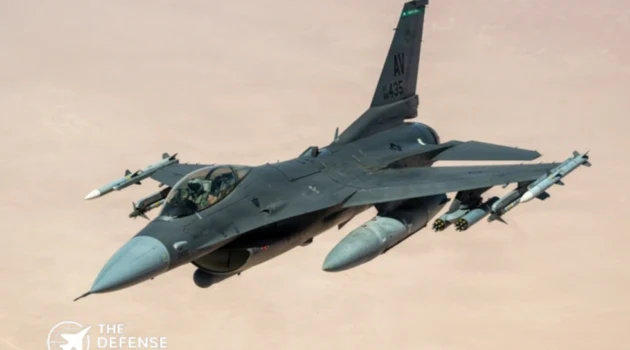
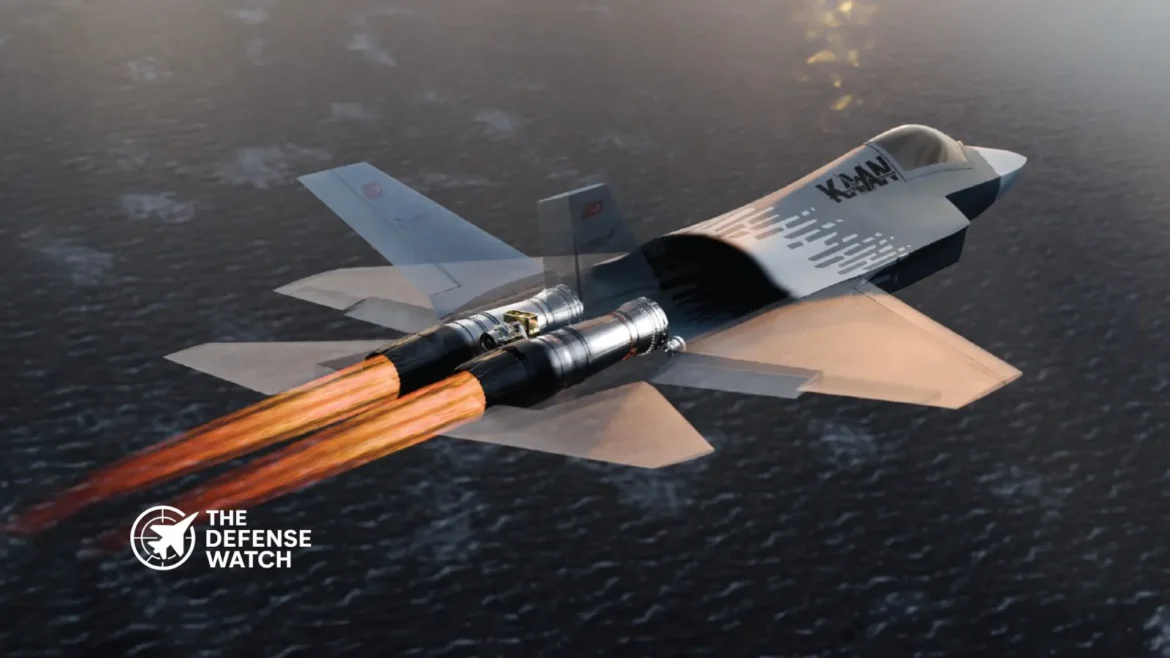
For Türkiye, that capability can support the broader modernization of its combat aviation force. The country operates F-16 fighters and is developing the KAAN fighter, making an indigenous advanced training aircraft strategically relevant to the long-term pilot pipeline.
The value is therefore not simply measured by how many HÜRJET aircraft enter service. It also depends on how effectively the aircraft, simulators, instructors, maintenance infrastructure and training syllabus operate as one system.
Spain Gives HÜRJET A Major European Customer
HÜRJET has also moved into a significant export phase.
Spain selected HÜRJET as part of its new Integrated Combat Training System, known as ITS-C, which is led by Airbus with Turkish Aerospace as the aircraft manufacturer. The program covers 30 HÜRJET aircraft intended to replace Spain’s remaining F-5 advanced trainers.
Turkish Aerospace puts the value of the Spanish procurement at €2.6 billion and says deliveries are planned to begin in the fourth quarter of 2028 and continue through 2036.
The Spanish program is strategically important because it places HÜRJET within a NATO member’s military training architecture. It also introduces Airbus and Spanish industry into the wider program, including aircraft customization, training infrastructure and sustainment.
That gives HÜRJET a potential path into a broader European training market, although future opportunities will depend on cost, certification, industrial arrangements, availability and the aircraft’s performance against competing trainer platforms.
Production And Export Create A Larger Industrial Test
The Turkish Air Force aircraft’s maiden flight comes at a point when HÜRJET is no longer solely a domestic development effort.
Türkiye now has to demonstrate that the aircraft can move from prototype production to repeatable manufacturing while maintaining quality, configuration control and supportability. That is a more demanding industrial challenge than producing a small number of prototypes.
The Spanish order increases that pressure because the program must eventually support different customer requirements while retaining a common aircraft architecture.
For Turkish Aerospace, successful production and delivery of the domestic aircraft will therefore be as important as the original flight-test achievements. A reliable production system is essential if HÜRJET is to develop into a sustainable export product.
What Comes Next For HÜRJET
The August 30 sortie begins another important stage of the program rather than completing it.
The first Turkish Air Force production aircraft will need to continue flight testing and move through the remaining acceptance process before delivery. At the same time, Turkish Aerospace is expected to continue series production and development work on later aircraft.
The company has also been examining additional HÜRJET configurations. Turkish Aerospace CEO Mehmet Demiroğlu said in August that the company had begun work on a navalized HÜRJET concept and was pursuing additional NATO export opportunities.
For now, the central milestone is more straightforward: the first HÜRJET built for the Turkish Air Force has left the ground.
The 18 minute flight marks the point at which Türkiye’s indigenous supersonic trainer begins proving not only the aircraft design, but also the production configuration that will eventually support the country’s military pilot training system.
Bottom Line
The first production HÜRJET’s maiden flight is a significant industrial and operational milestone for Türkiye. It confirms that the program has progressed beyond its two principal development prototypes and into flight testing of aircraft intended for actual Turkish Air Force service.
The larger test will be completing acceptance, sustaining production and translating the aircraft’s advanced training capabilities into a dependable pilot-training system. The Spanish export program adds another demanding benchmark, giving HÜRJET a chance to establish itself beyond Türkiye as a NATO-compatible advanced trainer.
For the Turkish Air Force, the immediate objective is clear: turn the production aircraft now flying into a reliable training asset for the next generation of fighter pilots.

KAAN Fighter Jet Awaits US Approval For F110 Engines
The KAAN fighter jet program is nearing a key milestone as Türkiye expects the United States to approve exports of the F110 GE 129E turbofan engine for early production aircraft.
According to Turkish Aerospace Industries, approval for the U.S.-made engines could come in February or March 2026. The engines will power the first serial production batches of the KAAN Block 10 and Block 20 aircraft.
(adsbygoogle = window.adsbygoogle || []).push({});TUSAŞ General Manager Mehmet Demiroğlu said the company does not anticipate delays in the engine approval process, citing ongoing coordination between U.S. and Turkish officials.
Ten Engines Already In Hand
Demiroğlu confirmed that TUSAŞ already holds ten F110 engines. These are sufficient for prototype aircraft currently in development.
He stated that the company has faced no issues in the development phase related to propulsion. The existing engines support flight testing and system integration as the KAAN fighter jet moves through its early operational evaluation cycle.
The F110 GE 129E engine is produced by GE Aerospace and is widely used in advanced fourth generation fighters, including variants of the F 16. The engine provides high thrust output suitable for twin engine configurations such as KAAN.
Final Approval Stage Underway
TUSAŞ is now in what Demiroğlu described as the final stage of U.S. export approval. The authorization would allow the F110 engines to be installed in the first batch of KAAN Block 10 and Block 20 aircraft intended for operational service.
Based on discussions with both governments, TUSAŞ expects no disruption in deliveries. Approval could be issued within weeks.
(adsbygoogle = window.adsbygoogle || []).push({});The export decision follows established U.S. defense trade procedures. Such transfers require clearance under U.S. export control regulations and coordination between industry and government authorities.
First Delivery Set For 2029
The first KAAN fighter jet delivery to the Turkish Air Force is scheduled for early 2029.
Block 10 and Block 20 aircraft will rely on the F110 engine as an interim propulsion solution. These early blocks are expected to focus on core air dominance capabilities while additional systems mature.
The KAAN program represents Türkiye’s effort to field a domestically developed fifth generation fighter aircraft. The platform is designed to incorporate stealth shaping, advanced sensors, network centric warfare features, and internal weapons carriage.
The aircraft conducted its maiden flight in 2024, marking a significant milestone in Türkiye’s military aviation ambitions.
Transition To A National Engine By 2033
While early production models will use U.S. engines, TUSAŞ plans to equip the KAAN Block 30 aircraft with an indigenous powerplant.
Demiroğlu said the first test of the national engine is targeted for 2032, with final delivery planned for 2033. This shift would reduce reliance on foreign propulsion systems and strengthen domestic aerospace capabilities.
Engine development is a complex and resource intensive effort. It involves advanced materials, turbine blade technology, and high temperature performance engineering. Few nations maintain the industrial base required for fifth generation fighter engines.
(adsbygoogle = window.adsbygoogle || []).push({});Türkiye has been investing heavily in defense industrial self sufficiency over the past decade, particularly in aerospace, unmanned systems, and missile technology.
Strategic Context
The KAAN fighter jet plays a central role in Türkiye’s long term air power strategy. The program gained additional urgency aFter Ankara’s removal from the F 35 program in 2019.
Since then, Turkish defense planners have emphasized indigenous development across air, naval, and land systems.
The F110 export approval would signal continued defense industrial cooperation between Washington and Ankara, despite periodic political tensions.
The engine decision also carries operational significance. Without timely approval, serial production timelines could face adjustments. However, TUSAŞ leadership has publicly stated that current indicators point toward a smooth authorization process.
(adsbygoogle = window.adsbygoogle || []).push({});Program Outlook
With prototypes flying and engine supplies secured for testing, the KAAN fighter jet remains on track for initial operational delivery at the end of the decade.
Upcoming milestones include expanded flight testing, avionics integration, weapons certification, and low rate initial production planning.
As the program advances, propulsion remains a key focus area. The transition from the F110 engine to a domestically produced alternative will mark a critical phase in Türkiye’s effort to field a fully sovereign fifth generation combat aircraft.
For now, industry officials appear confident that U.S. approval for the F110 GE 129E engines will arrive within the expected timeframe.
HGK 84 Precision Guidance Kits Delivered to Turkish Air Force
Turkey has delivered the first 2026 production batch of HGK 84 Precision Guidance Kits to the Turkish Air Force, marking another step in Ankara’s long running effort to expand indigenous smart munition capabilities. The delivery was completed under a contract between the Ministry of National Defence and state owned defense firm ASFAT, with development support from TUBITAK SAGE.
(adsbygoogle = window.adsbygoogle || []).push({});The kits have entered service with the Turkish Air Force, often referred to domestically as the Steel Eagles of the Sky, and are intended to enhance the accuracy and operational flexibility of existing Mk 84 general purpose bombs.
HGK 84 Program Overview and Role
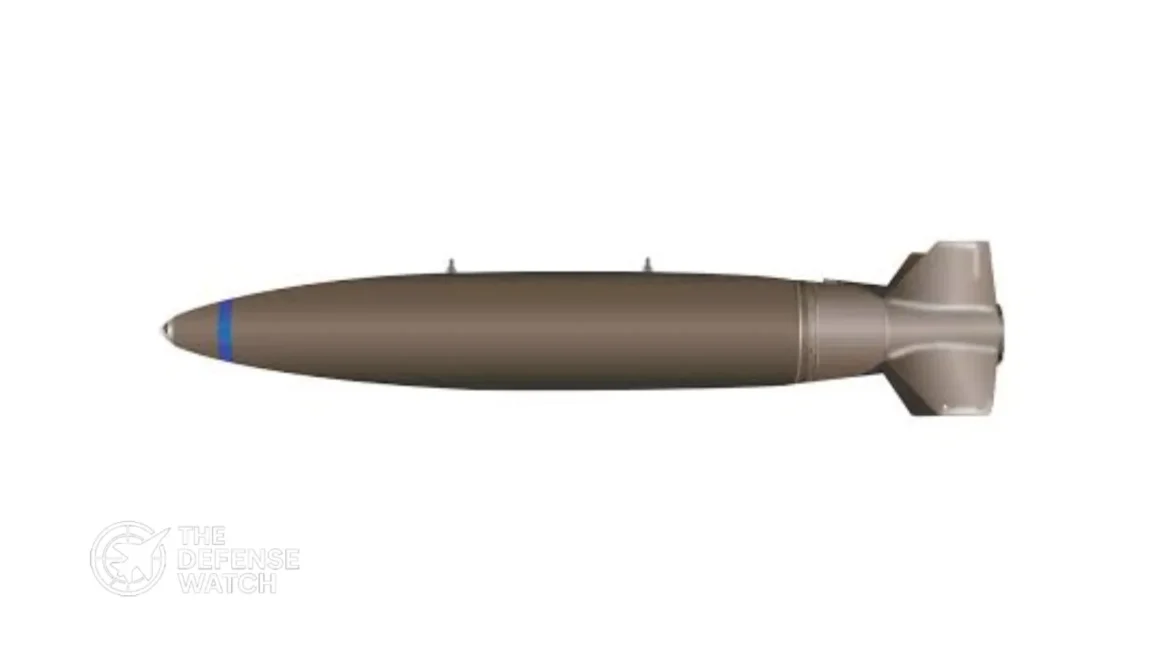
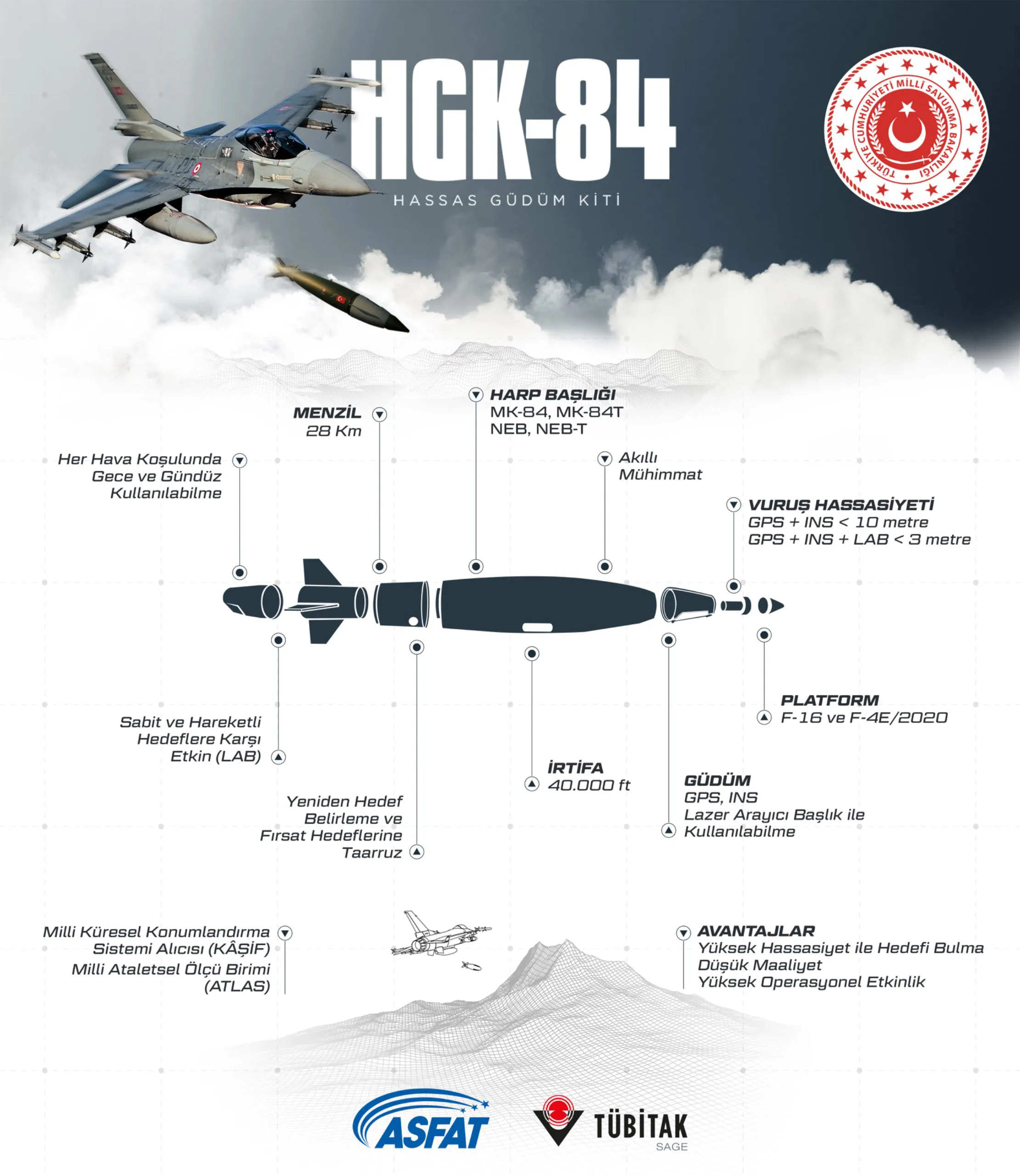
The HGK 84 Precision Guidance Kit is a GPS and INS based guidance package designed to convert standard 2,000 pound Mk 84 unguided bombs into all weather precision guided weapons. Developed by TUBITAK SAGE, the system has been in Turkish service for more than a decade and continues to receive incremental improvements.
By using satellite aided navigation, the HGK 84 allows Turkish Air Force aircraft to conduct precision strikes without relying on laser designation, which can be degraded by weather, smoke, or battlefield obscurants. This capability is especially relevant for deep strike, fixed target suppression, and strategic infrastructure missions.
The HGK family includes multiple variants, with the HGK 84 tailored specifically for the Mk 84 bomb class, offering extended stand off release profiles when deployed from higher altitudes.
2026 Delivery Under ASFAT Contract
According to the Ministry of National Defence, the newly delivered HGK 84 Precision Guidance Kits represent the first batch produced and handed over in 2026 under an ongoing production agreement with ASFAT. ASFAT is responsible for program coordination, production oversight, and delivery to the Turkish Armed Forces.
(adsbygoogle = window.adsbygoogle || []).push({});
Image Source : ASFAT The contract reflects Turkey’s broader policy of sustaining domestic production lines for critical air delivered munitions, ensuring continuity of supply without dependence on foreign vendors or export approvals.
Officials emphasized that production was carried out in cooperation with TUBITAK SAGE, which remains the design authority and technical backbone of the HGK program.
Integration With Turkish Air Force Platforms
The HGK 84 Precision Guidance Kit is compatible with several Turkish Air Force aircraft types, including the F 16 Fighting Falcon fleet that forms the backbone of Turkey’s combat aviation force.
Integration with national mission computers and software allows the weapon to be employed using indigenous targeting data, mission planning tools, and command and control systems. This alignment supports Turkey’s push for platform independence and full sovereign control over strike capabilities.
The system has previously been demonstrated in live fire exercises and operational deployments, showing circular error probable values measured in only a few meters under test conditions.
Strategic Importance for Turkey’s Airpower
The continued delivery of HGK 84 kits highlights Turkey’s emphasis on cost effective modernization rather than wholesale replacement of legacy weapons. By upgrading existing bomb stocks with guidance kits, the Turkish Air Force can significantly expand its precision strike inventory at a fraction of the cost of new build smart munitions.
This approach also aligns with NATO operational concepts, where precision engagement and reduced collateral damage are central requirements for modern air operations.
From a geopolitical standpoint, maintaining an independent precision munition production capability gives Turkey operational resilience during periods of political tension, export restrictions, or supply chain disruption.
Turkey’s Broader Smart Munition Ecosystem
The HGK 84 is part of a wider Turkish smart weapons portfolio developed by TUBITAK SAGE and other national firms. This portfolio includes laser guided kits, stand off glide bombs, bunker penetration weapons, and air launched cruise missiles.
(adsbygoogle = window.adsbygoogle || []).push({});Together, these systems support Turkey’s goal of becoming a self sufficient airpower producer, capable of sustaining high tempo operations without reliance on external suppliers.
Defense analysts note that continued serial deliveries such as the 2026 HGK 84 batch signal program maturity rather than experimental development, reinforcing confidence in domestic production quality and lifecycle support.
Outlook
While no new export announcements were made alongside the 2026 delivery, Turkey has previously promoted the HGK family to allied and partner air forces operating Western standard aircraft and Mk series bombs.
For the Turkish Air Force, the latest HGK 84 Precision Guidance Kit delivery ensures sustained availability of proven precision strike tools as Ankara balances fleet modernization, indigenous fighter development, and regional security commitments.
- (adsbygoogle = window.adsbygoogle || []).push({});