U.S. Navy Demonstrates Robotic At Sea Refueling For T38 USV
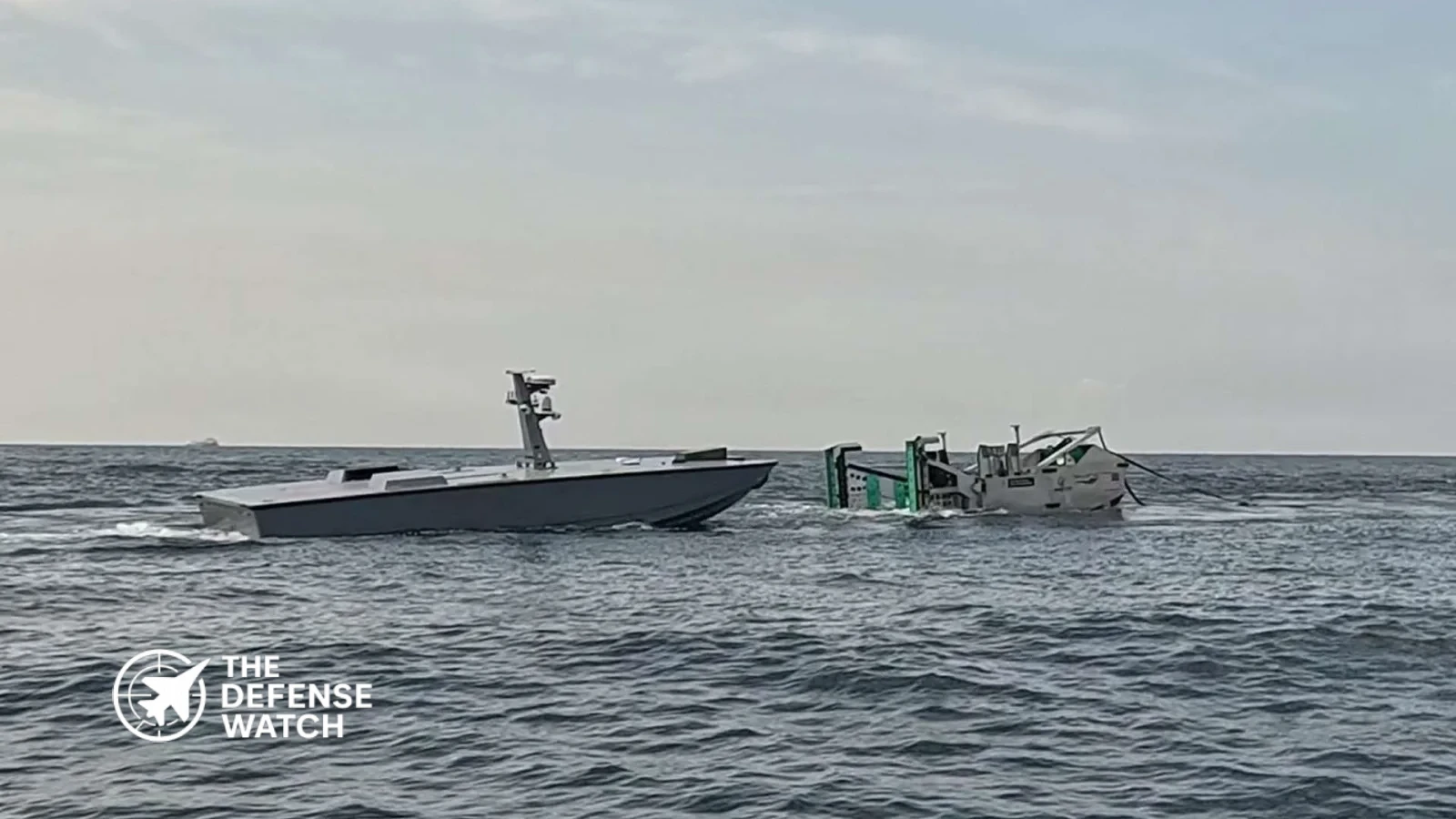
The U.S. Navy has demonstrated robotic at sea refueling of a T38 unmanned surface vessel, showing how unmanned craft could remain on station longer without returning to port for fuel. The Naval Air Warfare Center Weapons Division’s Blue Water Instrumentation program led the demonstration with industry partner Sealartec, using a robotic towable capture and connection device.
Takeaways
The U.S. Navy has demonstrated a robotic system capable of refueling a T38 unmanned surface vessel at sea, addressing a major endurance limitation for long duration unmanned operations.
The August 11 demonstration took place off Joint Expeditionary Base Little Creek Fort Story, Virginia. The Navy-industry team used the training support vessel USNS Vindicator to tow the refueling device while the T38 approached, connected, received fuel and separated from the system.
The demonstration represents an important development for unmanned maritime operations because fuel endurance can determine how long a USV can provide surveillance, instrumentation or other support away from a port or crewed support vessel.
How The Robotic Refueling System Worked
The system tested by the Navy is based on Sealartec’s towable capture and connection device, or TCCD. Rather than requiring personnel to manually handle a conventional refueling hose on the receiving USV, the system is designed to allow the unmanned vessel to capture the connection point while operating at sea.
During the August demonstration, the T38 repeatedly conducted full capture, refueling and release cycles. The Navy reported that the system transferred 400 gallons of fuel to the T38.
The testing was not limited to a single successful connection. According to Sealartec’s chief executive Amitai Peleg, approximately 100 connection cycles were completed during several days of testing leading up to and including the main event.
That repeated testing matters because an operational refueling system has to function reliably despite vessel movement, relative speed, waves, wind and variations in positioning. A system that works once under controlled conditions would have limited operational value without repeatability.
T38 Provides The Test Platform
The T38, developed by Maritime Tactical Systems, is a compact unmanned surface vessel designed around a modular architecture and autonomous operations.
MARTAC identifies the Devil Ray T38 as a platform combining high speed, payload capacity and endurance, with an open architecture intended to support different payloads and missions. The company also reports that a T38 completed a 192 hour autonomous mission off California in May 2026.
The Navy has previously employed T38 Devil Ray vessels in experimentation with unmanned systems. In the Middle East, U.S. Naval Forces Central Command’s Task Force 59 used T38 USVs during exercises involving manned and unmanned teaming and demonstrated the ability to engage maritime targets with an embarked Lethal Miniature Aerial Missile System.
The platform’s relatively small size makes the refueling demonstration particularly relevant. The Navy is not simply testing how a large unmanned ship can receive fuel from a conventional oiler. It is examining how smaller autonomous vessels can be supported without putting additional personnel aboard the receiving platform.
Why Refueling Matters For Unmanned Naval Operations
Endurance is one of the central challenges facing unmanned surface vessels.
An unmanned platform can remove the need for crew accommodations, life support and many other systems associated with conventional ships. That can create more room for fuel, sensors, communications equipment or mission payloads. But a USV still has to manage its available energy and eventually return to port or receive support.
The Navy’s Blue Water Instrumentation program is particularly interested in this problem because its assets support testing of advanced long range weapons. According to the Navy, hypersonic and precision long range fires can require flight profiles extending thousands of miles beyond fixed range boundaries, creating a need for data collection assets distributed over large areas.
If an unmanned instrumentation vessel has to return to port whenever its fuel supply becomes limiting, the resulting gap can reduce coverage and interrupt a test sequence.
At sea refueling changes that equation. Instead of treating fuel exhaustion as a hard endpoint for an unmanned mission, the Navy can potentially build a support architecture in which smaller USVs receive fuel from other maritime assets while remaining within the operating area.
From Operator Assisted Testing To Autonomous Refueling
The latest demonstration was an important step, but it should not be confused with a completely autonomous refueling operation.
The Navy described the next milestone as an end to end autonomous refueling demonstration. That test is expected to cover vessel rendezvous and approach, capture, fuel transfer, disconnection and return to mission as one continuous evolution.
The distinction is important. Autonomous navigation and autonomous refueling are separate technical problems that must eventually work together.
A USV approaching a moving refueling device must determine its relative position and movement accurately enough to establish a connection. The system must then maintain a stable relationship during fuel transfer and safely disengage before returning to its assigned mission.
The Navy’s current work also includes reducing command and control latency and integrating next generation local positioning systems to improve maneuvering and support autonomous refueling.
A Broader Navy Push Toward Persistent Unmanned Vessels
The T38 demonstration fits into a larger U.S. Navy effort to make unmanned surface vessels more persistent and useful in operational environments.
In May 2026, the Navy selected seven companies to advance through at sea testing under its Medium Unmanned Surface Vessel marketplace. The selected companies are Sea Machines, Leidos, Saronic Technologies, Galliano Marine Services, PacMar Technologies, Birdon and Huntington Ingalls Industries. Successful vessels are expected to become eligible for follow on production opportunities.
The Navy has also pursued technologies that allow larger unmanned vessels to operate for extended periods without routine human intervention. In 2023, Naval Sea Systems Command announced completion of a 720 hour continuous power demonstration for a diesel generator intended for Large USV operations.
Together, these efforts address different parts of the same operational problem: an unmanned vessel is most useful when it can remain deployed without requiring frequent human intervention.
The Technical Challenge Is More Than Fuel Transfer
The hardest part of robotic refueling is not necessarily moving fuel from one tank to another. The more difficult challenge is reliably connecting two moving systems in an uncontrolled maritime environment.
Several factors become important as the Navy moves toward full autonomy:
| Challenge | Operational Requirement |
|---|---|
| Vessel rendezvous | Accurate relative navigation between USV and refueling system |
| Approach control | Precise maneuvering despite waves, wind and vessel motion |
| Physical capture | Reliable connection without personnel intervention |
| Fuel transfer | Controlled transfer while maintaining the connection |
| Disconnection | Safe separation without damaging either platform |
| Positioning | High accuracy local positioning for close maneuvering |
| Command and control | Low latency communications and reliable supervisory control |
| Mission recovery | USV must automatically return to its assigned mission |
These requirements explain why the Navy is progressing through repeated connection testing before attempting a fully autonomous evolution.
The approach also reduces risk by separating the problem into manageable stages. The T38 demonstration first establishes that a robotic connection mechanism can repeatedly capture and release the vessel and transfer fuel at sea. Future tests can add more autonomous decision making and navigation.
Implications For Long Duration Naval Operations
The immediate application is Navy weapons testing, but the underlying capability has broader implications for unmanned maritime operations.
A USV that can receive fuel without returning to port could spend more time collecting sensor data, supporting range operations, conducting surveillance or performing other assigned tasks. More importantly, the Navy could distribute unmanned platforms across larger operating areas while reducing the frequency of crewed support missions.
That can improve the efficiency of a distributed force. Instead of designing every unmanned vessel around maximum possible endurance, the Navy can begin considering an ecosystem in which smaller platforms are periodically supported by other vessels.
The concept also aligns with the Navy’s broader interest in distributing capabilities across more platforms. The service has described unmanned systems as a way to increase operational persistence and expand naval power while creating additional options for fleet operations.
Earlier U.S. Navy Work On Unmanned At Sea Refueling
The T38 test is not the Navy’s first attempt to solve the refueling problem.
In December 2024, DARPA announced that its No Manning Required Ship program had completed an at sea fueling test involving the experimental unmanned surface vessels Ranger and Mariner. The test demonstrated a refueling probe connection without human assistance on the receiving side.
That work demonstrated an important principle for unmanned maritime systems: the receiving vessel should be able to participate in refueling without requiring personnel to handle hoses or lines.
The newer T38 demonstration advances the concept through a different architecture using a towable robotic connector. It therefore adds another approach to the Navy’s growing body of experience with unmanned vessel logistics.
What Comes Next
The next major milestone for the Blue Water Instrumentation team is an end to end autonomous refueling demonstration.
The Navy says that effort will combine rendezvous, approach, capture, fuel transfer, disconnection and return to mission. The program also plans to reduce command and control latency and introduce improved local positioning technology to support more precise autonomous maneuvering.
For the T38 and similar USVs, successful development of these capabilities would address one of the practical limits on persistent unmanned operations. The significance is not simply that a robotic system transferred fuel at sea, but that the Navy is working toward a support model in which unmanned vessels can refuel, resume their missions and remain deployed with less dependence on crewed intervention.