

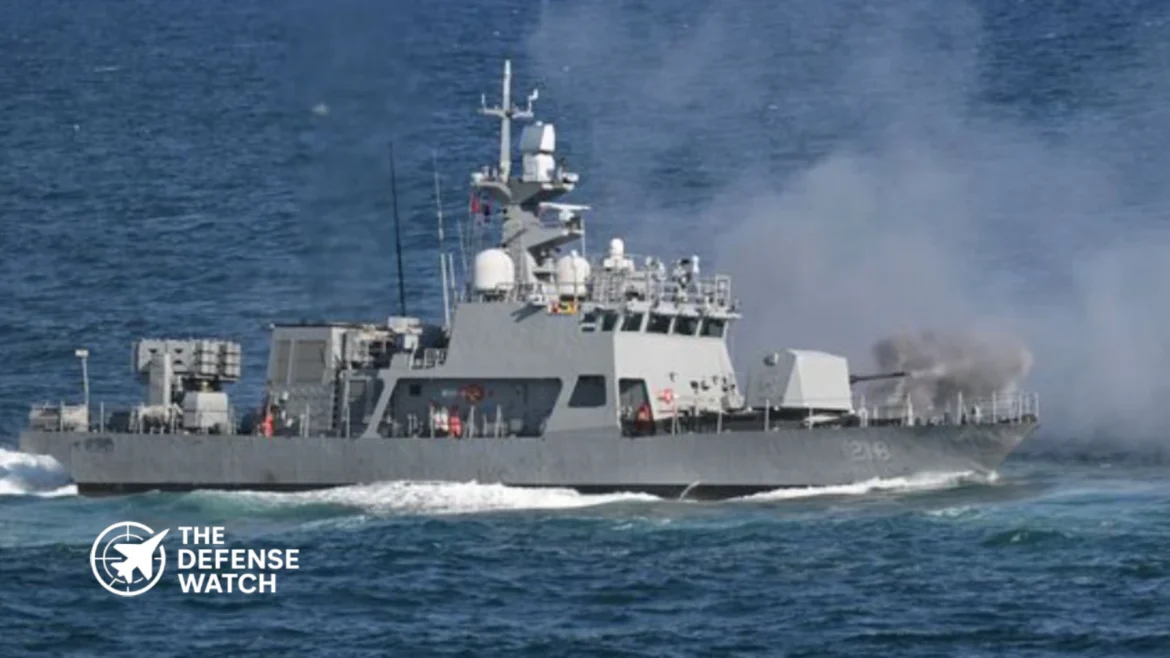
South Korea Delivers First Geomdoksuri-B Batch-II Patrol Craft
South Korea has delivered the first Geomdoksuri-B Batch-II fast patrol craft to the Republic of Korea Navy, marking the start of a new phase in the country’s replacement of aging coastal combatants. South Korea’s Defense Acquisition Program Administration, or DAPA, handed over the vessel at HJ Heavy Industries’ Yeongdo shipyard in Busan on 14 August 2026 after the first Batch-II craft completed sea trials.
The Geomdoksuri-B, also designated Patrol Killer Medium Rocket, or PKMR, forms part of South Korea’s broader Patrol Killer Experimental program. The platform is intended primarily for littoral operations and rapid-response missions, with particular relevance to the waters surrounding the Northern Limit Line, where the Republic of Korea Navy maintains a persistent maritime security presence.
Takeaways
South Korea has begun receiving the second batch of its Geomdoksuri-B fast patrol craft.
1. First Batch-II Craft Delivered
South Korea’s Defense Acquisition Program Administration handed over the first Geomdoksuri-B Batch-II fast patrol craft to the Republic of Korea Navy on 14 August 2026 at HJ Heavy Industries’ Yeongdo shipyard in Busan.
2. Built For Littoral Combat
The approximately 230-ton craft is designed for rapid-response missions in coastal waters, including operations around the Northern Limit Line, the maritime boundary separating North and South Korea in the Yellow Sea.
3. 40-Knot Performance
The 44-meter-long vessel uses waterjet propulsion and can reach approximately 40 knots, giving the Navy a fast platform for interception, patrol and coastal security missions.
4. Rocket And Gun Armament
The class carries a 76 mm Hyundai WIA naval gun, a 12-cell 130 mm Biryong guided rocket launcher and remotely operated 12.7 mm weapon stations.
5. Replaces Older Chamsuri Craft
The Batch-II program continues South Korea’s effort to replace aging Chamsuri-class patrol boats with faster vessels offering greater firepower, modern combat systems and improved survivability.
Geomdoksuri-B Batch-II Program
The Batch-II program began in 2022 after completion of the earlier Batch-I program, which ran from 2017 through 2022. The first Batch-II vessels were launched in 2025 before undergoing testing and evaluation ahead of delivery to the Navy.
HJ Heavy Industries has become the principal shipbuilder for the program. The company completed all 16 Geomdoksuri-B Batch-I vessels and subsequently won contracts covering the Batch-II fleet. By December 2025, HJ Heavy Industries had secured contracts for all 16 Batch-II vessels, bringing its total production responsibility across the two programs to 32 craft.
The latest four-ship Batch-II contract, covering hulls 13 through 16, was valued at KRW 312.5 billion. Earlier contracts covered the first four vessels and the following four, while another four-ship order in December 2024 brought the Batch-II program to 12 contracted vessels before the final four were ordered in 2025.
Compact Platform Built For High-Speed Coastal Operations
The Geomdoksuri-B is a relatively small combatant, measuring approximately 44 meters in length and 7 meters in beam, with a displacement of about 230 tons. Its waterjet propulsion system enables a top speed of approximately 40 knots. The vessel is operated by a crew of roughly 20 to 23 personnel.
| Specification | Geomdoksuri-B Batch-II |
|---|---|
| Type | Fast patrol craft |
| Naval designation | Patrol Killer Medium Rocket, PKMR |
| Length | Approximately 44 m |
| Beam | Approximately 7 m |
| Displacement | Approximately 230 tons |
| Propulsion | Waterjets |
| Maximum speed | Approximately 40 knots |
| Crew | Approximately 20 to 23 |
| Main gun | 76 mm Hyundai WIA naval gun |
| Rocket system | 12-cell 130 mm Biryong guided rocket launcher |
| Secondary weapons | Remote 12.7 mm weapon stations |
The combination of small size, high speed and guided rocket armament reflects a design optimized for coastal combat rather than sustained blue-water operations. This distinction is important because the Republic of Korea Navy operates a layered fleet in which large surface combatants provide area air defense, anti-submarine warfare and long-range strike capabilities, while smaller craft provide localized surveillance, interception and rapid-response functions.
The Geomdoksuri-B therefore fills a specific tactical role. Its value lies less in endurance or sensor reach than in the ability to move quickly through restricted coastal waters and bring significant short-range firepower to a relatively small platform.
Weapons Configuration Supports Littoral Missions
The primary weapon fit includes a 76 mm Hyundai WIA naval gun. The gun provides a flexible weapon for surface engagements and other naval fire-support requirements, while the vessel’s 12-cell 130 mm Biryong guided rocket launcher gives it a more substantial strike capability against surface targets.
The Biryong system is particularly significant in the context of South Korea’s coastal defense requirements. Earlier descriptions of the Geomdoksuri-B family identified guided rockets, remote fire control and electronic warfare equipment among the capabilities intended to improve the class over older patrol boats.
Remote 12.7 mm weapon stations provide additional close-range defensive and engagement capability. The overall configuration gives the craft multiple weapon layers without requiring the displacement or crew size of a conventional corvette or frigate.
Northern Limit Line Remains A Key Operational Context
The Geomdoksuri-B program is closely linked to South Korea’s requirement to maintain capable patrol forces around the Northern Limit Line in the Yellow Sea.
The maritime boundary has been the site of serious confrontations between North and South Korean naval forces. South Korean officials have therefore placed particular emphasis on replacing older 170-ton Chamsuri-class vessels with newer patrol craft capable of responding quickly to incidents in the area.
The Geomdoksuri-B offers a larger and more heavily armed successor to the legacy patrol craft. Its approximately 40-knot speed allows it to rapidly reposition within coastal sectors, while its guided rockets provide greater reach and precision than conventional unguided small-caliber weapons.
This is also where the platform’s compact design becomes operationally relevant. A large warship can provide greater endurance, sensors and weapons capacity, but a fast patrol craft can operate closer to shore, respond rapidly to contacts and maintain a distributed presence across multiple coastal sectors.
Batch-II Extends An Established South Korean Design
The Batch-II program is not a completely new ship class. Instead, it builds on the operational experience of the 16-ship Batch-I fleet.
HJ Heavy Industries previously completed all 16 Batch-I vessels, while the Batch-II program introduces the next production group under the same broader Geomdoksuri-B family. The company has described the vessels as replacements for the aging Chamsuri fleet and as rapid-response assets for Northern Limit Line and coastal defense missions.
The use of an established hull and production base can also reduce some acquisition risks compared with developing an entirely new patrol craft. South Korea can retain an existing industrial and logistics structure while introducing newer equipment and maintaining a common operational concept.
That approach is consistent with broader South Korean naval modernization, which combines new high-end surface combatants with a continuing effort to renew smaller vessels used for coastal security and tactical response.
Implications For South Korean Naval Modernization
The delivery is significant because it strengthens the lower end of the Republic of Korea Navy’s surface combatant structure at a time when South Korea is simultaneously investing in larger warships, submarines, missile defense and advanced unmanned systems.
DAPA’s broader 2026 defense planning calls for continued investment in advanced military capabilities, including maritime systems, while emphasizing improvements across South Korea’s wider defense architecture.
For the Navy, the Geomdoksuri-B provides a practical means of maintaining a modern coastal force without assigning larger and more expensive ships to every routine patrol or rapid-response mission.
The platform also demonstrates the importance of speed and distributed firepower in waters where reaction time can be more important than endurance. A fleet of small, fast combatants can complicate an adversary’s targeting problem by distributing weapons across multiple mobile platforms rather than concentrating all capability aboard a small number of large ships.
A Complement To South Korea’s Larger Warships
The Geomdoksuri-B should not be viewed as a substitute for South Korea’s frigates, destroyers or submarines. Its operational role is narrower.
Large surface combatants provide capabilities such as air defense, long-range precision strike, anti-submarine warfare and fleet command. The Geomdoksuri-B instead provides high-speed coastal presence, local surface combat capability and rapid reaction.
This division of roles allows the Republic of Korea Navy to use different platforms according to the threat and geography. In the confined waters around the Korean Peninsula, that layered approach can be particularly relevant.
The Batch-II delivery therefore represents more than another patrol boat entering service. It continues the replacement of an aging coastal fleet while maintaining a specialized capability for one of the most sensitive maritime environments in East Asia.
What Comes Next
The first Geomdoksuri-B Batch-II craft has now completed the transition from shipyard construction and trials into operational naval service. The remaining Batch-II vessels will follow as HJ Heavy Industries completes production under the existing contracts.
With all 16 Batch-II craft contracted, the program gives the Republic of Korea Navy a substantial follow-on fleet built around a common high-speed patrol craft design. Combined with the 16 Batch-I vessels already delivered, the two batches represent a 32-ship modernization effort centered on the PKMR mission.
For South Korea, the immediate benefit is a larger pool of modern fast patrol craft capable of operating in coastal waters and supporting maritime security around the Korean Peninsula. For the wider regional security environment, the program illustrates Seoul’s continued focus on maintaining a layered naval force capable of responding across both high-end and localized maritime threats.