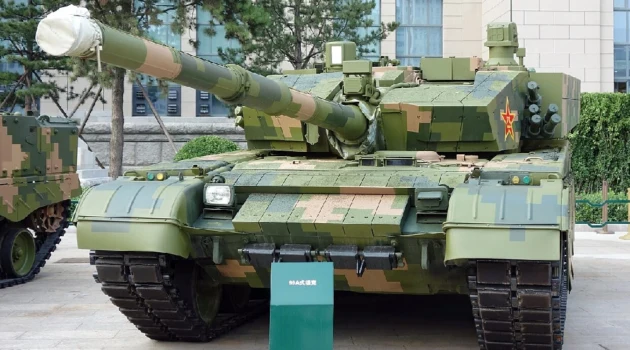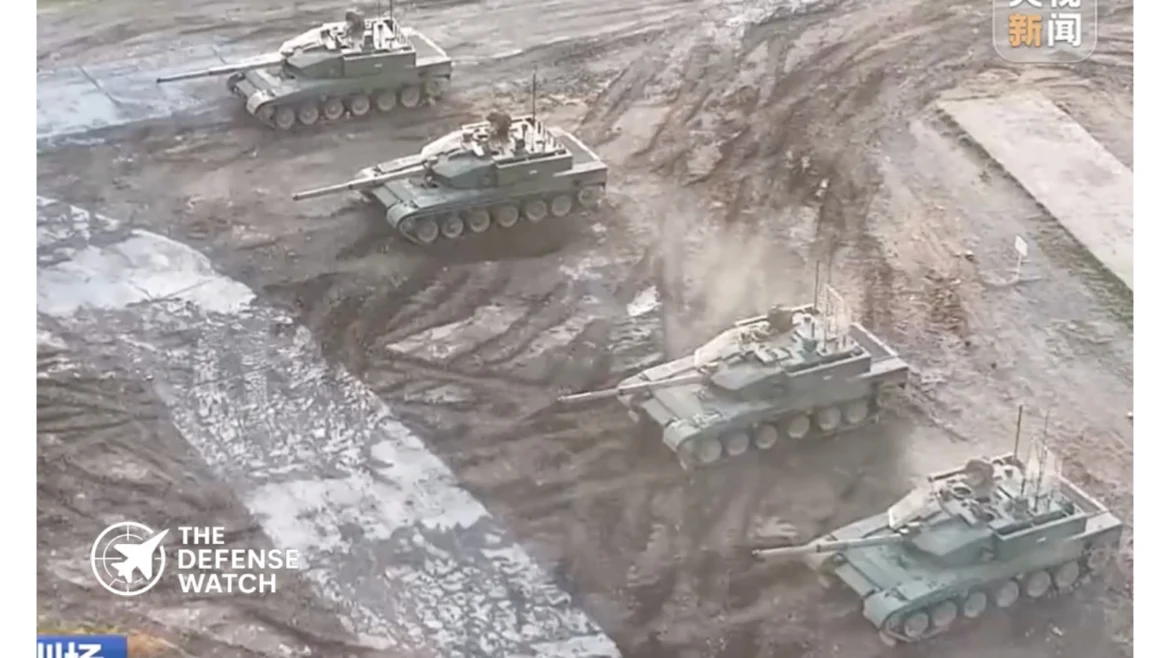
Executive Summary
- CCTV footage released in September 2026 shows four Type 99B main battle tanks from a PLA 80th Group Army brigade conducting a live-fire assessment in Shandong.
- The exercise tested target search, identification, engagement while stationary and on the move, communications, maneuver through obstacles, and three-person crew performance.
- The more significant development is the emphasis on information systems and networked operations, suggesting that the Type 99B is intended to operate as part of a connected combined-arms formation rather than as an isolated tank.
China has released rare footage of the Type 99B main battle tank conducting live-fire training, providing a clearer view of how the People’s Liberation Army is integrating its newest publicly identified 99-series tank into operational training.
The footage, released by CCTV News on September 16, shows a brigade of the PLA’s 80th Group Army conducting a live-fire assessment at a training area in Shandong Province. Four Type 99B tanks are shown maneuvering, loading ammunition, operating their sights and engaging simulated targets under different battlefield conditions.
The exercise is significant less because it demonstrates a new gun or a disclosed performance figure than because of what it reveals about how China is training the tank to fight. The assessment emphasized target detection and selection, communications with higher command, movement through obstacles and engagement while maneuvering.
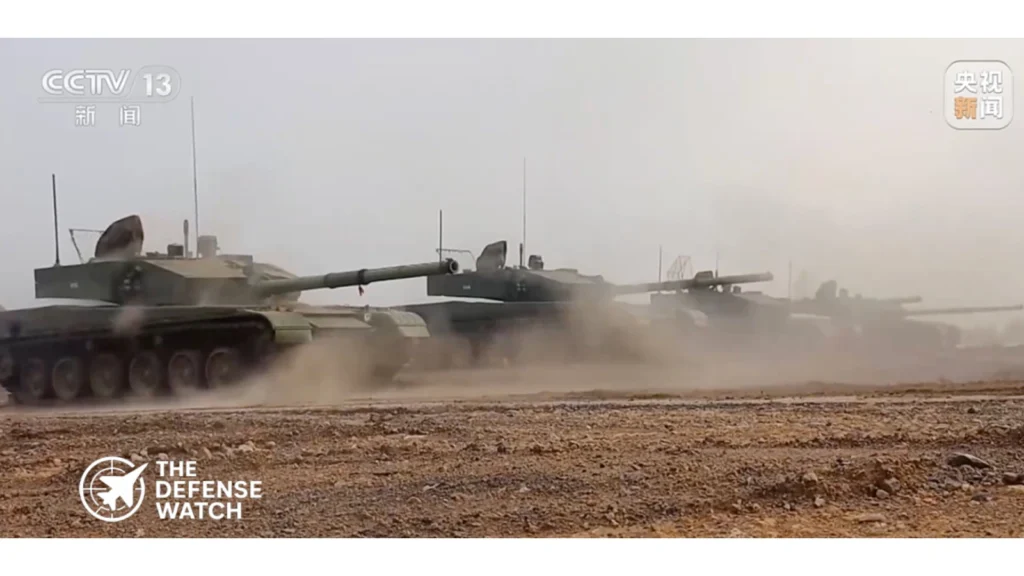
Type 99B Demonstrates Live-Fire and Maneuvering Skills
According to CCTV footage described by Global Times, the training involved fixed targets positioned at different ranges and directions. Tank crews were required to independently assess the tactical situation and select appropriate targets.
One sequence showed a Type 99B firing an armor-piercing round at a target approximately 1,200 meters away from a stationary position. Another sequence showed a tank engaging a simulated enemy tank while moving, with the target approximately 1,000 meters away. These figures describe the training scenario shown in the broadcast, not the maximum effective range of the tank’s weapon system.
The exercise also tested the crews’ ability to operate in difficult terrain. Drivers negotiated bridges, water-filled pits and craters while commanders maintained communications and directed engagement tasks.
The assessment included sideways and rearward firing scenarios and additional routes, obstacles and restricted passages intended to make the exercise more demanding. CCTV reported that all designated targets were destroyed during the assessment.
Three-Person Crew Remains Central
The footage also provides evidence of the Type 99B’s three-person crew arrangement. The crews were evaluated on their ability to identify and engage designated targets within prescribed time limits, both from stationary positions and while moving.
This matters because modern armored warfare increasingly depends on reducing the time between detection, identification, decision and engagement. A tank’s effectiveness therefore depends not only on armor and gun performance but also on crew workload, sensors, communications and access to information from other elements of a combined-arms formation.
Type 99B Builds on the Type 99A
Chinese official sources have previously described the Type 99B as an improved development of the Type 99A.
The Chinese Ministry of National Defense identified the Type 99B in December 2025 as the latest variant of China’s domestically developed third-generation main battle tank family and reported that the tank was designed for rapid and sustained operations in demanding environments, including high-altitude and cold regions.
Chinese state media also highlighted the Type 99B during the September 2025 Victory Day parade. CCTV described it as an improved Type 99A and pointed to changes involving communications and remotely operated weapon functions.
China’s Ministry of National Defense has separately described the Type 99B as part of a broader effort to improve integrated joint operations, firepower against multiple types of targets and mobility in complex terrain.
The available official information does not provide a complete technical specification for the Type 99B. Consequently, claims concerning its exact combat weight, armor protection, maximum speed, ammunition capacity, sensor performance or engagement range should not be treated as confirmed unless supported by authoritative Chinese documentation.
Type 99B vs. Type 99A
Area Type 99A Type 99B Design lineage Established Type 99-series MBT Development of the Type 99A Crew Three-person configuration Three-person configuration shown in training Main role Heavy armored combat Heavy armored combat with expanded information and networking emphasis Communications Earlier-generation architecture Official Chinese sources indicate improved communications and information systems Remote weapon capability Earlier configuration CCTV footage shows remotely operated secondary weapon features Training focus Conventional armored warfare Conventional skills plus greater emphasis on networked command and complex battlefield conditions Public technical data Limited Still limited and incomplete The most important distinction is therefore not necessarily a disclosed increase in raw firepower. It is the growing emphasis on information exchange, situational awareness and command integration.
Information Systems May Be the More Important Upgrade
Chinese military analyst Song Zhongping told Global Times that the Type 99B’s improvements are particularly important in its information systems. He described the tank as a node in a wider information network capable of receiving and executing orders from higher command more effectively.
That assessment is consistent with the direction of China’s wider land-force modernization.
Modern armored formations increasingly operate as sensor and weapons networks. Tanks can receive information from other vehicles, unmanned systems, artillery units and higher command elements, potentially allowing crews to focus on engagement decisions rather than relying exclusively on their own optical observation.
This becomes especially important in environments where drones continuously expose armored formations. A tank that can rapidly receive target information from another sensor may not need to expose itself for as long as a platform operating primarily through its own sights.
The September exercise did not demonstrate the complete battlefield network surrounding the Type 99B, so the precise level of integration remains unclear. However, the emphasis on communications and command during the exercise indicates that China is training armored crews around a broader information architecture.
Drone Threats Are Now a Core Training Problem
The footage also highlights an important problem facing modern main battle tanks: traditional armored warfare assumptions are increasingly being challenged by inexpensive unmanned systems.
Global Times reported that the Type 99B exercise represented a foundation for more complex training, including operations under extensive drone disruption. Song specifically identified drones as an emerging battlefield challenge requiring new tactics.
This is consistent with lessons emerging from recent conflicts, where small unmanned aircraft have been used for reconnaissance, artillery spotting and direct attack against armored vehicles.
For a modern tank formation, survivability therefore depends on more than passive armor protection. Units require early warning, camouflage, electronic protection, counter-UAS systems, dispersed operations and rapid access to accurate battlefield information.
The Type 99B footage does not show enough detail to establish what dedicated counter-drone systems are integrated into the tank itself. It does, however, show that Chinese training planners recognize drone-saturated conditions as a requirement for future armored operations.
China Is Moving Beyond Platform-Centric Armored Warfare
The Type 99B also needs to be viewed alongside China’s newer Type 100 main battle tank and Type 100 support combat vehicle, both of which were displayed alongside the Type 99B during the 2025 Victory Day parade.
Chinese state media presented these systems as part of a new ground combat formation. CCTV reported that the Type 99B, Type 100 and Type 100 support vehicle were being developed around increasingly informationized and unmanned approaches to ground warfare.
This suggests that China is not simply replacing one tank model with another. The broader direction is toward combining armored vehicles with sensors, unmanned systems, digital communications and supporting fires.
The distinction is important. A modern tank’s battlefield value increasingly depends on the formation around it. A well-connected tank may receive targeting information from external sensors, coordinate with infantry and supporting fires, and operate under a command structure capable of rapidly reallocating targets.
That approach mirrors a wider international trend toward networked armored warfare, although the specific architecture and degree of automation differ among militaries.
Operational Significance for the PLA
The Type 99B’s transition into increasingly demanding training provides an indication that the PLA is moving beyond equipment introduction toward developing repeatable tactical proficiency.
The September assessment included target search, identification, selection, communications, maneuver and engagement while moving. Those are basic armored warfare skills, but combining them under restricted terrain and time pressure provides a more meaningful test of operational readiness than static demonstrations.
Chinese official reporting has also emphasized the Type 99B’s suitability for demanding environments. The Ministry of National Defense previously said the tank is intended for rapid and sustained operations in high-altitude and cold conditions.
Such capabilities have potential relevance to China’s western land borders, where terrain, altitude and weather can complicate the movement and sustainment of heavy armored units. Public footage alone, however, does not establish where specific Type 99B units are permanently assigned or how many vehicles have entered service.
What the Footage Does Not Confirm
The new footage should not be interpreted as a complete demonstration of the Type 99B’s combat capability.
Several important characteristics remain undisclosed in authoritative public sources. These include exact armor composition, protection levels, engine output, maximum road speed, ammunition load, sensor specifications and the detailed architecture of its battlefield network.
Similarly, publicly circulated claims about specific active protection, artificial intelligence or advanced targeting capabilities should be separated from confirmed information unless Chinese military authorities formally identify those systems.
The footage does establish something more limited but still important: Type 99B crews are conducting live-fire training involving stationary and moving engagements, complex terrain, communications and multi-directional firing tasks. That provides direct evidence of operational training without requiring assumptions about undisclosed technical specifications.
The Broader Modernization Trend
China’s ground-force modernization is increasingly moving toward a combination of heavier armored platforms, digital command systems and unmanned capabilities.
The Type 99B occupies an intermediate position in that transition. It retains the basic concept of a conventional main battle tank while incorporating improvements intended to make it more effective inside an information-driven formation.
The appearance of the Type 100 family alongside the Type 99B suggests that China is simultaneously pursuing a newer generation of armored vehicles. This means the Type 99B should not necessarily be viewed as the final stage of Chinese tank development, but as part of a broader transition in PLA ground combat architecture.
For foreign militaries, the relevant issue is therefore not simply how the Type 99B compares with an individual Western or Russian tank. The more important question is how effectively Chinese armored formations can connect tanks with reconnaissance, unmanned systems, artillery, air defense and command networks under battlefield conditions.
The September training footage provides an early public indication that this integration is becoming a central part of Type 99B employment.
Key Takeaways
- Type 99B training: Four Type 99B tanks participated in a live-fire assessment conducted by a PLA 80th Group Army brigade in Shandong.
- Operational skills: Crews practiced stationary and moving engagements, target selection, communications and maneuver through obstacles.
- Information warfare: Chinese reporting places particular emphasis on upgraded information systems and network connectivity.
- Drone environment: PLA training planners are preparing for armored operations under conditions involving extensive drone activity.
- Technical caution: Exact Type 99B performance figures and detailed protection specifications remain incompletely disclosed in public official sources.