

Executive Summary: Fairbanks Morse Defense is investing €6.98 million to expand its Vestdavit manufacturing facility in Redzikowo, Poland, with the project expected to increase annual davit production by 80%. Groundbreaking took place on August 13, 2026, with completion planned for the fourth quarter of 2027, creating a larger European production and sustainment hub for NATO and allied naval forces.
Fairbanks Morse Defense Expands Poland Naval Manufacturing
Fairbanks Morse Defense is expanding its Poland naval manufacturing capacity with a €6.98 million investment at its Vestdavit facility in Redzikowo, a move designed to increase production of naval davits and maritime handling systems for European and NATO customers. The company said the project will create its global Davit Manufacturing Centre of Excellence and raise annual production capacity to as many as 150 davits.
The expansion was announced after FMD broke ground on August 13 in cooperation with the Pomeranian Regional Development Agency and local and regional authorities. The enlarged facility is scheduled to become operational in the fourth quarter of 2027.
The investment is part of FMD’s broader effort to expand its naval equipment manufacturing and lifecycle support network in Europe. The company acquired Vestdavit in 2025, adding its Polish manufacturing operation to a portfolio that already included Welin Lambie, a UK-based naval davit manufacturer acquired in 2023.
€6.98 Million Investment Will Expand Production
The Redzikowo project will substantially increase the physical and manufacturing capacity of the existing facility.
| Expansion Area | Planned Capability |
|---|---|
| Total investment | €6.98 million |
| New construction | About €5 million |
| Production equipment and test yard | About €1.9 million |
| Existing facility | 3,000 square meters |
| Expanded facility | 5,600 square meters |
| Production increase | 80% |
| Future annual capacity | Up to 150 davits |
| Planned completion | Q4 2027 |
| Expected employment growth | About 30% over three years |
FMD said the additional space will include dedicated areas for steel fabrication, machining, assembly and testing. The expanded layout will allow several davits to be assembled simultaneously rather than relying on a more constrained production sequence.
Additional computer numerical control machining and testing capacity is also expected to reduce production cycles. The facility will manufacture systems from both Vestdavit and Welin Lambie and will support hydraulic and electrical assembly as well as winch installation.
Why Naval Davits Matter To Fleet Operations
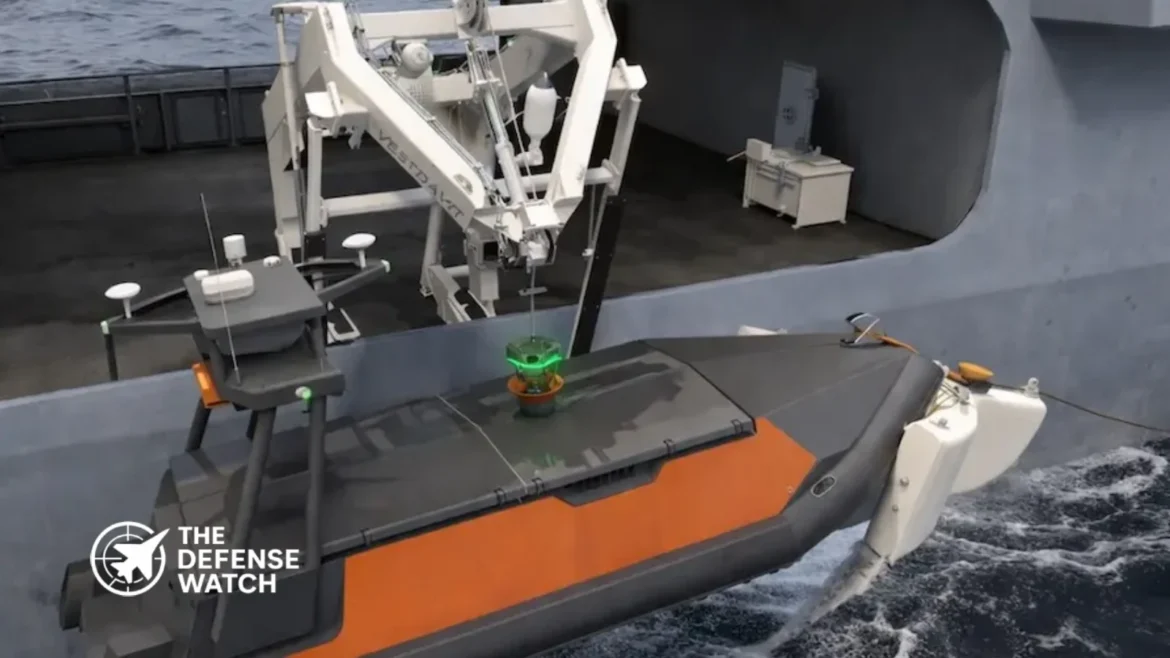
Naval davits are specialized launch and recovery systems used to move boats and other craft between a ship and the water. Their role can include launching and recovering rigid-hull inflatable boats, rescue craft, workboats and, increasingly, autonomous maritime systems.
The equipment is not a combat system in the conventional sense, but it directly affects a vessel’s ability to conduct missions that depend on small craft. These can include boarding operations, maritime security, search and rescue, logistics, inspection and other ship-to-water activities.
For autonomous vessels, the engineering challenge becomes broader. Launch and recovery equipment must accommodate different vehicle configurations while managing mechanical loads, sea motion, electrical systems, hydraulics and safe recovery procedures.
Vestdavit has more than four decades of experience in the sector and has delivered more than 2,200 davit systems to naval and offshore operators, according to FMD. Its portfolio includes dual-point lifting systems, automated boat-handling technology and launch and recovery systems designed for unmanned surface and undersea vessels.
Poland Becomes A Larger European Naval Production Hub
The location of the expansion is significant because Redzikowo gives FMD a manufacturing base inside the European defense industrial ecosystem.
FMD’s European network already includes the Polish manufacturing facility, Welin Lambie’s UK operation and service capabilities elsewhere in Europe. The company also acquired a naval handling facility in Peterborough, Ontario, in July 2026 as part of its wider effort to expand support for allied fleets.
The Poland investment therefore represents more than an increase in factory floor space. It strengthens FMD’s ability to manufacture, test and maintain naval handling equipment closer to many of its European customers.
That can be particularly relevant for equipment such as davits, where lifecycle support matters almost as much as initial production. Naval launch and recovery equipment operates in a demanding marine environment and requires periodic inspection, maintenance, component replacement and overhaul.
FMD said the Redzikowo expansion is intended to reduce delivery and support timelines by increasing regional manufacturing capacity and strengthening European supply chains.
NATO And European Naval Demand
FMD’s expansion comes as European navies continue to invest in fleet modernization and maritime readiness.
The company already supports customers across the NATO maritime community. Following the Vestdavit acquisition, FMD identified the U.S. Navy, Royal Navy and Canadian Coast Guard among the company’s customers, alongside European naval operators including France, Italy, Germany, the Netherlands, Belgium, Finland and Norway.
The broader FMD portfolio also has established U.S. naval applications. In 2023, Welin Lambie received a purchase order from Newport News Shipbuilding for four davits for the U.S. Navy’s Ford-class aircraft carriers CVN 80 and CVN 81, following earlier deliveries for CVN 78 and CVN 79.
In June 2026, the U.S. Navy also issued a presolicitation for engineering, maintenance, material, repair and overhaul services for Welin Lambie davit systems installed on several classes of U.S. Navy ships. The solicitation covered LHD, an LCS-2 variant, CVN 78 and LSD-class ships.
These examples illustrate why manufacturing capacity and lifecycle support are closely connected. A larger European production base can support new construction while also providing a regional source of components and technical services for existing fleets.
The Strategic Importance Of Regional Sustainment
The most important aspect of the Redzikowo project is not simply the 80% production increase. It is the attempt to build additional European capacity for equipment that sits within the broader naval support chain.
Naval readiness depends on more than the availability of major platforms such as frigates, destroyers and aircraft carriers. Smaller systems can also determine whether ships can conduct routine and specialized missions effectively.
Increasing production to as many as 150 davits per year gives FMD greater flexibility to support multiple programs at the same time. It also provides additional capacity for future requirements without requiring all manufacturing to be concentrated in a single location.
The planned expansion from 3,000 to 5,600 square meters is particularly relevant because it combines fabrication, machining, assembly and testing within a larger facility. That configuration can reduce production bottlenecks and make it easier to conduct quality-control activities before systems leave the plant.
The company also expects employment at the site to increase by approximately 30% over the next three years. FMD said recruitment will focus on welders, electricians, hydraulic technicians, assemblers and engineers, reflecting the specialized labor requirements of naval equipment manufacturing.
Implications For U.S. And Allied Naval Industrial Capacity
For the United States, the development is relevant because FMD supplies equipment used by U.S. naval and Coast Guard fleets while expanding its manufacturing footprint among allied countries.
FMD’s U.S. Coast Guard support contract for Welin Lambie davits, for example, provides for OEM parts, technical services, overhauls and new systems through an indefinite-delivery framework that could extend through 2030.
This creates a broader industrial model in which U.S. and European production sites support related naval requirements across allied fleets. Such arrangements can improve access to specialized manufacturing capacity while distributing production and sustainment capability across multiple locations.
The Redzikowo facility is therefore best understood as part of FMD’s larger naval industrial strategy rather than as an isolated factory expansion. The company has been adding marine propulsion, handling and shipboard equipment capabilities through acquisitions and internal investment, with the stated objective of supporting U.S. and allied fleet readiness.
What Comes Next
Construction at Redzikowo is scheduled to continue through 2027, with completion targeted for the fourth quarter. Once operational, the expanded facility is expected to produce up to 150 davits annually and support a broader range of maritime handling programs.
The key measure will be whether the additional production capacity translates into shorter manufacturing and support timelines for European and NATO customers. The facility’s combination of fabrication, machining, assembly and testing capacity will give FMD a larger industrial base from which to pursue both current contracts and future naval handling requirements.
For NATO fleets, the project adds another European manufacturing node for a specialized but operationally important class of naval equipment. For FMD, it represents a significant step in consolidating its davit businesses and expanding its position as a supplier to the allied maritime industrial base.