

Executive Summary
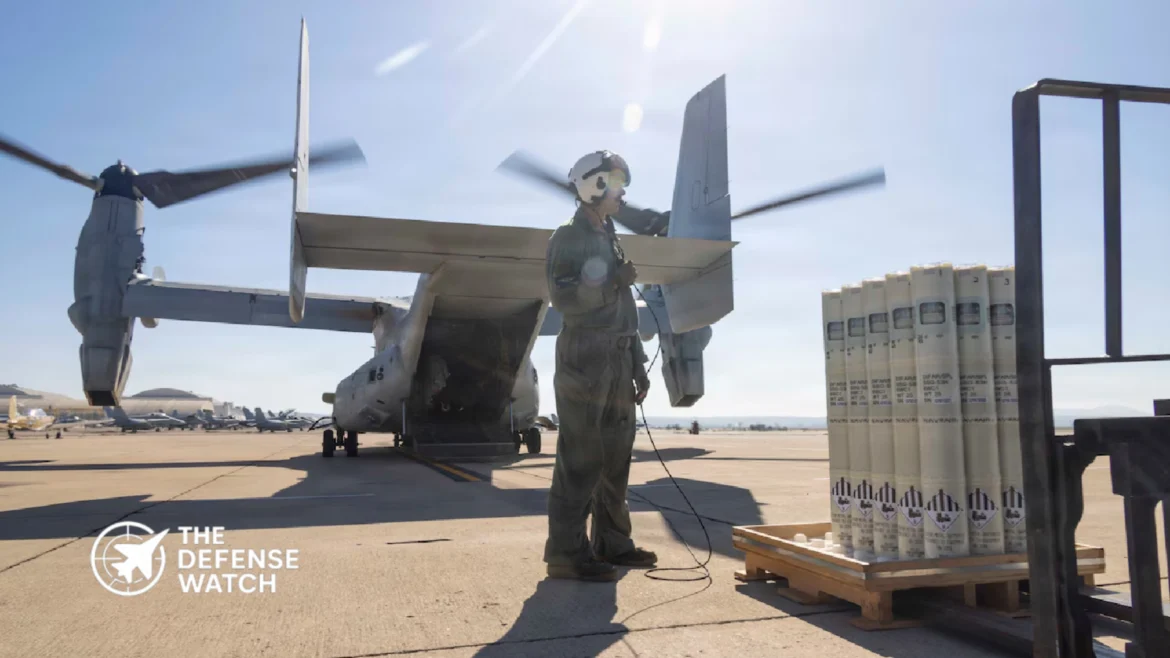
- A joint Navy and Marine Corps test team conducted the first lot acceptance test of sonobuoys launched from an MV-22B Osprey off San Clemente Island, California, on Aug. 19, 2026.
- The test validated the Osprey as an alternative aircraft for the Navy’s Sonobuoy Quality Assurance Program, which checks randomly selected production units for reliability and acoustic performance before fleet delivery.
- The result does not make the MV-22B a dedicated ASW aircraft. Instead, it expands the number of aircraft that can support sonobuoy testing and provides experience that could inform future tiltrotor support to maritime surveillance and ASW operations.
The U.S. Navy and Marine Corps have demonstrated that the MV-22B Osprey can launch sonobuoys for Navy acceptance testing, opening an alternative pathway for validating acoustic sensors before they reach operational units. The milestone took place off San Clemente Island, California, on Aug. 19 and involved the Air Anti-Submarine Warfare Systems Program Office, the V-22 Joint Program Office and Marine Operational Test and Evaluation Squadron 1.
The significance is primarily logistical and operational rather than a new weapons capability. The Navy’s sonobuoy quality assurance process depends on over-water testing of production samples, and the Osprey now provides another aircraft option when the traditional test platform is unavailable or constrained. That could reduce the risk of testing delays affecting the flow of mission-ready sonobuoys to fleet units.
Why the Osprey Was Tested for Sonobuoy Operations
Sonobuoys are expendable airborne acoustic sensors used to collect underwater sound associated with ships and submarines and transmit that information to remote processing systems. NAVAIR identifies several sonobuoy families, including the AN/SSQ-36, AN/SSQ-53, AN/SSQ-62, AN/SSQ-101 and AN/SSQ-125, supporting platforms such as the P-8A Poseidon and MH-60R.
The Navy’s quality assurance process is separate from routine operational ASW missions. Random production samples are dropped over water so their reliability and acoustic performance can be assessed before the wider inventory is delivered to operational squadrons.
Historically, the Navy used P-3C Orion aircraft assigned to Air Test and Evaluation Squadron 30, or VX-30, for these acceptance drops. The P-3 used automated launch equipment controlled from the aircraft, providing a substantially different deployment method from the Osprey’s manual approach.
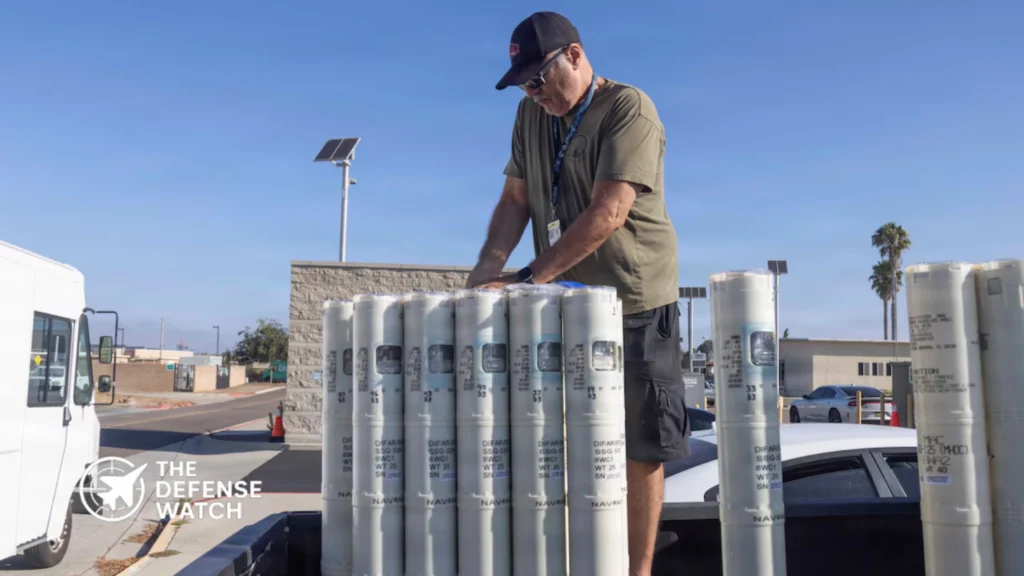
The Osprey therefore was not simply being tested as another aircraft that can carry a buoy. The evaluation addressed whether a tiltrotor with a different aircraft configuration, crew workflow and launch procedure could reliably perform the specific testing task.
Manual Launching Changes the Test Method
The biggest technical difference was the launch process.
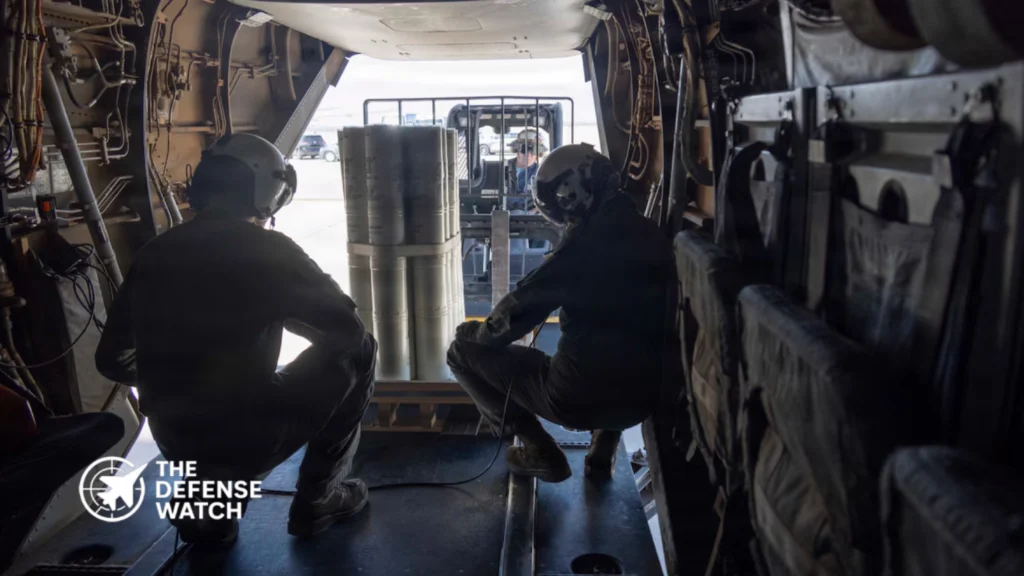
The MV-22B does not use the same automated sonobuoy launch arrangement described for the legacy P-3C test aircraft. Instead, crew chiefs operated from the open rear cargo ramp, removing container caps and inverting launch tubes so the buoys could enter the aircraft’s slipstream.
That approach introduces a different timing problem. Manual deployment takes longer between individual releases than an automated launcher, so the VMX-1 aircrew reduced aircraft speed to achieve the required spacing and pattern for acoustic testing.
The procedure required the pilot to maintain stable flight parameters while the copilot handled navigation, timing and communications. Crew chiefs then had to coordinate the programming and release of each buoy from the cargo compartment.
This is an important distinction for future tactical employment. The test demonstrated a workable launch procedure, but it did not establish that the MV-22B can reproduce the complete sensor employment model of a P-8A or MH-60R.
Key Test Differences
| Area | Legacy P-3C test method | MV-22B test method |
|---|---|---|
| Aircraft type | Fixed-wing maritime patrol aircraft | Tiltrotor |
| Sonobuoy launch | Automated launch containers | Manual launch from rear cargo ramp |
| Crew involvement | Automated release controlled from cockpit | Pilot, copilot and crew chiefs coordinate release |
| Test adjustment | Automated spacing | Reduced airspeed to compensate for manual release intervals |
| Primary purpose | Sonobuoy quality assurance | Alternative quality assurance platform |
| Broader significance | Established testing method | Adds redundancy and joint-force flexibility |
The Navy has not publicly disclosed specific acoustic performance results from the Aug. 19 test. The available information confirms that the mission met its test criteria, while the Air Anti-Submarine Warfare Systems Program Office and V-22 Joint Program Office will analyze acoustic and deployment data to refine procedures.
This Is Not Yet an Osprey ASW Conversion
The test should not be interpreted as an announcement that the Marine Corps is converting the MV-22B into a dedicated anti-submarine warfare aircraft.
The aircraft’s established Marine Corps mission remains the transport of troops, equipment and supplies from ships and land bases for combat assault and assault support. NAVAIR describes the MV-22B as a medium-lift tiltrotor designed to replace the CH-46E Sea Knight.
By contrast, the Navy’s dedicated airborne ASW architecture includes the P-8A and MH-60R, supported by specialized acoustic sensors, processing and mission systems. NAVAIR describes the P-8A and MH-60R as current platforms for its sonobuoy families.
The Osprey’s value in this test is therefore different. Its contribution is the ability to provide another aircraft capable of deploying the expendable sensors, particularly when the Navy needs additional flexibility in its test and support infrastructure.
That distinction matters because sonobuoy deployment is only one element of ASW. Detecting, classifying and tracking a submarine requires acoustic processing, tactical mission systems, communications, intelligence and trained operators in addition to physically placing sensors in the water.
A Broader Move Toward Distributed ASW Support
The Osprey test follows an earlier Navy effort to expand sonobuoy deployment beyond conventional maritime patrol aircraft.
In 2024, NAVAIR reported successful hand-launched sonobuoy deployments from a CH-53E Super Stallion. The service said the work expanded the heavy-lift helicopter’s flexibility for supporting ASW in the joint environment, with similar testing planned for the CH-53K King Stallion.
That development provides useful context for the MV-22B evaluation. Rather than treating sonobuoys as equipment that can only be deployed from traditional ASW aircraft, the Navy and Marine Corps are testing whether other aviation assets can safely and reliably place the sensors into the maritime environment.
The potential benefit is resilience.
A distributed force may have more aircraft available for supporting individual ASW-related tasks than a force that depends exclusively on a small number of specialized platforms. However, that does not mean every aircraft becomes an ASW platform. Instead, different aircraft can contribute to selected parts of the larger sensor and surveillance architecture.
For the Navy, that distinction could become increasingly relevant as undersea warfare places greater demands on maritime surveillance and sensor availability.
Supply Chain Resilience May Be the Immediate Payoff
The most concrete benefit of the Osprey test is not tactical submarine hunting. It is supply-chain resilience.
The Navy’s sonobuoy quality assurance process must verify production samples before inventory can move into operational use. If the aircraft normally used for those tests becomes unavailable or faces scheduling constraints, the testing pipeline can become a potential bottleneck.
Adding the MV-22B gives the program another aviation option.
That matters because the Navy’s airborne ASW inventory depends on large numbers of expendable acoustic sensors. NAVAIR has also previously highlighted efforts to maintain and expand the domestic sonobuoy industrial base, including competitive production arrangements intended to support continuity of supply.
The Osprey initiative therefore fits into a broader acquisition and sustainment problem: producing sensors is only part of the requirement. Those sensors also need to be tested, accepted and delivered without creating avoidable delays between manufacturers and operational squadrons.
Where the Osprey Fits Against Existing ASW Aircraft
The MV-22B should be viewed as complementary rather than competitive with the Navy’s dedicated ASW aircraft.
| Platform | Primary ASW relevance | Sonobuoy role | Key distinction |
|---|---|---|---|
| P-8A Poseidon | Dedicated maritime patrol and ASW | Operational ASW sensor employment | Specialized fixed-wing ASW platform |
| MH-60R Seahawk | Ship-based ASW and surface warfare | Operational sonobuoy employment | Rotary-wing platform closely integrated with surface combatants |
| MV-22B Osprey | Tested support role | Quality assurance and potential future support | Tiltrotor flexibility, manual deployment |
| CH-53E/CH-53K | Heavy-lift support | Hand-launched sonobuoy testing demonstrated for CH-53E | Large payload and joint support role |
NAVAIR identifies the P-8A and MH-60R among the platforms currently supporting the Navy’s sonobuoy systems. The MV-22B and CH-53 family developments represent a different concept, using aircraft already present in the joint force for additional mission-support functions.
This approach also avoids the cost and complexity of creating a completely new specialized aircraft simply to provide additional test capacity. The available sources do not provide a program cost comparison, so claims of specific financial savings from the MV-22B test would be premature.
Tactical Potential Remains a Future Question
The Navy and Marine Corps explicitly said the test provides experience that will help VMX-1 refine tactics, techniques and procedures for future tiltrotor ASW support. The two program offices will use acoustic and deployment data to refine procedures for future quality assurance missions and joint fleet operations.
That wording is important.
The demonstration establishes a foundation for additional work, not a fully operational MV-22B ASW capability. Future evaluations would need to address issues beyond the physical release of sonobuoys, including repeatability, aircraft and crew workload, sensor spacing, communications, mission coordination and integration with wider ASW networks.
The Osprey’s ability to operate from ships and austere locations could make it useful for distributed maritime operations, but the available test information does not establish specific operational range, search-area coverage or submarine detection performance for an MV-22B sonobuoy mission. Those figures should therefore not be inferred from the aircraft’s published transport specifications.
What the Test Means for the Fleet
The Aug. 19 demonstration is best understood as a capability-enabling test rather than a new frontline ASW system.
Its immediate effect is to give the Navy another aircraft option for sonobuoy quality assurance. That can reduce dependence on a single legacy testing method and provide additional flexibility when aircraft availability, scheduling or geographic constraints affect the normal testing process.
Its longer-term importance is the possibility of using Marine Corps aviation assets to support selected maritime sensing tasks. The previous CH-53E sonobuoy work and the new MV-22B test show that Navy and Marine Corps aviation organizations are examining how existing aircraft can contribute to the wider undersea warfare enterprise without turning them into dedicated patrol aircraft.
For a fleet preparing for increasingly distributed maritime operations, that kind of flexibility can matter at the margins. But the operational value of the Osprey in ASW will ultimately depend on follow-on testing and how effectively its sensor deployment capability can be integrated with the Navy’s established acoustic processing and ASW command architecture.
The current evidence supports a narrower conclusion: the MV-22B has demonstrated that it can serve as an alternative platform for Navy sonobuoy quality assurance, while further work will determine how far that capability can be extended into future joint maritime operations.