

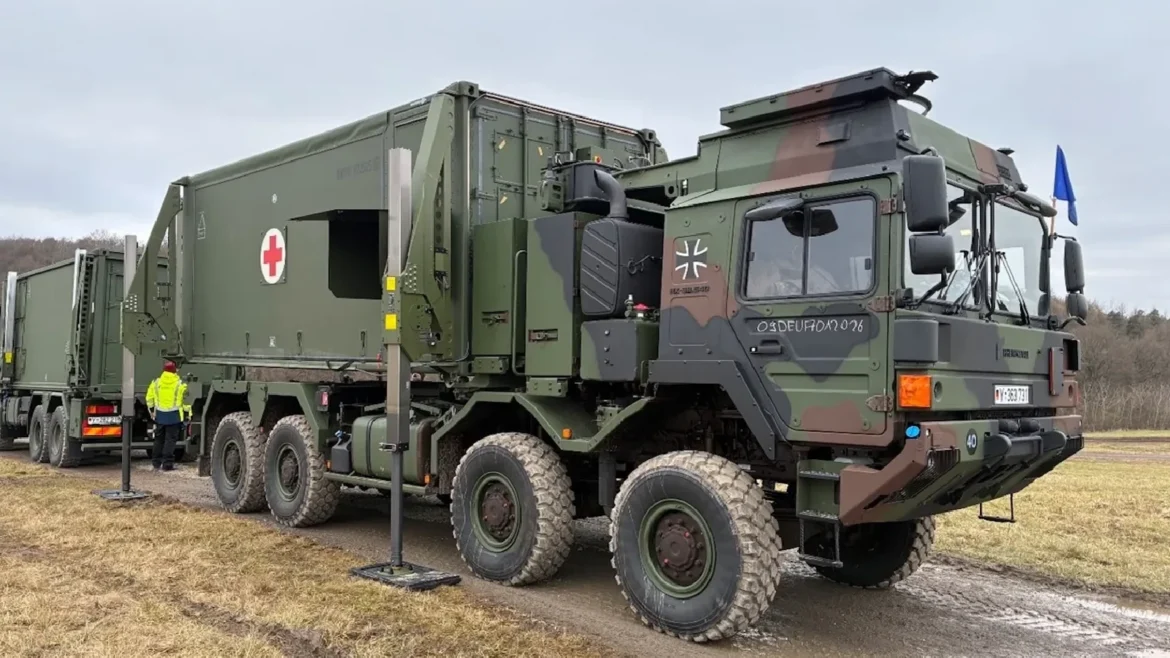
Rheinmetall Project Solutions GmbH has received a Bundeswehr order for 149 additional mobile rescue stations worth more than €500 million gross, expanding Germany’s planned fleet of rapidly deployable battlefield medical facilities. The procurement was authorized by the Federal Office of Bundeswehr Equipment, Information Technology and In-Service Support, known as BAAINBw, with the German Bundestag’s Budget Committee approving the framework-contract call-off on July 8, 2026.
BAAINBw formally commissioned Rheinmetall Project Solutions on July 13. The systems form part of the Bundeswehr’s Modular Medical Facilities, or MSE, program and provide NATO Role 1 medical care. Rheinmetall said production is scheduled to begin in the first quarter of 2027, while the Bundeswehr plans to replace its existing rescue stations by the end of 2029.
Takeaways
Rheinmetall’s major Bundeswehr medical support order
1. €500+ Million Procurement
Rheinmetall Project Solutions has received a Bundeswehr order worth more than €500 million for 149 additional mobile rescue stations.
2. 149 Mobile Medical Stations
The systems are designed to provide NATO Role 1 medical care, including emergency treatment, stabilization and preparation of wounded personnel for evacuation.
3. 112 Protected Configurations
The order includes 112 ballistically protected stations and 37 unprotected systems, reflecting the growing need for survivable medical support near combat zones.
4. Production Starts in 2027
Rheinmetall plans to begin production in the first quarter of 2027, with the Bundeswehr targeting replacement of its existing rescue stations by the end of 2029.
5. Supports High-Intensity Warfare
The mobile, containerized design allows medical facilities to be deployed, dismantled and relocated, helping German forces maintain medical support in a battlefield shaped by drones, long-range fires and persistent surveillance.
Why Germany Is Expanding Mobile Battlefield Medical Capacity
The procurement addresses a basic but increasingly important requirement in high-intensity warfare: medical units must remain close enough to combat forces to provide rapid stabilization while being mobile enough to relocate when the tactical situation changes.
The new stations represent NATO Role 1 care. This is the first formal medical treatment level after self-aid and buddy-aid. Its primary tasks include maintaining vital functions, emergency treatment, stabilization and preparation for evacuation to higher levels of medical care. The Bundeswehr also states that limited emergency surgical procedures can be performed at the stations.
This distinction matters because the systems are not intended to replace larger Role 2 or Role 3 medical facilities. Instead, they form the forward end of the medical evacuation chain. In a major NATO land operation, that forward layer can determine how quickly casualties are stabilized before movement to more capable surgical facilities.
The design also reflects lessons from Ukraine. Rheinmetall describes the stations as highly mobile, while the Bundeswehr says they can be transported, assembled, operated, dismantled and moved with their personnel in a short period. This allows medical support to follow maneuver units rather than remaining tied to a fixed location.
Each station consists of two containers, a connecting element and its transportation component. Rheinmetall’s earlier description of the system identifies independent generators and air-conditioning equipment for the container modules, while medical equipment is mounted on standardized Airliner rails to support changes to the internal configuration.
The architecture provides an important degree of redundancy. Rheinmetall has previously stated that each container has its own generator, meaning a failure of one power unit does not necessarily make the complete facility unusable. The stations can also operate with the containers together or independently for several days.
Contract Breakdown & Financial Allocation
Procurement Scope
- Contractor: Rheinmetall Project Solutions GmbH
- Contracting authority: BAAINBw
- Quantity: 149 additional mobile rescue stations
- Reported value: More than €500 million gross
- Program: Bundeswehr Modular Medical Facilities, or MSE
- Medical level: NATO Role 1
- Production start: First quarter of 2027
- Fleet replacement target: End of 2029
- Framework contract: Established in 2024
- Previous fixed order: 16 stations
- Total planned fleet after this call-off: 165 stations, according to Rheinmetall’s reporting
Protected Versus Unprotected Systems
The July 2026 call-off includes both protected and unprotected configurations.
- Ballistically protected: 112 systems
- Unprotected: 37 systems
- Protected share: Approximately 75.2 percent
- Unprotected share: Approximately 24.8 percent
The protected systems are designed to provide resistance against small-arms fire and fragmentation, according to the Bundeswehr. The relatively large protected component indicates that survivability is a central requirement for forward medical support rather than an optional enhancement.
The reported contract value translates to an average of more than approximately €3.36 million per newly ordered station if the entire value were divided evenly across 149 systems. That calculation should not be treated as a unit price because the procurement contains different configurations and associated equipment, and the official announcement does not publish a detailed cost breakdown.
Schedule and Geographic Allocation
The available official procurement information does not provide a percentage breakdown of manufacturing or workshare by German state, Rheinmetall facility, subcontractor or other geographic location. It also does not identify individual station deployment locations.
The confirmed schedule is:
- July 2026: BAAINBw authorizes the 149-system call-off.
- First quarter 2027: Production scheduled to begin.
- Through 2029: Existing Bundeswehr rescue stations are progressively replaced.
- End of 2029: Replacement program scheduled to be completed.
There is also no foreign military sales component identified in the official announcement. This is a German domestic Bundeswehr procurement rather than an FMS-funded acquisition.
Industry Impact & Acquisition Insight
The procurement is structured as a call-off from a framework contract, rather than a completely new competition for each batch. In practical terms, the framework establishes the contractual basis for ordering additional systems when Germany has funding and requirements approved. The July order therefore converts an existing procurement pathway into a major production commitment without requiring the Bundeswehr to restart the entire acquisition process. The Budget Committee approval on July 8 was the key parliamentary funding milestone for this call-off.
The acquisition also strengthens Rheinmetall’s position in Germany’s military medical logistics market. Rheinmetall Project Solutions and Rheinmetall Mobile Systeme have already developed related mobile medical capabilities for Germany and foreign customers. In October 2025, Rheinmetall received a separate contract worth more than €300 million for six highly mobile protected NATO Role 2B medical facilities intended, among other uses, for Germany’s brigade in Lithuania.
That distinction is important. The 149 rescue stations are Role 1 systems intended for immediate forward care, while the later Role 2B program provides a substantially more capable medical layer closer to the front. Together, the procurements show Germany building a layered medical support architecture rather than relying on a single class of field hospital.
The procurement also illustrates how battlefield survivability is increasingly shaping military logistics. Medical units traditionally depend on predictable rear-area infrastructure, but long-range fires, drones and persistent surveillance make fixed facilities more vulnerable. Containerized systems that can be moved rapidly reduce the time a medical site remains exposed and allow commanders to reposition support as the tactical situation changes.