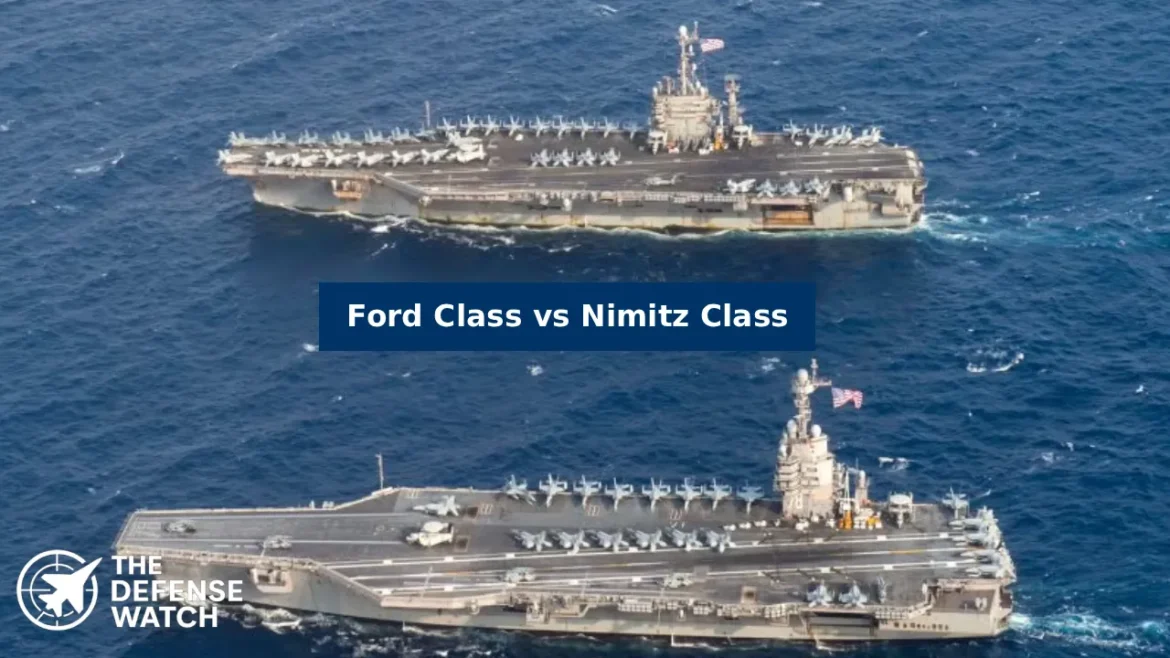
U.S. Navy’s Carrier Evolution: Ford Class vs Nimitz Class
The U.S. Navy plans to eventually acquire ten Ford-class carriers to replace current carriers on a one-for-one basis, starting with USS Gerald R. Ford replacing USS Enterprise, and later replacing the Nimitz-class carriers. This transition represents the most significant technological leap in American carrier design since the Nimitz class entered service in 1975.
Understanding the differences between Ford class vs Nimitz class carriers is essential for assessing the future direction of U.S. naval power projection. While both classes displace approximately 100,000 tons and serve as the centerpiece of carrier strike groups, the Ford class incorporates revolutionary technologies designed to enhance operational efficiency, reduce lifecycle costs, and accommodate future weapons systems.
Launch and Recovery Systems: Steam vs Electromagnetic
The most visible operational difference between the two carrier classes involves how they launch and recover aircraft.
The Nimitz uses a steam-powered catapult system, while the Ford features the more efficient Electromagnetic Aircraft Launch System (EMALS). Traditional steam catapults have served reliably for decades, generating and harnessing steam to slingshot aircraft forward. However, this system requires extensive infrastructure to generate and store steam throughout the ship.
The EMALS accelerates aircraft more smoothly, putting less stress on their airframes. The EMALS also weighs less, is expected to cost less and require less maintenance, and can launch both heavier and lighter aircraft than a steam piston-driven system. This flexibility proves crucial as the Navy integrates new aircraft types, including heavier strike fighters and lighter unmanned aerial vehicles, into carrier air wings.
For aircraft recovery, the Nimitz employs the MK 7 Aircraft Recovery System, whereas the Ford uses the Advanced Arresting Gear system, designed to handle a wider range of aircraft with less maintenance. The AAG system uses advanced control algorithms and energy-absorbing water turbines to safely arrest aircraft while reducing maintenance requirements compared to the hydropneumatic MK 7 system.

Power Generation: Meeting Future Energy Demands
Nuclear propulsion distinguishes both carrier classes from conventional vessels, but their reactor designs differ substantially.
The new Bechtel A1B reactor for the Gerald R. Ford class is smaller and simpler, requires fewer crew, and yet is far more powerful than the Nimitz-class A4W reactor. Two reactors will be installed on each Gerald R. Ford-class carrier, providing a power generation capacity at least 25% greater than the 550 MW of the two A4W reactors in a Nimitz-class carrier.
Even more significant, the Navy outlined a requirement for a minimum increase of 150% in the power-generation capacity for the CVN 21 carrier compared with the Nimitz-class carriers. This dramatic increase in electrical generation capacity addresses limitations that constrained the Nimitz class. As new technologies were added over decades, the Nimitz design’s electrical capacity became increasingly strained, leaving little margin for emerging systems.
The Ford class dedicates only half its electrical generation capacity to currently installed systems, reserving substantial capacity for future directed-energy weapons, advanced sensors, and other power-intensive technologies that may emerge during the carrier’s 50-year service life.
Manning and Automation: Doing More With Less
Personnel costs represent a significant portion of carrier operating expenses, making crew size reduction a key design objective for the Ford class.
Whereas the Nimitz-class carrier has around 6,000 people serving onboard, the Ford class has just over 4,000. Automation makes this possible, reducing the risk to human life in combat situations. More specifically, the Ford-class is larger than its predecessor, the Nimitz-class, but accommodates between 500 and 900 fewer crew members.
This reduction stems from extensive automation throughout the ship. Systems that reduce crew workload have allowed the ship’s company on Gerald R. Ford-class carriers to total only 2,600 sailors, about 700 fewer than a Nimitz-class carrier. The embarked air wing also operates with fewer personnel due to improved aircraft maintenance systems and more efficient ordnance handling.
The automation extends to weapons movement, which previously required extensive manual labor. The movement of weapons from storage and assembly to the aircraft on the flight deck has also been streamlined and accelerated. Ordnance will be lifted to the centralized rearming location via higher-capacity weapons elevators that use linear motors.These electromagnetic elevators can move ordnance without crossing aircraft movement areas, reducing traffic congestion and accelerating rearming operations.
Sortie Generation Rate: Operational Tempo
An aircraft carrier’s value depends on its ability to generate sustained air operations. The Ford class was specifically designed to increase sortie rates compared to its predecessor.
The ship’s systems and configuration are optimized to maximize the sortie generation rate of attached strike aircraft, resulting in a 33 percent increase in SGR over the Nimitz class. While the Nimitz class can sustain 120 sorties per day with surge capability to 240, the Ford-class carriers are intended to sustain 160 sorties per day for 30-plus days, with a surge capability of 270 sorties per day.
This enhanced operational tempo results from multiple design improvements working in concert: the faster EMALS launch system, improved weapons elevators, better flight deck layout with a repositioned island, and more efficient aircraft maintenance procedures.
Physical Configuration and Design
While both classes share similar overall dimensions, the Ford class incorporates significant structural changes.
On the Ford class, the island’s footprint was substantially shrunk and it was moved back by 140 feet on the ship to provide for more deck space overall and to create a deck layout that is supposed to enhance operational tempo substantially The War Zone. The smaller, relocated island creates additional space for aircraft operations and simplifies flight deck traffic flow.
The Ford class has just three aircraft elevators instead of four, but their placement and larger size are supposed to actually enhance operations, not hinder them. By eliminating one elevator and repositioning the remaining three, designers created a more efficient layout that reduces conflicts between aircraft movements on the flight deck.
The island itself reflects technological evolution. Its island, shorter in length and 20 feet taller than that of the Nimitz class, is set 140 feet farther aft and 3 feet closer to the edge of the ship. This unique shape accommodates advanced radar arrays, with the lead ship USS Gerald R. Ford equipped with the Dual Band Radar system featuring six separate AESA arrays providing 360-degree coverage.
Cost Analysis: Initial Investment vs Lifecycle Expenses
The Ford class carries a substantially higher initial procurement cost than the Nimitz class.
The USS Gerald R. Ford is the most expensive warship ever built, with a price tag of $13.3 billion. This compares to the Nimitz-class unit cost of about $8.5 billion in FY 2012 dollars, equal to $11.4 billion in 2024 dollars for newer ships in the class.
However, Navy officials project significant lifecycle cost savings. Each ship in the new class will save more than $4 billion in total ownership costs during its 50-year service life, compared to the Nimitz-class. More recent analysis suggests even greater savings, with the Ford class now slated to cost about $5 billion per ship less than its predecessor, the Nimitz class, over the life of each ship.
These savings derive primarily from reduced crew size and lower maintenance requirements. U.S. aircraft carriers cost over a billion dollars a year to maintain, not including the cost of operating the embarked air wing. The Ford class’s automation and improved systems design should reduce these annual expenses substantially.
Maintenance cycles also differ between classes. The Nimitz class requires five major docked maintenance availabilities during its service life, while the Ford class was designed to require only three such availabilities, further reducing downtime and costs.
Radar and Sensor Systems
Both classes employ advanced radar systems, though specific configurations differ.
The Nimitz class uses a combination of rotating 2D and 3D radar systems, including the SPS-48E 3D air search radar and SPS-49 2D radar. These proven systems provide effective air search and tracking capabilities but require significant space and maintenance.
The lead Ford-class ship introduced the Dual Band Radar combining X-band multifunction radar and S-band volume search radar in a single integrated system with six planar AESA arrays. However, developmental challenges led the Navy to modify its approach for subsequent ships. Starting with USS John F. Kennedy (CVN-79), the Navy will install the Enterprise Air Surveillance Radar (EASR), which uses three arrays and offers greater commonality with other surface combatants.
Defensive Armament
Both carrier classes rely on similar defensive weapons systems, as their primary defense comes from escort vessels in the carrier strike group.
Short-range defensive systems include the Rolling Airframe Missile (RAM) system and Evolved Sea Sparrow Missile (ESSM) for engaging incoming anti-ship missiles. The Close-In Weapon System (CIWS), featuring the Phalanx 20mm gatling gun, provides last-ditch defense against missiles that penetrate outer defensive layers.
The Ford class features updated versions of these systems integrated with more advanced fire control and the Ship Self-Defense System for coordinated defensive responses. However, the basic defensive philosophy remains unchanged—carriers depend heavily on escort vessels equipped with long-range air defense systems like the Aegis Combat System to provide the primary defensive umbrella.
Operational Service and Fleet Status
The Nimitz-class has participated in many conflicts and operations across the world, including Operation Eagle Claw in Iran, the Gulf War, and more recently in Iraq and Afghanistan. With ten ships in service spanning construction from 1968 to 2009, the class represents decades of operational experience and continuous incremental improvements.
The Ford class remains in its early operational phase. USS Gerald R. Ford (CVN-78) commissioned in July 2017 and completed its first deployment in 2023-2024, including operations in the Eastern Mediterranean during the Israel-Hamas conflict. During the 239 days underway, the carrier logged more than 17,826 flight hours and 10,396 sorties, sailed more than 83,476 nautical miles, and safely transferred 20.7 million gallons of fuel with zero mishaps.
USS John F. Kennedy (CVN-79) is more than 90% complete and expected to deliver in 2025. USS Enterprise (CVN-80) is approximately 35% complete, while USS Doris Miller (CVN-81) is in early construction stages. The Navy is planning to procure CVN-82 and CVN-83 in a two-ship contract later this decade.
Analysis: Evolutionary vs Revolutionary Change
The transition from Nimitz to Ford class represents evolutionary refinement rather than revolutionary redesign in basic carrier operations, but introduces revolutionary changes in specific technological systems.
The fundamental carrier mission remains unchanged—projecting naval aviation power globally through a nuclear-powered mobile airfield. Both classes share similar displacement, speed, and overall operational concepts. The Ford class retains the proven CATOBAR (Catapult Assisted Take-Off But Arrested Recovery) arrangement that distinguishes U.S. supercarriers from smaller STOVL carriers operated by other nations.
However, the accumulation of technological improvements creates qualitatively different capabilities. The combination of EMALS, advanced arresting gear, electromagnetic weapons elevators, tripled electrical generation capacity, and 25% increased sortie generation rate fundamentally enhances operational effectiveness. These improvements should prove increasingly valuable as the Navy integrates new aircraft types, particularly unmanned systems and potentially sixth-generation manned fighters, into carrier air wings over coming decades.
The crew reduction represents perhaps the most significant long-term advantage. With personnel costs comprising a major portion of operating expenses, reducing crew size by 500-900 personnel generates substantial savings. This reduction also makes the ships less labor-intensive to operate during an era when recruiting and retention challenges affect all military services.
Critics note that the Ford class remains vulnerable to the same anti-access/area-denial threats confronting all large surface combatants—anti-ship ballistic missiles, advanced submarines, and saturation attacks by cruise missiles or unmanned systems. However, proponents argue that properly defended carrier strike groups remain highly survivable and uniquely capable of sustained, high-tempo combat operations that no alternative platform can match.
The substantial initial cost difference—approximately $2 billion more than late Nimitz-class ships—raises questions about affordability, particularly given Navy budget constraints and competing priorities. However, if projected lifecycle savings materialize, the Ford class should prove more cost-effective over its 50-year service life despite higher procurement costs.
Ultimately, the Ford class represents the Navy’s commitment to maintaining carrier-centric naval power projection well into the 21st century, incorporating technologies to enhance effectiveness while reducing operating costs. Whether this strategy proves correct depends on how naval warfare evolves over coming decades and whether alternative platforms like submarines, unmanned systems, or distributed surface combatants can replicate carriers’ unique combination of striking power, persistence, and diplomatic presence.
FAQs: Ford Class vs Nimitz Class Carriers
What is the main technological difference between Ford class and Nimitz class carriers?The primary difference involves launch and recovery systems. Ford-class carriers use electromagnetic catapults (EMALS) instead of steam catapults, and Advanced Arresting Gear instead of the hydraulic MK 7 system. These electromagnetic systems reduce stress on aircraft, require less maintenance, and can handle a wider range of aircraft weights.
How many fewer crew members does the Ford class require compared to Nimitz class?Ford-class carriers operate with 500 to 900 fewer personnel than Nimitz-class ships. Where Nimitz-class carriers have approximately 6,000 crew members (including ship’s company and air wing), Ford-class carriers operate with approximately 4,500 personnel due to extensive automation.
Are Ford class carriers more expensive than Nimitz class carriers?Initially, yes—USS Gerald R. Ford cost $13.3 billion compared to approximately $11.4 billion for recent Nimitz-class ships. However, each Ford-class carrier is projected to save $4-5 billion in lifecycle costs over its 50-year service life through reduced crew size and lower maintenance requirements.
Can Ford class carriers launch more aircraft sorties than Nimitz class?Yes. Ford-class carriers can sustain 160 sorties per day with surge capability to 270 sorties, representing approximately a 33% increase compared to Nimitz-class carriers, which sustain 120 sorties daily with surge capability to 240 sorties.
How much more electrical power does the Ford class generate?Ford-class carriers generate at least 25% more total power than Nimitz-class ships, with approximately 150% more power dedicated to electrical generation. This increased capacity supports current systems while reserving substantial power for future directed-energy weapons and advanced sensors.


U.S. Navy Aircraft Carriers Dominate Global Sea Power in 2025
The U.S. Navy maintains a fleet of 11 aircraft carriers in 2025, fulfilling its statutory requirement under the National Defense Authorization Act. These nuclear-powered supercarriers represent the most potent projection of American military power, capable of deploying air wings that rival entire nations’ air forces. As the service transitions from the venerable Nimitz class to the technologically advanced Gerald R. Ford class, u.s. navy aircraft carriers 2025 remain the cornerstone of maritime dominance in an increasingly contested global environment.
As of November 2025, carrier strike groups are deployed globally, with USS Gerald R. Ford operating in the Caribbean Sea, USS George Washington underway in the Philippine Sea, and USS Nimitz conducting operations in the South China Sea. This forward presence demonstrates the Navy’s ability to respond rapidly to crises while maintaining deterrent posture in critical regions.
The Ford-Class Revolution: Next-Generation Carrier Technology
The Fiscal Year 2025 Budget Request allocates continued funding for three Gerald R. Ford-class carriers: USS John F. Kennedy (CVN-79), USS Enterprise (CVN-80), and USS Doris Miller (CVN-81). These vessels incorporate technologies that fundamentally transform carrier operations.
Electromagnetic Launch and Recovery Systems
The Ford class features the Electromagnetic Aircraft Launch System (EMALS), which replaces traditional steam catapults with electromagnetic induction to smoothly accelerate aircraft during takeoff. This innovation reduces stress on airframes while enabling the launch of a broader range of aircraft weights, from lightweight unmanned aerial vehicles to heavy strike fighters.
The Advanced Arresting Gear (AAG) uses digital controls for more precise braking and energy absorption during aircraft recovery. Together, EMALS and AAG increase sortie generation rates by approximately 30 percent compared to Nimitz-class carriers, dramatically enhancing combat tempo.
Enhanced Power Generation and Automation
Ford-class carriers employ an all-electric power system, eliminating steam service lines used on previous Nimitz-class carriers. The new Bechtel A1B reactor generates at least 25 percent greater power capacity than Nimitz-class A4W reactors, with electrical generation capacity tripled.
Despite being massive warships, Ford-class carriers operate with approximately 2,600 sailors—nearly 700 fewer than Nimitz-class vessels—made possible by automation technologies handling munitions transport, aircraft handling, and maintenance tracking. This reduced crew requirement translates to lower operational costs and improved quality of life for personnel.
Advanced Sensors and Combat Systems
The Dual Band Radar (DBR) system provides comprehensive detection and tracking capabilities, significantly improving radar performance in hostile and contested environments. The DBR integrates S-band Multi-Function Radar and X-band Volume Search Radar into a single cohesive unit, enabling simultaneous tracking of multiple targets while providing enhanced situational awareness.
Current Fleet Status and Deployments
USS Gerald R. Ford (CVN-78): The Flagship
USS Gerald R. Ford, commissioned in July 2017, replaced the aging USS Enterprise (CVN-65) and is now an active part of the fleet with enhanced power projection capabilities. The Ford carries twin-engine F/A-18E/F Super Hornets with a maximum combat range of 1,250 miles, along with electronic-jamming aircraft, airborne early warning and control planes, cargo and passenger planes, and helicopters.
In November 2025, the USS Gerald R. Ford Carrier Strike Group entered the Caribbean Sea, with 4,000 sailors and dozens of military aircraft aboard the lead ship, as part of Operation Southern Spear. The strike group includes nine carrier air wing squadrons, two Arleigh Burke-class guided-missile destroyers, and an integrated air and missile defense command ship.
Nimitz-Class: Enduring Workhorses
USS George Washington (CVN-73) operates as the forward-deployed carrier in Yokosuka, Japan, while USS Nimitz (CVN-68) conducts operations in the South China Sea. The Nimitz class continues to shoulder the burden of global presence operations while Ford-class vessels complete their transition to full operational capability.
The USS Nimitz, commissioned in 1975, is scheduled for deactivation in May 2026, marking the beginning of the Nimitz-class retirement process. However, the USS Dwight D. Eisenhower (CVN-69), originally scheduled to retire in 2026, will remain in service until 2030 due to delays in Ford-class construction.
The Transition Challenge: Managing Fleet Size During Modernization
The Navy faces a delicate balancing act maintaining its 11-carrier force requirement while retiring aging Nimitz-class vessels and introducing Ford-class replacements. USS John F. Kennedy (CVN-79), initially scheduled for commissioning in 2025, is now expected to enter service in 2027. USS Enterprise (CVN-80) is under construction with a scheduled launch in 2025 and commissioning in 2029, while USS Doris Miller (CVN-81) is slated for construction in 2026 with projected delivery in 2032.
In January 2025, the Navy announced that two additional Ford-class carriers will be named USS William J. Clinton (CVN-82) and USS George W. Bush (CVN-83). The service ultimately plans to acquire 10 Ford-class carriers to completely replace the Nimitz class on a one-for-one basis.
Budget Realities and Construction Economics
According to Congressional Budget Office estimates, the Navy’s 2025 shipbuilding plan would cost an average of $40.1 billion per year over the 2025-2054 period—46 percent more than the average annual funding received over the past five years. This funding gap presents significant challenges for maintaining the carrier fleet at required strength levels.
The dual-carrier procurement contract for CVN-80 and CVN-81, awarded in FY 2019, is expected to yield approximately $4.0 billion in savings through economies of scale achieved by constructing both ships under a single contract. Navy officials have indicated that buying the fifth and sixth Ford-class carriers together could shave billions compared to serial purchases.
Operational Demands and Strategic Competition
Carrier strike group deployments have been extended multiple times over the past three years, initially for deterrence patrols in the Mediterranean Sea, then for operations in U.S. Central Command following Hamas attacks in southern Israel and Houthi attacks in the Red Sea. This persistent demand underscores the enduring relevance of aircraft carriers in modern conflict.
The Navy has only 11 aircraft carriers, and in general, only three are at sea at any one time because of the need for maintenance and training. Regional combatant commanders consistently request carrier presence, with U.S. Indo-Pacific Command requiring coverage to counter China’s growing naval capabilities, Central Command needing support for operations against Iran and the Houthis, and European Command seeking deterrence against Russia.
The China Factor
China has been rapidly expanding and modernizing its naval capabilities, with the People’s Liberation Army Navy now operating the Liaoning and Shandong carriers, while a third, Fujian, has recently been launched. China’s Fujian carrier has advanced to choreographed deck movement and catapult launches, though the U.S. maintains advantages in carrier aviation culture, magazines afloat and ashore, and allied intelligence-surveillance-reconnaissance infrastructure.
The U.S. response centers on continued investment in Ford-class carriers, which provide superior operational capabilities through technologies like EMALS and AAG, enhanced sortie generation rates, and increased power projection that allows the Navy to maintain maritime dominance in contested regions.
Air Wing Composition and Future Integration
Ford-class carriers can accommodate more than 75 aircraft, including F/A-18E/F Super Hornet strike fighters, E-2D Advanced Hawkeye early warning aircraft, EA-18G Growler electronic warfare jets, and MH-60 Seahawk helicopters. Future integration will include the F-35C Lightning II stealth fighter and the MQ-25 Stingray unmanned refueling aircraft.
The Ford does not currently carry the Navy’s newest stealth fighter jet, the F-35C, as modifications needed to support the fifth-generation aircraft are not expected until a future maintenance period. Once integrated, the F-35C will provide unprecedented stealth strike capabilities from the carrier deck.
The service plans to buy 76 MQ-25 Stingrays at an estimated cost of about $13 billion. These carrier-based unmanned tankers will extend the combat radius of manned strike fighters, effectively increasing the carrier’s power projection envelope without risking additional aircrew.
Analysis: Carriers Remain Central to Naval Strategy Despite Challenges
The U.S. Navy’s commitment to maintaining 11 aircraft carriers reflects strategic calculations that extend beyond pure military capability. Carriers serve as floating symbols of American power and commitment, providing visible deterrence that no other platform can match. As Vice Admiral Daniel Cheever noted, aircraft carriers are symbolic of America and serve as a visible deterrent around the globe, with everyone knowing when a carrier is near or approaching.
The transition from Nimitz to Ford class, while necessary, presents timing challenges that could temporarily reduce fleet availability. Extended service lives for Nimitz-class carriers like USS Eisenhower demonstrate the Navy’s pragmatic approach to maintaining force structure during this critical transition period. These extensions carry costs—older ships require more maintenance and operate less efficiently—but the alternative of falling below the 11-carrier threshold would create unacceptable capability gaps.
The Ford class has overcome its troubled early development period. By 2025, reliability issues have been largely resolved, and the carrier is settling into routine operations after a long shakedown. Recent imagery shows USS Gerald R. Ford conducting full flight operations across European waters, demonstrating that the Navy’s investment in next-generation systems is paying dividends.
Budget pressures remain the most significant long-term threat to carrier force structure. The 46 percent funding increase required to execute the Navy’s shipbuilding plan appears unrealistic in the current fiscal environment. This gap may force difficult choices between carrier numbers and other naval priorities, including submarines, surface combatants, and unmanned systems.
China’s carrier development, while impressive, still lags American capabilities in critical areas including operational experience, logistics support, and integration with allied forces. However, the pace of Chinese naval expansion cannot be ignored. The Ford-class technological edge provides a buffer, but maintaining that advantage requires continued investment in both ships and air wing modernization.
Looking ahead, the carrier’s role may evolve as unmanned systems, directed-energy weapons, and advanced missiles reshape naval warfare. The Ford class’s expanded electrical generation capacity positions these ships to integrate future technologies, ensuring relevance through mid-century. Whether 11 carriers remain sufficient in future high-intensity conflicts against peer competitors remains an open question that doctrine, budget, and geopolitics will ultimately answer.
FAQs
How many aircraft carriers does the U.S. Navy have in 2025?The U.S. Navy operates 11 aircraft carriers in 2025, consisting of one Ford-class carrier (USS Gerald R. Ford) and 10 Nimitz-class carriers. This meets the statutory requirement established by Congress for maintaining a minimum 11-carrier force.
What is the difference between Ford-class and Nimitz-class carriers?Ford-class carriers incorporate electromagnetic aircraft launch systems, advanced arresting gear, increased electrical power generation, reduced crew requirements, and enhanced automation compared to Nimitz-class ships. These improvements enable 30 percent higher sortie rates while operating with 700 fewer sailors.
When will USS John F. Kennedy be commissioned?USS John F. Kennedy (CVN-79), the second Ford-class carrier, is now expected to be commissioned in 2027. The delivery was delayed by two years from the original 2025 target due to construction challenges and technical integration issues.
Why is the USS Nimitz being retired?The USS Nimitz, commissioned in 1975, has reached the end of its 50-year designed service life. The carrier is scheduled for deactivation in May 2026 to be replaced by newer Ford-class carriers that offer improved capabilities and reduced operating costs.
How much does a Ford-class aircraft carrier cost?The USS Gerald R. Ford cost approximately $13 billion to construct, making it the most expensive aircraft carrier ever built. Subsequent Ford-class ships benefit from lessons learned and dual-procurement strategies that reduce per-unit costs through economies of scale.