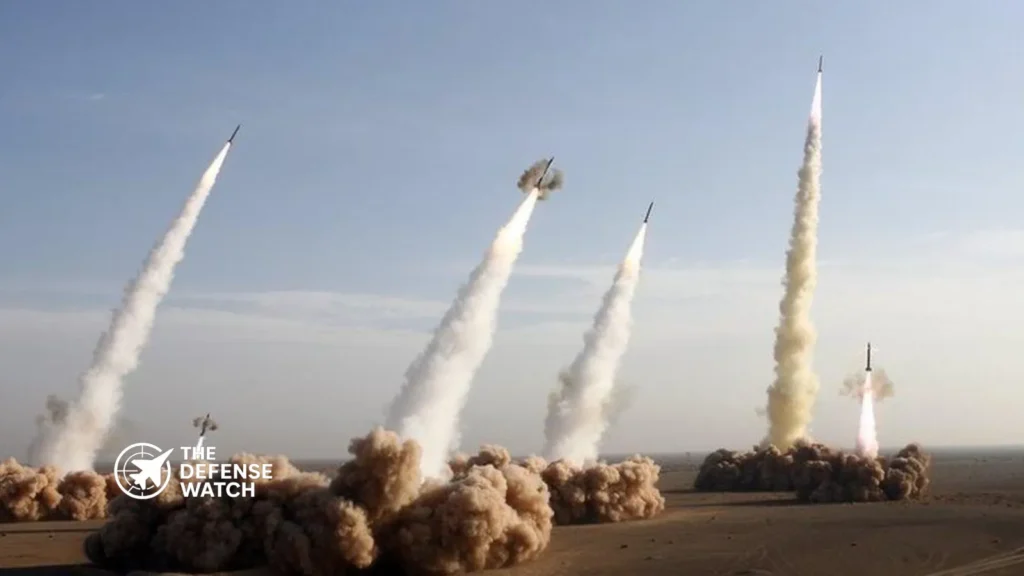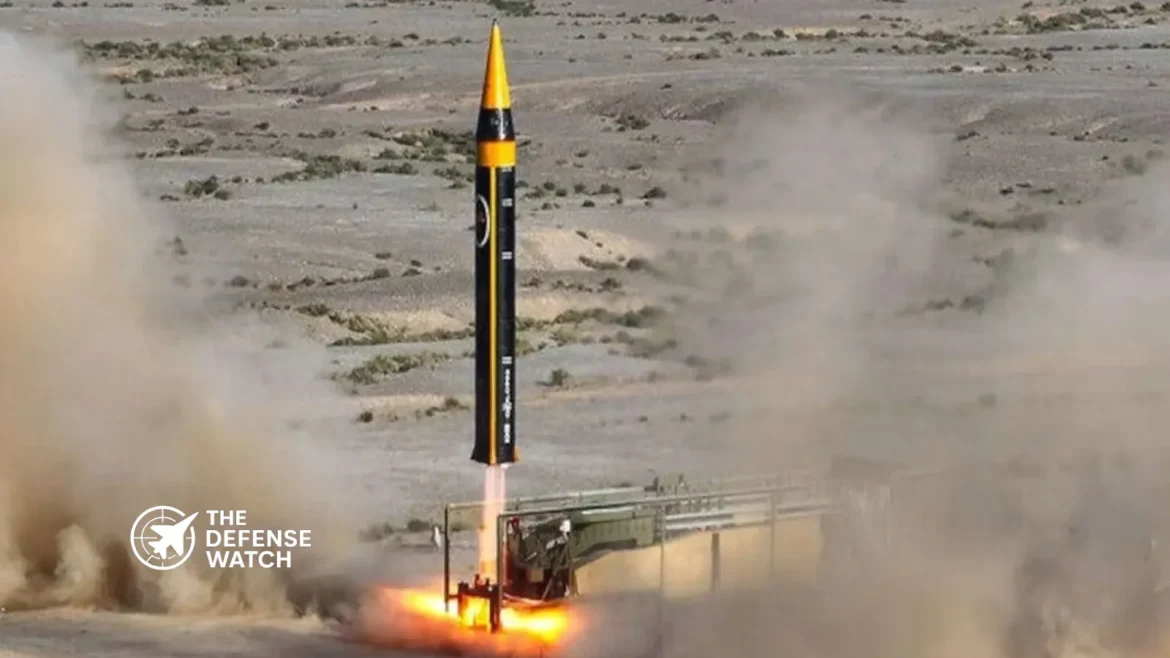
- ► Iran claims launch of hypersonic capable Kheibar missile toward Israeli air defense targets.
- ► Kheibar described as long range ballistic system with enhanced maneuverability.
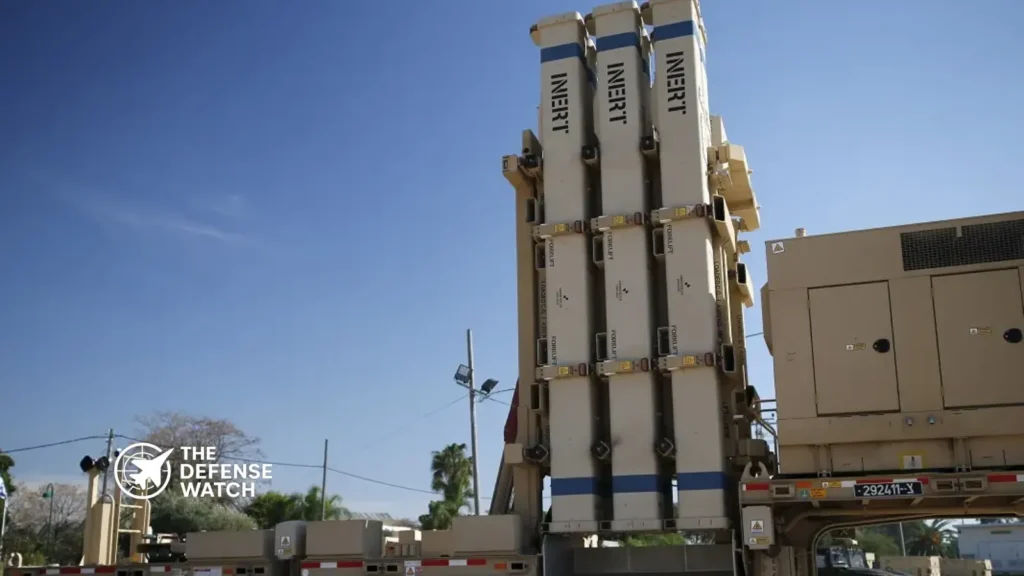
- ► Israel maintains layered missile defense including Arrow and David’s Sling systems.
- ► No independent confirmation yet of hypersonic glide vehicle capability.
- ► Development underscores growing missile competition across the Middle East.
Iran Hypersonic Capable Kheibar Missile Launch Raises Air Defense Concerns
The Iran hypersonic capable Kheibar missile launch has drawn renewed scrutiny from defense analysts after Tehran claimed the weapon was fired toward Israeli air defense networks during ongoing hostilities.
(adsbygoogle = window.adsbygoogle || []).push({});Iranian authorities stated that the Kheibar missile was launched as part of a broader strike package aimed at overwhelming and penetrating Israeli missile defense systems. The claim, if confirmed, would mark another step in Iran’s effort to showcase longer range and potentially maneuverable ballistic missile capabilities.
Officials in Iran described the Kheibar as hypersonic capable, though no independent verification has yet confirmed whether the missile demonstrated sustained hypersonic glide characteristics or simply traveled at hypersonic speeds typical of ballistic trajectories.
Israel has not publicly confirmed the specific missile type used in the reported attack but has stated in recent briefings that its multi layered air defense architecture remains operational.
What Is The Kheibar Missile?
The Kheibar missile, sometimes referred to as Khorramshahr 4 in Iranian media, is part of Tehran’s expanding ballistic missile inventory. It is believed to be derived from earlier liquid fueled systems but reportedly features design refinements to improve range, payload flexibility, and survivability.
Iranian state media has previously claimed the missile can carry a large warhead over distances exceeding 1,000 miles. Analysts note that such range would allow coverage of targets across much of the Middle East.
The Iran hypersonic capable Kheibar missile launch claim centers on speed and maneuverability. All ballistic missiles reach hypersonic velocities during reentry, typically exceeding Mach 5. However, true hypersonic weapons often refer to systems equipped with maneuverable glide vehicles that can adjust trajectory during flight, complicating interception.
There is no open source evidence confirming that the Kheibar employs a hypersonic glide vehicle comparable to programs under development in the United States, China, or Russia. The distinction matters operationally. A maneuverable reentry vehicle presents a greater challenge to radar tracking and interceptor timing than a predictable ballistic arc.
Targeting Israeli Air Defenses
The stated objective of the Iran hypersonic capable Kheibar missile launch was to pressure air defense networks in Israel.
Israel fields a layered missile defense system that includes Arrow for long range ballistic threats, David’s Sling for medium range missiles, and Iron Dome for short range rockets. These systems are supported by advanced radar and battle management networks designed to prioritize high value targets and manage interceptor inventories.
In recent years, Israeli defense officials have emphasized upgrades to counter maneuverable and high speed threats. This includes software improvements and interceptor refinements intended to address emerging missile profiles from regional adversaries.
If the Kheibar demonstrated any terminal maneuvering capability, it would test those defenses. Even absent advanced glide features, a large payload ballistic missile can stress interception systems simply through volume and range.
Strategic Significance
The Iran hypersonic capable Kheibar missile launch reflects Tehran’s broader strategy of deterrence through missile force expansion. Iran continues to invest heavily in ballistic missile development under the oversight of the Islamic Revolutionary Guard Corps.
Ballistic missiles serve multiple purposes in Iranian doctrine. They provide long range strike options without reliance on an air force that faces modernization constraints due to sanctions. They also signal technological progress intended to bolster domestic and regional deterrence messaging.
From a regional security perspective, claims of hypersonic capability raise concerns among Gulf states and Israel alike. Even incremental improvements in accuracy, speed, or maneuverability can shift the balance between offense and defense.
Defense analysts caution, however, that official claims often exceed independently verified performance data. Without telemetry, debris analysis, or confirmation from third party intelligence sources, the true technical characteristics of the Kheibar remain difficult to assess.
Outlook
The Iran hypersonic capable Kheibar missile launch is likely to intensify scrutiny of missile defense readiness across the region. It may also accelerate further investment in early warning systems, interceptor stockpiles, and sensor integration.
For Israel and its partners, the core question is not only whether the Kheibar is genuinely hypersonic in the advanced sense, but whether Iran can produce and deploy it in meaningful numbers.
As missile technology spreads and evolves, the competition between offensive strike systems and defensive interception networks will remain a defining feature of Middle East security dynamics.
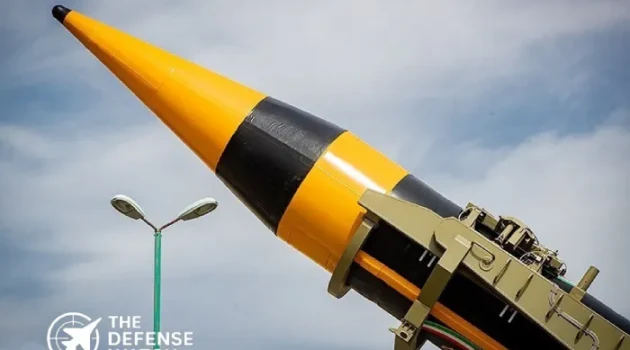

- ► Trump warned Iran ICBM development could eventually threaten the U.S. homeland.
- ► U.S. intelligence has long assessed Iran is improving long range ballistic missile technology.
- ► Iran maintains the largest ballistic missile arsenal in the Middle East, according to Pentagon assessments.
- ► Tehran says its missile program is defensive and not subject to nuclear negotiations.
- ► The debate underscores renewed focus on U.S. missile defense and deterrence posture.
Iran Long Range Missile Program Under Scrutiny
Iran ICBM development has been a concern for U.S. policymakers for more than a decade. While Iran currently fields medium and intermediate range ballistic missiles capable of reaching Israel and parts of Europe, U.S. officials have warned that technologies used in space launch vehicles could shorten the timeline for a future ICBM.
The Defense Intelligence Agency has previously assessed that Iran seeks to improve missile accuracy, payload capacity, and survivability. The Pentagon has repeatedly described Iran as possessing the largest ballistic missile inventory in the Middle East.
Tehran insists its missile program is purely defensive. Iranian officials argue that ballistic missiles are necessary for deterrence, especially given regional tensions and conventional force imbalances.
Still, American defense planners differentiate between regional systems and a true intercontinental capability. An operational ICBM would require not only extended range, typically exceeding 5,500 kilometers, but also reliable reentry vehicle technology and guidance systems capable of surviving atmospheric reentry at high velocity.
Technical Pathways To An Iranian ICBM
Iran has demonstrated significant advances in solid fuel propulsion, satellite launch vehicles, and multi stage rocket design. Analysts often note that space launch programs share overlapping technologies with long range ballistic missiles.
However, converting a space launch vehicle into a military grade ICBM is not a simple step. Weaponization, miniaturization of payloads, and survivable basing concepts are complex engineering challenges.
U.S. intelligence agencies have historically assessed that while Iran retains the technical foundation for future Iran ICBM development, it has not yet fielded an operational intercontinental system.
The distinction matters for homeland defense planning. The United States relies on the Ground based Midcourse Defense system in Alaska and California to counter limited ICBM threats from rogue states. Any credible Iranian intercontinental capability would factor into future missile defense funding and modernization debates.
Strategic Implications For U.S. Defense Policy
Trump’s warning places renewed attention on missile defense, sanctions enforcement, and regional deterrence.
If Iran were to achieve a credible ICBM capability, it would alter threat calculations beyond the Middle East. The ability to target the continental United States would elevate Tehran’s strategic leverage and potentially complicate crisis decision making.
At the same time, experts caution against conflating capability development with intent. Intelligence assessments typically separate technical progress from policy decisions to deploy or arm such systems.
The broader context includes stalled nuclear diplomacy, regional proxy conflicts, and Iran’s expanding unmanned and missile exports. Ballistic missiles remain central to Iran’s military doctrine, particularly given its limited modern air force.
Regional And Global Security Context
Iran’s missile force has been used as a signaling tool in recent years, including strikes against regional adversaries and militant targets. These actions demonstrate operational readiness of shorter range systems, but do not confirm intercontinental capability.
Washington’s approach has alternated between diplomatic engagement and maximum pressure sanctions. Missile activity has remained a consistent friction point across administrations.
The renewed focus on Iran ICBM development underscores a larger strategic question: how to balance deterrence, missile defense investment, and diplomatic channels without escalating tensions.
For now, U.S. officials continue to monitor Iran’s missile testing and space launch activities closely. Any confirmed shift toward operational intercontinental range systems would likely trigger policy responses spanning sanctions, force posture adjustments, and accelerated missile defense upgrades.
Assessment
Iran ICBM development remains a prospective rather than operational threat based on publicly available U.S. intelligence findings. However, the technological trajectory of Iran’s missile and space programs keeps the issue central to homeland security planning.
Trump’s warning reflects longstanding bipartisan concern over Tehran’s ballistic missile ambitions. Whether that concern translates into new policy initiatives will depend on intelligence developments and the broader geopolitical environment.
For defense planners, the issue is less about rhetoric and more about timelines, technical indicators, and strategic intent. Those factors will shape how seriously Washington recalibrates its homeland missile defense posture in the coming years.
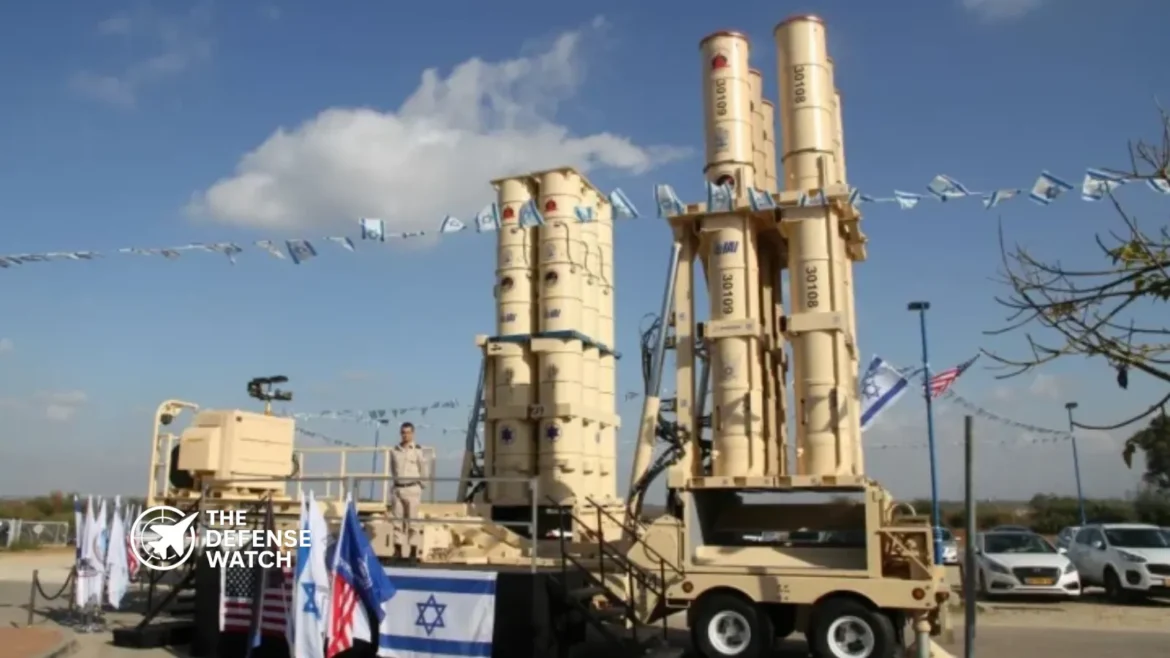
- ► Israeli officials assess Iran could possess up to 5,000 ballistic missiles by 2027.
- ► Iran fields short and medium range ballistic missiles capable of reaching Israel and U.S. bases in the Gulf.
- ► Israel operates a layered missile defense network including Iron Dome, David’s Sling, and Arrow systems.
- ► U.S. forces in the Middle East rely on Patriot and THAAD batteries to defend key installations.
- ► Iranian missile production has continued despite sanctions and export control regimes.
- ► Large scale missile salvos pose saturation risks to existing regional missile defense systems.
Israel Iran Ballistic Missile Threat: A Growing Strategic Challenge
The Israel Iran ballistic missile threat is entering a new phase as Israeli officials warn that Tehran could field up to 5,000 ballistic missiles by 2027.
(adsbygoogle = window.adsbygoogle || []).push({});The warning reflects more than a raw number. It signals a shift in regional military balance, particularly for Israel’s layered missile defense architecture and for U.S. forces deployed across the Gulf.
Iran has steadily expanded its ballistic missile inventory over the past decade, despite international sanctions. Its arsenal now includes short range and medium range systems such as the Shahab and Sejjil families, along with precision guided variants that improve targeting accuracy. Israeli assessments suggest production capacity, not just stockpile size, is accelerating.
For Israel and its U.S. partners, the issue is no longer whether Iran has missiles. It is whether existing defensive systems can absorb sustained, large scale salvos.
Operational Impact: Stress Testing Missile Defense
Israel’s air and missile defense network is built around layered interception.
The lowest tier is the Iron Dome, designed primarily for short range rockets. Above it sits David’s Sling, intended for medium range threats. At the top tier is the Arrow system, developed with U.S. support to intercept longer range ballistic missiles outside the atmosphere.
This structure has proven effective against limited salvos from Gaza and sporadic launches from regional actors. A potential inventory of 5,000 Iranian ballistic missiles presents a different challenge.
(adsbygoogle = window.adsbygoogle || []).push({});Ballistic missile defense is constrained by interceptor inventory and reload time. Even high success rates can be strained if dozens or hundreds of missiles are launched in waves. Each interceptor carries significant cost, often in the millions of dollars per round.

For the United States, the operational concern centers on forward deployed forces. U.S. installations in Qatar, Bahrain, Kuwait, and the United Arab Emirates host air assets, logistics hubs, and command nodes. Many rely on the MIM-104 Patriot and THAAD for protection.
Those systems were designed to counter limited missile threats from state actors. A surge in Iranian production shifts the problem from capability to capacity.
Regional Security Context
Iran’s missile doctrine emphasizes deterrence through volume and survivability. Lacking a modern air force comparable to Israel or the United States, Tehran has invested heavily in ballistic and cruise missiles as asymmetric tools.
Over the past decade, Iran has demonstrated the ability to strike regional targets, including U.S. positions in Iraq in 2020. That strike highlighted improvements in accuracy and coordination.
If the projected growth materializes, the Israel Iran ballistic missile threat will not be confined to Israel. Gulf states hosting U.S. forces would also fall within range of large portions of Iran’s inventory.
(adsbygoogle = window.adsbygoogle || []).push({});This dynamic complicates coalition planning. It increases the demand for integrated air and missile defense, data sharing, and coordinated early warning across the region.
Industrial And Budget Dimensions
Missile defense is expensive on both sides of the equation.
Iran’s production of solid fuel ballistic missiles suggests a growing domestic industrial base. Solid fuel systems reduce launch preparation time and increase survivability.
On the defensive side, interceptors are costly and production lines are finite. U.S. budget documents from recent fiscal years show continued funding for Patriot and THAAD modernization, as well as support for Israeli systems through joint programs.
If threat assessments drive increased interceptor procurement, Congress will face tradeoffs. Resources allocated to missile defense may affect funding for other priorities such as next generation aircraft or naval modernization.
For Israel, sustained high interceptor usage in a major conflict would require rapid resupply, likely with U.S. assistance. That creates a direct linkage between U.S. industrial capacity and Israeli homeland defense.
Comparison With Competitors
Other regional actors face missile threats, but few match the scale projected for Iran.
North Korea maintains a significant ballistic missile force, though its focus is oriented toward Northeast Asia and the United States. Russia and China field larger arsenals, but their strategic focus lies elsewhere.
What differentiates Iran is the combination of geographic proximity to Israel and Gulf bases, growing missile numbers, and the potential use of proxy groups to complicate defense planning.
The Israel Iran ballistic missile threat is therefore distinct in its regional density. Distances are short, warning times are limited, and saturation attacks are feasible.
Strategic Assessment
The projected expansion of Iran’s missile arsenal has direct implications for regional power balance.
First, it reinforces deterrence through the threat of mass retaliation. Even if Israeli and U.S. defenses intercept a high percentage of incoming missiles, a small number penetrating defenses could inflict significant damage.
Second, it pressures defense budgets. Sustaining sufficient interceptor stocks requires steady procurement and industrial readiness. That benefits defense contractors involved in missile defense programs, but it also strains fiscal planning.
Third, it strengthens the case for deeper U.S. and regional integration. Shared radar networks, joint exercises, and coordinated command structures become more critical as missile numbers grow.
(adsbygoogle = window.adsbygoogle || []).push({});Fourth, escalation risks increase. In a crisis, preemptive strikes against missile launchers could be seen as necessary by one side and escalatory by the other. The speed of ballistic missile exchanges leaves limited room for diplomatic intervention once hostilities begin.
Finally, the signal to allies and adversaries is clear. Missile capability is central to modern deterrence in the Middle East. Airpower alone no longer defines regional superiority.
What happens next will depend on three factors: the pace of Iranian production, the scale of Israeli and U.S. interceptor procurement, and whether regional states move toward a more unified air and missile defense architecture.
Why This Matters Now
This issue matters now because timelines are compressing. A projected 2027 benchmark is within current defense budget cycles.
Procurement decisions made in Washington and Jerusalem over the next two years will determine whether defensive capacity keeps pace with offensive growth.
For the United States, the question is not only about defending Israel. It is about protecting U.S. forces and preserving freedom of action in the Gulf.
(adsbygoogle = window.adsbygoogle || []).push({});For Iran, expanding missile inventories enhances leverage without crossing the nuclear threshold.
For Israel, maintaining credible deterrence depends on proving that even a large scale missile campaign would fail to achieve strategic objectives.
The Israel Iran ballistic missile threat is therefore not just a numbers game. It is a test of industrial capacity, alliance cohesion, and the credibility of layered missile defense under stress.