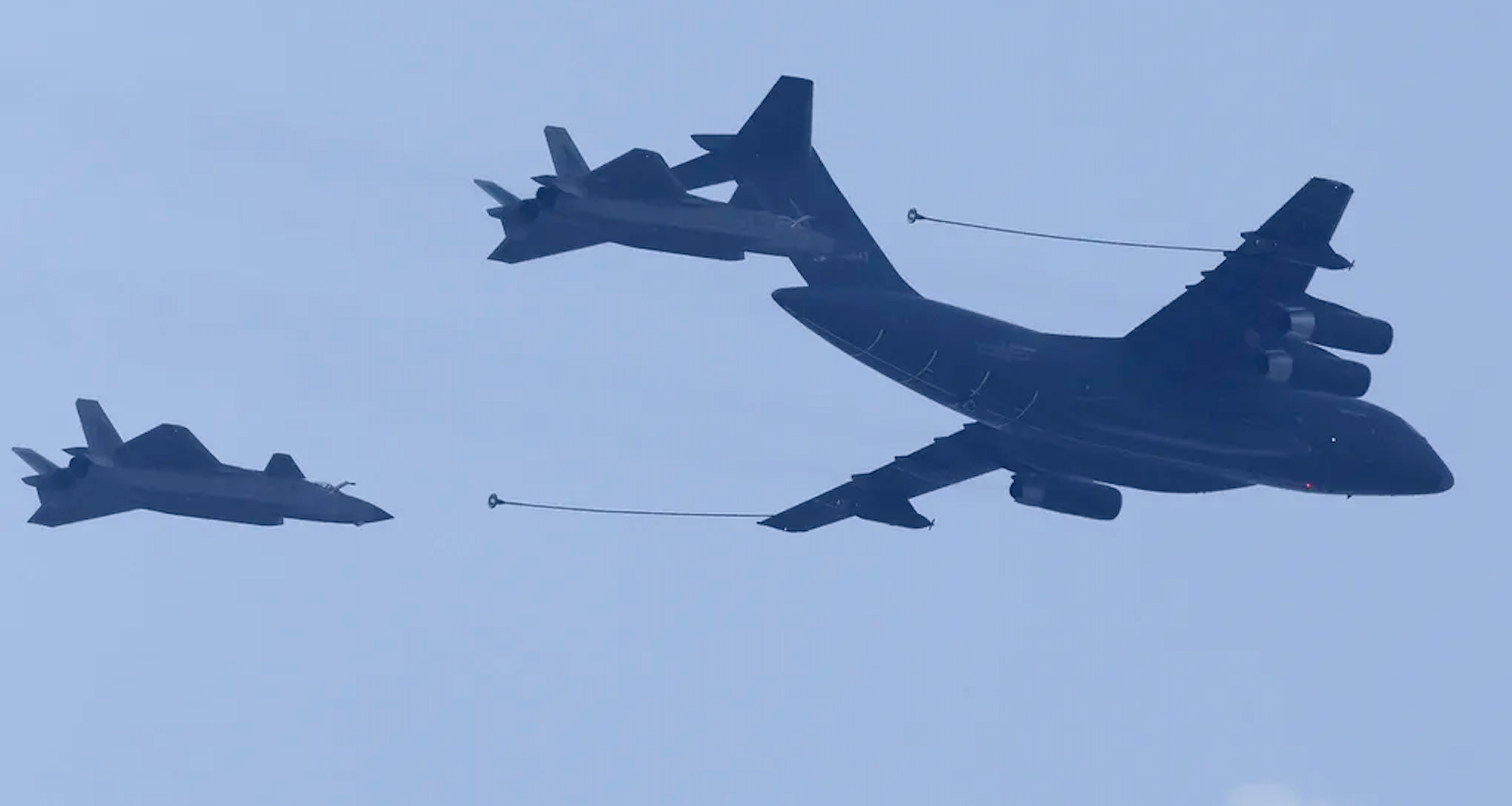
China’s Sixth-Generation Fighter Program Advances to Refueling Tests
China’s sixth-generation fighter program has reached another visible flight-test milestone, with footage reportedly showing two next-generation prototypes conducting aerial refueling from a YY-20 tanker aircraft on August 28. Reported the footage on August 29, while subsequent reporting identified the aircraft as prototypes associated with China’s emerging sixth-generation combat aircraft effort.
Takeaways
New footage reportedly shows Chinese sixth-generation fighter prototypes conducting aerial refueling from a YY-20 tanker, providing a new indication of progress in long-range flight testing.
The aircraft shown remain officially unidentified. Open-source analysts have generally used the provisional J-36 designation for the large Chengdu prototype first observed in December 2024, while the separate Shenyang design is commonly referred to as the J-50. Those names should not be treated as confirmed People’s Liberation Army designations.
The latest footage is significant primarily because aerial refueling is an important step in integrating a new combat aircraft with the wider air force. It indicates that testing is moving beyond basic flight operations toward procedures required for longer-range missions and sustained operations.

What the New Footage Shows
According to reporting on the August 28 footage, two Chinese next-generation fighter prototypes can be seen operating with a YY-20 tanker. The available imagery does not provide enough information to establish the exact aircraft variant, test location, mission profile or quantity of fuel transferred.
That distinction matters. The aircraft have been publicly observed since late 2024, but many of their most important characteristics remain undisclosed.
Feature Current Open-Source Assessment Aircraft type Chinese next-generation fighter prototypes Common analyst designation Chengdu J-36, Shenyang J-50 Official designation Not publicly confirmed Configuration Tailless designs have been observed Refueling aircraft YY-20 tanker Latest reported event Aerial refueling footage, August 28, 2026 Development status Flight testing Operational entry Not officially announced Radar, weapons and combat radius Not publicly confirmed The large Chengdu aircraft is notable for its tailless configuration and three-engine arrangement. Its size has led analysts to associate it with missions requiring substantial internal fuel, sensor capacity and weapons carriage, although the exact design objectives remain classified.
The Shenyang aircraft has a different configuration and is considerably smaller. Because both programs remain under development, it is premature to assume that either aircraft represents the final production configuration of a future Chinese sixth-generation fighter.

Chinese Sixth Generation Fighter Demonstrates Extraordinary High-Alpha Manoeuvrability Why Air-to-Air Refueling Is an Important Milestone
For a long-range combat aircraft, aerial refueling is more than a method of adding fuel. It is part of the operational system required to generate persistent combat power at extended distances.
A tanker can allow a fighter to depart its base with a different fuel and weapons balance, extend its time in a patrol area, or recover after conducting a long-range mission without consuming the fuel needed for contingencies.
For China, this capability has particular relevance in the Indo-Pacific, where distances between mainland bases, maritime operating areas and potential targets can be substantial.
The U.S. Department of Defense has previously assessed that China is developing its aerial refueling fleet to extend the operating range of fighter and bomber aircraft. The Pentagon’s 2024 China Military Power Report specifically identified the Y-20-based tanker as an important improvement to the PLA Air Force’s ability to conduct operations beyond the First Island Chain.
The emergence of the YY-20 therefore has to be considered alongside China’s longer-range fighter designs rather than as an independent capability.
The YY-20 Changes the Range Equation
China historically relied on a relatively limited tanker fleet compared with the United States. The introduction and expansion of Y-20-based tankers changes that equation by providing a larger domestic platform capable of supporting a broader range of aircraft.
The Y-20 family is based on China’s heavy transport aircraft, providing substantially greater capacity than older tanker conversions derived from the H-6 bomber.
Recent Chinese military imagery has already shown YY-20 tankers supporting J-20 stealth fighters. That provides an important precedent for integrating the tanker with China’s fifth-generation force before the appearance of the newer prototypes.
The reported sixth-generation refueling footage therefore fits into a broader development pattern. China is not simply testing a new fighter airframe. It is also developing the support aircraft, sensors, command-and-control architecture and aerial refueling infrastructure needed to operate advanced combat aircraft at greater distances.

Fourth Flight Prototype of China’s Ultra-Long Range Sixth Generation Fighter Aerial Refueling Also Creates New Technical Demands
Refueling a new aircraft in flight requires more than installing a compatible refueling system.
The aircraft must maintain precise relative position and speed with the tanker while pilots or automated flight-control systems manage the aircraft during the transfer. The process must work reliably under different weather, turbulence and lighting conditions.
For a stealth aircraft, the design challenge is also more complicated. Designers must incorporate refueling equipment without creating unnecessary radar-signature compromises.
The aircraft’s refueling system must therefore be integrated with the broader low-observable architecture rather than treated as an isolated component.
The latest footage does not reveal how China has solved those problems. It does, however, show that the program has reached a stage where tanker compatibility is being evaluated in flight.
What Is Known About China’s New Fighter Designs
The Chengdu prototype first became publicly visible in December 2024, alongside a separate aircraft associated with Shenyang. The emergence of two different designs indicated that China was exploring multiple approaches to its next-generation combat aircraft requirements.
The large Chengdu aircraft has attracted particular attention because of its unusual tailless configuration, very large airframe and three-engine layout.
Its physical dimensions suggest that designers have prioritized internal volume. That could support substantial fuel capacity, large sensors, weapons storage or other mission equipment, although no official specifications have been released.
The absence of published specifications is important when evaluating claims about performance. Public estimates of range, payload, radar capability and weapons integration remain uncertain and should not be presented as established specifications.
Implications for U.S. Airpower
The development has direct relevance for the United States because the Pentagon considers China its primary pacing challenge and has focused increasing attention on long-range airpower in the Indo-Pacific.
The U.S. response includes the Next Generation Air Dominance program and the F-47, which the Department of the Air Force selected Boeing to develop under an Engineering and Manufacturing Development contract in March 2025. The Air Force describes the F-47 as its sixth-generation crewed fighter and says the program is intended to preserve air superiority against advanced threats.
The important comparison is therefore not simply whether China or the United States has a sixth-generation aircraft flying first.
A more meaningful measure is whether either country can transition a prototype into a reliable operational system with mature engines, sensors, weapons, communications, electronic warfare systems, maintenance processes, trained crews and sufficient production capacity.
China’s latest refueling footage is evidence of progress in one part of that process. It is not evidence that the aircraft has completed development or achieved operational capability.
Why Tanker Integration Matters in a Pacific Conflict
The Indo-Pacific places unusual demands on tactical aviation because distances can quickly exceed the unrefueled operating limits of many fighter aircraft.
A force that can combine long-range fighters with tankers can distribute aircraft across a wider operating area and reduce dependence on individual forward bases.
For China, this could support operations farther from the mainland while allowing aircraft to remain within a broader network of Chinese air-defense, surveillance and command systems.
For the United States and its allies, the same development reinforces the importance of tanker survivability, distributed basing, long-range weapons and persistent intelligence, surveillance and reconnaissance.
Aerial tankers are high-value support assets. Their loss or forced withdrawal can reduce the effectiveness of fighters that depend on them for extended-range missions.
That creates an operational problem for both sides. China must protect its tanker fleet while using it close enough to support combat aircraft. The United States and its allies must account for increasingly capable Chinese aircraft and weapons that could threaten tankers operating inside contested airspace.
The Milestone Does Not Establish a Service-Entry Date
Despite the significance of the footage, there is still no public Chinese announcement confirming when a sixth-generation fighter will enter operational service.
Flight testing can continue for years after an aircraft demonstrates basic aerial refueling. Engine maturity, mission systems, weapons integration, software, electronic warfare, low-observable durability and production readiness all have to be resolved before a prototype becomes an operational combat aircraft.
China’s ability to produce multiple prototypes relatively quickly is nevertheless an important factor to watch.
The United States has also emphasized accelerated development for the F-47. The Air Force said its NGAD contract covers maturation, integration and testing of the complete system, with a small number of test aircraft to be produced before low-rate initial production.
This makes the coming years important for both programs.
A Shift From Prototype Testing to System Integration
The latest Chinese footage is best understood as a system-integration milestone rather than proof of a completed sixth-generation fighter.
The appearance of the aircraft alongside a YY-20 tanker shows that China is testing how its next-generation combat aircraft will interact with one of the supporting elements required for long-range operations.
That matters because future air combat will depend less on individual aircraft and more on connected systems involving fighters, unmanned aircraft, tankers, airborne early-warning platforms, satellites, electronic warfare assets and long-range weapons.
China’s sixth-generation fighter program remains opaque, but its progression from initial public flight observations to aerial refueling testing provides another measurable indication of development.
For U.S. and allied planners, the immediate lesson is not that a new Chinese fighter has suddenly become operational. It is that China’s next-generation airpower effort is progressing across multiple elements of the force, including the tanker infrastructure needed to extend the reach of advanced combat aircraft.
The central question now is whether Beijing can convert that rapid prototype activity into a dependable, scalable and combat-ready system.


