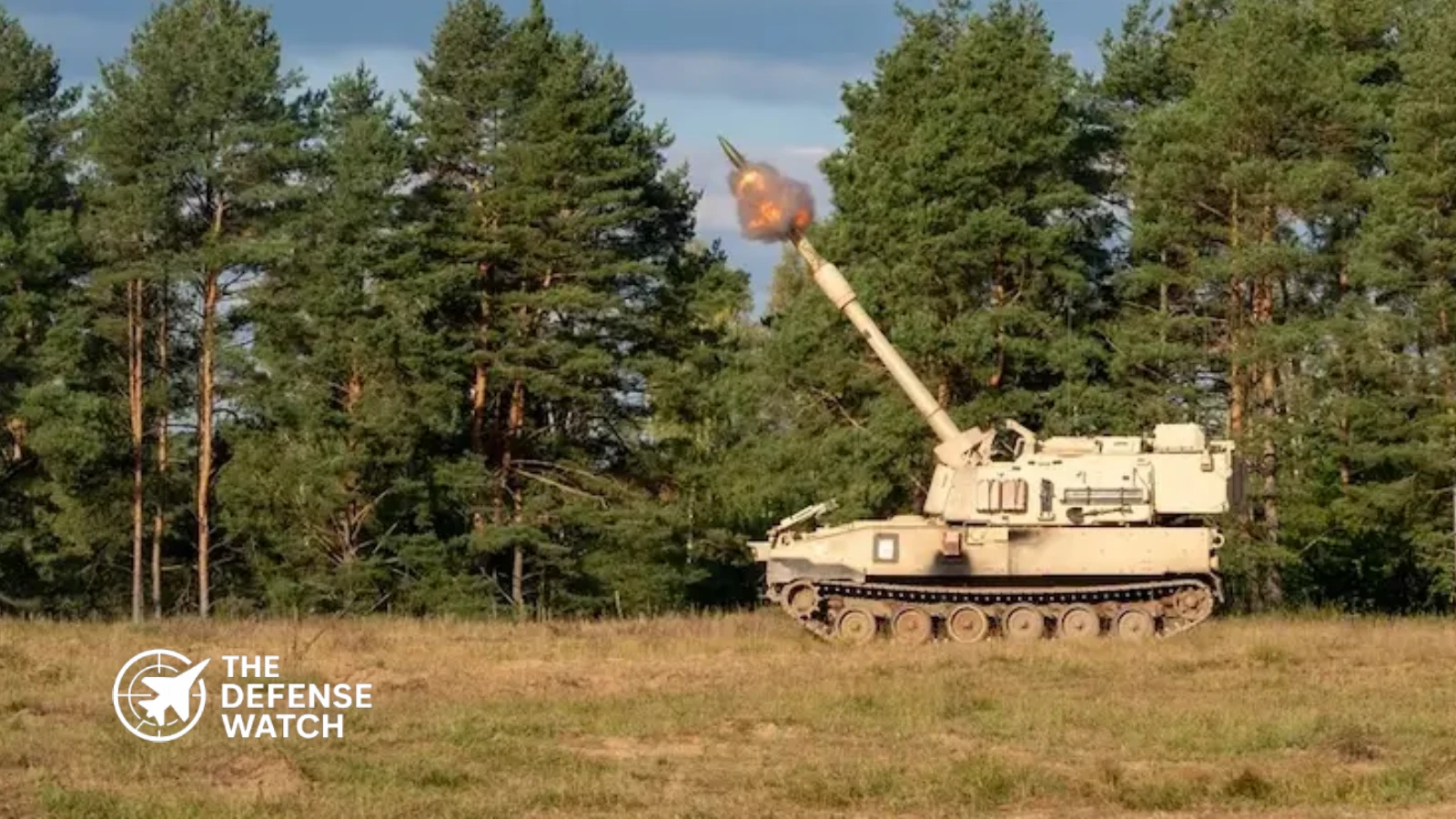
General Dynamics Demonstrates LR-PGK Precision Beyond 50 Kilometers
General Dynamics Ordnance and Tactical Systems has demonstrated its Long Range Precision Guidance Kit, or LR-PGK, guiding 155mm XM1113 rocket assisted projectiles beyond 50 kilometers during a field test at U.S. Army Yuma Proving Ground. General Dynamics said the September 2 demonstration was the first U.S. guidance kit demonstration of accurate 155mm cannon artillery guidance at a range exceeding 50 kilometers.
Takeaways
General Dynamics Ordnance and Tactical Systems demonstrated its LR-PGK guidance technology with XM1113 155mm rocket assisted projectiles at ranges beyond 50 kilometers.
The result is significant because the Army is trying to extend cannon artillery reach while maintaining precision and improving the ability of artillery units to operate against capable adversaries. The demonstration also comes as the service accelerates development of more mobile cannon systems and longer range ammunition.
What the LR-PGK Demonstration Shows
During the Yuma test, LR-PGK guided XM1113 rocket assisted projectiles at ranges greater than 50 kilometers. General Dynamics said the demonstrated accuracy substantially exceeded requirements associated with legacy guidance systems.
The demonstration should be distinguished from the maximum range of the projectile itself. XM1113 provides the rocket assisted propulsion and aerodynamic characteristics needed for extended range, while the LR-PGK provides course correction and guidance.
That distinction matters operationally. Extending artillery range without maintaining acceptable accuracy can increase ammunition expenditure and reduce the practical value of the additional reach. A guidance kit allows the Army to pair longer range projectiles with a precision capability rather than treating range and accuracy as separate requirements.
The Army’s current portfolio documentation identifies LR-PGK as a course correcting fuze with enhanced GPS anti-jam capability. The documentation lists the system with XM1113, XM1128 and M795 projectiles and identifies compatibility with M109A6/A7 Paladin, M777A2 and the Mobile Tactical Cannon.
XM1113 Is the Long Range Component
The XM1113 is a 155mm high explosive rocket assisted projectile intended to replace the older M549A1 rocket assisted round in 39 caliber artillery systems.
Earlier Army documentation established a nominal 40 kilometer maximum range for XM1113 when fired from 39 caliber systems. The projectile uses a larger rocket motor and a streamlined external configuration to produce substantially greater range than conventional 155mm ammunition.
The Army’s current ammunition portfolio lists XM1113 with a 37 kilometer range when paired with PGK in 39 caliber systems, 40 kilometers unguided from those systems, and 52 kilometers from 52 caliber weapon systems.
The latest LR-PGK demonstration goes beyond those previously published figures in a different sense. General Dynamics demonstrated the guidance kit controlling an XM1113 projectile beyond 50 kilometers, showing that the guidance technology can function at distances where projectile flight time, navigation error, atmospheric effects and communication with the weapon system become increasingly important.
LR-PGK Brings Precision to Extended Range Fires
The LR-PGK program has been designed around the Army’s requirement for longer range precision cannon fires.
The Army describes the XM1171 and XM1172 LR-PGK configurations as course correcting fuzes with enhanced GPS anti-jam capability. Current Army documentation gives an accuracy threshold of less than 30 meters circular error probable, or CEP, with an objective of less than 10 meters. It also lists a published range of 58 kilometers with XM1113, XM1128 and M795 projectiles.
Those figures provide useful context for the new demonstration.
| Capability | Current Army information |
|---|---|
| Projectile | 155mm XM1113 |
| Guidance system | LR-PGK |
| Demonstrated range | Greater than 50 km |
| Army listed LR-PGK range | 58 km with specified projectiles |
| Accuracy threshold | Less than 30 m CEP |
| Accuracy objective | Less than 10 m CEP |
| GPS capability | Peer threat environment |
| Compatible platforms listed | M109A6/A7, M777A2, Mobile Tactical Cannon |
| Projected full materiel release | FY2031 |
The distinction between demonstrated performance and an acquisition requirement is important. The Yuma event establishes a test result reported by General Dynamics. It does not by itself mean the system has completed every Army qualification, acquisition or fielding step.
Why the 50 Kilometer Threshold Matters
The U.S. Army is rebuilding its cannon artillery architecture around longer range, greater mobility and increased survivability.
Traditional 155mm artillery has generally operated at shorter ranges, creating a tradeoff between the position of friendly artillery units and the depth of targets they can reach. Longer range reduces that constraint and can allow fires units to influence targets farther behind an adversary’s forward positions.
But range alone is not enough.
Modern artillery operations increasingly take place in environments where counter-battery sensors, unmanned aircraft, electronic warfare and long range fires can expose artillery positions. A cannon unit that can reach farther but cannot rapidly move, maintain accurate targeting data or function under electronic attack can remain vulnerable.
That is why the LR-PGK demonstration is relevant beyond the projectile itself. The Army is attempting to combine range, precision, navigation resilience and platform mobility into a broader fires architecture.
Connection to the Mobile Tactical Cannon
The timing of the demonstration is particularly relevant to the Army’s Mobile Tactical Cannon program.
In August 2026, the Army announced an agreement with Hanwha Defense USA for development of Mobile Tactical Cannon prototypes. The agreement covers up to 18 wheeled self propelled howitzer systems for rapid prototyping, testing and Soldier experimentation, with an initial six systems and an option for 12 more.
The Army says MTC is intended to improve mobility, lethality, reliability and survivability, with potential replacement of M777 towed artillery in selected formations if the system is approved for fielding.
The LR-PGK program fits into this modernization effort because Army documentation specifically lists the Mobile Tactical Cannon as an intended integration platform.
This creates an important systems level relationship. A more mobile cannon can reposition faster, while extended range ammunition can allow it to engage targets from greater distances. Precision guidance can then reduce the number of rounds needed to achieve an intended effect, although actual ammunition expenditure will depend on target type, mission conditions and rules of engagement.
GPS Contested Operations Remain a Central Challenge
One of the most important elements of LR-PGK is not simply its maximum range. It is its intended operation in a GPS contested environment.
The Army identifies enhanced GPS anti-jam capability as a core characteristic of the LR-PGK. The program is intended to support operations against peer threats where satellite navigation signals could be degraded, disrupted or interfered with.
This requirement reflects lessons from modern warfare, where electronic warfare can affect navigation and communications across large areas.
A precision artillery projectile traveling more than 50 kilometers has a longer flight path and more time during which guidance errors can accumulate. Maintaining useful accuracy therefore requires not only an effective guidance mechanism but also a navigation architecture capable of dealing with degraded positioning information.
That makes anti-jam performance a major part of the system’s military value rather than a secondary feature.
From XM1113 to the Next Generation of Army Cannon Fires
The Army’s long range artillery effort extends beyond XM1113.
The service has been developing the XM1210, formerly known as XM1113 Extended Range, as a follow-on rocket assisted projectile intended for longer range weapon systems. Army documentation identifies the XM1210 as a follow-on to XM1113 and gives it a maximum effective range of more than 70 kilometers with precision.
The Army’s 2026 budget documentation also describes supercharge propellant development as part of its cannon transformation strategy. The effort is intended to support ranges beyond 50 kilometers from self propelled howitzers using cannon lengths greater than 52 calibers, with a stated objective of achieving lethality out to 70 kilometers with future long range precision fires systems.
This points to an evolutionary approach rather than a single weapon program.
The Army is simultaneously working on projectiles, propelling charges, guidance kits, cannon systems and mobile platforms. The goal is to ensure that improvements in one component do not become constrained by limitations elsewhere in the artillery chain.
The Technical Challenge Is More Than Range
Long range cannon artillery places significant demands on the entire weapon system.
Higher propellant energy creates greater pressure and thermal stress on gun components. Rocket assisted projectiles introduce additional mechanical and thermal considerations because the projectile must survive launch forces before the rocket motor operates during flight.
The Army has previously identified projectile reliability, rocket motor performance, rotating band behavior and protection of the explosive fill from excessive heat as important test areas for XM1113.
Guidance introduces another layer of complexity. The fuze has to survive launch acceleration, operate reliably after firing and provide course corrections without compromising projectile stability or the intended terminal trajectory.
The Yuma demonstration therefore represents one part of a larger engineering problem. Demonstrating precision beyond 50 kilometers is important, but the military value ultimately depends on repeatability, reliability, production capacity, platform integration and performance under operational conditions.
What the Demonstration Means for U.S. Artillery
The LR-PGK test gives the Army another data point in its effort to increase the reach of conventional cannon artillery.
The immediate significance is the demonstrated ability to guide an XM1113 projectile beyond 50 kilometers. The broader significance is the potential to combine extended range ammunition with a guidance system designed for contested navigation environments and newer mobile artillery platforms.
For U.S. forces, this could strengthen the role of cannon artillery between conventional close support and longer range missile systems. Cannon ammunition generally offers a different cost, logistics and volume of fire model from more complex missile weapons, making improvements in range and precision relevant to the Army’s effort to generate massed fires.
The capability is also being developed with allied interoperability in mind. General Dynamics identifies the LR-PGK and associated artillery technologies as solutions intended for the U.S. military and allies, while the Army continues to operate a broad family of NATO standard 155mm systems.
The next measure will be whether the demonstrated performance can translate into repeatable qualification results, production and eventual operational fielding.
For now, the Yuma test establishes a clear milestone: General Dynamics says its LR-PGK has demonstrated guided 155mm artillery beyond the 50 kilometer mark, while the U.S. Army continues to develop the ammunition, propellant and mobile cannon architecture needed to turn extended range precision fires into an operational capability.
