

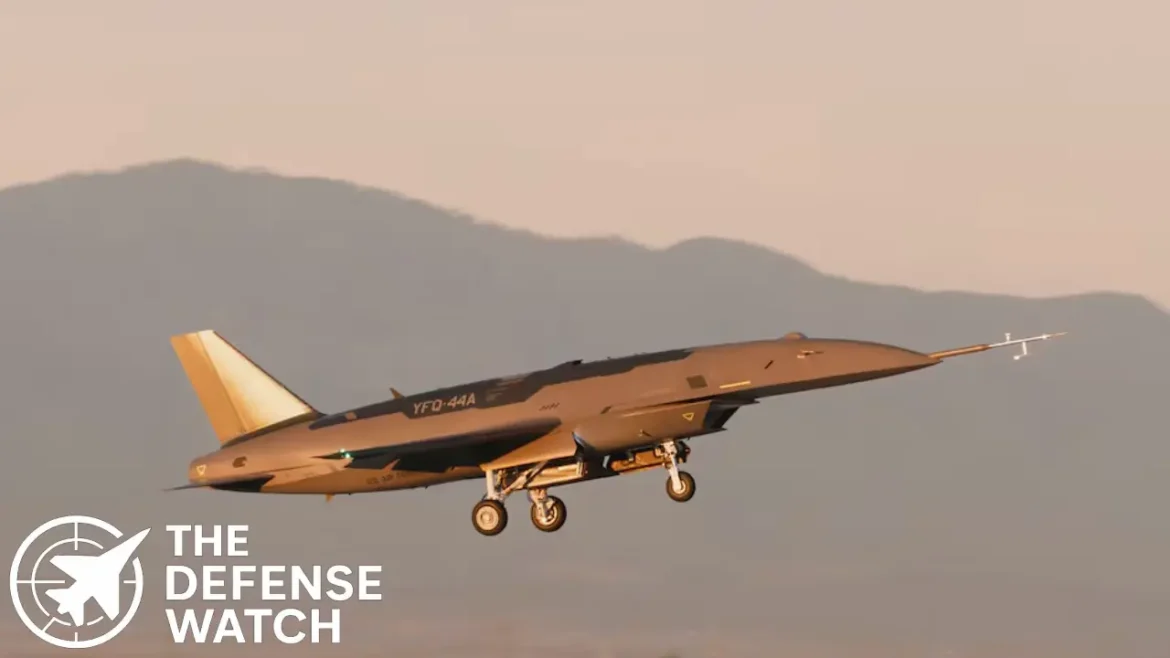
Anduril’s Drone Wingman Takes Flight
Anduril Industries, the defense technology firm founded by Palmer Luckey, has launched flight testing for its highly anticipated autonomous “Drone Wingman,” a next-generation unmanned aircraft designed to fly alongside U.S. Air Force fighters.
The milestone, announced on October 31, marks the company’s transition from design and ground testing to real-world flight trials — a critical step under the U.S. Air Force’s Collaborative Combat Aircraft (CCA) program. This effort aims to develop autonomous drones capable of teaming with crewed aircraft like the F-35 and F-15EX to perform combat, surveillance, and electronic warfare missions.
Anduril’s announcement comes amid growing competition among U.S. defense contractors to deliver cost-effective, AI-enabled aircraft that can expand the Air Force’s combat capabilities without risking human pilots.
Pioneering the CCA Vision
The Drone Wingman represents Anduril’s bid for the U.S. Air Force’s multibillion-dollar CCA initiative — one of the most ambitious unmanned programs in American defense history. The service envisions a fleet of AI-powered aircraft operating in tandem with human pilots to enhance lethality, survivability, and decision-making in high-threat environments.
While Anduril has not disclosed specific performance details, the company confirmed the aircraft is designed for modularity, enabling rapid integration of sensors, weapons, and mission systems. This design philosophy aligns with the Pentagon’s push for open-architecture platforms that can evolve as technology advances.
In a company statement, Anduril emphasized its “software-first approach,” integrating autonomous systems and artificial intelligence developed across its Lattice OS platform — a command-and-control system that underpins many of the company’s defense products, including counter-drone systems and autonomous underwater vehicles.
Private Sector Competition Intensifies
Anduril is one of several defense innovators — including Boeing, Lockheed Martin, and General Atomics — vying for a share of the Air Force’s future unmanned fleet. Boeing’s MQ-28 Ghost Bat, developed with the Royal Australian Air Force, and General Atomics’ Gambit series have already demonstrated key flight capabilities.
However, Anduril’s rapid development cycle and software-centric approach could set it apart in a field traditionally dominated by legacy aerospace giants.
According to Defense News, Anduril aims to deliver a “low-cost, high-performance” autonomous jet that can be produced and upgraded at the pace of software — a fundamental shift from traditional defense procurement models that often span decades.
This approach mirrors the Pentagon’s growing reliance on commercial innovation to outpace peer adversaries like China, which is aggressively developing its own loyal wingman and AI-enabled combat drone systems.
Analysis: Transforming U.S. Airpower Strategy
The flight test of Anduril’s Drone Wingman marks a pivotal shift in how the U.S. Air Force conceives air superiority in the 21st century. By integrating AI-driven aircraft into its force structure, the service can potentially multiply its combat presence without proportionally increasing costs or manpower.
Autonomous wingmen could serve as “force multipliers,” carrying sensors, weapons, or acting as decoys to protect human pilots. In a potential conflict with a technologically advanced adversary, such as China or Russia, these drones could provide the U.S. military with a decisive operational edge.
Moreover, the initiative reflects a strategic push to reduce risk to human pilots in high-threat environments while maintaining control through human oversight — a concept often described as “human-on-the-loop” rather than “human-in-the-loop.”
If successful, the CCA program could redefine air combat doctrine, replacing traditional formations with networked swarms of manned and unmanned aircraft that coordinate dynamically using AI and data links.
Broader Defense Context
The Air Force’s Fiscal Year 2025 budget request includes significant funding for CCA development, with projections estimating procurement of several hundred autonomous aircraft by the early 2030s.
Anduril’s participation in the program highlights a new model for defense partnerships — one where Silicon Valley-style startups work alongside traditional contractors to rapidly prototype and deploy defense technologies.
The company’s portfolio already includes the Ghost autonomous aircraft, the Dive-LD unmanned submarine, and Sentry Tower border surveillance systems, demonstrating its capability to integrate hardware and AI software across multiple domains.
Conclusion: The Future of AI in U.S. Combat Aviation
The start of flight testing for Anduril’s Drone Wingman signals more than a technological milestone — it represents the future of American airpower. As autonomous systems mature, they are poised to become indispensable elements of next-generation warfare, offering agility, scalability, and resilience.
If Anduril’s approach succeeds, it could redefine not just how the Air Force fights, but how the Pentagon procures and fields advanced systems in an era of strategic competition.