

Internal Bay Reveal Signals New Role
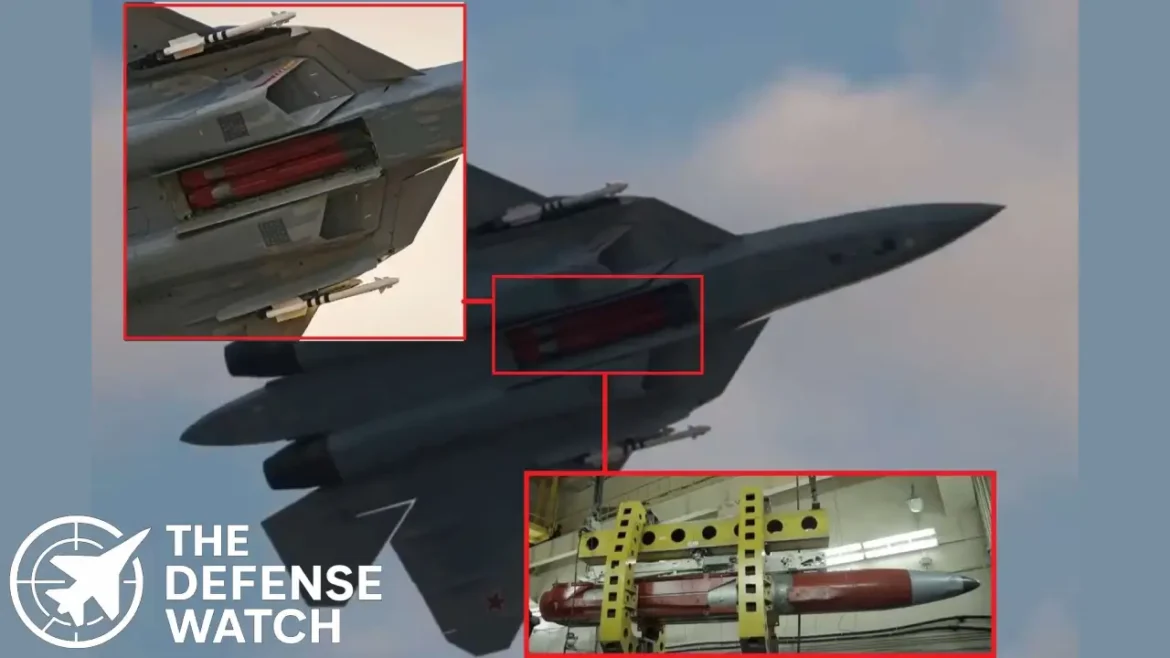
New promotional footage released by United Aircraft Corporation (UAC), a subsidiary of Rostec, on 9 November 2025 shows the Russian fifth-generation fighter Su‑57 in flight with its forward internal weapons bay open and carrying two large anti-radiation missiles of the Kh‑58 (AS-11 “Kilter”) family.
The footage highlights that this isn’t just an air‐show demonstration: the aircraft, test airframe T-50-9 (“509”), was shown performing dynamic passes with bay doors cracked open while the two anti-radiation missiles were visible inside the compartment.
This marking of an internal SEAD (suppression‐of‐enemy‐air‐defenses) load-out represents a significant signal about how Moscow envisions the Su-57’s role going forward.
Technical Architecture: What the Bay Setup Means
Analysts note that the forward bay imagery shows the Kh-58UShK variant on fold-out surfaces, mated to ejector units of the UVKU-50 family — established launchers for heavy internal stores on the Su-57.
According to publicly available technical data, the Su‐57 main internal bays are approximately 4.4 m long by 0.9 m wide and use UVKU-50L for weapons up to about 300 kg and UVKU-50U for heavier ordnance.
The external display also included a pair of R-74/R-74M2 short-range air-to-air missiles mounted externally, signaling a mixed load-out: internal large anti‐radiation missiles plus external short‐range AAMs for self-defense.
In other words: the Su-57 is being showcased not only as an air‐superiority fighter, but as a stealth shaped strike platform capable of first‐wave radar target engagement.
Strategic Timing & Export Aspirations
The choice to release this footage now is strategic. The UAC video comes just ahead of the Dubai Airshow 2025, where Russia is seeking foreign orders for the Su-57 despite sanctions and supply-chain challenges.
Leaks attributed to the “Black Mirror” group suggest export discussions with countries such as Iran, Algeria and Ethiopia — and the display is tailored to customers facing dense, modern SAM environments.
By emphasizing internal carriage of anti‐radiation missiles, Moscow aims to pitch the Su-57 as a stealth platform capable of suppressing advanced air-defense networks — a capability attractive to states confronting layered integrated air-defence systems (IADS).
Analysis: Implications for U.S. Defence and Global Security
For U.S. defence planners, the visible internal SEAD capability of the Su-57 warrants attention. The combination of low-observable shaping (internal bays) and anti-radiation missiles challenges the assumption that advanced stealth fighters are always purely air-to-air platforms. If exported, such a package could complicate regional air‐defence postures and raise the cost of operations for U.S. and allied air forces.
Globally, this development echoes a broader trend: fifth-generation fighters are increasingly being tasked with strike and SEAD roles — not just air‐superiority. The integration of heavy anti-radiation missiles suggests an evolving threat vector: stealth‐equipped fighters opening corridors through IADS to enable follow‐on strike aircraft.
From a technology standpoint, the demonstration of internal carriage and launch of heavy store (as shown by Kh-58s) confirms maturation of one of the more challenging aspects of stealth‐fighter design: weapons integration without sacrificing signature discipline. The U.S. may need to reassess its own SEAD/DEAD (destruction‐of‐enemy‐air‐defences) approaches given the potential for adversaries to field more capable stealth strike platforms.
Conclusion: What Comes Next?
Russia’s decision to showcase the Su-57 carrying two Kh-58 anti-radiation missiles internally signals its intention to operationalize a stealth‐shaped SEAD/strike role and to market that capability abroad. The next steps will likely include further demonstration flights, export offers, and potential combat employment signals. U.S. and allied S-team planners should monitor whether the Su-57 begins serial exports or enters wider service with this dual air‐to‐air/strike orientation — any of which would affect regional air‐defense dynamics and future procurement priorities.