

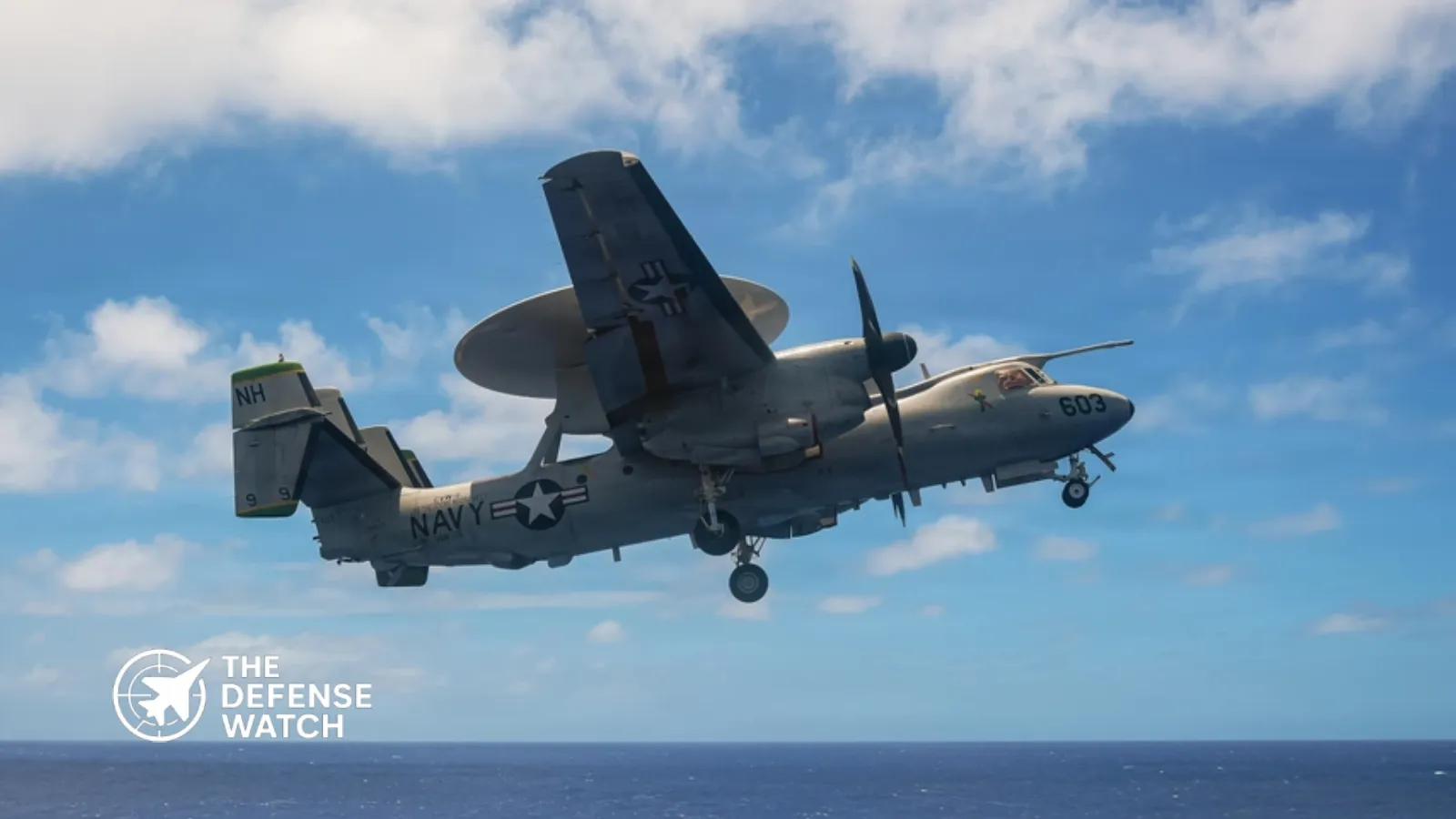
- Northrop Grumman received a contract worth up to $1.196 billion to produce three E-2D Advanced Hawkeye Block II aircraft for the U.S. Navy.
- Naval Air Systems Command awarded the undefinitized production contract, with work continuing through December 2031.
- The E-2D serves as the Navy’s primary airborne early warning, battle management, and network command aircraft for carrier strike groups.
- Initial funding of $583.4 million from Fiscal Year 2026 Navy aircraft procurement has been obligated at contract award.
- The aircraft will strengthen the Navy’s ability to detect cruise missiles, aircraft, drones, and maritime threats over long distances.
The U.S. Navy has awarded Northrop Grumman Systems Corp., Aerospace Systems a not to exceed $1.196 billion undefinitized cost, no fee contract to manufacture, deliver, and support three E-2D Advanced Hawkeye Block II airborne early warning aircraft. According to the Naval Air Systems Command (NAVAIR), headquartered at Patuxent River, Maryland, the program will continue through December 2031 and is funded through Fiscal Year 2026 Navy aircraft procurement appropriations.
NAVAIR stated that $583.39 million in FY2026 aircraft procurement funding has been obligated immediately following contract award. The acquisition was awarded on a sole source basis under 10 U.S. Code 2304(c)(1), which permits noncompetitive awards when only one responsible source is capable of fulfilling the government’s requirements.
Deep Technical & Strategic Context Analysis
The E-2D Advanced Hawkeye Block II is widely regarded as one of the world’s most capable airborne early warning and command and control aircraft. Built around the AN/APY-9 UHF AESA radar, the aircraft can simultaneously detect and track aircraft, cruise missiles, low observable targets, ballistic missile threats, unmanned systems, and surface contacts across hundreds of miles. Unlike conventional surveillance aircraft, the Hawkeye also functions as an airborne battle management node, distributing targeting information through Cooperative Engagement Capability (CEC), Link 16, and emerging Joint All Domain Command and Control (JADC2) architectures.
The platform has become increasingly important as the U.S. Navy prepares for potential high intensity operations in the Indo Pacific and other contested theaters where long range anti ship missiles, stealth aircraft, and drone swarms present growing challenges. Operating from aircraft carriers, the E-2D extends the sensor horizon well beyond that of shipboard radars, allowing carrier strike groups to identify threats earlier and coordinate intercepts using systems such as the SM 6, Standard Missile family, and the F-35C Lightning II. The latest Block II configuration also incorporates improved computing power, expanded networking capacity, and software upgrades designed to support future distributed maritime operations.
The awarded agreement is an undefinitized contract, meaning work can begin before all final pricing terms are negotiated. This procurement approach is typically used when maintaining production schedules is operationally critical. A cost, no fee structure reimburses allowable costs but does not include an additional profit fee during the undefinitized phase, helping the government accelerate procurement while limiting financial exposure until contract terms are finalized.
Contract Breakdown & Details
Contract Value
- Maximum contract value: $1.196 billion
- Contract type: Cost, no fee, undefinitized production contract
- Prime contractor: Northrop Grumman Systems Corp., Aerospace Systems
- Aircraft ordered: Three E-2D Advanced Hawkeye Block II aircraft
- Completion date: December 2031
Funding
- Initial obligation: $583.394 million
- Funding source: Fiscal Year 2026 Navy Aircraft Procurement
Contracting Authority
- Awarding agency: Naval Air Systems Command (NAVAIR)
- Contract number: N0001926C1017
- Competition: Sole source under 10 U.S. Code 2304(c)(1)
Workshare By Location
- Melbourne, Florida: 29.88%
- St. Augustine, Florida: 17.68%
- Liverpool, New York: 13.85%
- Indianapolis, Indiana: 4.95%
- Largo, Florida: 3.66%
- San Leandro, California: 2.52%
- Woodland Hills, California: 2.42%
- Aire sur l’Adour, France: 2.09%
- Rolling Meadows, Illinois: 1.72%
- Wimborne Minster, Dorset, United Kingdom: 0.01%
- Various U.S. locations: 21.22%
Why This Procurement Matters
The E-2D fleet represents one of the Navy’s highest priority aviation capabilities because it serves as the command and sensing hub for carrier air wings. As potential adversaries field increasingly sophisticated long range missiles, electronic warfare systems, and unmanned aircraft, maintaining production of the Hawkeye ensures the Navy preserves its ability to detect, classify, and coordinate responses against complex, multi domain threats.
The latest procurement also supports the broader modernization of the Navy’s carrier strike groups by integrating next generation networking technologies that connect fighters, destroyers, submarines, and joint forces into a common operational picture. As the Navy continues expanding distributed maritime operations and joint force integration, the E-2D remains one of the key enablers of future U.S. naval air power.
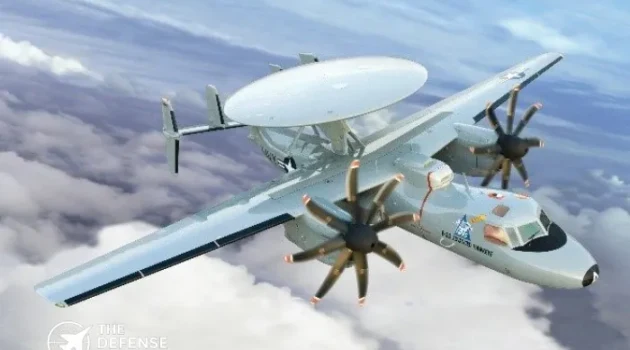


E 2D Advanced Hawkeye contract strengthens fleet radar readiness
The E 2D Advanced Hawkeye contract awarded to Northrop Grumman Systems Corp marks a significant sustainment investment for the US Navy airborne early warning fleet and its Japanese partner. The Navy has issued a ceiling priced delivery order valued at up to 198 million dollars for the procurement of 608 power amplifier module spares used on the E 2D Advanced Hawkeye aircraft.
(adsbygoogle = window.adsbygoogle || []).push({});The award was announced by the Department of Defense and executed by Naval Supply Systems Command Weapon Systems Support in Philadelphia. Work will be performed at Northrop Grumman facilities in Melbourne Florida and is scheduled for completion by February 2029.
Contract details and scope of work
Under delivery order N00383 26 F S50R, issued against an existing basic ordering agreement, Northrop Grumman will manufacture and deliver power amplifier modules critical to the E 2D radar and mission system architecture. These modules support the aircrafts advanced electronically scanned array radar, which provides long range air and maritime surveillance for carrier strike groups.
The delivery order does not include an option period. Funding at the time of award totals approximately 97 million dollars, split between Navy working capital funds and Foreign Military Sales funds. According to the announcement, 64.3 million dollars in Navy funds and 32.7 million dollars in FMS funding from Japan were obligated immediately and will not expire at the end of the current fiscal year.
Support for Japan through Foreign Military Sales
A portion of the E 2D Advanced Hawkeye contract supports Japan under the US Foreign Military Sales program. The Japan Air Self Defense Force operates the E 2D as part of its airborne early warning and control mission, replacing older E 2C platforms and expanding interoperability with US forces in the Indo Pacific.
By aligning US Navy and Japanese requirements in a single sustainment action, the Navy aims to streamline logistics and maintain common configuration standards across allied fleets. This approach reflects broader Pentagon efforts to improve readiness while supporting key regional allies through established FMS mechanisms.
Non competitive award rationale
The Navy solicited one firm for this requirement under the authority of Title 10 US Code 3204 a 1, which permits non competitive awards when only one responsible source can meet agency requirements. Northrop Grumman is the original equipment manufacturer for the E 2D mission systems, including the radar and associated electronic components.
Officials stated that one offer was received. This is consistent with past E 2D sustainment actions, which typically rely on the prime contractor due to proprietary designs and integration requirements.
Importance of power amplifier modules
Power amplifier modules are a key element of the E 2D Advanced Hawkeye radar system. They enable high power transmission and precise beam control, supporting the aircrafts ability to detect and track airborne and surface threats at extended ranges.
(adsbygoogle = window.adsbygoogle || []).push({});Maintaining an adequate supply of spares is essential for operational availability, especially as the E 2D fleet continues high tempo deployments aboard US Navy aircraft carriers and at land based sites. The contract supports long term sustainment as the platform remains a cornerstone of naval integrated air and missile defense.
Program background and broader context
The E 2D Advanced Hawkeye is operated by the US Navy and Japan and is widely regarded as one of the most capable airborne early warning platforms in service. It features a digital cockpit, advanced communications, and the AN APY 9 radar, allowing it to act as a battle management node across air, sea, and joint forces.
Northrop Grumman continues to serve as the prime contractor for the platform, supporting production, upgrades, and sustainment. Recent Navy budget documents have emphasized readiness and sustainment funding for high demand aviation assets, including the E 2D, as part of broader force posture and modernization efforts.
This latest E 2D Advanced Hawkeye contract aligns with those priorities, ensuring radar performance and mission availability through the end of the decade.