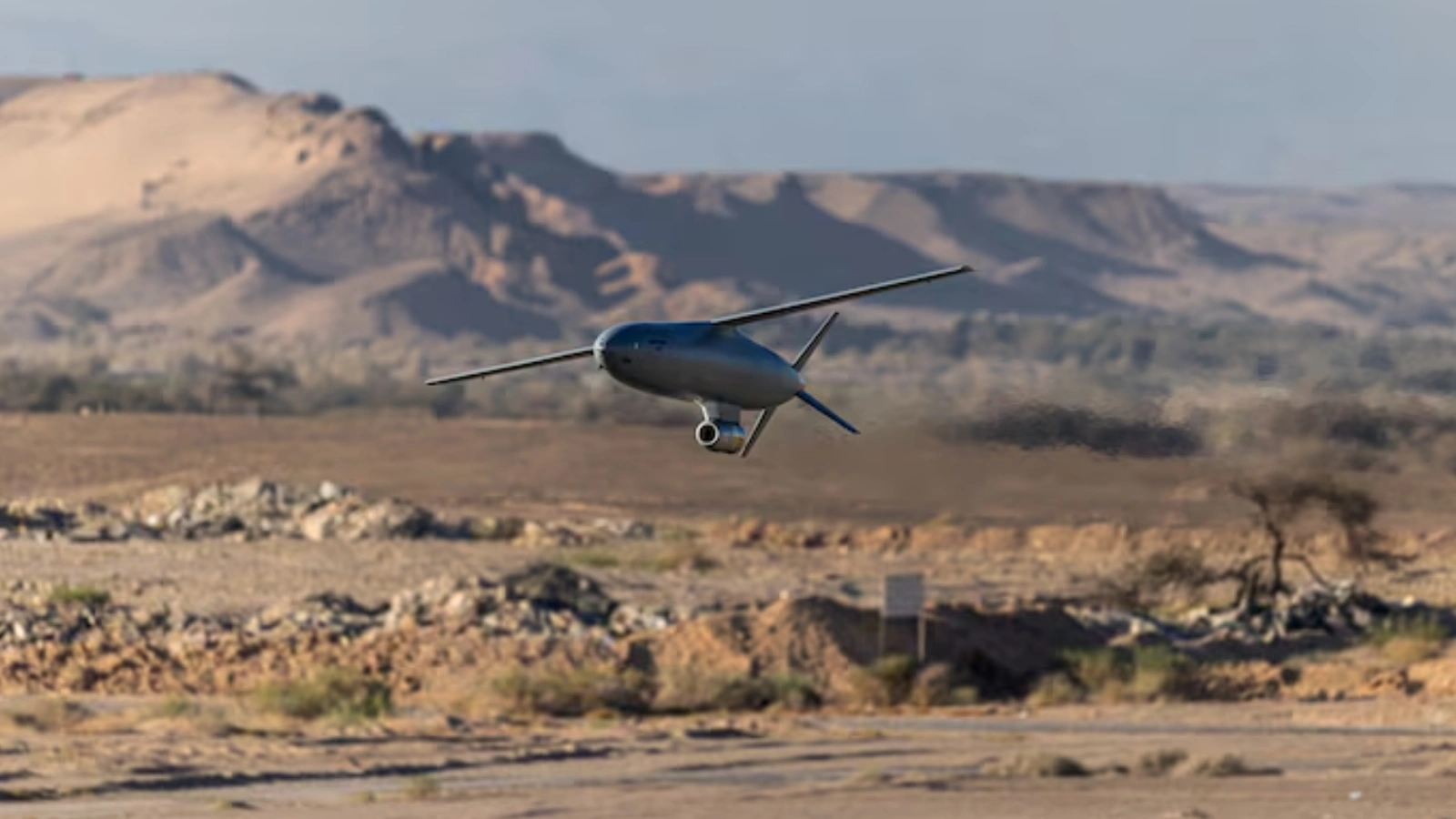
Covenant Anthem Cruise Missile Enters U.S. Affordable-Strike Market
Covenant has unveiled the Anthem cruise missile, a ground-launched, heavy-payload weapon that the U.S. defense startup says is designed for rapid mass production at a significantly lower cost than many existing long-range strike systems. Reuters reported on September 9 that Covenant is targeting a mid-six-figure unit price and has already accumulated roughly $150 million in orders.
Takeaways
Covenant has unveiled Anthem, a ground-launched cruise missile designed around a lower-cost, high-volume production model as the United States and its allies seek larger stocks of long-range precision weapons.
The announcement comes as the United States and its allies seek to rebuild precision-strike inventories while changing how long-range weapons are procured. The U.S. Air Force is already funding programs intended to put large numbers of lower-cost cruise missiles into production, making Covenant’s approach part of a wider shift rather than an isolated industry development.
What Is the Anthem Missile?
Anthem is a ground-launched cruise missile designed to carry a payload of more than 200 kg, or about 441 pounds. Covenant says the weapon is intended to complement more expensive and more sophisticated systems rather than replace them.
Reuters reported that Anthem uses a solid rocket motor for launch and a heavy-fuel jet engine for cruise flight. Covenant says the missile has completed more than 200 test flights over the past year.
The company has not publicly disclosed a complete set of operational specifications, including the missile’s exact maximum range, speed, dimensions, guidance architecture or final production configuration. Those omissions are important when comparing Anthem with established weapons such as Tomahawk and JASSM-ER.
| Feature | Anthem |
|---|---|
| Manufacturer | Covenant |
| Type | Ground-launched cruise missile |
| Payload | More than 200 kg |
| Launch propulsion | Solid rocket motor |
| Cruise propulsion | Heavy-fuel jet engine |
| Reported testing | More than 200 flight tests |
| Target unit cost | About $500,000 at full-rate production |
| Planned U.S. production | Up to 5,000 annually |
| Planned German production | Up to 5,000 annually |
| Planned Israeli production | Up to 2,000 annually |
| Reported orders | About $150 million |
| U.S. deliveries | Planned for 2027 |
The figures above are based primarily on Covenant statements reported by Reuters and should be treated as company targets or reported results where indicated.
Production Capacity Is the Main Story
The most significant aspect of Anthem may not be its individual technical specifications but the production model Covenant is pursuing.
Reuters reported that Covenant’s facilities in Dallas and Saxony, Germany, are each designed to reach production rates of about 5,000 missiles per year. A smaller facility in northern Israel is planned for approximately 2,000 annually, giving the company a potential combined capacity of about 12,000 missiles per year.
The German facility is expected to begin production in early 2027. Covenant says its initial rate will be approximately 1,000 missiles per year before increasing toward a 5,000-per-year rate by 2028.
That distinction matters. Designing a missile for mass production is different from demonstrating that a company can actually manufacture thousands of flight-qualified weapons every year. Engine availability, electronics, propulsion components, testing capacity, quality control and supply-chain resilience can all become limiting factors during a production surge.
Covenant says it has attempted to reduce this risk by avoiding dependence on a single supplier. The company has reportedly secured three solid-rocket-motor suppliers, with a fourth under development, and long-term agreements covering more than 4,000 jet engines over the next two years.
Why Low-Cost Cruise Missiles Matter
The strategic argument for weapons such as Anthem is straightforward: long-range precision weapons are valuable, but limited inventories can restrict how commanders employ them during a prolonged conflict.
Traditional high-end missiles provide capabilities that justify substantial development and procurement costs, including sophisticated guidance, survivability and long-range strike performance. But using only expensive weapons against large numbers of targets can create an unfavorable cost and inventory equation.
A lower-cost missile can instead provide additional capacity for missions where the highest-end weapon is not required.
The concept is already visible in U.S. Air Force planning. The service’s FY2027 budget identifies the Family of Affordable Mass Missiles, or FAMM, as a low-cost, standoff cruise missile program intended to provide affordable mass and complement more complex weapons. The budget requests procurement of 5,300 FAMM weapons in FY2028, 5,920 in FY2029 and 7,700 in FY2030, with a total planned procurement quantity of 26,910 through FY2031.
The Air Force also says FAMM is intended to provide long-range affordable mass capable of stressing enemy defensive inventories. That approach is directly relevant to the operational rationale behind Anthem.
Anthem and the U.S. Long-Range Strike Requirement
Covenant’s missile is entering a market where the U.S. military is already seeking greater quantities of affordable standoff weapons.
The Air Force has described its Extended Range Attack Munition, or ERAM, as a next-generation air-launched cruise missile intended to provide cost-effective long-range strike capability in large numbers. In January 2026, the service reported a successful live-warhead test that met all primary objectives.
FAMM represents another part of the same broader acquisition direction.
Covenant’s Anthem differs in an important way because it is designed as a ground-launched weapon. That potentially allows the missile to be deployed without consuming aircraft hardpoints or relying on manned aircraft to enter or approach the launch area.
Reuters reported that Covenant developed Anthem with the Pacific in mind, including the possibility of ground-launched weapons operating from allied territory. The company has specifically discussed the concept in relation to the geographic challenges of a potential conflict involving China.
That is an operational concept rather than evidence of a specific U.S. deployment plan. Any actual deployment would depend on range, guidance, survivability, basing arrangements, export controls and military integration requirements that have not been publicly detailed.
How Anthem Fits With Tomahawk and JASSM-ER
Covenant positions Anthem as a complementary weapon rather than a direct replacement for existing U.S. long-range missiles.
Reuters reported that the company sees the missile operating alongside weapons such as the Tomahawk and JASSM-ER. Tomahawk provides a mature long-range strike capability, while JASSM-ER gives the U.S. military an air-launched standoff option.
The key difference is the intended production and cost structure.
| Weapon | Launch Method | Primary Role | Publicly Reported Range | Cost Position |
|---|---|---|---|---|
| Anthem | Ground | Long-range precision strike | Not publicly specified by Covenant | Targeted around $500,000 |
| Tomahawk | Primarily naval/ground variants | Long-range land attack | About 1,000 miles for the cited variant | Higher-cost legacy system |
| JASSM-ER | Air-launched | Long-range standoff strike | About 600 miles | More than $1 million class |
| FAMM | Air and palletized configurations | Affordable mass strike | Extended-range variant planned above 1,000 nautical miles | Designed for lower cost |
The comparison should not be interpreted as a direct performance ranking. Anthem’s publicly available specifications remain incomplete, while Tomahawk and JASSM-ER are mature operational systems with established integration, testing and deployment histories.
Europe Is Becoming an Important Market
Covenant’s decision to establish production in Germany also reflects the growing European demand for long-range strike weapons.
Reuters reported that Covenant has secured one European contract for Anthem and is in discussions with additional customers, although the company has not publicly identified those countries. Initial deliveries from the German production line are expected in early 2027.
The European requirement has become more visible as governments reassess the size of their long-range missile inventories and the ability of existing industrial bases to replenish weapons quickly.
Germany is also pursuing other long-range strike capabilities. Reuters reported earlier this month that German forces successfully tested an Israeli-made LORA ballistic missile and are working on an upgraded Taurus NEO cruise missile.
Anthem therefore enters a European market that is already expanding across several categories of long-range weapons.
The Supply Chain Will Determine Whether the Model Works
The central challenge for Covenant is no longer simply proving that Anthem can fly.
More than 200 reported test flights provide evidence of an active development and testing campaign, but sustained production at several thousand weapons per year presents a different engineering and industrial challenge.
For a missile intended to be produced at scale, manufacturing repeatability becomes as important as individual weapon performance.
Covenant’s reported strategy of using multiple propulsion suppliers is designed to reduce the risk that one supplier becomes a bottleneck. The company also says it has secured long-term engine agreements.
If those arrangements translate into sustained production, the approach could help demonstrate a different model for the U.S. defense industry: smaller companies using commercial-style investment and manufacturing practices to produce large quantities of military hardware.
However, production targets should not be confused with delivered inventory. The decisive measure will be how quickly Covenant can move from test articles and initial production to consistent delivery of operationally qualified missiles.
What Comes Next for Anthem
Covenant expects U.S. deliveries in 2027 and plans to begin mass production in Germany in early 2027. The company is also developing a naval version of Anthem, according to Reuters reporting.
For the U.S. military, the broader significance is the emergence of another supplier pursuing the same basic requirement already identified by the Pentagon and Air Force: more long-range precision weapons that can be produced in substantial quantities.
The Air Force’s FY2027 budget shows that affordable mass is becoming a formal procurement objective, with thousands of FAMM weapons planned over the coming years.
Anthem’s success will ultimately depend on whether Covenant can turn its reported test record, supplier network and production ambitions into a reliable stream of fielded weapons.
That makes the company’s 2027 production ramp more important than the unveiling itself. The U.S. defense sector is increasingly focused not only on how capable a missile is, but also on how many can be built, how quickly they can be replaced and whether the industrial base can sustain production during a prolonged conflict.
